

The traditional RFP is no longer a procurement tool; it's a financial liability when it relies on subjective scoring and legacy templates. Most organizations face a critical misalignment between procurement execution and stakeholder goals, often failing to account for the price volatility inherent in the 2026 market. You understand that subjective vendor evaluation leads to poor fit and immediate margin erosion. Establishing rigorous supplier selection criteria for RFP processes is the only path to move beyond administrative tasks toward true value driving.
This clinical guide enables you to master the data-driven selection criteria and weighted scoring models necessary for strategic margin expansion. We provide a repeatable framework for vendor evaluation that integrates 2026 regulatory realities, such as the CMMC 2.0 compliance standards and the $9.5 million Department of Defense simplified acquisition threshold. You'll gain the spend intelligence required to ensure audit-ready compliance and transparency across your entire supply chain. This is the blueprint for transforming your RFP process into a precise tool for financial optimization and long-term supplier resilience.
Key Takeaways
- Transform procurement into a primary value driver by moving beyond bid price toward clinical should-cost modeling.
- Establish a data-driven taxonomy for supplier selection criteria for RFP that prioritizes technical precision and operational resilience.
- Replace subjective scoring with multi-factor performance indexing to ensure vendor alignment with strategic category management goals.
- Protect your bottom line by integrating market price trending and price risk management into the vendor evaluation process.
- Leverage AI-led procurement tools to automate weighted scoring models and deliver audit-ready transparency for every contract.
The Strategic Shift: Why RFP Supplier Selection Criteria are the New Value Drivers
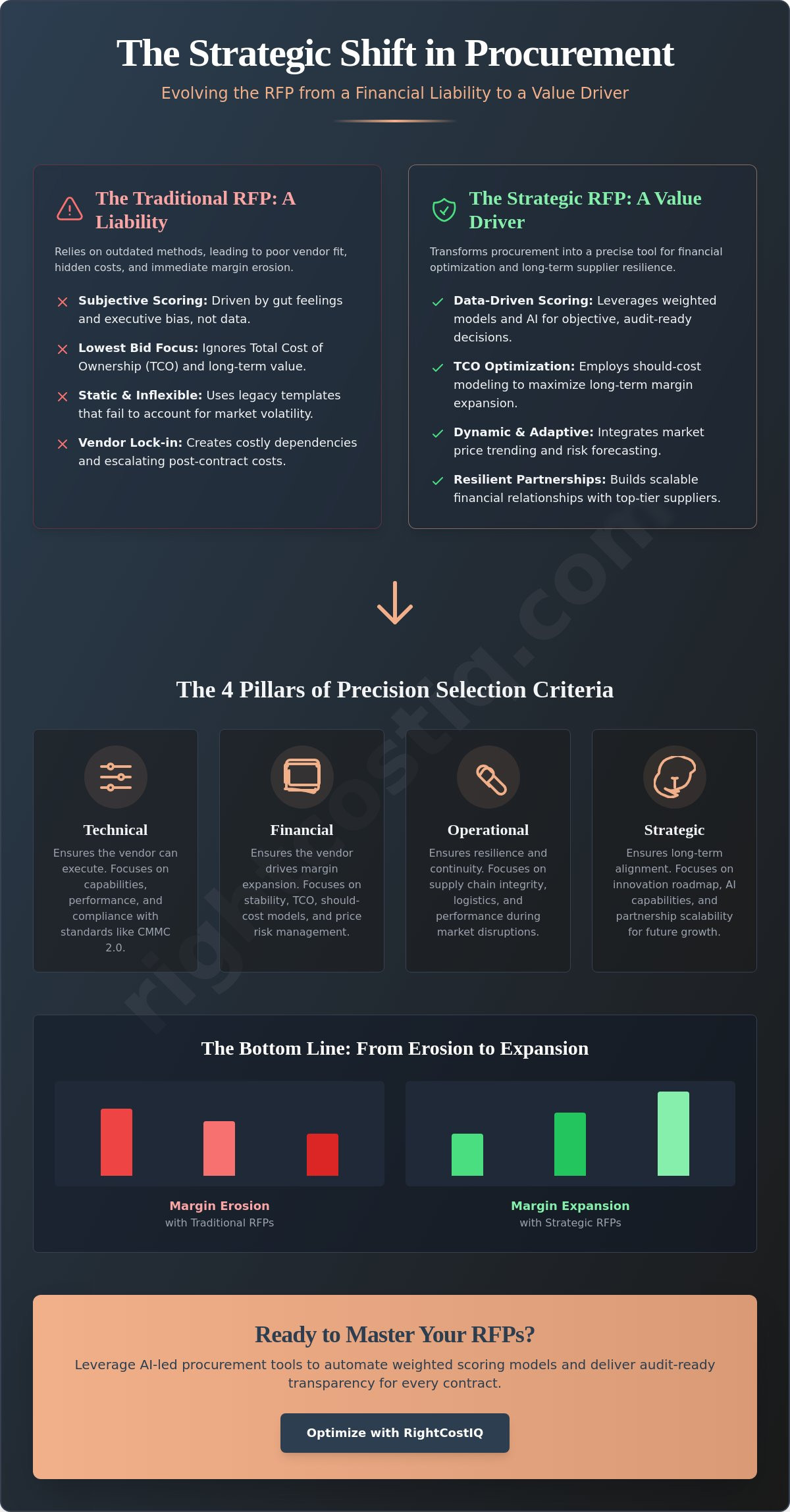
In high-stakes procurement, the supplier selection criteria for RFP function as the clinical architecture of the entire engagement. This isn't a mere checklist for compliance; it's a strategic blueprint designed to engineer margin expansion from the point of inception. Traditional procurement often treats criteria as a hurdle to clear, focusing on baseline requirements. Modern, AI-led procurement views these criteria as the primary mechanism for value creation. By shifting from a cost-center mentality to a value-driver model, organizations can index supplier capabilities against precise market benchmarks. This transition ensures that every dollar spent is optimized for maximum return. It's the difference between simply buying a service and architecting a competitive advantage.
Traditional "compliance-only" models focus on binary pass/fail metrics that ignore the nuances of market volatility. In contrast, strategic-optimization criteria evaluate how a vendor’s cost structure interacts with commodity indexing and labor trends. This methodical approach identifies the link between selection accuracy and long-term margin expansion. When you define your requirements with clinical precision, you aren't just filtering vendors; you're setting the financial trajectory of the entire category.
Procurement as the New Value Driver
Precision in selection directly dictates the Total Cost of Ownership (TCO). When criteria are vague, vendors often hide inefficiencies in their proposals, leading to vendor lock-in and escalating post-contract costs. Clinical precision allows you to dismantle these hidden cost structures before the contract is signed. By utilizing Source selection criteria that prioritize transparency and should-cost modeling, you eliminate the information asymmetry that favors the vendor. This level of rigor is explored further in our guide on RFP Management: Strategic Frameworks for AI-Led Procurement Optimization. Effective selection criteria ensure that procurement teams don't just secure a lower price, but a more resilient and scalable financial partnership.
Moving Beyond Subjective Intuition
High-stakes enterprise sourcing can't survive on gut feelings. Executive bias often skews results toward familiar names rather than the best technical fit, which creates significant risk in a 2026 regulatory environment. Data-driven supplier selection criteria for RFP provide an objective filter that mitigates this risk. By quantifying performance metrics and financial stability, you create an audit-ready trail of logic. Precision Sourcing is the alignment of vendor capabilities with market-indexed benchmarks. This methodical approach ensures that the shortlist represents the highest potential for margin expansion rather than just the lowest initial bid. It's about removing the noise from the evaluation process to focus on the data that actually impacts the bottom line.
The Taxonomy of Precision: Categorizing RFP Selection Criteria
A clinical approach to procurement demands a rigorous taxonomy. You can't optimize what you don't categorize. The most effective supplier selection criteria for RFP are organized into four distinct pillars: Technical, Financial, Operational, and Strategic. This structure ensures that every vendor capability is indexed against its specific impact on your bottom line. While Technical and Operational criteria ensure the vendor can execute the work, Financial and Strategic criteria ensure they can drive margin expansion. This comprehensive framework aligns with the Federal Acquisition Regulation on RFPs, which mandates a clear breakdown of evaluation factors to ensure transparency and competition.
Strategic criteria evaluate the vendor's long-term innovation roadmap and AI-led capabilities. In a market defined by rapid technological shifts, selecting a partner with a static tech stack is a recipe for obsolescence. Operational criteria focus on supply chain resilience and the vendor's ability to maintain continuity during market disruptions. Organizations that fail to prioritize these pillars often find themselves locked into contracts that lack the flexibility required for modern business environments.
Financial and Cost-Benchmarking Criteria
Financial evaluation must move beyond the initial bid price. Sophisticated procurement teams utilize "clean sheet" cost models to decompose a vendor's pricing structure into its core components. This transparency allows you to evaluate pricing against market price trending and commodity indexing. By identifying the underlying cost drivers, you can negotiate from a position of data-driven authority. Integrating price risk management as a core metric is essential for high-volatility categories. This allows you to forecast potential cost escalations and secure contractual protections before they impact your margins. Our market price trending services provide the intelligence needed to benchmark these proposals with absolute precision.
Technical and Performance Metrics
Technical assessments should prioritize historical performance tracking over marketing claims. You need to validate that a vendor's tech stack is compatible with your internal data architecture to avoid expensive integration failures. Assessing a vendor's reliability requires a focus on specific, quantifiable KPIs. Three essential metrics for technical validation include:
- On-Time Delivery (OTD) Rate: Measures the percentage of orders or milestones met within the agreed-upon timeframe.
- Quality Defect Rate: Tracks the frequency of non-conforming outputs or service failures per unit of engagement.
- Mean Time to Resolution (MTTR): Quantifies the vendor's efficiency in identifying and fixing technical or operational issues.
By indexing these metrics during the RFP phase, you set a performance baseline that ensures accountability from day one. This methodical validation process removes the guesswork from vendor selection and secures a partner capable of sustained operational excellence.
Weighted Scoring Models: From Subjective to Data-Driven
Scoring vendors based on arbitrary percentages is a legacy procurement failure. While many organizations rely on a simple linear split—often the standard 60% price and 40% quality—clinical margin expansion requires multi-factor performance indexing. This advanced approach anchors your supplier selection criteria for RFP in empirical data rather than executive consensus. Precise scoring models must include "knock-out" criteria. These are non-negotiable deal-breakers, such as CMMC 2.0 cybersecurity compliance or specific liquidity ratios, that immediately disqualify a vendor regardless of their cost profile. To ensure the robustness of your selection, you must perform sensitivity analysis. This process tests how slight shifts in weighting affect the final vendor ranking, identifying if a winner is truly superior or merely a byproduct of skewed weightings.
A data-driven scorecard acts as a strategic filter. It prevents the "low-ball" bid from winning when the vendor lacks the technical infrastructure to support long-term growth. By moving beyond subjective intuition, you create a defensible, audit-ready selection process that stands up to scrutiny from both internal stakeholders and external regulators. This is where procurement shifts from an administrative function to a high-level strategic architect.
Determining Weighting with Strategic Urgency
Assigning weights requires an objective assessment of business impact versus supply market risk. High-impact, high-risk categories demand a heavier emphasis on operational resilience and technical roadmap. Conversely, commodity categories may prioritize financial transparency and should-cost alignment. Cost should rarely be the dominant weight in strategic sourcing because the cheapest bid often masks high total cost of ownership (TCO) and significant integration friction. Weighting functions as the mathematical expression of your organization's risk appetite and strategic priorities. Aligning these weights with your category management procurement goals ensures that every RFP execution supports broader corporate financial objectives.
Performance Indexing vs. Traditional Scoring
Traditional scoring relies on subjective 1-5 scales that vary wildly by evaluator. Performance indexing replaces this ambiguity with objective anchors based on external market benchmarks. Instead of an arbitrary "4" for pricing, a vendor receives a score based on their percentage-based deviation from a "should-cost" model. This transition requires the integration of spend intelligence to validate vendor cost claims against real-world commodity data. If a vendor's labor rates are 15% higher than the regional average, the score reflects that specific deviation. This clinical approach removes evaluator bias and forces vendors to compete on factual efficiency. It transforms the evaluation from a popularity contest into a rigorous financial audit, ensuring that procurement remains the primary value driver for the enterprise.
Operationalizing the RFP: Integrating Risk and Market Forecasting
Static RFPs are a relic of a low-volatility era. To drive real margin expansion, you must operationalize the selection process by embedding forward-looking market intelligence. If your supplier selection criteria for RFP only evaluate a vendor's current price without considering future market shifts, you're architecting a financial blind spot. Clinical procurement requires evaluating how a vendor's cost structure will behave over the next 18 to 36 months. This involves analyzing their exposure to commodity fluctuations and their internal mechanisms for price risk management. By integrating these variables into the selection phase, you ensure that the chosen partner can maintain performance even when market conditions deteriorate.
AI-led analytics now allow procurement teams to move beyond historical data. You can use predictive models to identify suppliers at risk of service degradation or financial failure before they impact your operations. This proactive approach transforms the RFP from a one-time event into a continuous cycle of value optimization. It ensures that the "best" vendor isn't just the one with the best initial response, but the one with the most resilient operational framework.
Integrating Market Price Trending
You must assess whether a vendor's pricing model is indexed to relevant commodity benchmarks. A vendor who offers a fixed price without explaining their hedging strategy may be hiding a significant risk premium. Procurement teams should use spend analysis to determine the fair market value of proposals relative to current and forecasted trends. This isn't about finding the lowest price today; it's about forecasting future costs to ensure long-term margin stability. If a vendor refuses to provide transparency into their cost drivers, they fail the clinical standard for a strategic partner. Our market price trending and forecasting services provide the external benchmarks required to validate these vendor claims with absolute authority.
Supplier Risk Management as a Selection Criterion
Financial health evaluation must go deeper than a cursory glance at a balance sheet. You need to analyze liquidity and solvency ratios to ensure the vendor has the capital to weather economic downturns. Additionally, the impact of supplier diversity and regulatory compliance should be factored into your selection weightings to mitigate ESG and legal risks. Vendor Resilience is the ability to maintain margins under market volatility. By making resilience a non-negotiable criterion, you protect your organization from the hidden costs of supplier churn and supply chain disruptions. This level of rigor ensures that your procurement strategy is built on a foundation of data-driven stability rather than optimistic assumptions.
Post-selection, the focus shifts to vendor performance tracking. The criteria established during the RFP must serve as the baseline for ongoing audits. This ensures that the value promised during the bidding phase is actually delivered throughout the contract lifecycle. Without this continuous loop of tracking and benchmarking, the strategic gains made during selection will inevitably erode over time.
Optimizing Outcomes with RightCostIQ: AI-Led RFP Management
RightCostIQ functions as the strategic architect for organizations ready to move beyond administrative procurement. We engineer financial outcomes through AI-led margin expansion services that replace manual workflows with clinical precision. By automating the development of supplier selection criteria for RFP, we eliminate the subjective biases that historically lead to poor vendor fit and financial leakage. Our platform ingests global market data to ensure your criteria are anchored in real-time commodity indexing and labor trends. This automation allows your team to execute high-stakes sourcing events with the confidence that every requirement is backed by empirical evidence. You aren't just selecting a vendor; you're indexing your supply chain against the most efficient market benchmarks available.
Implementing a clinical RFP cycle is the final step toward enterprise efficiency. This process requires more than just better software; it requires a fundamental shift in how you view vendor relationships. RightCostIQ provides the should-cost modeling necessary to dismantle opaque pricing and reveal the true cost drivers within any category. This level of transparency is the only way to secure sustainable margin expansion in an era of market volatility. We provide the technical framework to move procurement from the back office to the boardroom, ensuring every contract is a strategic asset.
Precision Negotiation Assistance
Our negotiation assistance leverages deep benchmarking data to challenge vendor cost structures directly. Spend intelligence transforms these sessions from a subjective debate into a data-driven audit of vendor efficiency. We utilize the RFQ Sprint as a proprietary method for rapid sourcing, allowing you to compress months of work into high-impact, data-backed cycles. This method ensures that your supplier selection criteria for RFP are applied consistently across all categories, preventing value leakage. By using AI-led forecasting, we identify the exact moment to strike the market for the best possible terms. This proactive approach ensures you're never negotiating from a position of informational weakness.
The RightCost Academy: Technical Upskilling
Sustained competitive advantage depends on the technical capabilities of your procurement team. The RightCost Academy provides technical upskilling in advanced analytics and price risk management. We empower your staff to transition from traditional buyers into Strategic Architects who can navigate complex supply chain disruptions with data. This training ensures that your organization can maintain an audit-ready, clinical RFP process independently. You'll learn to integrate commodity indexing and performance tracking into your daily operations to protect margins. Optimize your next RFP with RightCostIQ to transform your procurement function into a relentless value driver.
Architecting the Future of High-Stakes Sourcing
Transitioning to a clinical RFP process requires more than a software update. It demands a fundamental re-engineering of how your organization evaluates vendor capabilities against market volatility. By moving from subjective scales to percentage-based deviation from should-cost models, you anchor your selection process in empirical reality. Refining your supplier selection criteria for RFP is the only way to protect long-term margins and ensure audit-ready transparency across your entire supply chain.
RightCostIQ provides the technical architecture needed to execute this shift. Our AI-led margin expansion framework and proprietary should-cost modeling dismantle opaque pricing structures. Combined with expert-led negotiation assistance, these tools ensure you capture every cent of potential value. Procurement is the new value driver, and the methodology you adopt today will define your competitive advantage for years to come.
Optimize your procurement outcomes with RightCostIQ's RFP Management services. You've now got the framework to transform your sourcing strategy into a relentless engine for efficiency. It's time to build a more resilient, data-driven future for your enterprise.
Frequently Asked Questions
What are the most important supplier selection criteria for an RFP?
The most critical criteria include financial transparency via should-cost modeling, operational resilience, and technical compatibility with your current tech stack. Strategic alignment with long-term innovation roadmaps also dictates your margin expansion potential. You must prioritize data-driven metrics over marketing claims to ensure a clinical fit with your organizational goals.
How do you calculate weighted scoring for an RFP evaluation?
Weighted scoring involves assigning a percentage value to each criterion based on its strategic urgency and impact on the total cost of ownership. You multiply the vendor's raw performance score by the assigned weight to generate a final performance index. This methodical approach prevents low-bid bias from overshadowing technical deficiencies or significant operational risks.
What is the difference between RFI, RFP, and RFQ selection criteria?
RFI criteria focus on broad market discovery and vendor capability mapping. RFP criteria prioritize strategic solutioning, risk management, and complex value drivers. RFQ criteria are strictly transactional, indexing specific technical requirements against commodity pricing and delivery timelines. Each stage requires a different level of clinical precision to optimize the final selection.
How can AI-led procurement improve supplier selection?
AI-led procurement automates the creation of supplier selection criteria for RFP by indexing global market data and historical performance metrics. Predictive analytics identify potential service degradation or financial instability before contract signing. This technology transforms procurement into a proactive value driver by removing human bias from the evaluation process.
What are 'knock-out' criteria in an RFP process?
Knock-out criteria are non-negotiable requirements that immediately disqualify a vendor from consideration. Examples include mandatory 2026 federal compliance standards like CMMC 2.0 or specific liquidity ratios. These deal-breakers ensure that only vendors meeting a baseline clinical standard proceed to the more complex weighted evaluation phase.
How do you handle subjective criteria like 'cultural fit' in a data-driven RFP?
Subjective criteria must be quantified through objective proxies such as documented reference scores or specific case study performance metrics. You can't rely on executive intuition. Instead, assign numerical values to alignment indicators like communication response times, ESG compliance reporting accuracy, and historical project management stability.
Why is cost benchmarking essential for RFP supplier selection?
Cost benchmarking provides the spend intelligence needed to challenge vendor price structures with data-driven authority. It identifies deviations from fair market value through commodity indexing and regional labor analysis. Without benchmarking, organizations risk overpaying for services that lack competitive efficiency and long-term margin sustainability.
How often should RFP selection criteria be updated?
Selection criteria require updates at least annually or following significant regulatory shifts. For instance, the 2026 executive order directing federal agencies toward fixed-price contracts necessitates immediate adjustments to evaluation frameworks. Regular audits ensure your supplier selection criteria for RFP remain aligned with current market price trending and evolving corporate risk appetites.


