
74% of Chief Procurement Officers successfully integrated AI into their workflows by the end of 2025, yet most organizations still struggle with vague vendor responses that make objective comparison impossible. Creating an effective request for proposal is no longer an administrative task; it's a clinical exercise in margin expansion and strategic price risk management. If your current process relies on inefficient manual cycles and lacks market price transparency, you're likely eroding your bottom line while competitors leverage the $9.5 billion procurement software market to gain a structural advantage.
You already know that procurement is the new value driver, but traditional bidding methods fail to deliver the precision required in a May 2026 economy with a 3.64% federal funds rate. This article provides a repeatable, high-precision framework designed to master the clinical execution of RFP development and secure high-performance vendor partnerships. We'll explore how to implement should-cost modeling and competitive benchmarking to minimize price risk and drive significant cost reduction, ensuring your vendor contracts align with the latest 2026 market intelligence and global ESG mandates.
Key Takeaways
- Engineer requirements using spend intelligence to transform the RFP from a standard document into a strategic instrument for margin expansion.
- Master the technical architecture for creating an effective request for proposal designed specifically for automated data extraction and clinical vendor comparison.
- Integrate should-cost modeling into your drafting phase to establish objective pricing benchmarks and eliminate market price opacity during the bidding process.
- Normalize vendor bids through methodical procurement category benchmarking to ensure high-precision, "apples-to-apples" financial analysis of all responses.
- Optimize the procurement lifecycle by transitioning from manual cycles to an AI-led strategy supported by professional negotiation assistance for high-value contracts.
The Strategic Anatomy of an Effective RFP
Procurement is the new value driver. This isn't just a corporate slogan; it's a financial necessity in May 2026 as the Federal Reserve maintains a 3.64% target rate. Organizations can't afford the margin erosion caused by legacy bidding processes. Creating an effective request for proposal serves as the primary lever for capturing value and insulating the enterprise against price risk. A high-precision RFP functions as a strategic architect's blueprint, moving beyond simple vendor selection to drive clinical margin expansion across the entire supply chain.
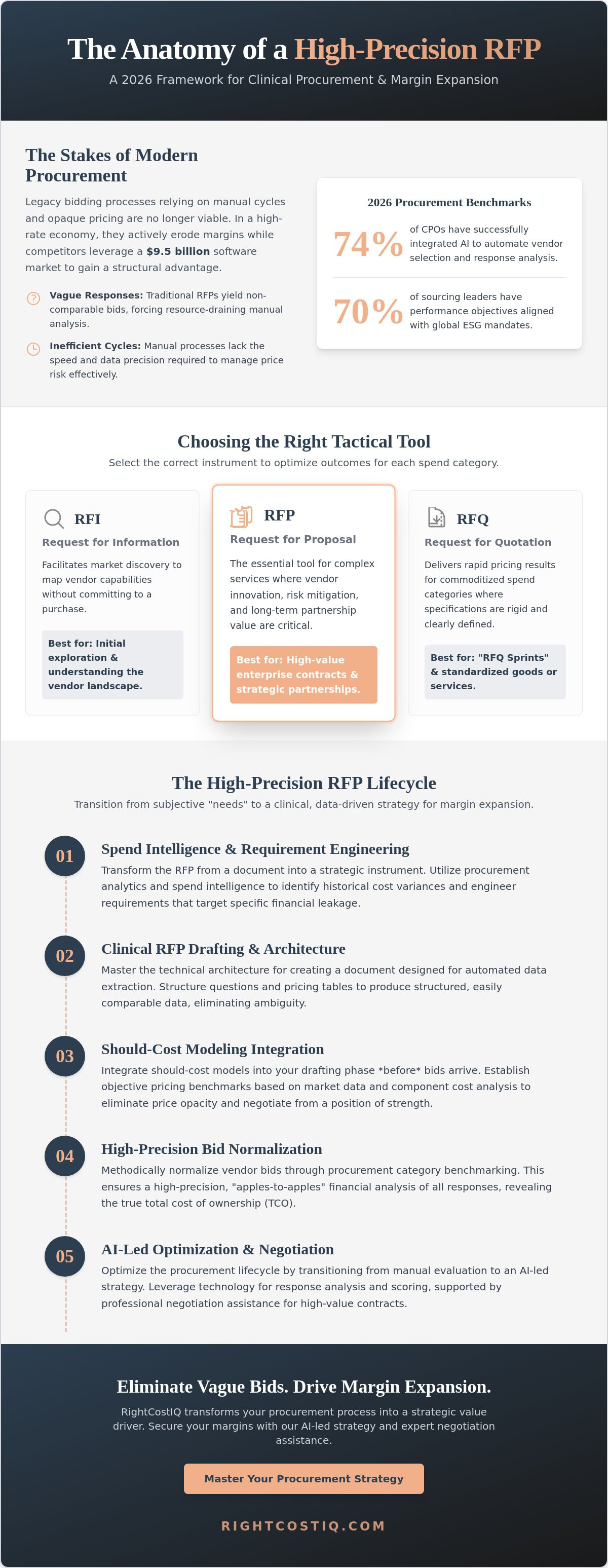
The 2026 standard for procurement precision demands more than a list of needs. It requires a document engineered to produce data-driven outcomes. With 70% of sourcing leaders now having performance objectives aligned with environmental sustainability, the modern RFP must integrate ESG criteria as a core financial metric rather than an afterthought. This shift transforms the document from a passive inquiry into an active instrument of corporate strategy.
RFP vs. RFI vs. RFQ: Choosing the Right Tactical Tool
Optimization requires selecting the correct instrument for the specific spend category. A Request for Information (RFI) facilitates market discovery. It's used to map vendor capabilities without committing to a purchase. For commoditized spend categories where specifications are rigid, "RFQ sprints" deliver rapid pricing results through a Request for Quotation. However, the Request for Proposal (RFP) remains the essential tool for complex service outcomes. Use an RFP when vendor innovation, risk mitigation, and long-term partnership value outweigh the base unit cost. It's the only vehicle capable of managing the multifaceted requirements of high-value enterprise contracts.
The Economic Impact of a High-Precision RFP
Precision in requirement engineering directly correlates to bottom-line performance. Vague RFPs result in non-comparable bids, forcing procurement teams into manual, resource-draining comparison cycles. High-precision sourcing utilizes spend intelligence and cost benchmarking to establish "should-cost" models before the first bid arrives. This data-driven approach increases "spend under management," a critical success metric that tracks the percentage of total enterprise spend actively optimized through strategic frameworks.
Consider the following 2026 benchmarks for procurement excellence:
- AI Integration: 74% of CPOs have integrated AI to automate vendor selection and response analysis.
- Market Transparency: Utilization of real-time commodity indexing to offset price volatility.
- Sustainability Alignment: 70% of sourcing leaders now prioritize carbon footprint data within the evaluation matrix.
By creating an effective request for proposal, you eliminate the information asymmetry that vendors often exploit. This clinical approach ensures that every dollar of spend is a deliberate investment in margin expansion rather than a sunk cost.
Phase 1: Spend Intelligence and Requirement Engineering
Legacy procurement processes often begin with a subjective list of "needs" gathered from siloed departments. This approach is fundamentally flawed. Creating an effective request for proposal requires a transition to requirement engineering powered by granular spend intelligence. Instead of asking what stakeholders want, we analyze what the data dictates. By utilizing procurement analytics to identify historical cost variances, organizations establish a clinical baseline for vendor performance. This data-first methodology ensures that the RFP isn't just a document; it's a strategic response to identified inefficiencies.
Category management strategies must be analyzed to set realistic expectations before the drafting phase begins. If a specific category shows a 12% price variance across different business units, the RFP must target this specific leakage. This level of precision is why 74% of Chief Procurement Officers are prioritizing AI integration to automate these complex data correlations. Spend intelligence serves as the foundational layer that informs the entire RFP scope by quantifying the financial return of every technical requirement.
Data-Led Requirement Gathering
Objective performance thresholds emerge when spend analysis is applied to the sourcing lifecycle. We categorize features through a financial lens, distinguishing between critical drivers and secondary "nice-to-haves" based on their impact on Total Cost of Ownership (TCO). This prevents technical specifications from inflating the project budget without a corresponding increase in value. Organizations seeking this level of clarity often utilize procurement category cost benchmarking to validate their internal data against market realities. Spend intelligence informs the RFP scope by mapping existing spend patterns against verified market benchmarks to eliminate information asymmetry.
Stakeholder Alignment and Margin Goals
Engineering a high-performance RFP requires enterprise-wide buy-in. A cross-functional sourcing team ensures that technical requirements align with C-suite margin expansion targets. We draft the "Problem Statement" as a clinical business challenge rather than a simple request for services. This forces vendors to propose solutions that solve specific financial or operational gaps. Alignment prevents the "requirement creep" that often inflates costs during the bidding phase. It ensures that the final document reflects a unified strategic front, ready to secure high-performance partnerships. When stakeholders are aligned on margin goals from day one, the resulting RFP becomes a powerful tool for driving bottom-line results.
Phase 2: Drafting the RFP with Clinical Precision
Drafting is not a creative writing exercise; it's a structural engineering task. Creating an effective request for proposal requires a framework that facilitates automated data extraction and immediate financial comparison. By 2026, the volume of vendor data necessitates a machine-readable structure that bypasses the need for manual data entry. We mandate specific response formats to ensure clinical bid comparison, stripping away vendor marketing fluff to reveal the underlying cost structure. This approach integrates rigorous vendor compliance and performance tracking clauses directly into the document's DNA, ensuring accountability from the outset.
We incorporate should-cost modeling to anchor vendor pricing expectations before the first response arrives. This prevents the price inflation often seen in enterprise bids by establishing a "clean sheet" cost baseline. Organizations that fail to use these models often suffer from significant cost overruns due to information asymmetry. By setting a data-driven ceiling, you force vendors to compete on efficiency rather than just margin preservation. This level of precision is vital in an economy where the 3.64% federal funds rate demands absolute capital efficiency.
The Essential Sections of a Modern RFP
A modern RFP consists of three critical pillars. The Project Overview establishes the strategic context, aligning vendor solutions with the margin expansion goals identified in Phase 1. Technical Specifications follow, utilizing requirement engineering to achieve zero-ambiguity. Finally, Standardized Pricing Tables are non-negotiable. These tables force vendors to provide costs in a uniform format, which is essential for accurate procurement analytics. Standardized pricing tables enable clinical negotiation by highlighting specific cost drivers that deviate from the established should-cost model.
Engineering the Evaluation Criteria
Evaluation criteria must be defined before the RFP is released to maintain objective integrity. We develop a weighted scoring rubric that prioritizes total value over the lowest sticker price. This rubric balances Technical Competence against Commercial Viability, ensuring the selected partner can deliver high-performance outcomes without introducing price risk. Commercial viability includes a vendor's financial stability and their ability to manage inflationary pressures, a critical factor for 70% of sourcing leaders in 2026. This methodical scoring ensures that the selection process remains objective, data-driven, and focused on the bottom line.
Phase 3: Response Evaluation and Should-Cost Benchmarking
Evaluation is the clinical phase where data-led engineering meets market reality. If the drafting phase was executed correctly, the evaluation isn't a subjective vote by a committee; it's a methodical calculation of value. Creating an effective request for proposal culminates here, where standardized response formats allow for the immediate normalization of vendor bids. We strip away qualitative fluff to focus on the "clean sheet" cost structures that drive long-term margin expansion. By May 2026, with the Federal Funds Rate holding at 3.64%, every basis point of margin recovered through rigorous evaluation directly impacts enterprise resilience.
We execute a high-precision comparison using procurement category cost benchmarking to validate vendor assumptions. This process identifies outliers whose pricing models deviate from established market price trending and forecasting. If a vendor's bid is 15% below the "should-cost" model, it signals a potential risk in service quality or financial stability. Conversely, bids significantly above the benchmark indicate a lack of operational efficiency. This data-backed approach prepares the sourcing team for a negotiation phase grounded in objective reality rather than vendor-led narratives.
Clinical Bid Normalization
Normalization ensures an "apples-to-apples" financial analysis by removing hidden costs and adjusting for variances in vendor assumptions. We utilize spend analytics to validate pricing against current market standards, ensuring that no vendor exploits information asymmetry. By visualizing bid spreads, procurement leaders identify competitive leverage points. This visualization highlights where specific vendors excel in cost efficiency and where they're overcharging for secondary services. Precision at this stage is the primary defense against price risk, allowing for an RFP management strategy that prioritizes structural savings.
Risk Assessment and Vendor Performance Tracking
We evaluate vendor financial stability through the lens of current economic volatility. High-performance partnerships require more than just low entry costs; they demand a vendor's ability to manage their own price risk and maintain performance levels over time. We integrate historical performance tracking data into the final selection process to ensure the vendor can meet the rigorous compliance standards of 2026. This includes verifying their registration on the Central Digital Platform if they're operating within UK public sector thresholds. Organizations that skip this step often face service disruptions that far outweigh any initial savings. To secure your supply chain, you should utilize price risk management and tracking services to monitor vendor health long after the contract is signed.
Optimizing the RFP Lifecycle with AI-Led Procurement Strategy
Manual "RFQ sprints" that defined previous procurement cycles can't keep pace with 2026 market volatility. True optimization requires a transition to AI-led procurement infrastructure. This shift moves the RFP from a one-time administrative event to a living component of the enterprise tech stack. RightCostIQ optimizes the end-to-end RFP management cycle by replacing manual evaluation with clinical, data-driven scoring. Creating an effective request for proposal in this environment means building a document that feeds directly into AI-driven margin expansion models, ensuring every response is instantly comparable against your "should-cost" benchmarks.
Implementing continuous vendor performance tracking post-award ensures that initial cost savings aren't lost to service degradation or "price creep." Industry data suggests organizations often lose 10% of contract value within the first 12 months due to a lack of rigorous oversight. Our framework mitigates this risk by integrating performance metrics directly into the contract lifecycle. This methodical approach transforms procurement from a cost center into a strategic value driver that influences enterprise resilience and long-term innovation.
The Future of AI-Led Sourcing
AI-led sourcing automates the most labor-intensive aspects of the sourcing process. By automating requirement extraction and response scoring, organizations reduce evaluation timelines by 60% while increasing objective accuracy. Predictive market price trending serves as a clinical negotiation lever, allowing procurement teams to anticipate shifts in the 3.64% Federal Funds Rate environment. This predictive capability is a core component of category management procurement, ensuring that lifecycle strategies reflect real-time economic data rather than historical guesses. AI doesn't just draft the document; it scores the viability of the partnership.
Securing Professional Negotiation Assistance
High-value enterprise contracts demand a level of technical precision that internal teams often lack the resources to maintain. Leveraging external expertise for high-stakes RFPs provides a structural advantage during the final bargaining phase. The ROI of professional cost benchmarking and spend intelligence is realized through the clinical elimination of "hidden" vendor margins. RightCostIQ acts as your strategic architect, providing the data-driven demeanor and specialized jargon needed to command the negotiation table. We bridge the gap between traditional procurement and cutting-edge SaaS innovation, ensuring your tech stack is optimized for maximum margin. Don't leave your bottom line to chance. Optimize your next RFP with RightCostIQ and secure the high-performance partnerships your enterprise requires.
Architecting the Future of Procurement Value
Mastering the clinical execution of RFP development is the primary requirement for driving margin expansion in the 2026 economic landscape. By transitioning from subjective requirement gathering to data-led engineering, organizations insulate themselves against the price risks inherent in volatile markets. Creating an effective request for proposal serves as the structural foundation for high-performance vendor partnerships, ensuring that every dollar of spend is optimized through should-cost modeling and methodical benchmarking.
The shift toward AI-led procurement infrastructure is no longer optional for firms aiming to maintain a competitive edge. RightCostIQ provides the technical framework necessary to bridge the gap between traditional sourcing and modern financial optimization. We combine AI-driven margin expansion methodologies with clinical precision in spend intelligence to secure structural savings. Our expert negotiation assistance for enterprise sourcing ensures that your contracts reflect real-time market truths. Schedule a Strategic RFP Optimization Audit to align your procurement strategy with the 2026 standard for precision. Your path to optimized vendor performance begins with a single, data-driven decision.
Frequently Asked Questions
What is the primary difference between creating an effective request for proposal and an RFQ?
RFPs target complex service outcomes and vendor innovation, while RFQs focus on commoditized spend categories with rigid specifications. Use an RFQ for rapid "RFQ sprints" where price is the only variable. The RFP process is essential for high-value enterprise contracts that require strategic alignment, risk mitigation, and long-term partnership value.
How long does a typical enterprise-level RFP management cycle take in 2026?
Enterprise RFP cycles in 2026 typically average 4 to 6 weeks when supported by AI-led procurement infrastructure. This represents a 50% reduction in cycle time compared to the 12-week manual processes common in 2024. Automated requirement extraction and response scoring allow strategic architects to move from discovery to award with significantly higher velocity.
Why is spend intelligence critical before drafting an RFP?
Spend intelligence establishes a clinical baseline by identifying historical cost variances across siloed business units. This data prevents requirement creep and ensures the RFP scope is grounded in verified financial reality. By quantifying the financial return of each specification, you eliminate the information asymmetry that often leads to margin erosion during the bidding phase.
Can AI-led procurement tools help in creating an effective request for proposal?
AI-led tools optimize the drafting phase by engineering requirements for zero-ambiguity and automated response comparison. 74% of Chief Procurement Officers currently leverage these technologies when creating an effective request for proposal. These systems ensure the final document is machine-readable, facilitating immediate "apples-to-apples" financial analysis of all incoming vendor bids.
What are the most common mistakes when engineering RFP evaluation criteria?
The most frequent error is over-weighting the initial sticker price at the expense of Total Cost of Ownership (TCO) and long-term commercial viability. 70% of sourcing leaders have now shifted toward performance objectives aligned with environmental sustainability and risk management. Ignoring these metrics leads to hidden costs that quickly erode the margins gained during the initial negotiation.
How does procurement category cost benchmarking improve RFP outcomes?
Category cost benchmarking provides the "should-cost" data needed to anchor vendor pricing to objective market standards. This allows procurement teams to identify outliers who deviate from the 3.64% Federal Funds Rate environment of May 2026. Benchmarking ensures that the final contract price reflects true operational efficiency rather than a vendor's desire for margin preservation.
What role does vendor performance tracking play in the RFP lifecycle?
Performance tracking ensures that vendors adhere to the rigorous compliance and service standards established in the initial contract. It functions as a clinical safeguard against service disruptions and unauthorized "price creep" after the award. Continuous monitoring is essential for maintaining the margin expansion goals that drove the original sourcing event.
How can I mitigate price risk during the contract negotiation phase?
Mitigate price risk by integrating commodity indexing and market price trending into your binding contract clauses. Creating an effective request for proposal requires these technical safeguards to protect the enterprise against sudden inflationary shifts or interest rate volatility. Utilizing expert negotiation assistance ensures that these risk management parameters are both clinically precise and legally enforceable.


