
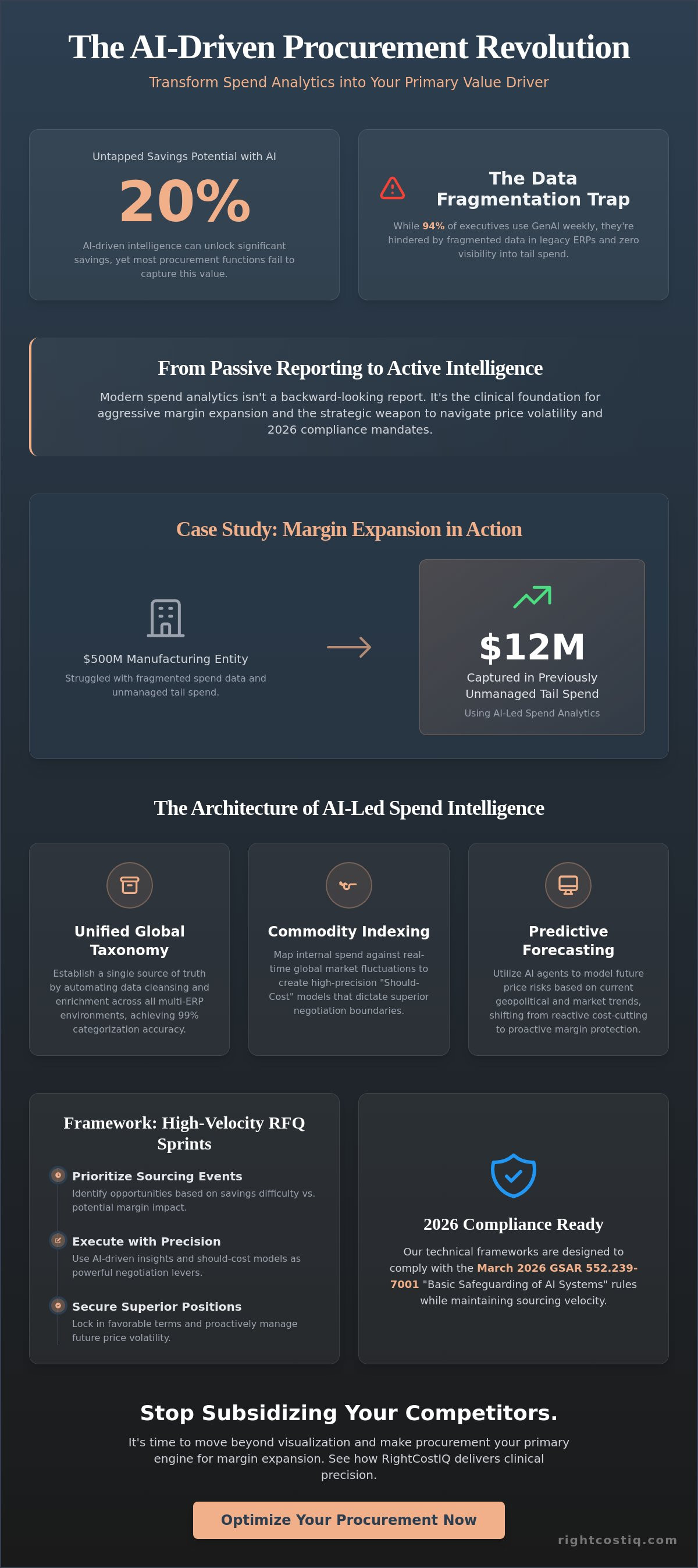
If your procurement function isn't capturing the 20% savings potential unlocked by AI-driven intelligence, you're essentially subsidizing your competitors' market share. While 94% of procurement executives now utilize generative AI tools weekly, most remain trapped by fragmented data across legacy ERP systems and a total lack of visibility into tail spend. You've likely realized that traditional cost-cutting is no longer sufficient; you need clinical precision to survive price volatility and complex 2026 compliance mandates. This case study demonstrates how advanced spend analytics serves as the strategic foundation for aggressive margin expansion and procurement optimization.
We'll show you exactly how to transform raw data into actionable negotiation levers that secure superior market positions. You'll discover the technical frameworks required to comply with the March 2026 GSAR 552.239-7001 "Basic Safeguarding of AI Systems" rules while maintaining high-velocity RFQ Sprints. This article provides a methodical preview of automated cost benchmarking and should-cost modeling techniques designed for the high-stakes financial realities of the 2026 fiscal landscape. It's time to move beyond visualization and embrace procurement as your primary value driver.
Key Takeaways
- Redefine procurement as a primary value driver by transitioning from passive reporting to active spend intelligence for aggressive margin expansion.
- Establish a unified global taxonomy across multi-ERP environments to resolve data fragmentation and achieve clinical precision in cost benchmarking.
- Examine how a $500M manufacturing entity utilized AI-led spend analytics to identify and capture $12M in previously unmanaged tail spend.
- Deploy high-velocity RFQ Sprints using a structured framework that prioritizes sourcing events based on savings difficulty and potential margin impact.
- Combine AI-driven intelligence with elite negotiation assistance to secure superior market positions and proactively manage 2026 price volatility.
Beyond Visualization: Spend Analytics as a Strategic Value Driver
Procurement is the new value driver. This philosophical shift requires moving beyond the static dashboards that defined the previous decade. Modern spend analysis isn't a passive reporting exercise; it's the clinical foundation for aggressive margin expansion. In the 2026 fiscal landscape, spend analytics functions as an active intelligence layer that identifies cost leakage in real time. It provides the high-fidelity data required to navigate price volatility and the new March 2026 federal AI procurement mandates. Leaders now recognize that generic dashboards are insufficient for the strategic demands of a $6.08 billion market. They demand precision that translates directly into superior negotiation positions and enterprise resilience.
The Shift from Data Collection to Spend Intelligence
Basic data aggregation merely collects historical invoices and categorizes them into broad buckets. AI-led spend intelligence applies commodity indexing and predictive modeling to that data, transforming it into a forward-looking strategic asset. This allows procurement leaders to anticipate market shifts before they impact the bottom line. As of May 2026, 86% of organizations plan to scale these AI implementations to manage the complexities of fragmented ERP data. By integrating real-time market price trending, firms move from reactive cost-cutting to proactive margin protection. Spend intelligence is the clinical intersection of high-fidelity data and strategic negotiation power.
The architecture of modern spend intelligence relies on several key capabilities:
- Automated Data Enrichment: Cleaning multi-ERP data to ensure a single source of truth.
- Commodity Indexing: Mapping internal spend against global market fluctuations.
- Predictive Forecasting: Using AI agents to model future price risk based on current geopolitical trends.
Margin Expansion: The Ultimate Procurement Metric
Clinical precision in data directly fuels EBITDA growth. When visibility into tail spend reaches 100%, negotiation leverage shifts back to the enterprise. Organizations deploying AI-led analytics unlock savings of approximately 20% by identifying unmanaged spend and redundant supplier relationships. This level of optimization requires a sophisticated approach to Category Management in Procurement. By treating every dollar as a lever for margin expansion, the procurement function becomes a strategic architect of the company's financial health. It's no longer about what you spent yesterday. It's about how your spend intelligence dictates your profitability tomorrow. High-fidelity data eliminates the guesswork, allowing for should-cost modeling that holds vendors accountable to market realities. This relentless focus on the bottom line ensures that every procurement action is an intentional step toward organizational optimization.
The Architecture of Spend Intelligence: AI-Led Taxonomy and Data Enrichment
Clinical precision in procurement starts with a unified global taxonomy. Fragmented data across multiple ERP systems represents the primary barrier to margin expansion. By 2026, 40% of enterprise applications will embed AI agents, making a standardized data architecture non-negotiable. Automated data cleansing removes the noise, allowing spend analytics to surface high-fidelity insights that were previously buried in unstructured text. Prompt engineering now plays a critical role in this refinement process. It enables teams to train models to recognize complex service descriptions and categorize them with 99% accuracy. This isn't just data hygiene. It's the technical foundation for superior negotiation leverage.
Clinical Data Enrichment Processes
Effective spend analytics requires more than internal visibility. You must integrate external market price trending into your internal spend profiles. This creates high-precision "Should-Cost" models that dictate negotiation boundaries. Adhering to GAO best practices for strategic procurement ensures that your data enrichment aligns with proven frameworks for leveraging buying power. Supplier parentage mapping is equally vital. It consolidates fragmented spend across subsidiaries to maximize volume discounts. Automated anomaly detection then identifies maverick spend, flagging non-compliant transactions before they erode your margins.
Building the AI-Led Tech Stack
Evaluating platforms in 2026 requires looking beyond basic visualization. Your tech stack must offer real-time data enrichment and seamless integration with your existing RFP Management Strategic Frameworks. Software alone won't deliver the required results. You need a system that translates analytics into immediate action. If your current tools don't offer automated identification of savings opportunities, it's time to optimize your procurement infrastructure with a more sophisticated partner. This holistic approach ensures that your high-level strategy and technical execution remain perfectly aligned. By prioritizing platforms that utilize American AI Systems, you also ensure compliance with the March 2026 federal safeguarding mandates while maintaining a competitive edge.
Case Study: Executing Margin Expansion through Advanced Spend Analysis
A $500M manufacturing entity represents a classic example of how data fragmentation stifles profitability. With procurement operations distributed across three distinct legacy ERP systems, the organization lacked a unified view of its global liabilities. This lack of visibility led to redundant supplier relationships and massive price variances for identical SKUs. By implementing AI-led spend analytics, the firm moved from a state of passive reporting to active margin protection. The results were immediate and measurable, delivering a 14% margin expansion within 180 days of the initial diagnostic phase. This success wasn't achieved through simple cost-cutting, but through the clinical application of spend intelligence to every sourcing decision.
Phase I: Diagnostic Spend Profiling
The initial diagnostic phase focused on ingesting and normalizing 24 months of historical data to establish a single source of truth. We utilized "clean sheet" cost modeling to break down indirect spend categories into their constituent parts, including labor, materials, and overhead. This granular analysis revealed that $12M in tail spend was entirely unmanaged, flowing through 1,400 disparate vendors without any pre-negotiated contracts. Category cost benchmarking further indicated a 22% overpayment in indirect spend compared to 2026 market standards. These federal spend analytics challenges regarding legacy system integration and poor data categorization are common in large-scale manufacturing, yet they represent the primary opportunity for immediate margin recovery. Establishing this baseline allowed for the implementation of a rigorous vendor performance tracking service to ensure future compliance.
Phase II: Strategic RFP Execution
With high-fidelity data in hand, the focus shifted to the execution of strategic RFQ sprints. These time-boxed, analytics-driven sourcing events allowed the client to consolidate 40% of their vendor base into high-performance partnerships. RightCostIQ provided professional negotiation assistance, scripting playbooks that utilized internal spend intelligence to dictate terms. By leveraging market price trending and forecasting, the team timed these RFQ sprints to coincide with favorable commodity cycles, maximizing the impact of every contract renewal. This approach transformed the procurement function from a back-office cost center into a primary value driver. The integration of spend analytics into the negotiation process ensured that every agreement was grounded in clinical data precision rather than anecdotal evidence. This methodical execution secured superior market positions and created a resilient procurement infrastructure capable of managing future price risk with absolute confidence.
From Insights to RFQ Sprints: The Practical Implementation Framework
Dashboards alone don't expand margins. While 94% of procurement executives now utilize generative AI tools weekly, many struggle to translate high-fidelity spend analytics into signed contracts. The RFQ Sprint solves this by collapsing the traditional six-month sourcing cycle into a high-velocity, four-week event. This clinical workflow ensures that identified savings don't evaporate during prolonged negotiations. Success requires prioritizing categories based on a matrix of "Savings Difficulty vs. Potential Impact." High-impact, low-difficulty categories like indirect services often yield the fastest EBITDA growth, while complex direct materials require more intensive should-cost modeling. Precision is mandatory. You must move from a dashboard alert to a negotiation script with absolute speed to capture the 20% savings potential inherent in AI-led procurement.
Step-by-Step RFQ Sprint Execution
A successful sprint follows a methodical, three-step process designed for maximum efficiency. First, identify price variance through spend analytics benchmarking to pinpoint exactly where your current contracts exceed market standards. Second, validate market price trends to establish a "Should-Cost" floor, ensuring your negotiation targets are grounded in real-time commodity data. Finally, execute rapid RFP management with a pre-qualified vendor pool to secure the best possible terms. This structured approach eliminates the administrative bloat that typically delays procurement cycles. If your current process lacks this level of velocity, it's time to implement a high-performance sourcing framework that prioritizes margin expansion over mere data collection.
Managing Price Risk and Volatility
In May 2026, 66% of organizations utilize predictive analytics to manage supply chain risk and commodity volatility. Continuous monitoring is the only way to ensure that the savings you realize today are sustained throughout the contract lifecycle. Automated vendor performance tracking prevents contract leakage by flagging non-compliant billing in real time. Leaders must maintain a clinical focus on "Spend Under Management" metrics, ensuring that at least 85% of total enterprise spend is governed by active intelligence. By using forecasting models to hedge against future commodity price spikes, firms can lock in margins even in volatile markets. This proactive stance transforms procurement from a reactive cost center into a resilient strategic architect of enterprise value.
- Baseline Identification: Use clean-sheet models to define the absolute cost floor.
- Variance Analysis: Flag any invoice exceeding the should-cost model by more than 3%.
- Contractual Compliance: Link analytics directly to ERP payment gates to prevent maverick spend.
Optimizing Your Procurement Infrastructure with RightCostIQ
Software-only solutions often fail because they lack the tactical expertise required to execute on the insights they generate. While 40% of enterprise applications now embed AI agents, these tools don't negotiate contracts or manage high-stakes vendor relationships. RightCostIQ operates as a Strategic Architect, combining advanced spend analytics with elite negotiation assistance to ensure that identified savings actually hit the bottom line. We don't just provide a dashboard; we provide the clinical execution framework required to optimize your entire procurement infrastructure. Procurement is the new value driver, and our mission is to ensure your team has the tools and the strategy to lead that transformation.
The RightCostIQ advantage lies in our ability to bridge the gap between traditional procurement and cutting-edge SaaS innovation. By utilizing our proprietary RFQ Sprints, clients move from data ingestion to signed agreements with unparalleled velocity. We also recognize that a modern tech stack is only as effective as the team operating it. Through the RightCost Academy, we provide the technical upskilling necessary for your team to master prompt engineering and should-cost modeling. This ensures your organization maintains a permanent competitive advantage in a 2026 landscape defined by volatility and complex federal AI mandates.
The Clinical Service-Technology Hybrid
Our RFP management and negotiation assistance services integrate directly with our analytics platform, creating a seamless transition from insight to action. We develop custom benchmarking models tailored to specific industry verticals, accounting for unique market price trending and forecasting needs. This isn't a generic service; it's a precision-engineered solution for high-level decision-makers. RightCostIQ delivers margin expansion through AI-led precision and a relentless focus on the bottom line. Our hybrid model ensures that your procurement strategy remains aligned with the pragmatic realities of global finance and the latest March 2026 GSAR safeguarding standards.
Next Steps for Strategic Leaders
Transforming procurement from a cost center into a primary value driver begins with a comprehensive spend analytics audit. This diagnostic identifies immediate cost-leakage points and establishes the roadmap to achieving 90%+ spend under management. By consolidating fragmented data and implementing automated vendor performance tracking, you secure a superior market position. It's time to move beyond generic consulting and embrace a data-driven partnership that prioritizes results over process. You can optimize your margin with RightCostIQ today and redefine your procurement function as a resilient engine for enterprise growth.
Clinical Precision: The Roadmap to 2026 Margin Expansion
The transition from passive reporting to active spend intelligence is no longer optional. As 86% of organizations scale their AI implementations by late 2026, the competitive gap between data-rich and data-poor firms will widen. This case study proves that a unified global taxonomy and high-velocity RFQ Sprints are the primary drivers of EBITDA growth. By integrating external market price trending into internal spend analytics, leaders neutralize price volatility and secure superior negotiation positions.
Optimizing your procurement infrastructure requires a sophisticated partner capable of bridging the gap between raw data and signed contracts. RightCostIQ operates as an AI-Driven Margin Expansion Firm, providing the clinical precision needed to manage complex 2026 federal safeguarding mandates. Our Strategic RFP Management Specialists and Professional Negotiation Assistance services ensure every dashboard insight translates into a measurable result. It's time to move beyond generic visualization and embrace procurement as your new value driver.
Secure Your Margin Expansion Strategy with RightCostIQ. Your organization is ready to capture the next level of operational efficiency.
Frequently Asked Questions
What is the primary difference between spend analysis and spend analytics?
Spend analysis focuses on the historical categorization and visualization of past expenditures to understand where capital was deployed. In contrast, spend analytics utilizes AI-led modeling and predictive intelligence to forecast future price trends and prescribe specific margin expansion actions. It transforms static reporting into a proactive value driver for the enterprise.
How does AI-led spend analytics identify maverick spend?
AI-led systems utilize automated anomaly detection to flag transactions that deviate from pre-negotiated contracts or established should-cost models. By 2026, 40% of enterprise applications are expected to embed AI agents that recognize non-compliant billing patterns across unstructured data sets in real time. This ensures that every dollar remains under management and aligned with strategic procurement goals.
Can spend analytics help with supplier risk management?
Yes, 66% of organizations in 2026 utilize predictive analytics for strategic risk management and supply chain decisions. These systems integrate vendor performance tracking with external market price trending to anticipate financial instability or delivery failures. This clinical oversight allows procurement leaders to mitigate disruptions before they impact the bottom line or erode organizational resilience.
How often should a clinical spend analysis be performed?
A clinical spend analysis should be a continuous, real-time process rather than a periodic quarterly event. High-performance organizations utilize automated data ingestion to maintain 100% visibility into daily liabilities and margin fluctuations. This constant monitoring ensures that procurement teams can execute high-velocity RFQ sprints the moment a cost-saving opportunity or price variance is detected.
What data sources are required for a comprehensive spend intelligence profile?
Comprehensive profiles require a unified ingestion of Accounts Payable (AP) data, Purchase Orders (PO), and P-card transactions across all fragmented ERP systems. This internal data must be enriched with external market price trending, commodity indexing, and supplier parentage mapping. Combining these sources creates the high-fidelity data required for clinical precision in cost benchmarking and negotiation script development.
How does spend analytics improve RFP management outcomes?
Spend analytics provides the objective "Should-Cost" floor required for superior negotiation leverage during sourcing events. By identifying exact price variances and market benchmarks, procurement teams can enter RFPs with fact-based targets. This intelligence accelerates the selection process and ensures that final contracts reflect the most competitive market rates available in 2026.
What is the typical ROI for professional spend analytics implementation?
Organizations that deploy AI-driven analytics within their procurement functions typically unlock a savings potential of approximately 20%. This ROI is achieved through the automated identification of savings opportunities, the elimination of maverick spend, and the consolidation of fragmented vendor bases. These results often manifest as a direct 14% margin expansion within the first 180 days of implementation.
How do you handle data cleansing for fragmented ERP systems?
Data fragmentation is resolved through the application of a unified global taxonomy and AI-led data enrichment processes. Prompt engineering techniques are utilized to normalize unstructured data from disparate legacy systems into a single source of truth. This clinical refinement removes the noise from multi-ERP environments, allowing strategic architects to identify margin opportunities that were previously hidden by poor data quality.


