
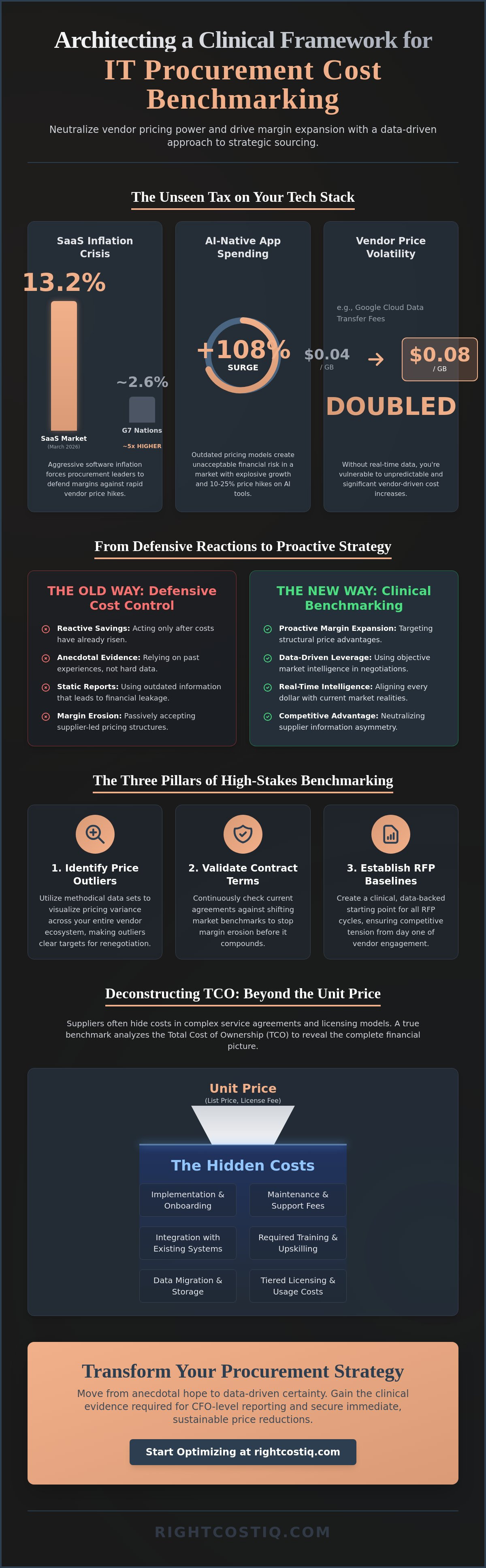
SaaS inflation reached 13.2% in March 2026, a rate nearly five times higher than the standard market inflation across G7 nations. This aggressive software inflation tax forces procurement leaders to defend margins against rapid vendor expansion, such as the doubling of Google Cloud data transfer fees to $0.08 per gigabyte. You recognize that anecdotal evidence fails during IT procurement cost benchmarking cycles where hidden costs and price volatility erode operational efficiency. Relying on outdated pricing models in an environment where AI-native app spending has surged 108% creates unacceptable financial risk.
This article delivers the methodical architecture required to transform raw market intelligence into precise negotiation leverage. By adopting a clinical, data-backed framework, you'll secure the objective justification needed for immediate price reductions and sustainable margin expansion. We will analyze the specific mechanics of standardized KPI tracking, price risk management, and the strategic integration of market trending data to neutralize vendor-driven volatility and optimize category performance.
Key Takeaways
- Transition from defensive cost control to a clinical architectural model that prioritizes margin expansion through comparative vendor analysis.
- Execute rigorous IT procurement cost benchmarking by utilizing data normalization to ensure a precise comparison across complex vendor variables.
- Look beyond superficial unit pricing to deconstruct the Total Cost of Ownership, integrating implementation and maintenance metrics into your strategic analysis.
- Transform raw benchmarking data into high-stakes negotiation leverage by defining specific category KPIs and executing a methodical data collection cycle.
- Maximize procurement outcomes by integrating advanced analytics into your RFP management and negotiation strategy for sustainable vendor performance.
The Strategic Imperative of Supplier Cost Benchmarking Analysis
Supplier cost benchmarking analysis operates as a clinical comparative analysis of vendor performance and pricing. It's not a simple retrospective audit. Effective cost benchmarking functions as a forward-looking architectural tool that transforms market data into negotiation leverage. While defensive cost control focuses on reactive savings, strategic benchmarking targets margin expansion by identifying structural price advantages. This process is the foundation of high-performance IT procurement cost benchmarking, ensuring every dollar spent aligns with current market realities rather than legacy contract terms.
Integrating this analysis into category management procurement allows leaders to move beyond transactional sourcing. The 2026 market climate demands this shift. With SaaS inflation reaching 13.2% as of March 2026, relying on historical static reports is a liability. Real-time data is the only defense against the 10% to 25% price hikes currently seen in AI-enabled tools. Static data leads to margin erosion; real-time intelligence drives competitive advantage.
Core Objectives of High-Stakes Benchmarking
High-stakes benchmarking aims to neutralize vendor pricing power through three specific execution pillars. First, it identifies price outliers across complex global supply chains using methodical data sets. When you visualize pricing variance across your entire vendor ecosystem, outliers become clear targets for renegotiation. Second, it validates current contract terms against shifting market benchmarks to stop margin erosion before it compounds. Third, it establishes a clinical baseline for upcoming RFP cycles. This ensures competitive tension from the first day of vendor engagement, preventing vendors from dictating terms based on your lack of market visibility.
The Economic Impact of Information Asymmetry
Information asymmetry is a primary driver of procurement inefficiency. Suppliers possess vast amounts of market pricing data that they use to build pricing models designed to maximize their own margins. When you lack transparency, you're forced into supplier-led pricing structures. Neglecting enterprise-grade IT procurement cost benchmarking results in significant financial leakage, often hidden within complex service level agreements or tiered licensing models. Shifting from anecdotal negotiation to data-driven strategic sourcing provides the clinical evidence required for CFO-level reporting. It moves the conversation from "what we hope to save" to "what the market dictates we pay," providing a rigorous justification for every price reduction demand.
Architecting a Clinical Benchmarking Framework
Rigorous IT procurement cost benchmarking requires a structured architectural foundation to yield actionable results. You must move beyond surface-level price checks and select a benchmarking methodology that aligns with your specific category objectives. The choice between internal, competitive, or functional paradigms determines the depth of your negotiation leverage. In a 2026 economy defined by rapid price shifts, this selection process must incorporate market price trending to account for the volatility in cloud infrastructure and enterprise software tiers. Relying solely on public industry benchmarks often results in generic, low-impact data. Maximum precision necessitates the use of proprietary data sets that reflect actual transaction values rather than aspirational list prices.
Establishing this framework allows procurement leaders to neutralize the information advantage held by vendors. By architecting a clinical model, you transform raw data into a strategic asset that justifies price reductions to the C-suite. Integrating market price trending and forecasting services into your foundational analysis ensures that your benchmarks remain relevant as market conditions evolve. This forward-looking approach prevents the use of obsolete data in high-stakes negotiation cycles.
Internal vs. External Benchmarking Paradigms
- Internal: This paradigm involves comparing performance and costs across global business units or decentralized departments. It identifies internal efficiency leaders and allows you to standardize the most favorable terms across the entire enterprise.
- External: Mapping your vendor pricing against direct competitors and industry leaders provides the external validation required for leverage. This is the primary tool for challenging supplier-led pricing models.
- Hybrid Models: The most sophisticated strategic architects utilize a hybrid model. This approach combines internal efficiency metrics with external price ceilings to achieve total optimization of the procurement function and maximum margin expansion.
Data Normalization and Statistical Integrity
Raw procurement data is inherently deceptive and requires clinical normalization to ensure an apples-to-apples comparison. You must meticulously adjust for volume discounts, regional logistics, and currency fluctuations to maintain statistical integrity. Removing this statistical noise reveals the true cost drivers within the supplier pricing model, allowing you to pinpoint exactly where margins are being eroded by hidden fees. Data normalization in procurement is the systematic process of adjusting heterogeneous cost variables to a common baseline to ensure audit-ready accuracy and objective comparison.
- Volume Adjustment: Scaling unit prices to account for tiered discount structures.
- Geographic Leveling: Factoring in regional tax implications and localized service delivery costs.
- Service Level Alignment: Ensuring that performance KPIs and support tiers are identical across all compared data points.
Deconstructing the TCO: Benchmarking Beyond the Unit Price
Unit price benchmarking is a superficial metric that often obscures the true financial impact of a vendor relationship. High-level decision-makers require a clinical deconstruction of the Total Cost of Ownership (TCO) to ensure margin protection. Relying on the face value of a contract leads to significant financial leakage, especially when implementation, maintenance, and logistics costs remain unanalyzed. IT procurement cost benchmarking must extend into these granular variables to provide an audit-ready justification for price reductions. For example, the doubling of Google Cloud data transfer rates to $0.08 per gigabyte in May 2026 demonstrates how infrastructure costs can eclipse initial license fees if not benchmarked within a TCO framework.
A sophisticated benchmarking strategy also quantifies supplier risk and compliance as tangible financial factors. Vendors that fail to meet cybersecurity standards, such as the mandatory CMMC 2.0 Phase 2 certification starting November 10, 2026, introduce liabilities that far outweigh any upfront savings. Evaluating innovation and ESG commitments through a clinical lens further ensures that vendor selection aligns with long-term enterprise growth goals. This approach transforms procurement from a tactical buying function into a strategic driver of corporate resilience.
Price Risk Management and Volatility Benchmarking
Volatility is the new constant in technology spending. With SaaS inflation reaching 13.2% in March 2026, static pricing models are obsolete. Evaluating supplier pricing against real-time market price trending and forecasting analytics is essential for protecting future margins. You must identify vendors that offer superior price risk mitigation strategies, such as CPI caps or multi-year price protections. Benchmarking contract flexibility and index-based pricing mechanisms allows your organization to pivot during economic shifts. This clinical analysis identifies which suppliers are absorbing market volatility and which are passing it directly to your bottom line through the "software inflation tax."
Vendor Performance and Compliance Metrics
Reliability is a quantifiable cost factor. Mapping defect rates and lead-time reliability against objective industry standards reveals the hidden penalty costs of poor performance. When a vendor fails to meet standardized KPIs, the resulting operational friction erodes the ROI of the entire category. Aligning vendor performance tracking with enterprise-wide efficiency goals ensures that you aren't just paying for a service, but for a specific business outcome. By benchmarking non-compliance costs, procurement teams provide the CFO with a data-backed argument for performance-based credits or the termination of underperforming contracts. This rigorous oversight mitigates the risk of shadow IT, which can account for up to 40% of spending if left unmanaged.
The Execution Cycle: Transforming Analysis into Negotiation Leverage
Deploying a clinical execution cycle ensures that IT procurement cost benchmarking data doesn't remain a static artifact. It must function as a dynamic driver of competitive tension. Transforming raw intelligence into financial results requires a methodical five-step architectural process. This cycle bridges the gap between high-level strategy and the granular realities of the negotiation room. It's the mechanism that converts statistical observations into tangible margin expansion.
- Step 1: Define Scope. Establish specific category KPIs and benchmarking boundaries to focus the analysis on high-impact spend areas.
- Step 2: Execute Normalization. Perform methodical data collection and clinical normalization across all variables to ensure statistical integrity.
- Step 3: Conduct Gap Analysis. Identify savings opportunities and performance deficits by mapping internal costs against market-leading benchmarks.
- Step 4: Strategic Negotiation. Develop a data-backed negotiation strategy for upcoming RFP management cycles to force vendor price correction.
- Step 5: Monitor ROI. Implement continuous tracking to measure the financial impact of benchmarking initiatives and adjust strategies in real-time.
Executing the Clinical Gap Analysis
Visualizing the delta between your current costs and those of market leaders provides an immediate roadmap for action. You must categorize these gaps into immediate savings targets versus long-term strategic improvements. This differentiation allows for a phased execution that secures "quick wins" while building a foundation for sustainable margin growth. Clinical gap analysis identifies specific cost variances that allow the C-suite to adjust quarterly financial forecasts with a precision level that anecdotal evidence cannot support. By quantifying these deficits, you provide the objective evidence required to challenge supplier-led pricing models during contract renewals.
Benchmarking as a Strategic Negotiation Lever
Presenting benchmarking data to suppliers shifts the balance of power. It moves the discussion from subjective bargaining to an objective, data-led partnership. You'll use market trending data to justify rigid price caps and escalation clauses, protecting the organization from the 8.7% average SaaS price increases seen in early 2026. This transparency forces vendors to defend their pricing structures against clinical market realities rather than relying on information asymmetry. Transitioning to this expert-led model ensures that your procurement team operates as a sophisticated strategic architect rather than a tactical buyer. To optimize your next negotiation cycle, utilize procurement category cost benchmarking and analytics to secure the most favorable market terms.
Optimizing Procurement Outcomes through Managed Benchmarking
Enterprise-level IT procurement cost benchmarking requires a sophisticated combination of advanced technology and expert-led strategic execution. While automated software tools provide baseline visibility, they often fail to account for the nuanced complexities of enterprise-scale service categories. Capturing the full value of a benchmarking initiative necessitates integrating these insights into a comprehensive RFP management strategy. This approach ensures that data-driven findings translate directly into contractually binding savings. Professional negotiation assistance acts as the final catalyst, bridging the gap between identifying a price outlier and securing a corrected rate from a resistant vendor.
RightCostIQ analytics empower high-level decision-makers to architect a resilient, cost-optimized supply chain. By utilizing proprietary data sets and clinical normalization, we eliminate the guesswork from vendor selection. This expert-led model provides the strategic urgency required to combat the "software inflation tax" and maintain operational efficiency in a volatile market. It's the difference between simple price tracking and total category optimization.
The ROI of Professional Benchmarking Services
CFOs demand a clear, quantifiable payback period for any procurement investment. Professional cost benchmarking analysis delivers this by identifying immediate margin expansion opportunities that internal teams might overlook due to resource constraints. Outsourcing the heavy lifting of analytics and performance tracking reduces the operational burden on your procurement department, allowing them to focus on high-level strategic planning. This process also ensures that every vendor change or price reduction is backed by audit-ready documentation. Maintaining this level of statistical integrity is essential for corporate governance and long-term financial forecasting accuracy. You'll gain a clinical justification for every dollar saved, making it easier to demonstrate procurement's impact on the bottom line.
Architecting Future-Proof Supply Chains
Transitioning from reactive price checks to proactive market intelligence is the hallmark of a strategic architect. You must anticipate market shifts before they impact your P&L. RightCostIQ integrates market price trending into long-term strategic planning, allowing you to mitigate risks associated with the 8.7% average SaaS price increases projected for 2026. This forward-looking stance protects your organization from infrastructure cost spikes, such as the doubling of North American data transfer fees. By leveraging expert-led forecasting, you ensure that your procurement function remains a primary driver of financial growth rather than a reactive cost center. It's time to move beyond anecdotal evidence and secure your margins with clinical precision.
Architect your cost optimization strategy with RightCostIQ.
Mastering the Architecture of Margin Expansion
Success in a volatile 2026 market requires a shift from reactive cost control to a clinical, forward-looking architectural framework. You've seen how deconstructing Total Cost of Ownership and applying rigorous data normalization neutralizes the information advantage held by vendors. Effective IT procurement cost benchmarking isn't a static exercise; it's a dynamic negotiation lever that identifies price outliers and forces competitive tension during critical RFP cycles. By integrating real-time market intelligence, you move beyond superficial unit price comparisons to secure deep, sustainable margin expansion.
Relying on anecdotal evidence in an era of 13.2% SaaS inflation creates unacceptable financial risk for the enterprise. You need an expert partner to transform raw datasets into high-stakes negotiation leverage. RightCostIQ provides the clinical precision in RFP management and data-driven price risk management required to protect your bottom line. Our expert-led negotiation assistance ensures that benchmarking-identified savings are fully captured in every contract renewal. It's time to transition from tactical buying to sophisticated strategic sourcing.
Architect your cost optimization strategy with RightCostIQ.
Frequently Asked Questions
What is the primary difference between cost benchmarking and cost analysis?
Cost benchmarking is a clinical comparison of your pricing and performance against external market peers to identify competitive gaps. Cost analysis is an internal deconstruction of your own spend to understand where capital is allocated. While analysis identifies internal spend patterns, benchmarking reveals if those costs align with current market realities. It's the difference between knowing your costs and knowing your market position.
How often should an enterprise conduct a supplier cost benchmarking analysis?
Enterprises should conduct a supplier cost benchmarking analysis at least annually or prior to any major contract renewal cycle. In 2026, high-volatility categories like cloud infrastructure require quarterly reviews to account for rapid price shifts. This frequency ensures your procurement strategy remains aligned with real-time market trending. Regular cycles prevent margin erosion caused by static pricing in a dynamic economic environment.
Can benchmarking be applied to highly specialized or custom-engineered categories?
Benchmarking applies to specialized categories by utilizing functional comparisons or proxy data sets. You analyze the underlying cost drivers, such as specialized labor rates or raw material indices, rather than the finished custom product. This methodical approach ensures you aren't overpaying for unique services that share common market inputs. It provides a data-backed baseline even when direct apples-to-apples comparisons aren't immediately visible.
What are the most critical KPIs to track during a procurement benchmarking cycle?
The most critical KPIs include Total Cost of Ownership (TCO), unit price variance against market medians, and vendor performance reliability scores. Tracking these metrics during an IT procurement cost benchmarking cycle provides the data-backed justification needed for price corrections. It moves the focus from simple unit cost to overall value and risk. These KPIs ensure that savings don't come at the expense of operational integrity.
How does benchmarking help in mitigating supply chain price risk?
Benchmarking identifies vendors whose pricing models are outliers compared to market volatility indices. By mapping current rates against forecasting analytics, you can justify the implementation of CPI caps and index-based pricing mechanisms. This proactive stance protects your margins from the software inflation tax currently impacting enterprise budgets. It allows you to anticipate price hikes and secure multi-year protections before market shifts occur.
Is internal benchmarking as effective as external market comparison?
External market comparison is superior for capturing immediate negotiation leverage and margin expansion against competitors. Internal benchmarking is effective for identifying process inefficiencies and standardizing favorable terms across decentralized global business units. A hybrid approach provides the most comprehensive architectural view of your procurement health. It ensures you're efficient internally while remaining competitive in the broader market landscape.
What data sources are most reliable for procurement benchmarking in 2026?
Reliability in 2026 depends on proprietary transactional data sets and real-time market indices rather than static historical reports. You should prioritize sources that reflect actual negotiated prices rather than vendor list prices. Expert-led analytics platforms provide the most audit-ready intelligence for high-stakes decision-making. These sources offer the clinical precision required to challenge supplier-led pricing models during complex negotiations.
How can I ensure my benchmarking data is normalized correctly for a global RFP?
Correct normalization for a global RFP requires adjusting for volume tiers, regional tax structures, and currency fluctuations. You must also align service level agreements to ensure you're comparing identical support and performance standards. This clinical precision prevents statistical noise from obscuring true savings opportunities. Methodical normalization is the only way to ensure an audit-ready comparison that withstands C-suite scrutiny during the vendor selection process.


