
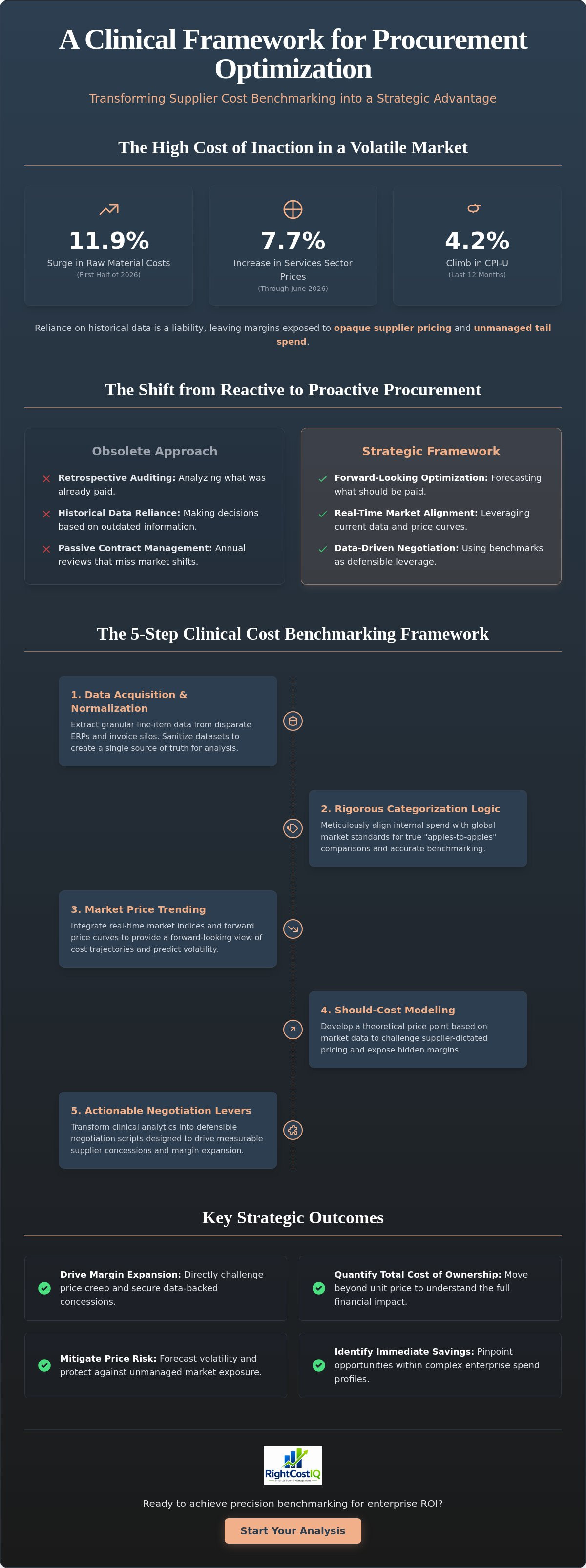
With raw material costs in the manufacturing sector surging by 11.9 percent in the first half of 2026 alone, is your procurement strategy actually protecting your margins or merely documenting their erosion? You've likely realized that opaque supplier pricing structures and unmanaged tail spend are silent killers of corporate profitability in this volatile climate. Relying on historical data is a liability when the GSA is implementing a revolutionary FAR overhaul and the CPI-U has climbed 4.2 percent over the last 12 months.
This article provides the clinical framework required to execute a rigorous supplier cost benchmarking analysis, converting raw metrics into defensible negotiation levers. You'll master the data-driven methodologies necessary to transform vendor performance tracking into a primary driver for financial growth. We'll explore how to mitigate risk through market price trending and price risk management to ensure your procurement optimization strategy delivers measurable bottom-line results through 2026 and beyond.
Key Takeaways
- Transition from retrospective price auditing to forward-looking cost optimization by assessing clinical market alignment and forward price curves.
- Execute a rigorous supplier cost benchmarking analysis built on standardized data hygiene and categorization logic to secure defensible negotiation leverage.
- Quantify the full Total Cost of Ownership by integrating market price trending and logistics data to forecast financial volatility in a shifting regulatory environment.
- Transform clinical procurement analytics into strategic negotiation scripts designed to drive measurable supplier concessions and margin expansion.
- Utilize automated vendor performance tracking and category analytics to identify immediate savings opportunities within complex enterprise spend profiles.
The Strategic Imperative of Supplier Cost Benchmarking Analysis
Enterprise financial resilience in 2026 is no longer a byproduct of passive contract management; it's a result of clinical market alignment. As raw material costs in the manufacturing sector surged by 11.9 percent in the first half of 2026, traditional procurement models that rely on historical price auditing have become obsolete. A forward-looking supplier cost benchmarking analysis is now the primary mechanism for protecting margins against systemic price volatility. This process shifts the focus from what was paid yesterday to what should be paid tomorrow based on real-time market dynamics. Cost benchmarking serves as the foundational data architecture for this transition, providing the objective transparency needed to challenge legacy pricing structures.
Modern procurement optimization requires a continuous, data-driven framework that treats every contract as a dynamic financial instrument. Relying on annual reviews is a strategic failure when the services sector has already seen price increases of 7.7 percent through June 2026. High-level decision-makers must deploy a benchmarking architecture that operates with the same speed as the global market. This approach transforms procurement from a back-office function into a strategic architect of the bottom line.
Benchmarking as a Driver of Margin Expansion
Supplier cost benchmarking analysis is the systematic comparison of internal spend against external market benchmarks to identify efficiency gaps. This clinical assessment allows procurement teams to quantify the specific delta between current contract rates and real-time market indices. Without this visibility, "price creep" silently erodes profitability as suppliers pass through inflationary costs that may not align with actual market trending. By utilizing automated tracking, organizations can identify these discrepancies immediately, turning market intelligence into a direct lever for margin expansion. This level of precision is essential for managing unmanaged tail spend, where fragmented pricing often hides significant savings opportunities.
The Cost of Inaction: Opaque Pricing and Risk
The "Lean Paradox" represents a critical vulnerability where over-optimized procurement teams, focused solely on internal process efficiency, miss macro-market shifts that threaten financial stability. Inaction leads to unmonitored Purchase Price Variance (PPV), where the lack of sophisticated analytics leaves the enterprise exposed to arbitrary supplier increases. Sophisticated benchmarking mitigates the risk of the "Lowest Price Trap." This trap occurs when a focus on initial unit cost ignores the long-term financial impact of logistics volatility and quality failures. A clinical framework ensures that every negotiation is backed by defensible data, protecting the organization from the risks inherent in opaque supplier pricing and unmanaged market exposure.
A Clinical Framework for Executing Category Cost Benchmarking
Executing a successful supplier cost benchmarking analysis requires more than surface-level data collection; it demands a clinical approach to data hygiene. Without a sanitized data set, any resulting benchmarks are functionally useless for high-stakes negotiations. Defensible analytics begin with the extraction of granular line-item data from disparate ERP systems and invoice silos. This process eliminates the noise of unmanaged spend and provides a clear view of actual consumption patterns. By establishing a rigorous data foundation, procurement leaders move from reactive auditing to proactive financial orchestration. Strategic decision-makers can access real-time market intelligence to begin their categorization overhaul immediately.
Categorization logic is the next pillar of the clinical framework. Internal spend must be meticulously aligned with global market standards to ensure "apples-to-apples" comparisons. This alignment allows for the integration of market price trending into the benchmarking lifecycle, providing a forward-looking view of cost trajectories. With raw material prices expected to increase by 14.1 percent in 2026, understanding how your specific categories align with these macro-economic shifts is critical. Should-cost modeling then serves as the final validation engine, providing a theoretical price point that challenges supplier-dictated pricing structures and exposes hidden margins.
Data Acquisition and Normalization
Normalization is the critical bridge between raw data and actionable intelligence. Procurement teams must normalize for volume, geography, and SKU-level specifications to remove variables that distort market comparisons. Utilizing should-cost analytics establishes baseline expectations before engaging with vendors. This methodical approach ensures that procurement optimization isn't based on anecdotal evidence but on a clinical assessment of what the market actually supports for your specific operational footprint.
Advanced Category Analytics
Advanced analytics require applying clinical precision to category management procurement. This involves differentiating between commodity-driven benchmarks, which fluctuate with raw material indices, and service-based benchmarks, which are influenced by labor and overhead trends. Through automated data ingestion, the speed and accuracy of your supplier cost benchmarking analysis increase exponentially. This allows for real-time adjustments as market conditions shift, ensuring that your negotiation levers remain sharp and your financial risk is mitigated through continuous oversight.
Quantifying Total Cost of Ownership (TCO) and Price Risk
A clinical supplier cost benchmarking analysis is fundamentally incomplete if it terminates at the unit price level. True procurement optimization requires a comprehensive deconstruction of the Total Cost of Ownership (TCO) equation, which accounts for the financial impact of logistics, quality, and compliance. In a market where the energy index increased by 23.5 percent over the 12 months ending in May 2026, failing to benchmark landed costs creates a massive blind spot in financial forecasting. Strategic architects don't just look at the invoice; they analyze the entire value chain to identify where hidden margins are leaking through inefficient supply chain variables. This level of scrutiny is essential for maintaining enterprise financial resilience against the 4.2 percent CPI-U increase recorded in 2026.
Integrating price risk management into the benchmarking workflow transforms procurement from a reactive cost center into a proactive risk mitigation engine. This approach utilizes market price trending models to anticipate volatility before it impacts the bottom line. With raw materials in the manufacturing sector projected to see a net-average price increase of 14.1 percent in 2026, the ability to quantify financial volatility is a prerequisite for survival. Benchmarking must serve as the diagnostic tool that identifies which categories are most exposed to these systemic market swings. Organizations that fail to integrate these models will find themselves defenseless against the 8.9 percent price increases expected in the services sector throughout the remainder of the year.
Beyond the Invoice: The TCO Framework
The TCO framework demands the incorporation of landed costs and incidental fees into every benchmarking model. Invoice pricing often masks the true expense of supplier lead times and poor reliability, which can disrupt manufacturing capacity utilization, currently operating at 86.9 percent as of June 2026. Measuring the 'Cost of Quality' serves as a critical differentiator in a clinical analysis. High-performing organizations use these metrics to justify higher unit prices from reliable vendors when the TCO analysis proves they offer superior long-term value compared to lower-cost, high-risk alternatives. This ensures that procurement decisions are based on total financial impact rather than superficial savings.
Price Risk Management and Forecasting
Effective procurement strategy leverages market price trending to anticipate cost shifts through 2027. By quantifying the financial volatility of key categories, decision-makers can implement defensive strategies against inflationary pressures. Leveraging price risk management and tracking allows firms to hedge against market swings with surgical precision. This methodology ensures that benchmarking isn't just a historical record but a forward-looking roadmap for financial growth. It enables teams to lock in favorable rates and avoid the 'lowest price trap' that often leads to catastrophic supply chain failures in volatile economic climates.
From Analytics to Action: Benchmarks as Negotiation Levers
Data without application is merely overhead. To achieve clinical margin expansion, you must transform your supplier cost benchmarking analysis into a high-fidelity negotiation script. Suppliers frequently weaponize macro-economic volatility, such as the 23.5 percent energy index spike seen in 2026, to justify broad-based price increases across all categories. Without granular benchmarks, your team is forced into a defensive posture. A clinical framework allows you to pivot to an offensive strategy, using market intelligence to dismantle arbitrary price hikes and drive specific concessions. Execute a clinical procurement diagnostic to identify immediate negotiation levers within your current contract portfolio.
The transition from analytics to action requires a shift in how your team perceives market data. Benchmarks aren't static reports; they're dynamic tools for financial orchestration. By utilizing a clinical supplier cost benchmarking analysis, procurement leaders can establish a "market reality" that overrides supplier-driven narratives. This approach is essential in a climate where services sector prices have already climbed 7.7 percent through June 2026. Organizations that lead with data-driven transparency secure better terms and build more resilient, performance-based supplier relationships.
Strategic Negotiation Assistance
Positioning benchmarks as objective market reality during contract talks removes the emotional friction often found in legacy negotiations. By utilizing negotiation coach frameworks, sourcing teams can maximize outcomes by focusing on the delta between current rates and validated market indices. This methodology is particularly effective for countering "inflationary" claims. When a supplier cites the 4.2 percent CPI-U increase to justify a 10 percent hike, your team can counter with precise category data that reflects actual production cost shifts, maintaining margin integrity.
Optimizing the RFP Lifecycle
Precision in the RFP lifecycle requires the injection of benchmarking data at the earliest stages of vendor selection. By integrating data into RFP management: precision frameworks, you can standardize supplier response evaluations based on pre-set benchmarks. This removes subjectivity and ensures that every proposal is measured against clinical market standards. Long-term compliance is then secured through continuous vendor performance tracking. This ensures that the savings negotiated during the RFP phase don't erode over time due to unmanaged price creep or service failures, keeping your bottom line protected through 2026 and beyond.
RightCostIQ: Precision Benchmarking for Enterprise ROI
RightCostIQ represents the technological culmination of the clinical frameworks discussed throughout this analysis. It integrates advanced market intelligence with rigorous financial strategy to automate the identification of savings across complex procurement categories. By replacing manual, error-prone spreadsheets with a centralized benchmarking architecture, organizations maintain a real-time pulse on market alignment. This shift is critical for achieving sustainable margin expansion in an era of persistent inflationary pressure. Utilizing a clinical supplier cost benchmarking analysis within this digital ecosystem ensures that every procurement decision is backed by objective, verifiable data.
The platform acts as a strategic architect for the modern procurement department, bridging the gap between high-level financial goals and technical execution. It doesn't just report on costs; it provides the diagnostic tools necessary to restructure supplier relationships for maximum profitability. This methodology transforms procurement from a reactive cost center into a primary driver for enterprise financial growth, ensuring that your organization remains competitive regardless of market volatility.
The RightCostIQ Advantage
The platform utilizes proprietary market intelligence models to provide precise 2026 cost forecasting, allowing decision-makers to move beyond historical data liabilities. This holistic approach combines RFP management with strategic negotiation assistance, ensuring that every sourcing event is backed by clinical precision. It's a scalable infrastructure designed for global procurement optimization, providing the consistency required to manage cross-border supply chain volatility. By centralizing these functions, RightCostIQ creates a rhythmic cadence of efficiency that resonates through the entire corporate finance structure.
A primary driver of margin erosion is the 'Unmanaged 20%,' often consisting of fragmented, low-value transactions that escape traditional scrutiny. RightCostIQ provides specialized tail spend management solutions that apply the same clinical benchmarking standards to these overlooked categories. By automating the identification of price discrepancies in tail spend, the platform recovers hidden margins that typically leak through unmonitored procurement channels, ensuring that no stone is left unturned in the pursuit of bottom-line growth.
Execution and Implementation
Transitioning to an automated benchmarking architecture requires a methodical implementation strategy that aligns with your specific industry realities. RightCostIQ allows for the customization of benchmarking standards to ensure industry-specific compliance, whether you're managing manufacturing raw materials or complex service contracts. This ensures that the data-driven methodologies of a supplier cost benchmarking analysis are applied with surgical accuracy to your operational footprint. It's time to move beyond the limitations of manual analysis and embrace a relentless focus on delivering specific business solutions.
Execute your supplier benchmarking with RightCostIQ to secure your bottom line and transform your procurement function into a strategic engine for financial growth.
Architecting Financial Resilience Through Clinical Benchmarking
Mastering a supplier cost benchmarking analysis transforms procurement from a reactive cost center into a strategic architect of corporate profitability. Clinical data hygiene and rigorous TCO deconstruction expose hidden margins that legacy auditing models consistently overlook. By integrating market price trending and should-cost modeling, your team can neutralize supplier-driven inflationary narratives and secure defensible contract terms.
The path to enterprise ROI in 2026 requires more than manual spreadsheets; it demands an automated architecture designed for relentless efficiency and market alignment. RightCostIQ provides the specialized tools necessary to execute this transition with surgical precision. Our platform integrates proprietary 'Should-Cost' modeling architecture with clinical negotiation assistance frameworks to ensure every RFP delivers maximum value. Don't let market volatility dictate your bottom line when you can leverage automated price risk management and forecasting to protect your growth.
Optimize Your Procurement Outcomes with RightCostIQ Analytics
Take the first step toward a data-driven future and redefine what's possible for your organization's financial health.
Frequently Asked Questions
What is the primary difference between spend analysis and supplier cost benchmarking?
Spend analysis focuses on internal historical outflows to categorize where capital was allocated; supplier cost benchmarking analysis validates those internal costs against external market indices to identify efficiency gaps. While spend analysis provides a retrospective view of organizational behavior, benchmarking provides a clinical assessment of market alignment and negotiation potential. This external validation is the primary mechanism for identifying where internal pricing has deviated from real-time market standards.
How often should an enterprise perform a supplier cost benchmarking analysis?
Enterprises must adopt a continuous monitoring architecture to navigate 2026 market volatility. With raw material costs in the manufacturing sector already surging by 11.9 percent through June 2026, static annual reviews are insufficient. High-stakes procurement environments require monthly price tracking and quarterly deep-dive benchmarking to ensure contract rates remain aligned with rapidly shifting macro-economic conditions and inflationary trends.
Can benchmarking be applied to indirect spend and tail spend categories?
Benchmarking is highly effective for the "Unmanaged 20 percent" of spend where fragmented transactions often hide significant margin leakage. Clinical benchmarking architectures automate the identification of price discrepancies across indirect categories, providing the transparency needed to consolidate vendors and secure volume-based concessions. This systematic approach transforms tail spend from a source of erosion into a primary driver for financial growth.
How does market price trending impact the accuracy of cost benchmarks?
Market price trending provides the forward-looking context required to maintain benchmark relevance in a shifting economy. Failing to account for specific volatility, such as the 23.5 percent energy index increase recorded in May 2026, renders static benchmarks obsolete. Integrating trend data allows procurement architects to adjust baseline expectations and forecast financial risk with clinical precision, ensuring negotiation levers remain sharp.
What data points are required to build a defensible Should-Cost model?
Building a defensible model requires granular data on raw material indices, labor rates, overhead allocations, and logistics costs. It also necessitates an understanding of industry-specific variables, such as manufacturing capacity utilization, which reached 86.9 percent in June 2026. These data points allow procurement teams to construct a theoretical price point that challenges supplier-dictated pricing and exposes hidden margins during contract renegotiations.
How can procurement teams use benchmarking to mitigate supplier risk?
Benchmarking acts as a diagnostic tool to identify suppliers whose pricing significantly deviates from market reality, which often signals financial instability or operational inefficiency. By quantifying these deviations, procurement teams can proactively diversify their sourcing strategies before price volatility or supplier failure impacts the bottom line. This clinical oversight is essential for maintaining supply chain resilience in a high-inflation environment.
Is specialized software necessary for clinical-grade benchmarking in 2026?
Manual spreadsheets are functionally incapable of processing the data density required for modern procurement optimization. Clinical-grade benchmarking in 2026 demands automated data ingestion and sophisticated analytics to handle the rapid price shifts seen in both the manufacturing and services sectors. Specialized software provides the rhythmic cadence of efficiency and accuracy needed to transform raw metrics into strategic financial outcomes.
What is the typical ROI for professional RFP management and benchmarking services?
ROI is measured through measurable margin expansion and the mitigation of unmanaged price risk. Professional benchmarking services typically identify significant savings by aligning legacy contracts with validated market standards and optimizing the total cost of ownership. Beyond direct cost reduction, these services deliver ROI through increased operational efficiency and the implementation of defensible negotiation frameworks that protect profitability long-term.


