
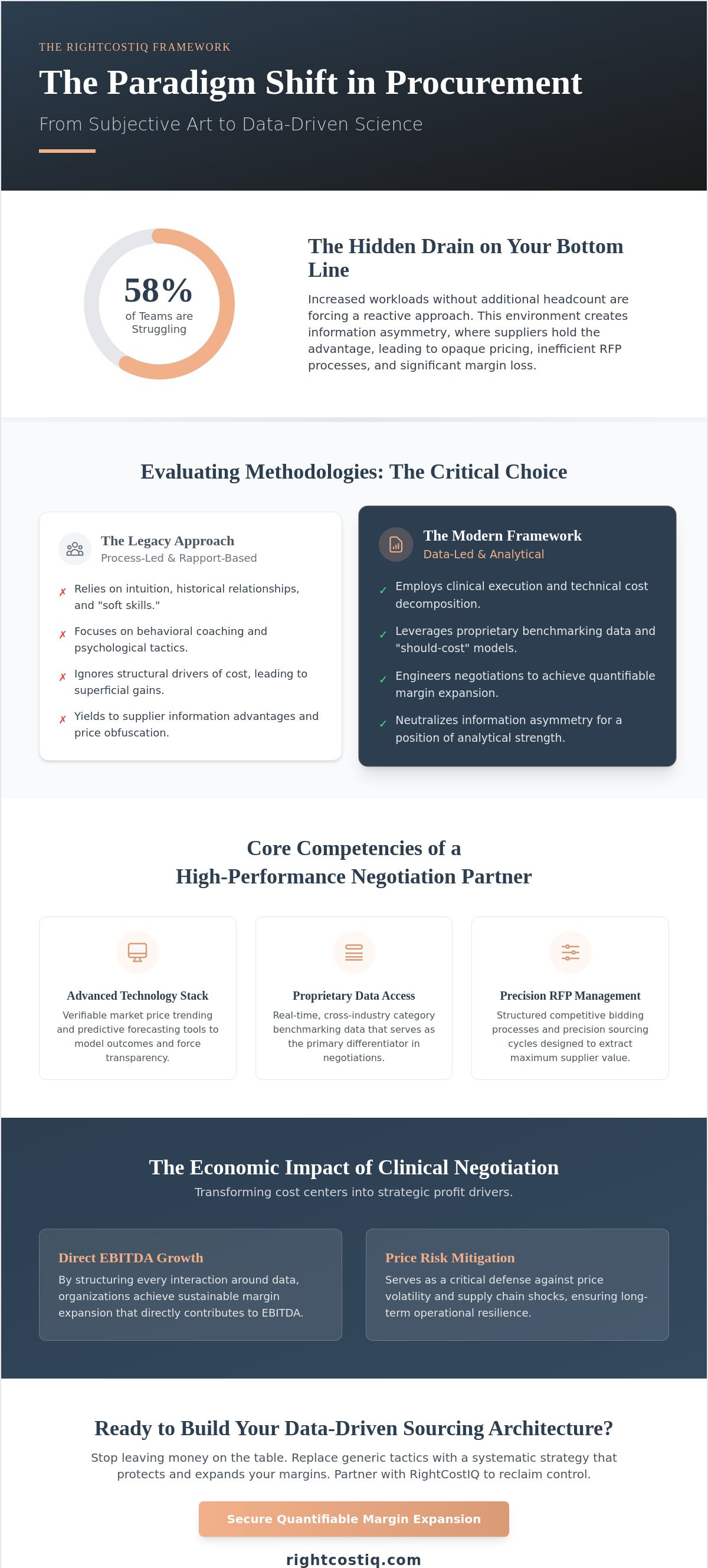
The era of negotiation as an art form has ended. Today, 58% of procurement teams are struggling under increased workloads with no additional headcount, forcing a shift from subjective persuasion to clinical market intelligence. Selecting a high-performance procurement negotiation consultant is now a requirement for organizations seeking to eliminate information asymmetry and reclaim lost margins. You likely recognize that opaque market pricing and inefficient RFP processes are draining your bottom line while internal teams lack the specialized expertise for complex, high-value categories.
This guide provides the framework to identify partners capable of delivering quantifiable margin expansion and mitigated price risk through advanced forecasting. We'll examine the technical benchmarks, data-driven sourcing methodologies, and analytical frameworks required to transform your high-value negotiations into a repeatable engine for financial growth. You'll learn how to evaluate consultants based on their ability to integrate predictive analytics and cost benchmarking into a systematic strategy that ensures operational resilience. It's time to replace generic tactics with a data-driven sourcing architecture that protects your bottom line.
Key Takeaways
- Transition from traditional deal-making to a clinical model of financial optimization that leverages data-integrated strategic sourcing.
- Evaluate a procurement negotiation consultant based on their analytical execution capabilities and access to proprietary category benchmarking data.
- Audit potential partners by scrutinizing their technology stack and verifying the depth of their market price trending and forecasting tools.
- Utilize advanced RFP management and precision sourcing cycles to extract maximum supplier value and secure quantifiable margin expansion.
- Integrate vendor performance tracking with price risk management to build a repeatable framework for long-term operational resilience.
The Strategic Mandate for a Procurement Negotiation Consultant
A procurement negotiation consultant functions as a specialized architect of financial optimization. They don't simply "close deals." They engineer the technical and commercial conditions under which maximum value is extracted from the supply base. Traditional procurement often relies on legacy deal-making models built on intuition and historical relationships. Modern strategic sourcing demands a departure from this subjective approach. It requires a data-integrated methodology that aligns technical cost structures with corporate financial objectives. By treating negotiation as a clinical discipline, organizations can move beyond simple cost-cutting to achieve sustainable margin expansion.
External intervention becomes a strategic necessity at specific trigger points. When an organization faces highly complex RFPs, volatile commodity categories, or sustained margin compression, internal teams often lack the bandwidth or specialized data to compete effectively. Suppliers leverage deep market insights and pricing algorithms to maintain high margins. The consultant’s primary objective is to neutralize these supplier information advantages. This ensures the buyer operates from a position of analytical strength rather than reactive defense. Selecting a procurement negotiation consultant is a tactical decision to reclaim control over the procurement process and eliminate waste.
Beyond Soft Skills: The Analytical Shift
The 2026 market has rendered rapport-based negotiation obsolete. Suppliers use sophisticated data models to protect their interests, making "soft skills" insufficient for high-stakes contracts. Information Asymmetry Neutralization is the process of stripping away these hidden supplier advantages through technical cost breakdowns. This shift means that category management procurement must be integrated into the earliest stages of negotiation planning. Without a clinical framework for category analysis, negotiation remains a superficial exercise. Success requires a deep dive into "should-cost" models and market trending data to force transparency.
The Economic Impact of Professional Negotiation Assistance
Clinical negotiation preparation has a direct, measurable impact on EBITDA growth. By structuring every interaction around data, organizations transform cost centers into profit drivers. Professional negotiation assistance serves as a critical risk mitigation tool against price volatility and supply chain shocks. Engaging an expert for RFP Management ensures that the competitive bidding process is structured to yield maximum transparency. It's not about getting a "fair price." It's about securing the most competitive commercial terms possible while maintaining operational resilience. High-performance consultants deliver a significant ROI by identifying hidden cost drivers that internal teams frequently overlook during standard sourcing cycles.
Evaluating Consultant Methodologies: Data-Led vs. Process-Led
Methodology determines the ceiling of financial capture. Many firms offer behavioral coaching centered on interpersonal persuasion and psychological tactics. This approach is fundamentally limited because it ignores the structural drivers of cost. An elite procurement negotiation consultant prioritizes analytical execution. They treat the negotiation as a technical exercise in cost decomposition and market alignment. This shift moves the consultant from a passive advisor to a strategic architect of the sourcing lifecycle. It's not about how you speak; it's about what you know. Analytical execution ensures that every demand is backed by a verifiable data point, leaving suppliers with no room for obfuscation.
Proprietary benchmarking data is the primary differentiator in a consultant’s toolkit. Without access to real-time, cross-industry cost data, consultants are merely guessing at supplier margins. High-performance partners integrate technology to provide automated tracking of commercial terms throughout the contract lifecycle. This ensures that the value negotiated at the outset doesn't erode due to "bracket creep" or unmonitored price adjustments. Relying on a data-driven procurement partner allows organizations to move from defensive cost avoidance to offensive margin expansion. This methodology transforms negotiation from a late-stage event into a continuous process of value discovery.
The Role of Category Cost Benchmarking
A consultant without real-time cost data is negotiating in the dark. Category cost benchmarking identifies "should-cost" models that challenge supplier quotes with surgical precision. This data allows procurement teams to break down a supplier's price into its constituent parts: raw materials, labor, overhead, and margin. The transition from price-taking to cost-modeling is critical. It forces suppliers to justify their pricing based on economic realities rather than market sentiment. When you understand the underlying cost structure, you stop asking for discounts and start demanding alignment with market benchmarks.
Market Price Trending and Forecasting Integration
Predictive analytics transform the timing of negotiations for maximum leverage. Instead of reacting to supplier-led price increases, organizations use market price trending to identify optimal windows for contract renewals. This clinical advantage allows for forecasting future price risk during the finalization of high-value agreements. Moving from historical spend analysis to future price risk management is a hallmark of sophisticated sourcing. It ensures that contracts remain competitive even as global market conditions shift. Forecasting doesn't just predict the future; it allows you to price risk into the contract today, securing long-term operational resilience.
Core Competencies of a High-Performance Negotiation Partner
Identifying a high-performance procurement negotiation consultant requires looking beyond interpersonal charisma or "negotiation culture." You need a partner who demonstrates technical proficiency in precision sourcing cycles and cost decomposition. They shouldn't just offer advice; they must possess the analytical rigor to manage complex category cost structures. This expertise allows them to navigate global supply chain dynamics where standard procurement teams often struggle. A consultant's value is found in their ability to translate market intelligence into specific, enforceable contract terms that protect your bottom line.
Mastery of price risk management is a non-negotiable competency. In a market where 86% of organizations plan to scale AI by 2026, your partner must use predictive modeling to mitigate financial volatility. This involves more than just looking at current quotes. It requires a deep understanding of how global market fluctuations impact specific cost drivers within your supply chain. A consultant who can't forecast price risk isn't protecting your margins; they're just documenting your losses. Your partner must be a strategic architect who builds financial safeguards into every commercial agreement.
RFP Management as a Negotiation Lever
A well-structured RFP isn't a administrative formality; it's a strategic weapon. It dictates the terms of the final negotiation by forcing suppliers into a framework of transparent pricing from the outset. High-performance consultants design RFPs that strip away vague "bundled" pricing. This forces vendors to compete on granular cost components, such as raw material indexes and specific service level credits. By the time the actual negotiation starts, the consultant has already used the RFP to establish a baseline of transparency that favors the buyer. This technical approach ensures that the eventual contract is built on a foundation of verifiable data rather than supplier-led narratives.
Vendor Performance and Compliance Tracking
The negotiation process doesn't end when the ink dries. Realized savings often diverge from negotiated savings due to a lack of technical oversight. A competent partner provides a dedicated Procurement and Vendor Performance Tracking Service to ensure post-negotiation compliance. This analytical oversight prevents "value leakage" and ensures that the commercial terms you fought for are actually delivered throughout the contract term. Performance data serves a dual purpose: it secures immediate ROI and fuels the intelligence for your next negotiation cycle. When you track compliance with precision, you enter future discussions with a documented history of vendor behavior, significantly increasing your leverage.
Selection Framework: How to Audit a Negotiation Consultancy
Selecting a procurement negotiation consultant requires a clinical audit of their operational capabilities. You can't rely on brand reputation or generic testimonials in a high-stakes sourcing environment. A rigorous vetting process ensures that your partner possesses the analytical tools necessary to dismantle supplier pricing defenses. This selection framework prioritizes technical evidence over professional charisma. It forces a transparent evaluation of how a consultant generates structural leverage during complex commercial discussions.
- Step 1: Audit Data Sources. Demand a demonstration of their proprietary category benchmarks. If a consultant relies solely on public data or your internal spend history, they can't identify the hidden margins suppliers are protecting.
- Step 2: Evaluate Technology Stack. Scrutinize their workflow for automation. A manual, spreadsheet-heavy process is prone to error and lacks the speed required for real-time market alignment. Analytics-driven sourcing is the only viable model for 2026.
- Step 3: Assess Category Depth. Verify their history with your specific high-value spend areas. Generalist consultants often miss the nuanced cost drivers inherent in specialized global supply chains.
- Step 4: Review Post-Deal Support. Ensure they provide a dedicated vendor performance tracking service. Negotiation success is measured by realized savings, not just the figures on a signed contract.
- Step 5: Verify Fee Structure. Seek alignment between their compensation and your actualized financial outcomes. High-performance partners often favor value-based models that reflect the EBITDA growth they generate.
Critical Questions for the Initial Consultation
The initial consultation is your primary opportunity to test a consultant's technical depth. Avoid discussing general philosophies; focus on granular deliverables. Ask: "What specific benchmarking data will you use to challenge our current suppliers' cost models?" Follow this by inquiring how they integrate market price forecasting into specific contract terms to mitigate future volatility. Finally, require a detailed description of their process for tracking vendor compliance after the deal is closed. If they can't provide a technical roadmap for these functions, they aren't a strategic partner.
Red Flags in Procurement Consulting
Identifying red flags early prevents the engagement of low-value advisors. An over-reliance on "negotiation tactics" or psychological maneuvers without supporting cost data is a primary warning sign. This suggests a lack of analytical depth. Another critical failure is the absence of a structured RFP management framework; a consultant who treats RFPs as administrative tasks won't extract maximum value. Beware of vague ROI promises that aren't tied to verifiable spend analytics. If the consultant can't link their activities to quantifiable margin expansion, their impact will be negligible.
The RightCostIQ Advantage: Precision Analytics in Negotiation
RightCostIQ represents the clinical alternative to traditional negotiation coaching. While generic firms focus on behavioral "soft skills," our approach centers on the technical decomposition of cost. As your procurement negotiation consultant, we provide a sophisticated sourcing architecture that prioritizes financial growth over interpersonal rapport. We replace subjective advice with data-led execution, ensuring that every commercial demand is anchored in verifiable market intelligence. This methodology transforms procurement from a back-office function into a primary driver of margin expansion. We don't just help you talk to suppliers; we give you the analytical tools to dismantle their pricing defenses.
Success in high-stakes sourcing requires more than just a seat at the table. It demands the integration of advanced cost benchmarking with a rigorous RFP management framework. RightCostIQ leverages proprietary analytics to identify hidden cost drivers that standard procurement teams often overlook. By utilizing our Market Price Trending and Forecasting Service, organizations can secure commercial terms that account for future market volatility. This proactive stance ensures that contract value is protected against price risk, maintaining operational resilience in an increasingly unpredictable global economy. Our Price Risk Management and Tracking Service allows decision-makers to visualize potential financial shocks before they impact the bottom line.
Clinical Execution of the RFP Lifecycle
RightCostIQ manages the entire RFP lifecycle to maximize your negotiation leverage. We design sourcing events that force supplier transparency through granular cost modeling and "should-cost" analysis. This process identifies hidden savings within complex category spend by stripping away bundled pricing and opaque service fees. We bridge the gap between initial sourcing strategy and final financial outcomes by ensuring the competitive environment is structured to favor the buyer. Our analytics-driven approach ensures that the final selection is based on the most competitive total cost of ownership rather than surface-level quotes. This technical oversight prevents suppliers from hiding margins in convoluted contract language.
Actualizing ROI through Performance Tracking
Negotiated savings only matter if they're actually realized. RightCostIQ provides a dedicated Vendor Performance Tracking Service to monitor compliance and price risk post-negotiation. We ensure that the commercial terms established during the sourcing cycle are maintained throughout the contract term. This data-driven oversight identifies value leakage early, allowing for immediate corrective action when vendor behavior deviates from agreed-upon benchmarks. By monitoring vendor performance with clinical precision, we help organizations maintain operational efficiency and secure the full ROI of their sourcing initiatives. Optimize your next high-stakes negotiation with RightCostIQ.
Architecting Sustainable Financial Optimization
The transition from behavioral persuasion to analytical execution is the only viable path to sustainable margin expansion. Organizations must move beyond simple cost avoidance and adopt a clinical framework for financial optimization. Success requires a commitment to technical rigor, including the integration of proprietary category cost benchmarking and real-time market price trending into every sourcing event. By auditing potential partners through a structured selection framework, you ensure that your strategy remains resilient against global volatility.
Engaging a high-performance procurement negotiation consultant allows you to neutralize supplier information advantages and reclaim lost value. This partnership transforms the RFP process from an administrative burden into a powerful lever for EBITDA growth. With clinical RFP management frameworks and dedicated vendor performance tracking, you secure the full ROI of every commercial agreement. It's time to replace intuition with precision. Secure Your Competitive Advantage with RightCostIQ Negotiation Assistance. Your path to operational resilience and superior contract terms starts with data-driven clarity.
Frequently Asked Questions
What exactly does a procurement negotiation consultant do?
A procurement negotiation consultant acts as a technical architect for high-stakes sourcing initiatives. They manage the clinical execution of the RFP process, perform category cost benchmarking, and utilize market intelligence to eliminate supplier information advantages. Their primary objective is to secure quantifiable cost savings and operational resilience through data-driven precision rather than generic negotiation tactics.
How does a negotiation consultant differ from a standard procurement firm?
Standard procurement firms often focus on tactical purchasing and administrative sourcing functions. A specialized consultant prioritizes analytical execution and the clinical application of market intelligence. They focus specifically on the commercial leverage points of high-value contracts. This specialized approach ensures that every demand is backed by verifiable cost models rather than historical relationship data.
Can a negotiation consultant help with existing contracts or only new RFPs?
Consultants provide significant value throughout the entire contract lifecycle, not just during new sourcing events. They use price risk management and market price trending to identify optimization opportunities in mid-term agreements. Additionally, they provide vendor performance tracking to ensure that the commercial terms negotiated at the outset are fully realized and haven't eroded over time.
How is the ROI of a procurement negotiation consultant measured?
ROI is measured through direct EBITDA impact and quantifiable margin expansion. Success is tracked by comparing final negotiated terms against "should-cost" benchmarks and historical spend analytics. A high-performance procurement negotiation consultant also delivers value through mitigated price risk and improved operational resilience, which protect the bottom line against future market volatility and supply chain shocks.
Do negotiation consultants work on a contingency or fixed fee basis?
Fee structures vary based on the specific engagement scope and the consultant's methodology. Many partners utilize value-based models that align their incentives with your actualized savings and financial outcomes. Others may offer project-based fees for RFP management or monthly retainers for ongoing price risk tracking and market forecasting services. It's essential to select a structure that reflects your specific financial goals.
What industries benefit most from procurement negotiation assistance?
Industries with complex cost structures and volatile supply chains see the most significant financial impact. This includes sectors like manufacturing, technology, and logistics where category spend is high and market pricing is often opaque. Any organization facing margin compression or a lack of internal expertise for high-value categories will benefit from the technical rigor of a data-driven partner.
What data should I have ready before hiring a consultant?
You should prepare comprehensive historical spend data, current supplier contracts, and any existing RFP documentation. Having a clear view of your category requirements and vendor performance history allows the consultant to immediately apply cost benchmarking and forecasting tools. Transparency regarding your internal sourcing processes is critical for identifying the leverage points that will drive the most significant financial optimization.
How long does a typical negotiation consulting engagement last?
Engagement duration depends on the complexity of the categories and the scope of the sourcing initiative. A targeted RFP management project might last three to six months from discovery to final contract execution. Ongoing services, such as vendor performance tracking and price risk management, typically operate on a long-term basis to ensure continuous alignment with shifting market conditions and sustained margin protection.


