
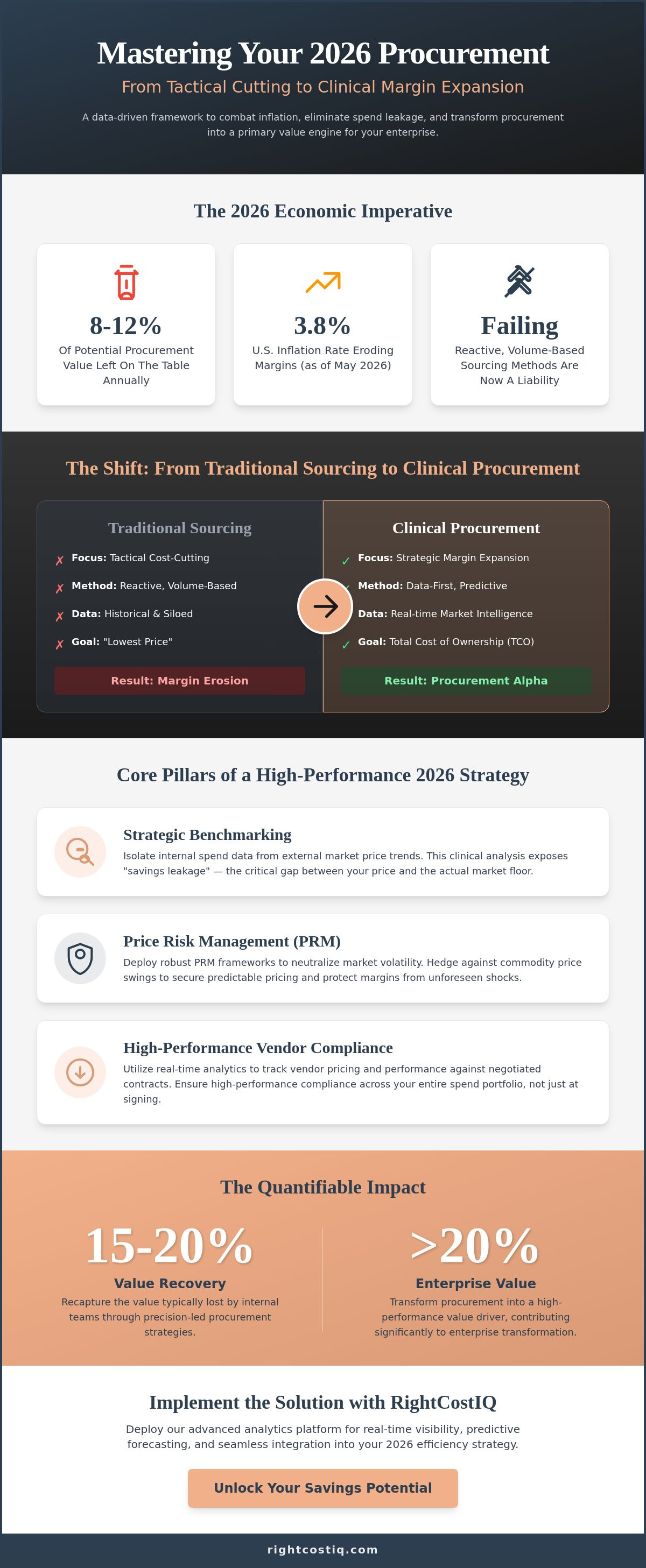
Most enterprises leave 8-12% of potential procurement value on the table annually while struggling against a U.S. core inflation rate projected at 3.2% for 2026. You've likely seen how fragmented data silos and persistent market price volatility erode margins, making traditional, reactive sourcing methods a liability. Developing a robust procurement cost savings strategy 2026 requires moving beyond tactical cost-cutting into a regime of clinical price risk architecture and professional negotiation precision. This transition is a financial imperative for maintaining enterprise value in a landscape defined by 3.8% U.S. inflation as of May 2026.
This article provides the data-driven frameworks and risk management protocols necessary to drive measurable procurement alpha. You'll master the architectures required to eliminate spend leakage and secure predictable pricing through advanced market intelligence. We'll examine the specific mechanics of category cost benchmarking, the impact of the April 2026 federal fixed-price contract mandate, and the technical integration of market price forecasting to ensure high-performance vendor compliance across your entire spend portfolio.
Key Takeaways
- Adopt a clinical procurement methodology to shift from reactive expense reduction to strategic margin expansion.
- Quantify savings by isolating internal spend metrics from external market price trending and benchmarking data.
- Recover the 15-20% of value typically lost by internal teams through a precision-led procurement cost savings strategy 2026.
- Neutralize volatility using Price Risk Management (PRM) frameworks to hedge against 2026 commodity price swings.
- Deploy RightCostIQ analytics for real-time visibility and high-performance vendor compliance tracking.
The 2026 Economic Imperative: From Tactical Cutting to Clinical Procurement
Clinical procurement represents a fundamental departure from the reactive, line-item reductions of the past decade. It's a data-first methodology that prioritizes enterprise-wide margin expansion over simple expense reduction. In the 2026 fiscal landscape, where J.P. Morgan Global Research reports a U.S. core inflation rate of 3.2%, tactical cost-cutting is no longer sufficient to protect the bottom line. Organizations must transition from transactional purchasing to a sophisticated strategic price risk architecture. This shift demands a "Strategic Architect" persona within the C-suite; an analytical leader who views procurement as a primary engine for financial growth rather than a back-office administrative function.
The traditional sourcing playbook focused on volume-based discounts is failing. Market price volatility and the April 2026 U.S. Federal mandate prioritizing fixed-price contracts have rewritten the rules of engagement. To stay competitive, your procurement cost savings strategy 2026 must integrate real-time market intelligence and predictive forecasting. This isn't just about paying less; it's about architecting a supply chain that is resilient to the inflationary pressures that saw U.S. rates hit 3.8% in April 2026. Transitioning to this clinical model ensures that every dollar spent is an investment in operational efficiency.
Deconstructing the 2026 Margin Pressure
Global supply chain recalibration has permanently altered unit cost structures. High-interest environments now dictate that procurement capital allocation be handled with the same rigor as an investment portfolio. Legacy methods fail because they rely on historical data that doesn't account for current volatility. Modern Strategic Sourcing requires granular visibility into data silos that previously obscured spend patterns. Without this transparency, enterprises continue to leave 8-12% of potential value on the table annually according to verified industry benchmarks. Efficient data orchestration is the only way to reclaim this lost margin.
The Shift to Risk-Adjusted Cost Savings
Achieving "Procurement Alpha" requires moving beyond the "lowest price" mindset toward Total Cost of Ownership (TCO) precision. This involves integrating market price trending and forecasting directly into the budgeting cycle. By establishing a clinical baseline for performance, firms can track vendor compliance with surgical accuracy. A robust procurement cost savings strategy 2026 utilizes price risk management to hedge against commodity swings, ensuring that margins remain protected regardless of market shifts. This level of precision transforms procurement into a high-performance value driver, contributing over 20% of the total value created in enterprise transformation programs.
Strategic Benchmarking: Quantifying Category Savings Potential
Strategic benchmarking in 2026 is a dynamic architecture. You can't rely on generic spend visibility tools that merely track historical invoices. To execute a superior procurement cost savings strategy 2026, you must differentiate internal spend data from external market price trending. This distinction allows you to identify "savings leakage," which is the delta between what you're paying and the actual market floor. Clinical spend analysis exposes these inefficiencies by isolating pricing anomalies across disparate vendor contracts and business units.
Standardizing category management across the enterprise ensures scalability. Without a clinical framework, individual departments often negotiate in isolation, leading to suboptimal vendor selection and fragmented pricing. By centralizing these insights, firms can implement Procurement Cost Reduction Strategies that scale with organizational growth. You can start this process by utilizing professional procurement category cost benchmarking and analytics to establish a verifiable baseline for every major spend category.
Clinical Spend Analysis Frameworks
Effective frameworks segment spend into high-impact categories and tail spend segments. High-impact categories require deep clinical analysis to identify vendor-specific pricing anomalies that erode margins. Tail spend management focuses on automation and consolidation to reduce administrative overhead. Procurement category cost benchmarking is the systematic process of aligning internal spend metrics with real-time market pricing to ensure competitive advantage. This methodology ensures you aren't just comparing your past performance against itself, but against the true market potential.
Leveraging Market Price Trending for 2026
Forecasting models are essential for category strategy in a volatile economy. Identifying "Best-in-Class" pricing benchmarks in sectors like technology requires more than a simple RFP; it requires a deep understanding of market price trending and forecasting. For a more granular look at these methodologies, consult our guide on Category Management in Procurement: A Clinical Framework for Margin Expansion (2026). Implementing category management can deliver 10-15% in cost savings, provided your procurement cost savings strategy 2026 is grounded in clinical precision rather than historical assumptions.
Architecting the RFP Lifecycle: Precision in Negotiation Assistance
The RFP has evolved from a simple procurement document into a high-precision strategic lever. In the current economic climate, simply issuing a request for proposal isn't enough to secure a competitive advantage. Internal negotiation teams frequently leave 15-20% of potential savings on the table because they lack the granular market intelligence required to challenge vendor pricing structures. A successful procurement cost savings strategy 2026 utilizes professional negotiation assistance to extract maximum value during the sourcing cycle. This clinical approach ensures that contract terms align with the lowest possible market floor rather than inflated vendor margins.
Comparing in-house RFP management with professional assistance reveals a significant gap in financial execution. Internal teams often prioritize speed and process compliance over aggressive cost optimization. Professional negotiators use advanced procurement cost reduction strategies to dismantle complex vendor quotes and identify hidden costs. This level of scrutiny is essential for high-value contracts where small percentage variances result in millions of dollars in spend leakage. Professional negotiators use data to dismantle complex quotes by:
- Benchmarking unit costs against real-time market floor data.
- Identifying unbundled service fees that inflate the total cost of ownership.
- Leveraging multi-vendor competitive tension to drive margin compression.
The Professional Negotiation Advantage
Professional assistance provides the market intelligence necessary to mitigate vendor power during high-stakes discussions. By using structured RFP management cycles, organizations can create a competitive environment that forces vendors to offer their best-in-class pricing from the outset. This methodology bridges the gap between initial sourcing and final financial execution. It transforms the negotiation from a social interaction into a data-driven exercise in margin expansion. It's a shift from accepting what is offered to demanding what the market dictates.
RFP Management as a Continuous Performance Loop
Modern RFPs must be structured for maximum vendor performance tracking and compliance. This involves setting specific KPIs within the contract language to ensure long-term value capture. Integrating these outcomes into broader RFP Management: Strategic Frameworks for AI-Led Procurement Optimization pillars allows for a seamless transition from selection to performance management. Professional RFP management in 2026 delivers immediate ROI by securing contract terms that are indexed to market floor pricing rather than vendor-dictated escalations. This continuous loop ensures that savings realized at the point of contract remain visible throughout the vendor lifecycle.
Price Risk Management: Mitigating Financial Volatility in 2026
Price Risk Management (PRM) in 2026 is no longer an optional secondary function. It's a clinical framework designed to insulate enterprise margins from the persistent volatility of global commodity markets. A successful procurement cost savings strategy 2026 relies on establishing a single source of truth for market pricing data. This eliminates the reliance on vendor-supplied indices which often lag behind actual market floors. By integrating market price trending and forecasting directly into your financial architecture, you transform procurement from a reactive cost center into a proactive risk-mitigation engine. This structural shift ensures that price escalations are challenged with objective data rather than accepted as inevitable market movements.
Hedging against commodity swings requires more than just financial instruments. It demands a deep integration of market intelligence into every sourcing decision. When procurement teams lack visibility into pricing trajectories, they remain vulnerable to sudden margin erosion. Clinical PRM frameworks use forecasting to identify "buy zones" and "wait zones," allowing organizations to time their high-value contract renewals with surgical precision. This methodology is essential for maintaining financial resilience in an economy where U.S. core inflation is projected at 3.2% for the 2026 fiscal year. You can secure your margins today by deploying our professional price risk management and tracking service to neutralize market volatility.
Forecasting as a Strategic Procurement Tool
Predictive sourcing replaces the obsolete model of reactive purchasing. Organizations that wait for contract expiration to evaluate market conditions are already at a disadvantage. Market price trending informs contract renewal timing by identifying optimal windows for negotiation, often months before a current agreement ends. When you integrate these predictive insights into C-suite financial reporting, procurement provides the visibility necessary for accurate capital allocation. This foresight is critical for managing the 3.8% inflation rate observed in early 2026, allowing leaders to adjust budgets before costs escalate.
Vendor Performance and Financial Resilience
Financial resilience depends on vendor adherence to market-linked pricing models. It's not enough to negotiate a favorable rate; you must track compliance with clinical precision throughout the contract lifecycle. Automated performance monitoring reduces operational risk by alerting stakeholders to pricing deviations or service level failures in real-time. This level of rigorous vendor performance tracking is a core pillar of a comprehensive procurement cost savings strategy 2026. High-performance compliance ensures that negotiated savings actually reach the bottom line, preventing the "savings leakage" that often occurs due to unmonitored vendor behavior.
Implementation: Integrating RightCostIQ for 2026 Efficiency
Execution is the final stage of the clinical framework. Deploying the RightCostIQ analytics platform provides the real-time spend visibility required to stop the 8-12% annual value leakage identified in current enterprise benchmarks. This implementation moves beyond generic spend tracking; it integrates professional RFP management and negotiation assistance to secure immediate ROI on high-value categories. A successful procurement cost savings strategy 2026 demands a roadmap that leads to documented procurement alpha by year-end. This involves establishing a methodical rhythm for quarterly cost benchmarking and market trending to ensure your pricing remains aligned with the 2026 fiscal landscape.
The roadmap to achieving documented procurement alpha involves three distinct phases. Phase one focuses on immediate savings through category benchmarking and RFP optimization. Phase two transitions into price risk management, where forecasting models hedge against the 3.2% U.S. core inflation projected for the year. Phase three concludes with enterprise-wide scaling, where vendor performance tracking is fully automated. This methodical progression ensures that procurement contributes its full 20% potential to enterprise value creation. By following this structured path, organizations can transform their cost structures from reactive to resilient.
Quarterly cost benchmarking acts as a rhythmic heartbeat for your procurement operations. It prevents "set and forget" contract mentalities that lead to margin erosion over time. By comparing internal performance against market price trending every 90 days, you can adjust sourcing strategies before volatility impacts the bottom line. This cadence is particularly vital given the April 2026 federal shift toward fixed-price contracts, which necessitates constant market floor verification. Maintaining this frequency ensures your procurement cost savings strategy 2026 is always operating with the most current market intelligence.
The RightCostIQ Onboarding Framework
Clinical benchmarking begins with rigorous data ingestion and cleansing. RightCostIQ normalizes fragmented spend data to create a baseline for negotiation. Within the first 30 days, the platform identifies high-priority negotiation targets where pricing anomalies are most severe. This rapid identification allows for immediate margin expansion. Simultaneously, setting up vendor performance tracking ensures that negotiated terms are strictly followed, capturing immediate compliance gains and preventing the administrative bloat that often accompanies manual tracking.
Long-Term Strategic Partnership
Long-term resilience requires looking beyond the current fiscal year. Continuous market forecasting allows your organization to stay ahead of 2027 volatility and shifting core inflation rates. Our partnership model focuses on technical upskilling, transforming your internal team into strategic architects through mentor-led initiatives. As the Intake-to-Procure market is projected to grow 15% by 2030, early adoption of these clinical tools is a competitive necessity. Secure your enterprise value and drive measurable growth through a data-driven partnership.
Optimize your 2026 procurement outcomes with RightCostIQ
Maximizing Enterprise Value Through Clinical Financial Architecture
The transition to a clinical procurement model is the primary driver for margin expansion in the current fiscal landscape. By replacing reactive sourcing with a data-driven procurement cost savings strategy 2026, organizations eliminate the 8-12% value leakage inherent in legacy systems. This framework relies on the integration of proprietary market price trending and forecasting models to neutralize volatility before it impacts the bottom line. Specialized healthcare financial analytics and clinical precision in vendor performance tracking ensure that negotiated savings are realized as tangible profit. Adopting these architectures transforms procurement into a high-performance engine for financial growth.
Secure your 2026 procurement alpha with RightCostIQ's RFP management and negotiation assistance. Your roadmap to superior financial execution starts with precision data and expert-led strategy.
Frequently Asked Questions
What is the most effective procurement cost savings strategy for 2026?
The most effective procurement cost savings strategy 2026 is the implementation of a clinical procurement framework that prioritizes margin expansion over simple expense reduction. This strategy leverages real-time category benchmarking and price risk management to neutralize inflationary pressures. By shifting from reactive purchasing to a data-driven architecture, enterprises can capture the 8-12% of value typically lost to spend leakage. It's about securing procurement alpha through professional negotiation precision and predictive market intelligence.
How does professional negotiation assistance differ from internal procurement teams?
Professional negotiation assistance utilizes granular market intelligence and proprietary benchmarking data that internal teams often lack. While in-house departments often prioritize process compliance and speed, professional negotiators focus on clinical margin compression. They dismantle vendor pricing structures by identifying hidden unbundled fees and leveraging competitive tension. This specialized approach recovers the significant savings that internal teams frequently leave on the table during complex RFP cycles due to data gaps.
Why is price risk management critical for 2026 financial stability?
Price risk management is critical because it insulates enterprise margins from the 3.2% core inflation rate projected for the 2026 fiscal year. Without a clinical risk framework, businesses remain vulnerable to sudden commodity price swings and market volatility. PRM allows for the creation of market-linked pricing models and strategic hedging. It transforms procurement into a proactive risk-mitigation engine, ensuring that financial stability isn't compromised by unmonitored vendor escalations or supply chain shocks.
Can procurement analytics integrate with existing ERP systems?
Sophisticated procurement analytics platforms are designed to ingest and cleanse data directly from existing ERP systems to create a clinical baseline. This integration creates a single source of truth by aggregating fragmented spend data from disparate business units. Once integrated, these tools provide the real-time visibility necessary for benchmarking and performance tracking. It's a seamless technical bridge that turns raw transactional data into actionable market intelligence, allowing for immediate identification of negotiation targets.
What are the benchmarks for category savings in the healthcare sector for 2026?
Implementing clinical category management can deliver 10-15% in cost savings within the healthcare sector for 2026. These benchmarks are achieved by aligning internal spend with best-in-class market floor pricing through advanced analytics. Success requires isolating unit cost variances and identifying vendor pricing anomalies that generic software misses. Organizations focusing on clinical precision in their procurement cost savings strategy 2026 consistently outperform those relying on legacy, volume-based discount models.
How does market price trending influence RFP management?
Market price trending transforms RFP management from a static document process into a dynamic negotiation lever. It allows procurement leaders to time contract renewals with surgical precision, identifying optimal buy zones before market floors rise. By indexing RFP requirements to forecasted price trajectories, firms secure contracts that remain competitive throughout their lifecycle. This data-driven approach eliminates the reliance on vendor-supplied indices, providing the leverage needed to demand market-aligned pricing from the outset.
What is the expected ROI of a professional RFP management service?
The ROI of a professional RFP management service is realized through immediate margin expansion and the capture of the 8-12% of value typically left on the table. Professional services pay for themselves by securing contract terms that align with clinical market floors rather than inflated vendor margins. Beyond direct cost reduction, the ROI includes long-term vendor compliance and reduced administrative overhead. It's a high-impact investment that delivers measurable procurement alpha within the first 90 days.
How can businesses manage tail spend effectively in 2026?
Effective tail spend management in 2026 requires the automation of procurement workflows and the consolidation of fragmented vendor pools. Businesses must use data-driven sourcing to identify pricing anomalies within low-value, high-volume transactions. By applying clinical benchmarking even to tail spend categories, organizations reduce the administrative burden while capturing incremental savings. This approach ensures that no segment of enterprise spend remains unmonitored, contributing to a holistic and relentless focus on the bottom line.


