
Beyond Tactical Haggling: The Evolution of Strategic Vendor Negotiation
In the relentless pursuit of enterprise margin expansion, traditional vendor negotiation—often characterized by adversarial haggling and surface-level price concessions—is obsolete. The modern procurement architect has moved beyond this reactive posture, embracing a data-first, analytical methodology. This is strategic vendor negotiation: a disciplined approach that re-engineers the sourcing process from a cost-center function into a powerful engine for value creation. It replaces the sentimental pursuit of a "win-win" outcome with a rigorous, objective-driven quest for optimal value, where every term, price point, and service level agreement (SLA) is validated by market intelligence and forensic cost analysis.
This evolution is not merely academic. In the 2026 economic landscape, where supply chain volatility and inflationary pressures are constant, procurement's ability to drive savings directly impacts profitability. Strategic negotiation leverages information symmetry, demanding a level of transparency that systematically dismantles a supplier's pricing power. By treating every negotiation as a financial modeling exercise, procurement leaders can align their outcomes directly with the C-suite's most critical objective: sustained, predictable margin growth.
The Cost of Information Asymmetry
Information asymmetry is the primary tool suppliers use to protect and expand their own margins at your expense. When a vendor knows more about their cost structure, market pricing, and production inputs than you do, they hold all the leverage. This imbalance allows for opaque pricing models where "hidden" costs—such as excessive risk premiums, bundled service fees, and inflated overheads—are embedded within legacy outsourcing and service agreements. Without access to granular market price trending and should-cost data, procurement teams are forced to negotiate in the dark, accepting price points that are based on the supplier's claims rather than objective reality. This information deficit is a direct and quantifiable drain on enterprise profitability.
Procurement as a Strategic Value Driver
The transformation from a tactical cost center to a strategic profit center begins when procurement shifts its operational mandate from simply processing purchase orders to actively engineering financial outcomes. This requires moving beyond siloed, transactional negotiations and integrating a holistic approach to strategic cost optimization into every stage of the sourcing cycle. When negotiation outcomes are directly tied to C-suite margin expansion goals, procurement's role is elevated. Every contract becomes an opportunity to not only reduce direct spend but also to mitigate risk, improve supplier performance, and build a more resilient supply chain. This strategic alignment ensures that negotiation efforts are not just about saving money today, but about building a competitive advantage for tomorrow.
Engineering Leverage through Should-Cost Modeling and Spend Intelligence
True negotiation leverage is not born from aggressive tactics; it is engineered through meticulous, data-driven preparation. The cornerstones of this preparation are should-cost modeling and spend intelligence—analytical frameworks that shift the balance of power from the supplier back to the buyer. By deconstructing a supplier's price point into its fundamental components, you can move the conversation from what a supplier wants to charge to what an item or service should objectively cost. This data-centric approach is the most effective defense against unsubstantiated price increases and margin erosion.
- The mechanics of should-cost modeling: This involves forensically deconstructing the supplier's profit and loss (P&L) statement for a specific product or service, breaking it down into direct materials, labor, overhead, logistics, and a reasonable profit margin.
- Utilizing spend intelligence: By aggregating and analyzing internal purchasing data, you can identify category-specific pricing anomalies, off-contract "maverick spend," and opportunities for volume consolidation that create negotiation leverage.
- Commodity indexing: This tool links the price of finished goods to the fluctuating costs of their underlying raw materials, providing an objective mechanism for managing price risk and validating supplier-initiated price changes.
- Benchmarking against market data: Comparing internal spend against real-time 2026 market price trending data provides the ultimate validation, anchoring your negotiation position in objective, third-party reality.
Deconstructing the Supplier Price Point
The most powerful tool in a negotiator's arsenal is the clean-sheet cost model. This bottom-up analysis starts with a blank slate to calculate the "should-cost" of a product or service. By identifying the specific labor rates, raw material inputs, machine time, and overhead components, you can build an accurate price independent of the supplier's quote. This model allows you to systematically challenge a supplier's embedded risk premiums and administrative markups with objective market data. Furthermore, by running "what-if" scenarios based on potential shifts in commodity prices or labor costs, you can forecast future price fluctuations and build proactive hedging strategies directly into the contract.
Spend Intelligence as a Negotiation Anchor
Spend intelligence is the analytical aggregation of historical and market pricing data to create a unified, actionable view of an organization's procurement activities. It serves as a critical anchor in any negotiation. By aggregating purchasing volumes across previously siloed business units, you can drive significant unit-cost reductions. This analysis also shines a light on "maverick spend"—off-contract purchasing that dilutes your volume and weakens your negotiation position. A clear, consolidated view of your total spend in a category, benchmarked against market rates through supplier cost benchmarking, provides an undeniable, data-backed foundation for demanding better pricing and terms.
Segmenting Negotiation Strategies: A Category-Specific Strategic Approach
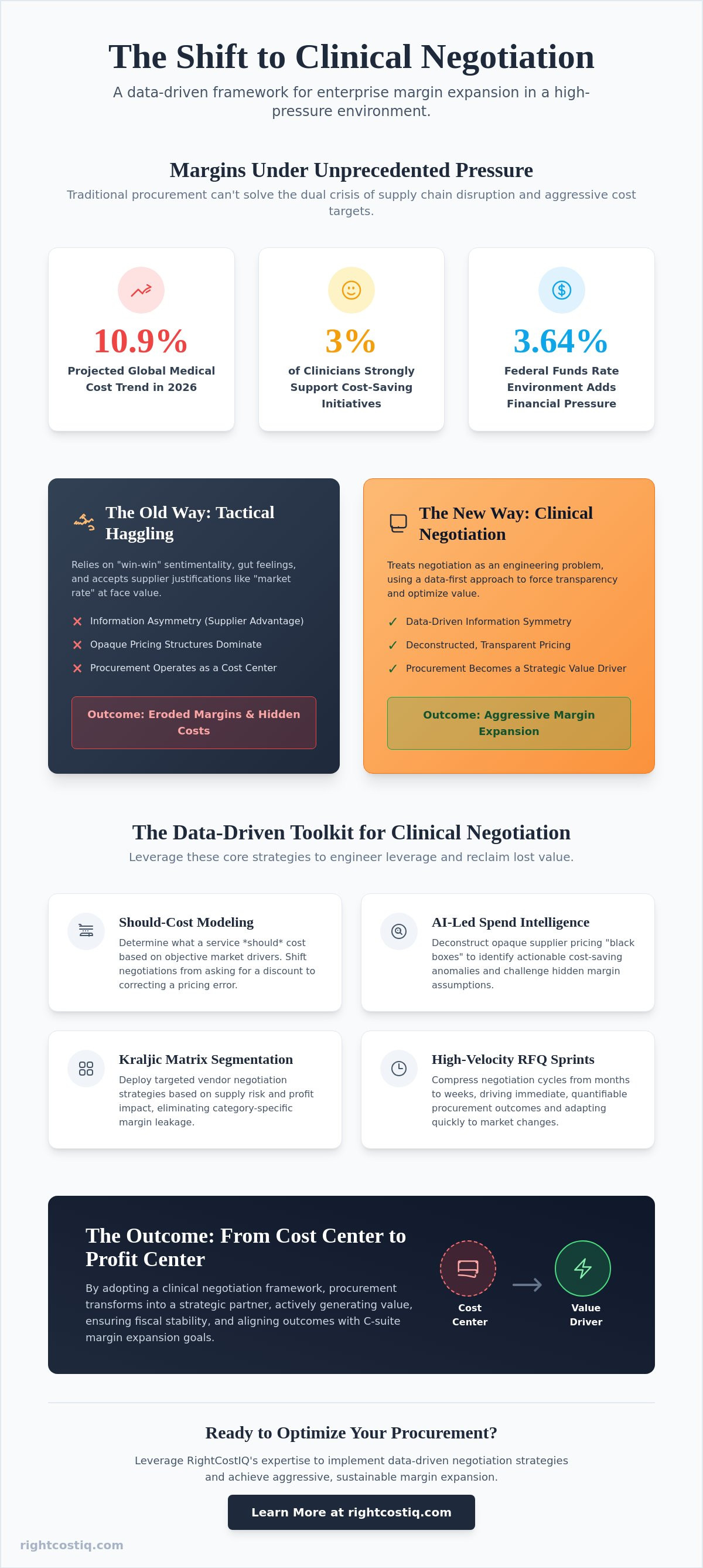
A "one-size-fits-all" negotiation strategy is a blueprint for margin leakage. Different procurement categories carry different levels of financial impact and supply risk, and your negotiation approach must reflect that reality. Applying the same aggressive, price-focused tactics to a strategic, sole-source partner as you would to a commoditized, multi-source supplier is a critical error. A segmented approach, often guided by a framework like the Kraljic Matrix, allows procurement teams to allocate their resources effectively, differentiating strategies for bottleneck, non-critical, leverage, and strategic categories to maximize value across the entire supplier portfolio.
This strategic segmentation ensures you are not over-investing time in low-value negotiations or, more dangerously, damaging a critical partnership by focusing solely on short-term cost reduction. It enables a nuanced approach where competitive tension is leveraged in high-spend commodity areas while collaborative, value-focused partnerships are nurtured for strategic, high-risk categories.
Strategic vs. Transactional Negotiation
The primary axis of segmentation is determining whether a negotiation is strategic or transactional. For a strategic supplier—one whose product or service is critical to your operations and difficult to replace—the goal may be to prioritize a long-term partnership that fosters innovation and joint value creation over immediate, aggressive cost reduction. In contrast, for high-velocity "Leverage" categories where multiple qualified suppliers exist (e.g., office supplies, standard IT hardware), the negotiation should be highly competitive and transactional, focused on driving down unit costs. For low-value, high-volume "Tail Spend," the most effective strategy is often to bypass manual negotiation entirely, managing these purchases through automated RFQ cycles and e-catalogs to minimize administrative overhead.
Risk-Adjusted Negotiation Frameworks
A sophisticated negotiation strategy allocates risk to the party best equipped to manage it. In strategic partnerships, this might involve trading a degree of exclusivity for forensic cost transparency, giving you full visibility into the supplier's cost drivers. This allows for a more collaborative approach to cost management where both parties work to remove inefficiencies. For all categories, it is critical to implement performance-linked SLAs and Key Performance Indicators (KPIs) that ensure compliance and translate negotiated terms into realized value. These frameworks transform the contract from a static document into a dynamic tool for managing risk and driving continuous improvement.
Executing the RFQ Sprint: A High-Velocity Framework for Optimization
The traditional, multi-month RFP process is often a value-destroying exercise. Extended timelines lead to stakeholder fatigue, allow competitive tension to dissipate, and delay the realization of savings. The "RFQ Sprint" is the antidote: a time-boxed, data-intensive sourcing event designed to compress the negotiation cycle from months to weeks without sacrificing analytical rigor. By front-loading the data analysis and leveraging AI-led tools, the RFQ Sprint maintains high competitive pressure through the final round of bidding, forcing suppliers to provide their best offer quickly.
This framework is built on a series of strategic, high-velocity steps that accelerate decision-making and lock in savings. Integrating real-time analytics allows for rapid evaluation of complex bids, ensuring that the final decision is based on a comprehensive, total-cost-of-ownership model rather than just the initial price point.
Preparation and Clean-Sheet Analysis
The success of an RFQ Sprint is determined before the first supplier is ever contacted. This intensive preparation phase involves three critical actions. First, all internal spend data is gathered and consolidated, while external cost benchmarks are sourced to establish a clear picture of the market. Second, a non-negotiable "Target Price" is set based on the results of a detailed should-cost model. This price becomes the anchor for the entire negotiation. Third, a data-driven BATNA (Best Alternative to a Negotiated Agreement) is developed, providing a clear, pre-approved alternative path should negotiations with the primary suppliers fail. This rigorous preparation removes ambiguity and empowers the negotiation team to act with speed and confidence.
Execution and Closing the Gap
Once the RFQ is released, the execution phase is characterized by rapid-fire negotiation rounds with a pre-qualified shortlist of top-tier suppliers. Each round is designed to "close the gap" between supplier bids and the pre-established Target Price. Market price trends are presented not as points for discussion, but as non-negotiable anchors that all bids must align with. This relentless focus on objective data prevents the conversation from devolving into subjective haggling. The final terms are then swiftly documented and executed within a professional strategic RFP management framework, ensuring that the velocity achieved during the sprint translates directly into bottom-line impact.
Optimizing Margin Expansion with RightCostIQ Negotiation Assistance
Executing this level of data-driven negotiation requires specialized expertise and powerful analytical tools. RightCostIQ provides the analytical data and professional support necessary to engineer leverage in high-stakes enterprise negotiations. Our platform and services are designed to arm your procurement team with the intelligence needed to challenge supplier pricing, mitigate risk, and secure best-in-market terms. We transform negotiation from an art into a science, ensuring your savings are not just negotiated, but fully realized and sustained.
- AI-led analytics: Our tools provide real-time forecasting for market price trending, giving you a decisive advantage in volatile commodity markets.
- Professional negotiation assistance: For high-value, complex enterprise contracts, our experts can lead or support your team to ensure optimal outcomes.
- Performance tracking: We ensure that negotiated savings translate to realized margin expansion by implementing robust systems for tracking vendor performance against contractual obligations.
Data-Driven Negotiation Support
RightCostIQ empowers your team with access to proprietary category cost benchmarking and analytics, providing an immediate, objective measure of your current pricing against the broader market. Our platform's should-cost models can be utilized in real-time to challenge supplier quotes during the negotiation process, deconstructing their pricing and exposing hidden margins. For organizations exposed to commodity volatility, our price risk management services provide the forecasting and strategic guidance needed to mitigate financial exposure and protect your bottom line.
Sustaining Savings through Performance Tracking
A successful negotiation is only the beginning. The final, critical step is ensuring that the "negotiated" savings become "realized" margin expansion. This requires diligent oversight of supplier performance and compliance. RightCostIQ offers automated vendor performance tracking services that monitor KPIs, track deliverables, and flag any deviations from the contract. This systematic oversight closes the loop on the procurement cycle, guaranteeing that the value you fought for at the negotiating table is delivered throughout the life of the agreement.
Ready to transform your procurement outcomes? Optimize your next negotiation with RightCostIQ assistance.
Frequently Asked Questions (FAQ)
What are the most effective vendor negotiation strategies for cost reduction?
The most effective strategies are data-driven and analytical. They include should-cost modeling to understand a supplier's true costs, leveraging spend intelligence to consolidate volume, benchmarking prices against the market, and using a time-boxed "RFQ Sprint" to maintain competitive tension.
How does should-cost modeling provide leverage in negotiations?
Should-cost modeling provides leverage by replacing the supplier's quoted price with an objective, data-backed "should-cost" figure. By deconstructing the price into its core components (materials, labor, overhead, profit), you can challenge inflated margins and unsubstantiated costs from a position of authority, forcing the negotiation to be based on facts, not claims.
What is the difference between tactical and strategic negotiation?
Tactical negotiation is typically short-term and price-focused, often resembling haggling. Strategic negotiation is a holistic, data-driven process that considers total cost of ownership, risk, long-term value, and supplier relationships. It aligns procurement activities directly with broader enterprise goals like margin expansion and supply chain resilience.
Can AI-led procurement tools really reduce vendor costs?
Yes. AI-led tools can analyze massive datasets to identify savings opportunities, forecast commodity price trends, and benchmark supplier quotes in real-time. This automates the analytical heavy lifting, allowing negotiation teams to make faster, more informed decisions that lead to significant cost reduction.
How do I negotiate with a sole-source supplier?
With a sole-source supplier, leverage shifts from competitive tension to information transparency. The key is to use should-cost modeling to gain a deep understanding of their cost structure. The negotiation should focus on collaborative cost-out initiatives, long-term value creation, and performance-based contracts rather than pure price pressure.
What is an RFQ Sprint and how does it drive margin expansion?
An RFQ Sprint is a compressed, high-velocity sourcing event that reduces the negotiation timeline from months to weeks. By using intensive data preparation and maintaining tight deadlines, it keeps competitive pressure on suppliers, forcing them to submit their best offers quickly and accelerating the realization of savings, which directly drives margin expansion.
How should I handle price increases due to commodity volatility?
Price increases should be validated against objective data. Use commodity price indexing to confirm that the supplier's requested increase is proportional to the actual market change in the underlying raw material. A strategic contract should already include clauses that govern how such volatility is managed, preventing suppliers from using it as an opportunity to expand their margins.
What role does vendor performance tracking play in cost reduction?
Vendor performance tracking ensures that the savings and service levels agreed upon during negotiation are actually delivered. By monitoring KPIs and enforcing SLAs, you prevent value leakage from non-compliance, service failures, or quality issues. This turns "negotiated savings" into "realized savings" on the P&L statement.


