
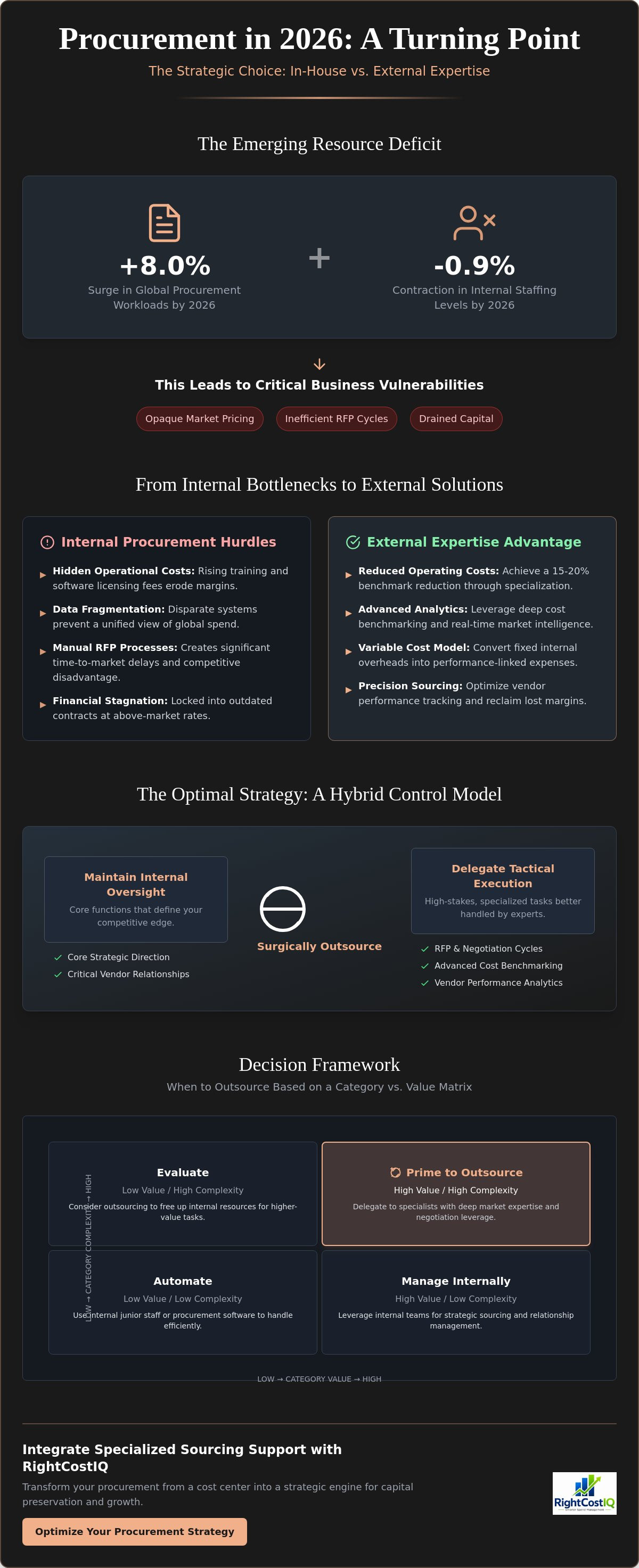
By the end of 2026, global procurement workloads will surge by 8.0% while internal staffing levels simultaneously contract by 0.9%. This resource deficit leaves high-level decision makers vulnerable to opaque market pricing and inefficient RFP cycles that drain capital without delivering results. You likely recognize that your internal team is currently overextended, making the choice between procurement consulting vs outsourcing a critical pivot for financial growth. It's an operational bottleneck that requires a surgical, data-driven solution to protect your margins.
This article provides a clinical framework to evaluate the ROI of these two distinct models. We'll dismantle the financial and operational impact of both paths to ensure your strategy aligns with the bottom line. You'll gain access to a specific decision-making matrix that prioritizes reduced operating costs and improved vendor performance. We'll analyze the transition from transactional procurement to strategic cost management, focusing on how data-backed negotiation strategies can reclaim lost margins in an increasingly complex 2026 market.
Key Takeaways
- Identify hidden operational costs within internal procurement infrastructure, including the training and software licensing burdens that erode corporate margins.
- Quantify the financial impact of procurement consulting vs outsourcing by evaluating the 15-20% operating cost reduction benchmark achievable through specialized external expertise.
- Deploy a hybrid control model that surgically outsources high-stakes execution while maintaining internal strategic oversight of critical vendor relationships.
- Utilize a clinical decision framework to determine exactly when to outsource the RFP and negotiation cycle based on a category complexity vs value matrix.
- Leverage advanced cost benchmarking and analytics to identify hidden savings and optimize vendor performance tracking through precision sourcing support.
The Strategic Calculus: Internal Infrastructure vs. Procurement Outsourcing
Global supply chain volatility in 2026 demands a level of agility that most legacy internal departments cannot sustain. Organizations face a fundamental resource allocation dilemma. They must decide whether to build expensive internal infrastructure or leverage specialized external partners. This decision between procurement consulting vs outsourcing isn't merely about headcount; it's a financial calculation of operational efficiency. Tactical execution often clogs the strategic pipeline, preventing C-suite leaders from focusing on long-term growth. To remain competitive, firms must distinguish between core strategic oversight, which should remain internal, and the heavy lifting of tactical execution, which is often better handled by external experts.
Internal procurement departments often carry invisible financial burdens that don't appear on a standard P&L. These include continuous upskilling requirements for staff to manage AI-driven tools, escalating enterprise software licensing fees, and the catastrophic cost of missed market opportunities. Procurement outsourcing offers a mechanism to convert these fixed, rising costs into variable, performance-linked expenses. It allows leadership to maintain strategic control while offloading the technical burdens that stifle innovation. Before committing to any model, a clinical procurement audit is mandatory. This audit must quantify current process latency and identify specific category leakage. Without this baseline data, any transition remains a gamble rather than a strategic maneuver.
Defining the Modern Procurement Burden
Simple purchasing has evolved into complex, multi-variable category management. Internal teams now struggle with data fragmentation, where disparate systems prevent a unified view of global spend. This lack of visibility slows decision-making speed significantly. Manual RFP processes create time-to-market delays that provide competitors with a decisive advantage. In 2026, speed is a primary driver of margin preservation. Teams that rely on outdated spreadsheets and manual vendor tracking can't compete with the real-time analytics provided by specialized partners.
The Economic Cost of Internal Stagnation
Procurement stagnation is the financial delta between market-available pricing and the higher rates locked within outdated internal contracts.
Maintaining a full-time expert for every niche category is fiscally irresponsible for mid-market and large enterprises alike. Specialized service engagement provides access to high-level negotiation leverage without the long-term liability of executive salaries and benefits. By focusing on Category Management in Procurement: A Clinical Framework for Margin Expansion (2026), firms can redirect their internal talent toward high-value strategic initiatives while leaving technical benchmarking to dedicated partners. This surgical approach ensures that every dollar spent is optimized against real-time market intelligence rather than historical internal averages.
Financial Drivers: Quantifying the ROI of External Procurement Expertise
Achieving a 15-20% reduction in operating costs is the clinical benchmark for professional procurement integration. This financial outcome remains out of reach for internal departments tethered to legacy processes and fragmented data sets. When evaluating procurement consulting vs outsourcing, the primary differentiator is the depth of external benchmarking data available to the organization. High-level decision makers utilize these metrics to transform procurement from a cost center into a primary engine for capital preservation. This methodology aligns with the strategic objectives outlined by the Federal Strategic Sourcing Initiative, which emphasizes the necessity of leveraging total spend to secure optimal market positioning.
External partners mitigate financial volatility through specialized price risk management. By identifying hidden category savings that internal audits frequently overlook, these partners provide a level of fiscal precision that protects margins during periods of supply chain instability. The integration of advanced analytics allows for a move away from anecdotal evidence toward a strictly data-driven decision framework.
Accessing Advanced Market Intelligence
Internal teams typically operate within a vacuum, lacking the cross-industry benchmarking data required to challenge unjustified supplier price increases. This information asymmetry results in significant capital leakage. Utilizing market price trending and forecasting allows organizations to predict future cost spikes and adjust their sourcing strategies accordingly. This shift from reactive buying to proactive financial strategy is the hallmark of a sophisticated procurement operation. It enables the C-suite to execute contracts based on future market trajectories rather than historical internal averages, ensuring that every dollar committed is optimized for maximum return.
Operating Cost Reduction Metrics
The primary levers for cost reduction are process automation and volume leverage. Specialized partners deploy technical analysis frameworks that accelerate the procurement lifecycle, reducing the time and resource drain associated with traditional sourcing. Increasing the percentage of "spend under management" directly correlates with improved corporate valuation and more transparent financial reporting. Precision-led RFP management ensures that competitive bidding cycles are not just faster, but more rigorous. This rigor identifies the most efficient vendors while eliminating the administrative overhead that typically bloats internal budgets. To understand how these metrics apply to your specific spend profile, consider a preliminary procurement efficiency analysis.
Financial strategy in 2026 requires more than just cost-cutting; it demands the surgical application of market intelligence to mitigate risk. External experts provide the specialized price risk management frameworks necessary to navigate volatile commodity markets. This results in a stable, predictable cost structure that supports aggressive business growth and long-term operational resilience.
The Risk-Control Paradox: Addressing Objections to Third-Party Sourcing
The primary psychological barrier to external integration is the perceived loss of control over vendor relationships. Strategic architects don't view this as a surrender of authority. Instead, it's a transition to a hybrid control model. In this framework, your internal leadership retains strategic oversight while a specialized partner manages the technical execution. This separation of duties mitigates the single-point-of-failure risk common in small internal departments. When a key procurement staffer departs, they often take years of category knowledge with them. Outsourcing ensures that your institutional intelligence remains secure and accessible through a standardized, professional infrastructure. It's a method of de-risking the organization against internal turnover.
Evaluating procurement consulting vs outsourcing requires a clinical assessment of your current visibility. If you can't track every vendor interaction in real-time, you've already lost control. Professional partners use advanced technology to bridge this gap, providing a level of transparency that manual internal processes can't match. This shift moves the procurement function from a black box to a transparent, data-driven workflow.
Mitigating Loss of Control through Technology
Specialized procurement platforms act as a centralized nervous system for your supply chain. These systems generate a digital audit trail for every RFP, negotiation, and contract amendment. This transparency ensures that third-party actions are always aligned with your corporate objectives. You retain full ownership of your data and category insights. Intellectual property isn't lost; it's codified. Real-time visibility allows high-level decision makers to intervene at any stage, ensuring that the external partner functions as a precision-tooled extension of the internal team. It's about enhancing oversight, not delegating it blindly.
Compliance and Vendor Performance Tracking
Clinical execution in 2026 demands automated vendor performance tracking to ensure strict contract adherence. External partners provide the objective distance necessary to conduct rigorous audits, effectively identifying maverick spend and tail spend leakage. These leaks often represent 20% or more of total spend, yet they remain invisible to overextended internal teams. By integrating specialized sourcing support, you enforce a standardized RFP management and compliance framework that eliminates unauthorized purchasing. This methodical approach ensures that vendor performance isn't just a subjective feeling but a quantifiable metric reported with surgical accuracy. It guarantees that the value negotiated during the RFP process is actually realized throughout the contract lifecycle.
Decision Framework: When to Outsource the RFP and Negotiation Cycle
C-suite leaders must apply a clinical evaluation to determine the optimal balance between procurement consulting vs outsourcing. This isn't a binary choice but a strategic deployment of resources across a complexity versus value matrix. High-value, high-complexity categories often require deep internal institutional knowledge. Conversely, categories characterized by high volume and low strategic impact frequently drain internal capacity without delivering a proportional return. Successful organizations identify the specific friction points where internal management becomes a fiscal liability. They then deploy external expertise to clear those bottlenecks.
Determining the break-even point for outsourcing the RFP function depends on the cost of internal resource hours versus the projected savings from specialized execution. If internal RFP cycles exceed ninety days, the opportunity cost of delayed savings often outweighs the expense of external support. Leaders should calculate the total cost per RFP, including staff salaries and software overhead, to identify where internal management fails to provide a competitive advantage.
Identifying High-Friction Categories
High-friction categories are defined by extreme price volatility or fragmented vendor landscapes. These categories require constant monitoring and real-time market intelligence that overextended internal teams cannot provide. Managing tail spend is the most logical starting point for outsourcing because it involves thousands of small-value transactions that consume disproportionate administrative resources. Strategic architects keep core direct spend expertise in-house to protect proprietary manufacturing or service processes. Indirect categories, such as facility management or IT hardware, are prime candidates for external execution where specialized market intelligence delivers immediate ROI. This surgical approach ensures internal talent focuses exclusively on the most critical strategic pillars.
Evaluating Internal vs. External Negotiation Leverage
The generalist internal buyer often lacks the granular category data needed to challenge sophisticated supplier pricing models. In contrast, an external specialist negotiator operates with cross-industry benchmarking data that exposes hidden margins. Engaging a Negotiation Coach for high-value contract renewals provides a decisive advantage by equipping your team with real-time price floors. This specialized support ensures that internal teams aren't negotiating from a position of data deficiency. Data-driven benchmarking serves as a primary lever in negotiation by replacing supplier-led narratives with verifiable market price floors. This methodical shift ensures that terms are dictated by market reality rather than historical internal averages. To quantify your internal negotiation gaps, you should access a preliminary procurement efficiency analysis.
Clinical Execution: Integrating Specialized Sourcing Support with RightCostIQ
RightCostIQ functions as a strategic architect for organizations caught in the traditional debate of procurement consulting vs outsourcing. We provide a surgical alternative to generic consulting by deploying a Precision Framework that prioritizes clinical cost benchmarking and analytics. This technology-first approach acts as a seamless extension of your internal finance team; it provides the specialized leverage required to identify hidden savings across complex spend categories. By integrating our vendor performance tracking service, organizations build a resilient supply chain anchored in quantifiable data rather than subjective vendor claims. We transform procurement from a reactive administrative function into a proactive driver of corporate valuation.
Our methodology focuses on the granular details of the procurement lifecycle, ensuring that every strategic decision is backed by real-time market intelligence. This clinical execution model eliminates the ambiguity often associated with external partnerships. It allows high-level decision makers to maintain total strategic control while offloading the technical burdens of data classification and price risk management.
The RFP Management Advantage
Streamlining the RFP lifecycle requires a departure from manual, resource-intensive workflows that drain internal capacity. RightCostIQ's methodology utilizes market price trending and forecasting to time RFP launches with surgical accuracy; this ensures your organization captures maximum savings during favorable market cycles. By offloading the technical execution of the RFP process, internal stakeholders experience a significant reduction in administrative friction. You maintain strategic oversight while our platform handles the granular data analysis and vendor communication. Accessing a preliminary procurement efficiency analysis allows you to visualize the immediate impact of this optimized workflow on your operating margins.
Negotiation Coaching and Price Risk Mitigation
Our Negotiation Assistance service represents a surgical strike on contract margins. We replace anecdotal negotiation tactics with rigorous, data-backed models that force vendors to justify every price point. Through Should-Cost modeling, we validate vendor pricing against real-time market data; this eliminates the information asymmetry that often favors the supplier. This clinical approach to price risk management ensures that your organization is protected from unjustified cost escalations even in volatile markets. We provide the technical upskilling and data-driven benchmarking your team needs to transform every contract renewal into a margin-expanding event. Optimize your procurement outcomes with RightCostIQ’s precision frameworks.
Strategic Alignment for Margin Preservation
The transition from a cost-heavy internal infrastructure to a high-efficiency sourcing model requires a surgical focus on data accuracy and category specialization. Organizations that successfully navigate the choice between procurement consulting vs outsourcing recognize that 2026 market volatility demands more than generalist oversight. By offloading tactical execution and utilizing advanced cost benchmarking, you transform procurement into a primary driver of corporate valuation. This strategic shift ensures that your internal talent remains focused on high-value initiatives while external experts handle the technical complexities of price risk management.
RightCostIQ, founded in 2023 by experts in healthcare financial analytics, provides the specialized frameworks necessary to secure a competitive advantage. We offer data-driven negotiation assistance for high-stakes enterprise contracts and precision market forecasting that protects your bottom line. It's time to replace anecdotal sourcing with clinical execution. Execute your next RFP with clinical precision; explore RightCostIQ solutions. Your path to optimized operational efficiency starts with a commitment to data-backed decision making.
Frequently Asked Questions
What are the primary benefits of outsourcing a procurement function?
The primary benefits include immediate access to specialized market intelligence and significant operational cost reduction. Outsourcing converts fixed internal overhead into variable, performance-linked expenses. This model allows organizations to scale procurement capabilities rapidly without the long-term liability of executive headcount or expensive software licensing fees.
Is it better to outsource direct or indirect spend categories?
Organizations should prioritize outsourcing indirect spend categories while retaining direct spend expertise in-house. Indirect categories often involve fragmented vendor landscapes that drain internal administrative resources. Keeping direct spend internal protects proprietary manufacturing processes and core strategic relationships, whereas indirect categories benefit from the volume leverage and benchmarking data of an external partner.
How does procurement outsourcing impact existing vendor relationships?
Outsourcing professionalizes vendor relationships by replacing anecdotal interactions with data-driven performance tracking. This shift ensures that communication remains focused on contract adherence and quantifiable deliverables. It eliminates the emotional bias that often leads to unjustified price increases, ensuring that vendor interactions are strictly business-oriented and results-focused.
Can we outsource just the RFP management portion of procurement?
Yes, you can surgically outsource the RFP management cycle to optimize specific sourcing events. This targeted approach is ideal for high-friction categories where internal teams lack the technical benchmarking data to secure optimal terms. It provides the precision of external expertise for high-stakes events without requiring a total departmental overhaul.
What is the typical ROI for engaging a procurement negotiation assistant?
Engaging a procurement negotiation assistant typically delivers a return that far exceeds the service cost through immediate contract savings and margin expansion. By utilizing cross-industry benchmarking and price risk management, these specialists identify savings opportunities that internal generalists frequently miss. The primary ROI driver is the elimination of information asymmetry during high-stakes renewals.
How does an external partner handle vendor performance and compliance?
External partners utilize automated tracking systems to conduct clinical audits of vendor performance against agreed-upon KPIs. These systems identify maverick spend and service failures in real-time, enforcing strict contract compliance across the supply chain. This objective distance ensures that vendor accountability isn't compromised by internal corporate politics or resource constraints.
What technologies are essential for a successful procurement outsourcing partnership?
A successful partnership requires integrated platforms for spend classification, should-cost analysis, and real-time market price trending. These tools, often enhanced by the intelligent automation and Agentic AI capabilities of IntellifyAi, bridge the gap between traditional business functions and digital innovation. They ensure that every procurement decision is backed by a verifiable digital audit trail and sophisticated data models.
How do we maintain supply chain visibility when using a third-party partner?
Visibility is maintained through centralized procurement dashboards that provide a real-time view of all third-party actions and spend data. When evaluating procurement consulting vs outsourcing, look for partners that offer a digital audit trail for every negotiation and contract amendment. This transparency ensures your internal leadership remains the strategic architect of the supply chain at all times.


