
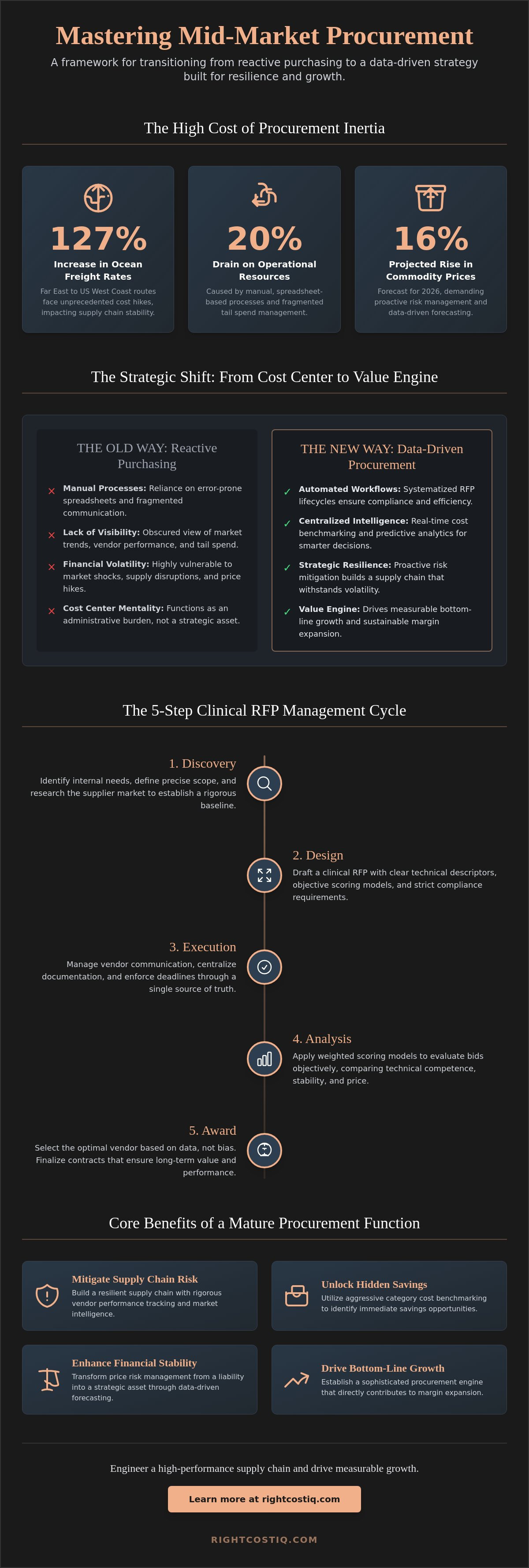
With commodity prices projected to rise by 16% in 2026 and ocean freight rates from the Far East to the US West Coast already up by 127%, is your procurement strategy built for resilience or mere survival? Most mid-market leaders recognize that manual, spreadsheet-based RFP processes and fragmented tail spend management currently drain 20% of their operational resources. You've likely seen how a lack of visibility into market price trends causes unnecessary financial volatility during periods of global instability. This article provides the clinical framework required to master procurement best practices for mid-sized companies, enabling a strategic transition from reactive purchasing to data-driven excellence. You'll learn to implement a repeatable RFP architecture, reduce category costs through aggressive benchmarking, and mitigate supply chain risk via rigorous vendor performance tracking. We'll move beyond basic administrative functions to establish a sophisticated procurement engine that drives measurable bottom-line growth and operational efficiency.
Key Takeaways
- Identify the technical descriptors of a mature procurement function to successfully navigate the mid-market inflection point.
- Implement a 5-step clinical RFP management cycle to eliminate manual spreadsheet errors and ensure rigorous vendor compliance.
- Utilize category cost benchmarking and analytics to uncover immediate savings opportunities that internal spend analysis often overlooks.
- Apply procurement best practices for mid-sized companies to transform price risk management into a strategic asset for financial stability.
- Integrate market price trending and vendor performance tracking to mitigate supply chain volatility and secure long-term contract excellence.
Navigating the Mid-Market Procurement Inflection Point
The mid-market inflection point represents a critical pivot where operational scale outstrips the capabilities of ad-hoc, reactive purchasing. Organizations reach this stage when decentralized buying behaviors begin to compromise enterprise-level financial growth metrics. At this junction, a firm must evolve toward a mature model defined by technical descriptors like automated RFP lifecycles, real-time category cost benchmarking, and integrated vendor performance metrics. Relying on fragmented, manual spreadsheet-based systems at this growth stage isn't just inefficient; it's a financial liability that obscures visibility into market price trends and creates systemic vulnerability. Transitioning to procurement best practices for mid-sized companies requires a shift from decentralized buying to a centralized, data-driven framework that treats every dollar of spend as a strategic investment. This evolution ensures that procurement functions as a value center rather than a cost center.
The Cost of Procurement Inertia
Inertia in procurement processes leads to significant financial leakage, particularly through unmanaged tail spend and inconsistent vendor compliance. When procurement functions remain reactive, organizations often lose up to 20% of their resource efficiency to sub-optimal sourcing and administrative bloat. This transition demands a "strategic architect" persona. This leader doesn't just manage vendors; they engineer high-performance supply chains that align with broader corporate objectives. By adhering to core procurement principles, these architects eliminate the volatility inherent in manual oversight. They replace guesswork with precision-driven risk management that directly impacts EBITDA. The cost of doing nothing is a compounding loss of competitive advantage.
Defining Success in 2026: Beyond Cost Savings
In 2026, success is measured by margin expansion and supply chain resilience rather than simple price reduction. With overall commodity prices forecasted to rise by 16% and energy costs projected to climb by 24% this year, cost-cutting alone is insufficient. Clinical execution in sourcing cycles involves the integration of market intelligence into every negotiation and contract lifecycle. Organizations must move toward a baseline of operational efficiency where data-driven forecasting mitigates the impact of global inflation and shipping disruptions. This sophisticated approach ensures that procurement best practices for mid-sized companies serve as a primary driver for long-term financial stability. It's about building a procurement engine that can withstand external shocks while maintaining internal profitability targets. Precision in execution is the only viable path forward in a volatile global economy.
Systematizing the RFP Lifecycle for Strategic Sourcing
Systematizing the RFP lifecycle transforms procurement from an administrative burden into a high-precision financial instrument. The transition from reactive buying requires a 5-step clinical RFP management cycle: Discovery, Design, Execution, Analysis, and Award. This structured approach eliminates the ambiguity that often results in sub-optimal vendor selection. By integrating procurement best practices for mid-sized companies, organizations can replace manual guesswork with a repeatable framework that ensures every sourcing event aligns with enterprise growth targets. Technical descriptors are essential during this process; they act as the rigid specifications that force vendors to provide compliant, comparable bids. Without these precision-engineered requirements, mid-market firms remain vulnerable to "scope creep" and hidden cost escalations.
Precision in RFP Design and Execution
Drafting an RFP that minimizes financial volatility requires a focus on vendor accountability and objective scoring. Effective RFP Management streamlines complex sourcing by centralizing communication and documentation in a single source of truth. Organizations should utilize scoring models that weight technical competence, financial stability, and price risk management equally. This clinical approach removes emotional bias from the selection process, ensuring that the final award is based on data rather than brand familiarity. High-performing teams use these models to identify vendors capable of maintaining performance even when global supply chain volatility indices show significant strain.
Negotiation Strategies for High-Stakes Procurement
Negotiation is not a soft skill; it's a data-driven exercise in margin protection. Professional Negotiation Coaching empowers procurement leaders to anchor discussions in objective reality rather than vendor-led narratives. By utilizing Should-Cost models, teams can dissect price quotes into their component parts, such as raw materials, labor, and overhead. This level of granularity is vital when commodity prices are forecasted to rise by 16% in 2026. For a deeper analysis of how technology enhances these cycles, refer to our framework on RFP Management: Strategic Frameworks for AI-Led Procurement Optimization. These advanced tactics ensure that mid-market firms maintain a competitive edge during high-stakes contract renewals.
Operational excellence extends beyond the signature. Integrating vendor performance tracking into the post-award phase ensures that the value captured during the RFP process isn't lost to poor execution. Tracking delivery speed, quality compliance, and price adherence creates a feedback loop that informs future sourcing events. It's time to stop guessing and start measuring. You can begin optimizing your sourcing cycles today with a free procurement diagnostic to identify immediate areas for improvement.
Leveraging Procurement Analytics and Cost Benchmarking
Strategic procurement requires a clinical transition from administrative reporting to advanced predictive analytics. While internal spend analysis provides a historical view of capital allocation, it lacks the context of external market price trending. True cost optimization occurs when organizations identify the delta between current contract rates and real-time market indices. Implementing procurement best practices for mid-sized companies involves using category cost benchmarking to pinpoint immediate savings opportunities that remain hidden within legacy agreements. By integrating these analytics into C-suite reporting, procurement leaders transform into strategic partners who provide the visibility needed for executive-level margin protection.
Identifying 'Should-Cost' gaps is the primary mechanism for reclaiming lost margin. This process involves a granular deconstruction of vendor pricing to ensure that mid-market firms aren't overpaying for overhead or inefficient supply chain routes. In an environment where global inflation remains a persistent threat, maintaining this level of visibility is a baseline requirement for financial stability. It's about moving beyond simple expense management toward a proprietary analytics framework that treats every category as a lever for enterprise growth.
Category Management: A Clinical Framework
Effective category management relies on a data-driven sourcing strategy that segments spend by risk and value. This approach ensures that high-impact categories receive the precision they require while low-value areas don't consume disproportionate resources. For a comprehensive guide on this methodology, consult our framework on Category Management in Procurement: A Clinical Framework for Margin Expansion (2026). A frequent challenge for growing firms is managing Tail Spend, which often accounts for 20% of resource drain. Automating the management of these fragmented transactions allows the procurement team to focus on high-stakes negotiations and strategic vendor development.
Benchmarking Against Market Realities
Success in volatile markets depends on an organization's ability to benchmark against shifting realities rather than historical averages. Utilizing a rigorous Should-Cost Analysis allows procurement teams to anchor negotiations in objective data. This is particularly critical when overall commodity prices are forecasted to rise by 16% throughout 2026. By leveraging market intelligence to forecast pricing trends, mid-market firms can front-load purchases or adjust safety stock levels before price hikes take effect. Data-driven sourcing isn't just about finding the lowest price; it's about maintaining a competitive advantage through superior market awareness and clinical execution.
Mitigating Financial Volatility via Market Price Forecasting
Mitigating financial volatility requires a clinical approach to price risk management, positioning it as a core strategic asset for mid-market stability. Market price trending serves as the analytical foundation for contract lifecycle management, ensuring that agreements remain grounded in economic reality rather than vendor-driven speculation. By integrating these procurement best practices for mid-sized companies, organizations can leverage forecasting models to neutralize the impact of supply chain disruptions before they reach the balance sheet. In an environment where Far East to US West Coast ocean freight rates have reached USD 4,258 per FEU, market intelligence becomes a primary lever during mid-contract renegotiations. It allows procurement leaders to challenge unsubstantiated price hikes with precision and authority.
The transition from defensive purchasing to offensive capital allocation depends on the accuracy of your forecasting engine. Strategic sourcing is no longer about finding the lowest static price; it's about understanding the trajectory of the market. When procurement teams possess real-time data on Brent crude oil or copper price projections, they gain the leverage necessary to secure favorable terms even in inflationary periods. This level of market awareness is what separates mature mid-market firms from those still trapped in reactive, high-volatility buying cycles.
Price Risk Management Architectures
Building a proactive price risk tracking system involves the continuous ingestion of global commodity indices and shipping data. Market price trending informs strategic decisions, such as front-loading purchases when energy prices are projected to increase by 24% as forecasted for 2026. Price Risk Management is the systematic identification and mitigation of cost volatility using predictive analytics. This architecture allows firms to lock in rates or diversify suppliers before market shifts compromise margins. It transforms the procurement department into a sophisticated risk management unit that protects enterprise value.
Supply Chain Resilience through Forecasting
Supply chain resilience is achieved at the intersection of market forecasting and vendor performance tracking. Data-driven models allow procurement teams to anticipate supplier capacity constraints or potential insolvency by monitoring lead times and price fluctuations relative to market benchmarks. Automated tracking architectures are no longer optional. They are the only way to maintain compliance in a landscape where the GEP Global Supply Chain Volatility Index indicates significant strain. Mid-market firms must adopt these frameworks to ensure their sourcing strategies are as resilient as they are cost-effective. Audit your current risk exposure with a free procurement diagnostic to identify systemic vulnerabilities in your supply chain.
Architecting a Data-Driven Procurement Infrastructure
Architecting a modern procurement infrastructure requires a clinical departure from traditional expense management. While simple expense management focuses on the reactive auditing of historical spend, strategic procurement optimization involves the proactive engineering of future capital allocation. A tech-enabled procurement department must integrate real-time benchmarking, automated RFP lifecycles, and predictive risk modeling into a single, unified architecture. Implementing procurement best practices for mid-sized companies at this level ensures that data isn't just collected but is actively utilized to drive margin expansion. This transition converts the procurement function from an administrative cost center into a high-performance value generator that supports enterprise-level growth objectives.
The core of this infrastructure is the integration of advanced technology into traditional business functions. Mid-market firms often struggle with decentralized data silos that obscure the true cost of goods and services. A data-driven framework eliminates these blind spots by providing a single source of truth for vendor performance and market price trends. This structural clarity is essential for maintaining competitive advantage in a global landscape characterized by persistent supply chain disruptions and shifting trade regulations. Precision in infrastructure design is the prerequisite for precision in sourcing execution.
The ROI of Strategic Procurement
The financial impact of professional RFP management and negotiation assistance is quantified through the expansion of Spend Under Management (SUM). By centralizing procurement activities within RightCostIQ's platform, mid-market organizations can achieve a level of scalability previously reserved for enterprise-level entities. This professionalized approach reduces tail spend leakage and ensures that every contract is anchored in current market realities. The resulting ROI isn't just found in direct cost savings; it's reflected in increased operational efficiency, reduced risk exposure, and the strategic alignment of the supply chain with corporate financial targets.
Implementation Roadmap for 2026
Executing these best practices within the next fiscal year requires a methodical implementation roadmap. C-suite leaders should prioritize the following immediate actions to initiate procurement optimization:
- Conduct a clinical audit of current vendor compliance and contract adherence.
- Migrate manual spreadsheet-based RFP processes to an automated management framework.
- Integrate external market price trending data into the category management cycle.
- Establish objective vendor performance tracking metrics to mitigate supply chain volatility.
Selecting partners who offer clinical precision and deep market expertise is critical for a successful transition. High-stakes procurement demands a partner that functions as a strategic architect rather than a generic consultant. By adopting these frameworks, mid-market firms can navigate the complexities of the 2026 economic landscape with confidence and authority. Optimize your procurement outcomes with RightCostIQ’s precision frameworks.
Engineering a Resilient Procurement Future
Mastering the mid-market inflection point demands a clinical shift toward technical precision and data-driven accountability. By systematizing the RFP lifecycle and leveraging advanced market price forecasting, organizations effectively neutralize the volatility inherent in modern global supply chains. Implementing procurement best practices for mid-sized companies ensures that your sourcing strategy functions as a high-performance engine for consistent financial growth. It's no longer enough to manage expenses; you must architect a procurement infrastructure that prioritizes margin expansion and supply chain resilience.
RightCostIQ, founded by industry experts in 2023, specializes in healthcare financial analytics and utilizes proprietary 'Should-Cost' modeling technology to deliver clinical execution in complex sourcing events. It's time to replace manual administrative habits with a sophisticated risk management architecture that protects your bottom line. Optimize your sourcing outcomes with RightCostIQ's precision RFP management and negotiation frameworks. Your path to procurement excellence starts with a commitment to data-driven optimization and strategic vendor alignment. Secure your competitive advantage today.
Frequently Asked Questions
What are the primary procurement challenges for mid-sized companies?
Mid-sized firms typically face fragmented data silos, manual spreadsheet-based RFP processes, and a lack of real-time visibility into market price trends. These inefficiencies lead to sub-optimal vendor selection and significant financial leakage, particularly through unmanaged tail spend. The transition from reactive buying to strategic sourcing remains the most critical hurdle for organizations scaling their operations.
How does RFP management improve sourcing outcomes?
Systematic RFP management replaces administrative guesswork with clinical execution and objective scoring models. By utilizing technical descriptors and structured vendor requirements, organizations ensure technical compliance and maximize competitive tension during the bidding process. This precision reduces the risk of cost escalations and ensures that final awards align with enterprise-level financial growth targets.
Why is category cost benchmarking essential for mid-market firms?
Category cost benchmarking identifies the delta between internal contract rates and real-time market indices to uncover immediate savings opportunities. It provides the data-driven validation needed to ensure vendors aren't overcharging for overhead or inefficient supply chain routes. This process is vital for protecting margins in a landscape where global commodity prices are forecasted to rise by 16% throughout 2026.
What is the difference between procurement and expense management?
Procurement is a proactive, strategic function focused on optimizing future capital allocation through data-driven sourcing and contract lifecycle management. Expense management is a reactive process centered on auditing historical spend to ensure policy compliance. While expense management tracks what has already occurred, procurement best practices for mid-sized companies focus on engineering value and mitigating future financial risk.
How can mid-sized companies manage tail spend effectively?
Effective tail spend management involves the automation of high-volume, low-value transactions to reclaim up to 20% of operational resources. By implementing automated tracking architectures, procurement teams can consolidate fragmented spend and eliminate the administrative bloat associated with minor purchases. This allows the department to focus on high-stakes negotiations and strategic vendor development.
What role does market price trending play in negotiation?
Market price trending provides an objective data anchor that shifts the power dynamic from the vendor to the buyer during negotiations. Accessing real-time market intelligence allows procurement leaders to challenge unsubstantiated price hikes with clinical precision. For example, knowing that energy prices are projected to rise by 24% in 2026 allows for proactive contract adjustments before market volatility impacts the balance sheet.
How do I measure the ROI of procurement best practices?
ROI is measured through the expansion of Spend Under Management (SUM) and the measurable reduction in the total cost of ownership (TCO) across key categories. Tracking realized savings against market benchmarks and monitoring vendor performance scores provides a clinical view of procurement's impact on EBITDA. These metrics validate the transition of the procurement department from a cost center to a value-generating strategic partner.
What is 'Spend Under Management' and why does it matter to the C-suite?
Spend Under Management (SUM) refers to the percentage of total organizational spend that is actively managed through strategic procurement frameworks. It is a critical KPI for the C-suite because higher SUM correlates directly with improved financial visibility and reduced operational risk. High SUM ensures that procurement best practices for mid-sized companies are being applied consistently to drive enterprise-level profitability and supply chain resilience.


