
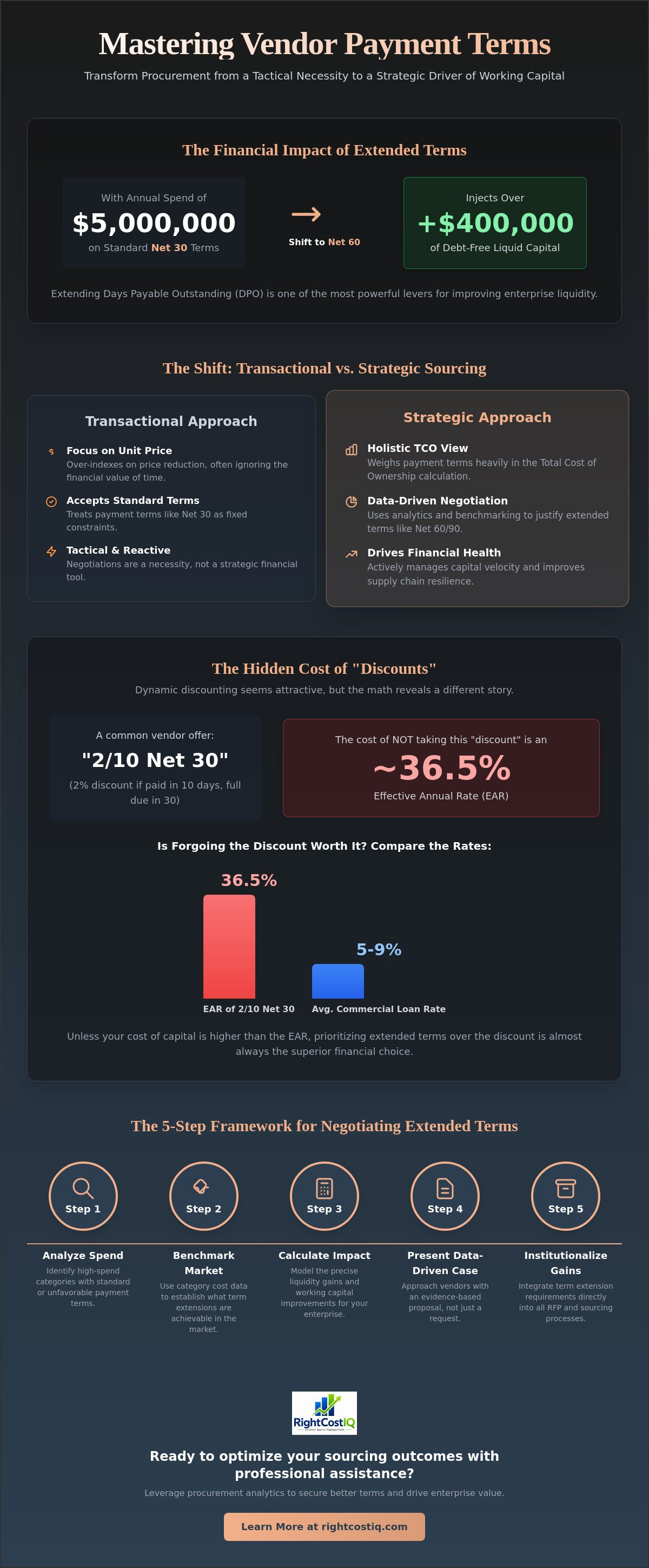
Did you know that shifting a $5 million annual spend from Net 30 to Net 60 terms injects over $400,000 of liquid capital directly back into your operations without a single cent of debt? Most procurement leaders accept standard industry terms as fixed constraints, yet mastering how to negotiate payment terms with vendors is the primary lever for neutralizing cash flow volatility and eliminating liquidity bottlenecks. You likely recognize that supplier resistance isn't just a negotiation hurdle; it's a symptom of insufficient market intelligence and misaligned financial incentives.
This article provides a clinical framework to maximize enterprise liquidity and stabilize your cash conversion cycle through data-driven payment structures. You'll master a repeatable, evidence-based methodology that utilizes category benchmarking and cost analytics to secure extended cycles like Net 60 or Net 90. By the end of this guide, you'll be equipped to transform vendor negotiations from a tactical necessity into a strategic driver of working capital efficiency.
Key Takeaways
- Understand the correlation between Days Payable Outstanding (DPO) and enterprise liquidity to transform payment cycles into a strategic growth lever.
- Master a clinical framework on how to negotiate payment terms with vendors to secure extended cycles and optimize working capital metrics.
- Deploy procurement category cost benchmarking and analytics to provide the data-driven justification necessary for neutralizing supplier resistance.
- Evaluate the technical mechanics of dynamic discounting and extended Net cycles to architect optimal payment structures for specific categories.
- Institutionalize liquidity gains by integrating term extension requirements directly into the RFP management and initial sourcing stages.
The Strategic Importance of Vendor Payment Terms in Modern Procurement
In high-performance procurement, payment terms function as sophisticated financial instruments rather than administrative afterthoughts. Enterprise valuation often hinges on liquidity metrics, specifically Days Payable Outstanding (DPO). By extending the window between receipt of goods and cash outflow, organizations effectively secure interest-free financing from their supply base. This strategic delay preserves cash for high-yield internal investments, R&D, or debt reduction, directly impacting the bottom line. Understanding how to negotiate payment terms with vendors is therefore a core competency for any strategic architect of procurement.
The current economic environment makes this optimization urgent. As of June 2026, average commercial loan interest rates remain between 5.46% and 8.75%. When a business pays an invoice early without a corresponding discount, it incurs a hidden cost equal to its weighted average cost of capital (WACC). Strategic procurement leaders treat these terms with the same clinical precision as unit pricing, recognizing that liquidity is a primary driver of supply chain resilience during market volatility. It's not just about paying bills; it's about managing the velocity of capital.
Defining the Economic Impact on Working Capital
The primary benefit of optimized payment cycles is the creation of 'float.' When an organization transitions from standard Net D payment terms like Net 30 to more aggressive Net 60 or Net 90 cycles, it significantly compresses the Cash Conversion Cycle (CCC). This metric tracks the time it takes for a dollar spent on inventory to return as revenue. Every day added to DPO represents capital that remains on the balance sheet. Conversely, paying vendors early without a dynamic discount represents an opportunity cost, as that capital could have earned a return elsewhere or reduced the need for expensive revolving credit lines.
The Shift from Transactional to Strategic Sourcing
Traditional procurement often over-indexes on unit price reduction, frequently overlooking the financial value of time. Strategic sourcing requires a holistic view where payment terms are weighted heavily in the total cost of ownership (TCO) calculation. In high-value contracts, a 5% price reduction might be less valuable than a 60-day term extension, depending on the firm's liquidity needs and cost of capital. Modern leaders utilize advanced procurement analytics to identify these term-extension opportunities across their entire spend portfolio. This data-driven approach allows for precise positioning during negotiations, ensuring that payment frameworks align with broader corporate financial goals. Mastering how to negotiate payment terms with vendors involves moving past transactional interactions and toward a model where procurement acts as a primary driver of enterprise financial health.
The Mechanics of Payment Terms: Deciphering the Options
Standard Net cycles constitute the foundation of commercial credit. While Net 30 remains the North American baseline for approximately 55-65% of B2B invoices, enterprise-level procurement often targets Net 60 or Net 90 to maximize liquidity. Moving beyond these defaults requires a deep understanding of how to negotiate payment terms with vendors using structured economic arguments. Prox (Proximo) or End-of-Month (EOM) terms further refine this by aligning payments with specific accounting periods, reducing administrative overhead and stabilizing cash outflow patterns.
Dynamic discounting offers an alternative incentive structure. A '2/10 Net 30' term allows a 2% discount if paid within ten days; otherwise, the full balance is due in thirty. From a clinical perspective, this represents a 36.5% effective annual interest rate. Unless your organization's cost of capital exceeds this threshold, prioritizing extended terms is often the superior strategic choice. Utilizing a three-step negotiation process helps procurement teams articulate these trade-offs to vendors who may prefer immediate cash flow over margin preservation.
Traditional Net Terms vs. Incentive-Based Structures
When evaluating incentive-based structures, procurement must calculate the Effective Annual Rate (EAR). If a vendor offers 1/15 Net 45, the cost of forgoing that discount is roughly 12.2%. In an environment where average commercial loan rates hover between 5.46% and 8.75%, taking the discount is mathematically sound. However, if liquidity is the priority, negotiating for Net 60 or Net 90 without discounts preserves the 'float' discussed in the previous section. Supply chain finance programs can bridge this gap, providing smaller vendors with early payment via third-party lenders while the buyer maintains extended cycles.
Advanced Payment Architectures for Enterprise Procurement
Enterprise-scale operations require automated, consolidated billing architectures to maintain efficiency. Fragmented payment cycles create high administrative friction and increase the risk of late fees. Integrating automated payment triggers within sophisticated RFP management systems ensures that negotiated terms are institutionalized from the contract's inception. For custom manufacturing or high-risk capital expenditures, milestone-based payments replace recurring cycles, linking cash outflow to verified performance hurdles. To identify specific optimization gaps in your current vendor contracts, you can evaluate your procurement data for immediate liquidity opportunities.
Leveraging Procurement Analytics as a Negotiation Lever
Successful negotiation requires more than persuasive rhetoric; it demands the deployment of clinical data to dismantle supplier objections. While basic research identifies a competitor’s name, sophisticated procurement analytics uncover the specific financial gaps between current terms and market standards. Mastering how to negotiate payment terms with vendors necessitates a shift toward evidence-based positioning where every demand is backed by category-specific intelligence. This data-driven approach transforms procurement from a cost center into a strategic architect of enterprise liquidity.
The primary weapon in this transition is the 'Should-Cost' model. By dissecting a vendor's cost structure, procurement can identify where extended terms are mathematically feasible for the supplier without compromising their operational stability. When procurement teams integrate advanced payment negotiation strategies with real-time performance metrics, they create a position of unassailable authority. This ensures that payment frameworks are not dictated by vendor defaults but are engineered to meet specific corporate financial targets.
Market Intelligence and Category Benchmarking
Accessing industry-specific data is critical for establishing what constitutes a 'standard' term within a specific category. For instance, while SaaS providers typically push for Net 30, the manufacturing sector frequently operates on Net 60 or Net 90 cycles. Utilizing cost benchmarking allows procurement to challenge non-standard vendor demands with clinical precision. If a Tier 1 supplier demands Net 15 despite a category benchmark of Net 45, the discrepancy becomes a primary negotiation point. Benchmarking terms across similar vendor tiers ensures that your organization isn't disproportionately funding a supplier's working capital at the expense of your own liquidity.
Data-Driven Justification for Term Extensions
Internal volume growth and vendor performance data serve as powerful trade-offs for extended payment cycles. High-performing vendors with low liquidity risk are often more amenable to term extensions when presented with long-term contract security or increased spend allocation. Conversely, a rigorous tail spend analysis often reveals that a significant portion of the supply base operates on fragmented, sub-optimal terms. Identifying these outliers allows for mass term consolidation, which reduces administrative friction and immediately improves Days Payable Outstanding (DPO). By quantifying these opportunities through analytics, procurement leaders can provide the CFO with a clear roadmap for improved enterprise valuation and cash flow optimization.
The 5-Step Clinical Framework for Negotiating Extended Terms
Negotiation success is a product of architectural preparation rather than situational charisma. To execute a superior payment strategy, procurement must follow a structured, five-step clinical framework. This methodology ensures that liquidity goals are met without damaging critical supplier relationships or incurring hidden cost premiums. Understanding how to negotiate payment terms with vendors requires moving beyond simple requests and toward a data-backed business case that aligns with the vendor's own financial incentives.
- Preparation: Conduct a comprehensive audit of historical spend and existing payment cycles. Use category benchmarking to identify where your current DPO lags behind industry standards.
- Positioning: Introduce payment expectations at the earliest possible stage of the sourcing lifecycle. Terms should never be a post-award discussion; they must be a fundamental selection criterion.
- Incentivization: Identify non-monetary levers such as volume guarantees, multi-year contract stability, or preferred vendor status that provide value to the supplier in exchange for extended cycles.
- Objection Handling: Anticipate and neutralize vendor concerns regarding cost of capital or cash flow. Use market data to prove that Net 60 or Net 90 is a category standard, not an unreasonable demand.
- Codification: Finalize terms in the Master Service Agreement (MSA) and ensure they are mirrored in your ERP system to prevent administrative drift or unauthorized early payments.
Integrating Terms into the RFP Lifecycle
The most effective way to secure favorable terms is to institutionalize them within the RFP management process. By setting mandatory minimum payment terms in the initial document, you filter for vendors capable of supporting your enterprise liquidity requirements. Weight these terms heavily in your vendor scoring matrix, treating payment flexibility with the same strategic importance as technical capability or unit price. If you encounter sophisticated pushback from Tier 1 suppliers during the bidding process, utilizing professional negotiation assistance provides the technical expertise needed to maintain your position without stalling the sourcing timeline.
Overcoming Supplier Resistance and Objections
Supplier resistance often stems from perceived cash flow risk. Address these concerns by highlighting your organization's superior credit rating and payment history, which reduces the vendor's risk profile. If a vendor remains recalcitrant, deploy a 'Gradual Extension' strategy. This involves moving from Net 30 to Net 45 in the first contract year, then transitioning to Net 60 in the second year. This phased approach demonstrates how to negotiate payment terms with vendors while maintaining long-term supply chain resilience. To benchmark your current vendor terms against 2026 industry standards, access our procurement liquidity diagnostic for immediate actionable insights.
Optimizing Sourcing Outcomes with Professional Assistance
Manual negotiation frameworks often collapse under the weight of enterprise complexity. Relying on anecdotal experience or outdated spreadsheets leaves significant liquidity on the table. In a high-stakes corporate environment, the ability to execute precise financial strategies depends on data density. Professional assistance provides the necessary architecture to transition from defensive bargaining to proactive financial engineering. Mastering how to negotiate payment terms with vendors at scale requires a systemic approach that integrates market intelligence with real-time analytics.
The ROI of professionalized negotiation strategy is measurable through immediate working capital improvements. By leveraging specialized negotiation assistance, organizations gain access to granular benchmarking data that justifies aggressive term extensions. This shift eliminates the guesswork from the procurement cycle. It ensures that every contract is optimized for both unit price and liquidity, maximizing the enterprise's total financial performance. High-level decision-makers recognize that strategic sourcing is an expert-led function, not a clerical one.
The Role of Technology in Negotiation Execution
Advanced data platforms act as a clinical multiplier for procurement teams. Automating vendor performance tracking ensures that leverage is maintained throughout the contract lifecycle, not just during the initial award. Utilizing RightCostIQ's negotiation coach allows procurement leaders to simulate outcomes and refine their positioning for high-stakes contracts. This technology also enables teams to forecast the impact of negotiated terms on future price risk, providing a holistic view of supply chain stability. Data-driven execution ensures that negotiated gains are institutionalized and protected from administrative drift.
Transforming Procurement into a Profit Center
Modern procurement must move beyond simple cost-cutting to become a primary driver of strategic value creation. A disciplined negotiation framework does more than just extend payment cycles; it improves enterprise valuation by optimizing the cash conversion cycle. This transformation requires a commitment to technical upskilling and the integration of sophisticated sourcing tools. The long-term benefits include enhanced liquidity, reduced financial risk, and a more resilient supply base. Organizations ready to modernize their infrastructure should schedule a consultation for RFP management and negotiation assistance to begin institutionalizing these clinical frameworks. Understanding how to negotiate payment terms with vendors is the first step toward redefining procurement's role in the corporate hierarchy.
Institutionalizing Enterprise Liquidity Through Strategic Frameworks
The transition from tactical bill-paying to strategic working capital management is a prerequisite for superior enterprise valuation. By deploying clinical RFP management frameworks and specialized procurement category cost benchmarking, organizations neutralize cash flow volatility and secure interest-free internal financing. Mastering how to negotiate payment terms with vendors ensures that your procurement function operates as a primary engine for working capital optimization.
Rigorous analytical positioning and data-driven price risk management dismantle supplier resistance; they transform traditional vendor relationships into strategic financial partnerships that prioritize liquidity. High-performance sourcing requires the integration of advanced technology with expert-led negotiation strategy to maintain a competitive advantage in a volatile market. Maintaining the status quo in payment cycles represents an unacceptable opportunity cost for any modern organization.
Optimize your next vendor negotiation with RightCostIQ's expert assistance and begin modernizing your procurement infrastructure today. Your organization's liquidity is too valuable to leave to chance; it's time to architect a more resilient financial future.
Frequently Asked Questions
How do I ask a vendor for Net 60 terms without sounding like we have cash flow issues?
Frame the request as a strategic alignment with corporate liquidity goals and enterprise valuation metrics rather than a financial necessity. Position the extension as a standard procurement requirement for high-volume partners to optimize Days Payable Outstanding (DPO). This approach signals professional financial management and a focus on long-term capital efficiency rather than immediate cash volatility.
Can vendors legally charge interest on late payments if terms aren't met?
Vendors can legally charge interest if the provision is explicitly codified in the signed contract or governed by specific state statutes. For federal agencies, the prompt payment interest rate is 4 1/8% per annum for the first half of 2026. Private commercial contracts must adhere to the governing law of the agreement, which often caps late fees to prevent usurious charges.
What is a 'reasonable' payment term for SaaS vs. manufacturing vendors?
SaaS vendors typically benchmark at Net 30 because their low cost of goods sold (COGS) allows for faster cycles. Manufacturing vendors more commonly operate on Net 60 or Net 90 cycles due to the high capital intensity and inventory lead times associated with physical production. Understanding these category-specific benchmarks is essential for how to negotiate payment terms with vendors without creating supply chain friction.
Should I accept a 2% discount for Net 10, or keep the cash for Net 60?
Accept the discount if your organization's cost of capital is lower than the 36.5% effective annual rate (EAR) represented by a '2/10 Net 30' offer. With 2026 commercial loan interest rates ranging from 5.46% to 8.75%, taking the early payment discount is usually the mathematically superior choice. If liquidity is the primary constraint, maintaining the cash for Net 60 provides a float that may be more valuable than the margin gain.
How do I handle a vendor that refuses to deviate from Net 30?
Deploy non-monetary trade-offs such as multi-year contract stability or increased spend allocation in exchange for the term extension. If the vendor remains recalcitrant, suggest a phased transition moving from Net 30 to Net 45 in the first year and Net 60 in the second. This gradual approach demonstrates a commitment to the supplier's cash flow health while still achieving your internal liquidity targets.
What are the risks of extending payment terms too far?
Excessive payment extensions can destabilize a supplier's operational health, leading to delivery failures or quality degradation. Small to mid-sized vendors often lack the capital reserves to float Net 120 terms, which may force them to increase their unit prices to cover the cost of financing. Strategic procurement requires a clinical balance between maximizing DPO and maintaining a resilient, healthy supply base.
How does procurement software help in negotiating better terms?
Procurement software provides the data architecture necessary to conduct category cost benchmarking and identify outliers in your tail spend. It automates vendor performance tracking, which gives you the objective leverage needed to justify term extensions based on historical reliability. By institutionalizing these data points, software ensures that negotiated frameworks are consistently applied across the entire enterprise.
Is it better to negotiate payment terms during the RFP or after selection?
Negotiate payment terms during the RFP stage while your leverage is at its peak. Including mandatory minimum terms in the initial sourcing documents ensures that vendors are pre-qualified based on their ability to support your liquidity requirements. Mastering how to negotiate payment terms with vendors involves treating these financial cycles as a primary selection criterion rather than a post-award administrative detail.


