
With the Producer Price Index for final demand advancing 6.5% over the 12 months ending in May 2026, the margin for operational error has effectively vanished. Organizations relying on reactive purchasing find their bottom lines eroded by persistent 5% producer price inflation and a Global Supply Chain Pressure Index that remains stubbornly above historical averages. Understanding the clinical divide between strategic sourcing vs tactical procurement is no longer a matter of administrative preference. It is a critical requirement for enterprise-level margin expansion.
You likely recognize that transactional, price-only buying leaves your organization vulnerable to market volatility and inefficient RFP cycles. This article provides the technical precision required to transition from reactive purchasing to a sophisticated value-creation model. You will master the distinctions between these two disciplines to reduce procurement risk and achieve quantifiable cost savings through advanced benchmarking. We will analyze the specific frameworks for category analytics, price risk management, and the integration of market intelligence into your sourcing architecture to drive sustainable financial growth.
Key Takeaways
- Establish a clinical framework for strategic sourcing vs tactical procurement to bridge the gap between transactional execution and enterprise-level value creation.
- Transition from reactive spot-buys to data-driven sourcing events that utilize vendor performance tracking to ensure long-term operational continuity.
- Deploy procurement category cost benchmarking and market price forecasting to identify immediate savings and mitigate future financial risk.
- Implement a hybrid sourcing architecture by segmenting spend to maximize efficiency across both high-volume tactical needs and complex strategic categories.
- Integrate RightCostIQ analytics into existing workflows to automate RFP management and drive quantifiable ROI through clinical negotiation precision.
Defining Strategic Sourcing vs Tactical Procurement: A Clinical Framework
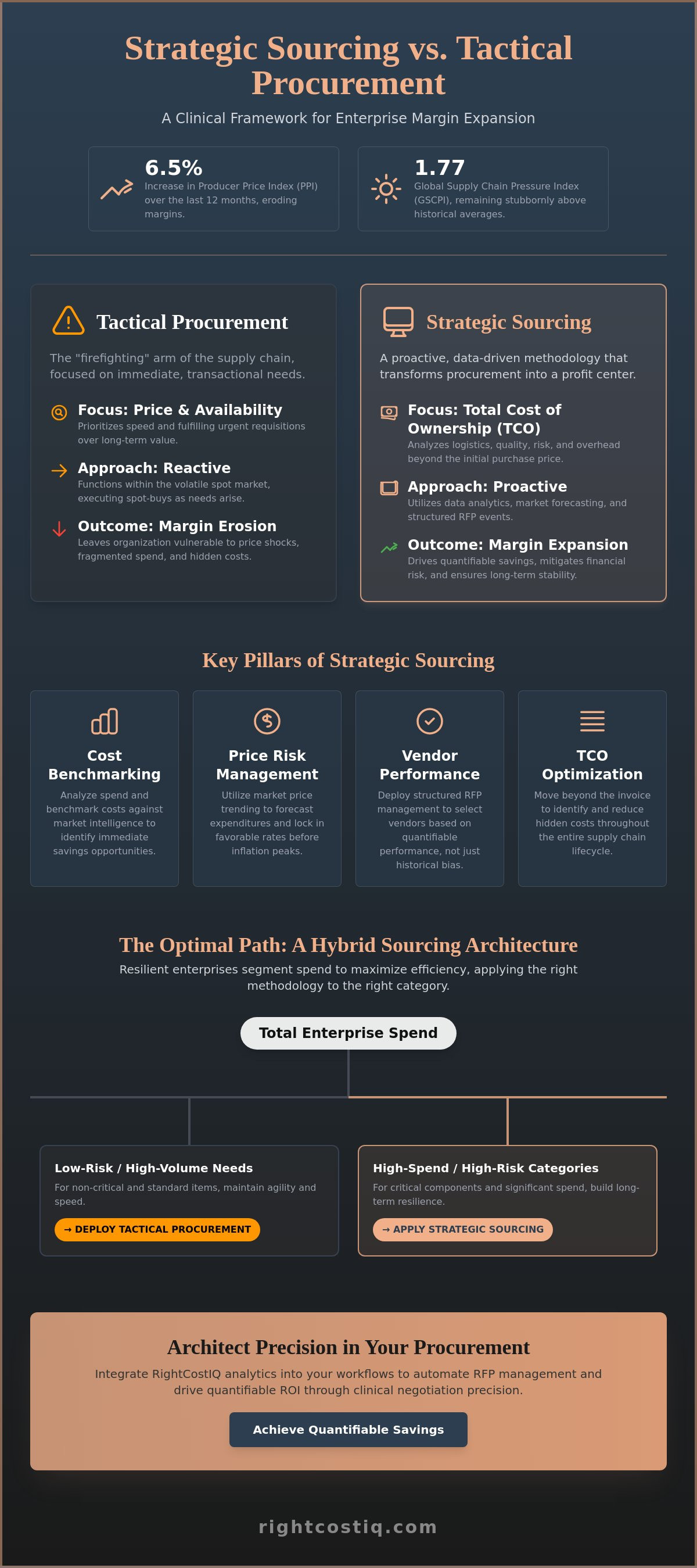
The operational divide between strategic sourcing vs tactical procurement determines an organization's ability to withstand external financial shocks. In a 2026 market characterized by a 6.5% year-over-year increase in the Producer Price Index, the distinction is no longer theoretical. It's the difference between margin preservation and fiscal erosion. Tactical procurement serves as the clinical execution of immediate, transactional requirements. It's a reactive function. Strategic sourcing, conversely, is a proactive, data-driven methodology designed to optimize the total cost of ownership (TCO) across the enterprise lifecycle.
Current supply chain pressures remain elevated, with the Global Supply Chain Pressure Index (GSCPI) registering at 1.77 in May 2026. This environment demands a fundamental shift from simple order-taking to rigorous category management. While tactical buying ensures the lights stay on, strategic sourcing ensures the business remains profitable. Relying solely on short-term fixes in a high-volatility market leads to fragmented spend and unmanaged price risk.
The Transactional Nature of Tactical Procurement
Tactical procurement prioritizes speed and immediate availability over long-term value. It functions primarily within the spot market, where pricing is volatile and subject to sudden spikes. This approach involves minimal due diligence regarding vendor performance tracking; instead, it focuses on fulfilling an urgent requisition. While often criticized for its lack of foresight, tactical buying remains essential for managing emergency supply disruptions. It's the "firefighting" arm of the supply chain. However, when tactical habits dominate the procurement function, organizations lose visibility into enterprise-wide spend and miss opportunities for volume-based negotiation.
Strategic Sourcing as a Driver of Margin Expansion
Strategic sourcing transforms procurement into a profit center by integrating procurement category cost benchmarking into every selection process. This framework doesn't just look at the purchase price. It analyzes logistics, quality, risk, and administrative overhead. Key components include:
- Price Risk Management: Utilizing market price trending to forecast expenditure and lock in favorable rates before inflation peaks.
- Comprehensive RFP Events: Deploying structured RFP management to ensure vendor selection is based on quantifiable performance metrics rather than historical bias.
- TCO Optimization: Moving beyond the invoice to identify hidden costs in the supply chain lifecycle.
By aligning procurement outcomes with enterprise-level financial growth, strategic sourcing mitigates the impact of the 5% producer price inflation forecast for the remainder of 2026. It replaces guesswork with clinical precision. A hybrid approach is now the standard for resilience. You must maintain the agility of tactical buying for low-risk items while applying a strategic sourcing framework to high-spend, high-risk categories to secure your competitive advantage.
Analyzing the Operational Lifecycle: Speed vs. Sustainability
The operational lifecycle of procurement is a constant negotiation between immediate necessity and long-term viability. Tactical procurement prioritizes the "now," utilizing rapid spot-buys to resolve immediate shortages or service gaps. While this ensures continuity, it frequently sacrifices sustainability. In the framework of strategic sourcing vs tactical procurement, the strategic approach views the RFP as a comprehensive sourcing event designed to stabilize the supply chain for extended periods. It moves beyond the purchase price to analyze the total lifecycle value of a supplier relationship.
Current market data suggests that speed in procurement often comes at a steep price. With the GEP Global Supply Chain Volatility Index showing elevated stockpiling and material shortages through May 2026, the temptation to buy fast is high. However, rapid purchasing without clinical oversight often means paying a "speed premium" that remains hidden until the year-end audit. Automated procurement platforms now bridge this gap, allowing organizations to maintain the velocity of tactical buying while applying the analytical rigor of strategic sourcing to every transaction.
Reactive Purchasing Cycles and Their Financial Leakage
Unmanaged tail spend represents a significant source of financial leakage. In tactical environments, the prioritization of speed leads to supplier fragmentation. Every new, unvetted vendor added for a one-off purchase increases administrative overhead and dilutes volume leverage. This lack of visibility into enterprise-wide costs results in surprise cost variances that erode the savings achieved in higher-profile categories. When you don't have a centralized view of these transactions, you're essentially operating with a blind spot that competitors with data-driven sourcing strategies will exploit.
Proactive RFP Management and Vendor Performance Tracking
Transitioning to proactive RFP management requires a fundamental shift in how organizations capture market intelligence. Comprehensive sourcing events integrate price risk management and market price trending data directly into the selection criteria. This ensures vendor selection is based on factual performance data rather than historical bias. Continuous vendor performance tracking serves as a clinical tool for ongoing contract optimization. It isn't enough to sign a contract; you must monitor delivery, quality, and compliance to maintain margin integrity. Building a resilient vendor ecosystem requires this level of strategic engagement to ensure your supply chain can withstand the 5% inflation forecast for the remainder of 2026.
Identifying these inefficiencies is the first step toward optimization. Analyzing your unmanaged tail spend reveals significant opportunities for immediate margin recovery and long-term cost stabilization.
Quantifying the Financial Delta: Cost Benchmarking and Price Risk
The financial delta between strategic sourcing vs tactical procurement is measured in basis points of margin. Tactical buying accepts market prices as fixed, reactive variables. Strategic sourcing challenges those prices through clinical benchmarking and predictive analytics. By leveraging procurement category cost benchmarking, organizations identify immediate savings opportunities that remain invisible to transactional teams. This data-driven approach moves beyond simple price comparisons to analyze the underlying cost drivers of every category.
Current economic indicators demand this level of precision. With the Producer Price Index for final demand advancing 6.5% in the 12 months ending May 2026, passive procurement is a recipe for margin erosion. Strategic sourcing teams use analytics to identify spend under management, ensuring that high-value categories aren't left to the whims of the spot market. This creates a structured environment where every dollar spent is optimized for maximum enterprise-level ROI.
The Economic Impact of Inefficient Category Strategy
Inefficient category strategies lead to significant price variance across operational units. Without a clinical framework, different facilities often pay different prices for the same SKU, a phenomenon known as procedure price variance. Data-driven sourcing identifies these outliers by comparing internal spend against objective market benchmarks. The transition from historical spend analysis to predictive cost modeling allows you to anticipate price shifts rather than simply reacting to them. This shift is essential for facility margins that are currently under pressure from the 5% producer price inflation forecast for the remainder of 2026.
Market Price Trending and Forecasting as Negotiation Levers
Forecasting is the primary clinical tool for mitigating commodity volatility. While competitors rely on vendor-supplied data, strategic teams utilize market price trending to anchor negotiations in economic reality. By implementing should-cost modeling, you can determine exactly what a product or service should cost based on current raw material indices and labor rates. This level of market intelligence provides the necessary leverage to challenge unjustified price increases from suppliers.
Strategic teams also use forecasting to time their RFP events. If market intelligence suggests a temporary dip in commodity prices, you can accelerate high-value sourcing events to lock in lower rates. This proactive approach protects the bottom line from the volatility seen in the May 2026 Global Supply Chain Pressure Index. It replaces the "order-taker" mentality with a sophisticated financial strategy that views procurement as a primary driver of corporate growth. Success in this environment requires moving away from the "lowest bid" and toward a clinical understanding of price risk management.
Implementing a Hybrid Sourcing Architecture for Enterprise Resilience
A resilient procurement function doesn't choose between strategic sourcing vs tactical procurement but integrates both into a clinical hybrid architecture. This framework ensures that high-velocity needs are met without compromising long-term margin integrity. Implementation begins with a rigorous five-step process designed to eliminate operational waste and maximize contractual leverage.
- Step 1: Segment spend. Use analytics to categorize every dollar as either tactical or strategic based on risk and value.
- Step 2: Deploy automation. Use automated RFP management for high-value categories where complexity demands precision.
- Step 3: Secure negotiation assistance. Integrate expert oversight to ensure final contracts align with current cost benchmarks.
- Step 4: Monitor performance. Establish a tracking system that measures vendor compliance against performance-based SLAs.
- Step 5: Conduct quarterly reviews. Adjust your category strategies based on shifting market price trends to capture new savings.
Identifying High-Impact Categories for Strategic Optimization
Apply the Pareto principle to identify the 20% of categories that drive 80% of your total spend value. These high-impact areas require a full strategic sourcing framework to mitigate the 5% producer price inflation forecast for late 2026. Conversely, low-value, non-critical items should remain within a streamlined tactical workflow to minimize administrative drag. Organizations often fail by ignoring tail spend, which can account for up to 20% of total expenditure. Automating these strategic frameworks allows you to capture value from fragmented spend without increasing headcount.
Leveraging Negotiation Assistance to Secure Competitive Advantage
Securing a contract is only the beginning of value realization. Utilizing a negotiation coach during complex RFP events ensures that your team moves beyond simple price discussions. Effective negotiation focuses on performance-based SLAs and contractual terms that reflect current market price benchmarks. This clinical approach prevents "contract creep" where initial savings are eroded by unmonitored service fees or price escalations. By aligning your contractual obligations with real-world market intelligence, you build a procurement function that acts as a primary driver of enterprise resilience.
Start your transition by conducting a comprehensive procurement diagnostic to identify immediate margin expansion opportunities.
RightCostIQ: Architecting Precision in Sourcing and Procurement
RightCostIQ provides the analytical infrastructure required to bridge the gap in strategic sourcing vs tactical procurement. By integrating clinical analytics into your existing procurement framework, you replace reactive purchasing with data-driven value creation. This transition ensures that every sourcing event is anchored in current market reality rather than vendor-supplied assumptions. You gain the ability to move beyond transactional execution to a model that prioritizes long-term financial health.
The ROI of professional RFP management services extends beyond initial price reductions. It encompasses operational efficiency, streamlined selection cycles, and the elimination of suboptimal vendor choices that often plague tactical environments. Automated vendor performance tracking further secures the supply chain by ensuring continuous compliance with negotiated SLAs. This level of oversight is essential for maintaining the margin expansion achieved through strategic sourcing frameworks.
Data-Driven Benchmarking for Sustainable Financial Growth
RightCostIQ provides access to specialized market price trending and forecasting services tailored for the volatile 2026 economic environment. With producer price inflation forecast at 5% for the remainder of the year, historical spend data is no longer a reliable anchor for future budgeting. Our platform identifies immediate savings in fragmented procurement categories by utilizing should-cost analysis and clinical benchmarking. We transform raw, unstructured spend data into actionable strategic intelligence. This process uncovers hidden cost drivers and provides the transparency needed to challenge unjustified vendor price escalations.
Professional Negotiation and RFP Execution
The shift from tactical buying to strategic partnership requires more than software; it requires clinical execution. RightCostIQ facilitates this transition by providing the professional negotiation assistance needed to handle high-stakes vendor interactions. We ensure that your team enters every sourcing event with a quantifiable competitive advantage based on real-time market intelligence. This approach eliminates the guesswork from the RFP lifecycle and replaces it with a structured methodology for value capture.
By aligning your procurement outcomes with enterprise-level growth metrics, you insulate the organization from the supply chain pressures observed in the first half of 2026. This isn't about simple purchasing. It's about architecting a procurement function that serves as a primary driver of corporate profitability. Contact RightCostIQ today to optimize your procurement outcomes and secure your competitive position in an increasingly volatile global market.
Architecting Financial Resilience Through Procurement Optimization
The distinction between strategic sourcing vs tactical procurement represents the boundary between operational survival and competitive financial advantage. You've seen how clinical benchmarking and predictive analytics transform procurement from a cost center into a primary driver of margin expansion. By moving beyond reactive spot-buys and implementing a hybrid sourcing architecture, your organization secures the transparency needed to mitigate persistent inflationary pressures. Sustained growth requires more than transactional speed; it demands the integration of specialized financial analytics and automated vendor performance tracking into every category strategy.
RightCostIQ delivers this precision through expert-led RFP management and specialized healthcare financial analytics expertise. We provide the clinical precision in cost benchmarking necessary to identify savings in fragmented spend and secure performance-based vendor agreements through automated vendor performance and compliance tracking. Don't leave your facility's margins to market volatility or fragmented tail spend. Optimize your procurement outcomes with RightCostIQ RFP Management and Negotiation Assistance and build a resilient supply chain grounded in data-driven certainty. It's time to lead your department with the authority of a strategic architect and drive measurable ROI.
Frequently Asked Questions
What is the primary difference between strategic sourcing and tactical procurement?
The primary difference lies in the time horizon and financial objective. Tactical procurement is a short-term, reactive function focused on immediate fulfillment at the lowest transactional price. Strategic sourcing is a long-term, data-driven methodology that optimizes the total cost of ownership and aligns procurement with enterprise-level financial growth. While tactical buying ensures operational continuity, strategic sourcing drives sustainable margin expansion through clinical market analysis.
When should a business prioritize tactical procurement over strategic sourcing?
Prioritize tactical procurement for low-value, non-critical items where the administrative cost of a strategic sourcing event exceeds the potential savings. This approach is also necessary during emergency supply disruptions where immediate availability is the primary metric for success. In these scenarios, the objective is rapid spot-market execution rather than long-term value creation. Maintaining this agility for low-risk categories prevents procurement bottlenecks and operational delays.
How does strategic sourcing contribute to price risk management?
Strategic sourcing mitigates financial volatility by utilizing market price trending and forecasting to anchor long-term contracts. This proactive approach allows organizations to lock in favorable rates before anticipated inflation, such as the 5% producer price inflation forecast for late 2026. By moving beyond reactive purchasing, firms protect their bottom lines from commodity price spikes and unpredictable market shifts observed in the Global Supply Chain Pressure Index.
What role does procurement analytics play in cost benchmarking?
Procurement analytics provide the clinical precision required to identify procedure price variance and outliers in vendor pricing. By transforming raw spend data into actionable intelligence, analytics allow firms to compare internal costs against objective industry benchmarks. This transparency identifies immediate savings opportunities and provides the data-driven leverage needed for high-stakes vendor negotiations. It replaces historical guesswork with predictive cost modeling for superior financial outcomes.
Can small businesses benefit from strategic sourcing frameworks?
Small businesses benefit by applying strategic sourcing frameworks to their highest-spend categories to maximize limited volume leverage. Even without enterprise-level scale, using data-driven sourcing to address tail spend and fragmented purchasing can yield significant margin recovery. Small organizations often find that automating these frameworks allows them to compete with larger entities by reducing administrative overhead and securing more competitive contractual terms.
How does RFP management software improve sourcing outcomes?
RFP management software improves outcomes by standardizing the selection process and ensuring vendor performance is measured against quantifiable metrics. This technology streamlines the transition from strategic sourcing vs tactical procurement by automating complex evaluation cycles and capturing market intelligence. It eliminates the inefficiencies of manual sourcing, allowing teams to focus on clinical negotiation rather than administrative data entry.
What are the risks of relying solely on tactical procurement?
Relying solely on tactical procurement leads to supplier fragmentation, unmanaged price risk, and significant financial leakage. Without a strategic framework, organizations pay a speed premium on every transaction and lack visibility into enterprise-wide spend. This reactive model is particularly dangerous in high-volatility environments where unmonitored cost increases can rapidly erode facility margins and lead to suboptimal vendor selection.
How do you measure the ROI of a strategic sourcing initiative?
Measure ROI by tracking quantifiable cost savings, total cost of ownership reductions, and contract compliance rates. A successful initiative should demonstrate a measurable decrease in procedure price variance and an increase in spend under management. Additionally, evaluate the impact on operational efficiency, such as reduced RFP cycle times and improved vendor performance metrics, to determine the overall financial contribution to the enterprise.


