
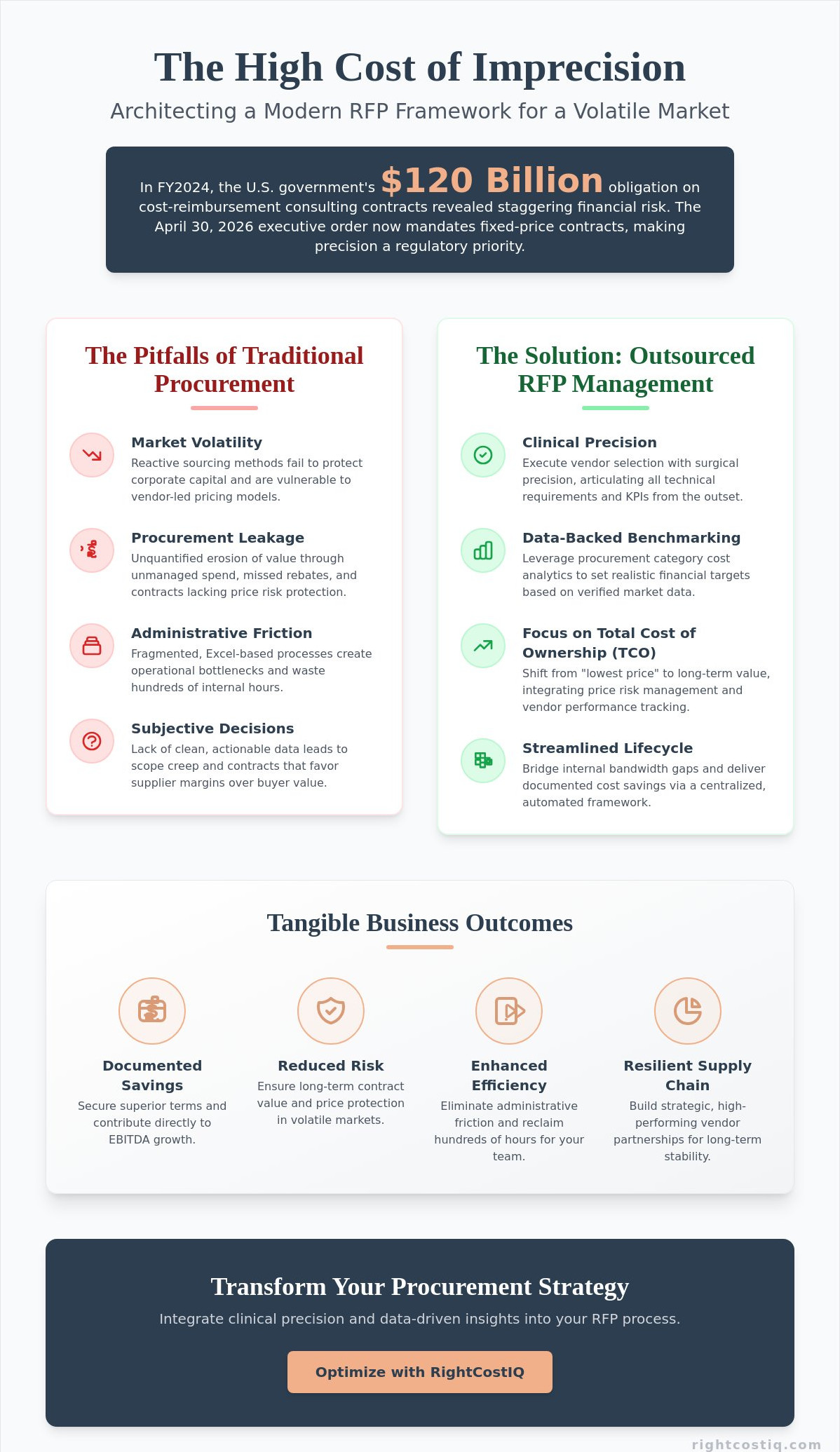
In Fiscal Year 2024, the U.S. government obligated approximately $120 billion on cost-reimbursement consulting contracts alone, a figure that reveals the staggering financial risk of imprecise procurement. Following the April 30, 2026, executive order mandating fixed-price contracts as the default standard, the requirement for rigorous scoping is now a regulatory priority. Many organizations struggle with procurement leakage and unmanaged spend because they lack the internal bandwidth for complex negotiations. Integrating professional outsourced RFP management services into your strategy provides the clinical precision needed to neutralize market price volatility. You likely recognize that traditional sourcing methods are no longer sufficient to protect your bottom line in a volatile market.
This article promises to help you master the selection and implementation of expert RFP services to secure high-value vendor contracts and eliminate leakage. We'll explore the integration of cost benchmarking, market price forecasting, and data-backed award recommendations. You'll gain a clear roadmap for optimizing your procurement functions and building a resilient supply chain through strategic vendor performance tracking.
Key Takeaways
- Identify clinical execution strategies to neutralize market price volatility and eliminate unmanaged spend.
- Leverage procurement category cost benchmarking to set realistic financial targets and create competitive tension through data-backed scoring.
- Master the selection of professional outsourced RFP management services by prioritizing technical competence and proprietary cost analytics.
- Integrate vendor performance tracking and price risk management into your framework to ensure long-term contract value.
- Architect a streamlined RFP lifecycle that bridges internal bandwidth gaps while delivering documented cost savings.
The Strategic Imperative for Outsourced RFP Management Services
Professional outsourced RFP management services represent a clinical financial instrument designed to execute vendor selection and contract negotiation with surgical precision. In the current 2026 fiscal landscape, procurement departments face a convergence of high market volatility, increasingly complex sourcing categories, and a critical scarcity of clean, actionable data. These factors create an environment where traditional, reactive sourcing methods fail to protect corporate capital. Organizations that treat procurement as a back-office administrative task often suffer from significant procurement leakage. This leakage is the unquantified erosion of value occurring through unmanaged spend, missed rebate opportunities, and contracts that lack price risk protection. By integrating professional RFP management, enterprises can rapidly expand their spend under management, transforming fragmented purchasing into a structured, data-driven financial strategy.
The role of these services is to act as a strategic architect. They replace subjective decision-making with objective cost analysis and market intelligence. This transition is essential for maintaining supply chain resilience in an era where market price trending changes weekly. Without a specialized partner to provide negotiation assistance and cost benchmarking, firms are essentially bidding in the dark, leaving themselves vulnerable to vendor-led pricing models that prioritize supplier margins over buyer value.
Eliminating Administrative Friction in Complex Sourcing
Manual procurement processes are the primary cause of operational bottlenecks. Transitioning from fragmented, Excel-based bid tracking to centralized, automated analytics platforms is a fundamental requirement for modern enterprise efficiency. This shift significantly reduces the internal labor burden on finance and operations departments, reclaiming hundreds of hours typically wasted on data entry and vendor follow-ups. Clinical precision in the preparation of a Request for Proposal (RFP) ensures that all technical requirements and performance KPIs are clearly articulated from the outset. This clarity eliminates carrier and vendor communication errors, preventing the "scope creep" that often inflates contract costs after an award is made. High-stakes procurement requires a relentless focus on document accuracy and standardized communication protocols to ensure every bid is evaluated on an identical, objective basis.
RFP Management as a Financial Growth Driver
Advanced negotiation assistance directly impacts the corporate bottom line by securing terms that go beyond simple price concessions. Professional outsourced RFP management services shift the focus from the "lowest price" to the Total Cost of Ownership (TCO). This comprehensive view accounts for price risk management, vendor performance tracking, and long-term market price forecasting. Utilizing a sophisticated framework ensures that contracts are not just signed but optimized for the entire lifecycle of the vendor relationship. For a detailed analysis of how technology-driven methodologies scale these outcomes, refer to our guide on RFP Management: Strategic Frameworks for AI-Led Procurement Optimization. By treating the RFP process as a high-level financial lever, organizations can secure superior vendor performance and documented cost savings that contribute directly to EBITDA growth.
Architecting the RFP Framework: Data-Driven Sourcing Components
Optimizing vendor selection requires a clinical framework that transcends basic price comparison. Architecting a high-performance RFP involves integrating data-driven sourcing components at every stage of the lifecycle. Professional outsourced RFP management services provide the technical infrastructure to execute this transition from administrative bidding to strategic financial engineering. This structured approach ensures that every variable, from baseline costs to long-term risk, is quantified and controlled before a contract is awarded.
The pre-RFP phase is the most critical stage for establishing financial control. Utilizing procurement category cost benchmarking and analytics allows decision-makers to set realistic targets based on verified market data rather than vendor-supplied estimates. This baseline functions as a clinical benchmark against which all subsequent bids are measured. During the bid event, the focus shifts to creating competitive tension through objective, data-backed scoring models. These models force vendors to compete on specific performance metrics, stripping away the influence of sales rhetoric and marketing fluff.
The evaluation phase demands a rigorous analysis of vendor proposals against real-time market price trending. This step is essential for identifying whether a vendor's pricing is sustainable or reflects a temporary market anomaly that could lead to future cost escalations. Finally, the negotiation phase leverages market intelligence to neutralize vendor price risk. By utilizing a price risk management and tracking service, organizations secure contracts that remain viable even during periods of high volatility. Integrating a market price trending and forecasting service ensures your RFP targets remain aligned with shifting economic realities and protects the long-term value of the agreement.
Advanced Benchmarking and Analytics Integration
Defining the baseline starts with rigorous spend analysis and category audits that expose deep-seated inefficiencies. Identifying hidden cost drivers within complex vendor proposals requires a granular breakdown of service components and labor rates. Procurement benchmarking is the non-negotiable prerequisite for RFP success. Without this data-driven foundation, procurement teams can't accurately assess the competitiveness of a bid or identify where a vendor is padding their margins.
Weighted Scoring and Objective Vendor Evaluation
Designing multi-variable matrices allows organizations to prioritize performance and risk alongside price. This structured approach ensures transparency and auditability throughout the vendor selection process, which is vital for maintaining compliance with internal governance standards. It reduces subjective bias in high-value contract awards, ensuring that decisions align with documented financial goals. By weighting criteria such as supply chain resilience and technical competence, enterprises can select partners that offer the highest total value rather than just the lowest initial cost.
Evaluation Criteria: Selecting the Right RFP Management Partner
Identifying the optimal partner for outsourced RFP management services requires a clinical assessment of their technical infrastructure. High-stakes procurement demands more than a simple facilitator. It requires a strategic architect capable of deploying proprietary procurement analytics to uncover cost-saving opportunities hidden within complex vendor datasets. Decision-makers must evaluate whether a potential partner possesses deep category expertise in specialized industries like finance or healthcare. These sectors involve unique regulatory constraints and cost drivers that generic consulting firms often overlook. A partner without specific industry depth can't provide the benchmarking precision needed to challenge vendor pricing models effectively.
A partner's negotiation methodology serves as the primary driver for contract value. A clinical approach prioritizes data-backed leverage over simple persuasive tactics. This methodology must be supported by a robust technology stack. Automated platforms ensure RFP lifecycle efficiency by centralizing communications and standardizing bid evaluations. Without these tools, the procurement process remains vulnerable to human error and subjective bias. Effective partners use these platforms to maintain a relentless focus on operational efficiency and financial growth metrics. They don't just manage a bid; they engineer a superior financial outcome.
Analytical Depth vs. Administrative Support
Traditional procurement consultants often focus on administrative support. They function as little more than "paper-pushers" who manage document flow without adding strategic value. In contrast, data-driven firms provide the analytical depth necessary to forecast market price trends and implement actionable price risk management strategies. Verifying a provider's ability to model future price volatility is essential for securing long-term contract stability. This analytical rigor ensures that award recommendations are based on documented facts rather than vendor promises. It's the difference between a successful contract and a missed opportunity for EBITDA growth.
Transparency and Reporting Standards
Transparency in the RFP process is a non-negotiable requirement for C-suite alignment. Reporting standards must provide real-time visibility into bid progress and granular vendor responses. Effective partners offer sophisticated dashboards that quantify projected versus actual savings. This data provides the financial evidence needed for executive buy-in and audit compliance. Integrating vendor performance tracking as a core service offering ensures that the value secured during the negotiation phase is actually realized during the contract's lifespan. This continuous oversight prevents the "value leak" that typically occurs after the initial award, maintaining a rhythmic focus on bottom-line results.
Operationalizing the RFP Lifecycle for Enterprise Efficiency
Efficiency in procurement isn't achieved at the moment of contract signing; it's forged through the clinical operationalization of the entire lifecycle. Establishing a strict timeline for execution ensures that stakeholder alignment remains intact and deadlines are met without compromising analytical depth. High-level decision-makers utilize outsourced RFP management services to bridge the gap between strategic intent and tactical execution. This systematic approach addresses the "hidden 20%" of unmanaged spend through advanced category management procurement, a framework designed for margin expansion. Refining the lifecycle based on real-world vendor performance data ensures that future sourcing events are grounded in operational reality rather than theoretical promises.
The transition from award to implementation requires a relentless focus on detail. Strategic architects don't just hand over a contract; they build the infrastructure for ongoing success. This includes setting clear communication protocols and defining escalation paths for vendor non-compliance. By treating the RFP as a living process rather than a static event, organizations can adapt to shifting market conditions while maintaining a firm grip on their cost structures. This level of operational rigor is what separates top-tier procurement departments from those that merely process invoices.
Vendor Performance and Compliance Tracking
Most organizations stop their oversight at the award stage, creating a critical vulnerability where negotiated value quickly evaporates. Effective lifecycle management demands the integration of vendor performance tracking from day one to ensure total contract compliance. Automating the monitoring of service level agreements (SLAs) allows for the immediate identification of "contract creep" or unauthorized price increases. Maintaining a continuous feedback loop between procurement and operations ensures that vendor performance data informs the next RFP cycle. If your current process lacks this post-award oversight, it's time to implement a procurement and vendor performance tracking service to protect your negotiated savings.
Risk Mitigation and Supply Chain Resilience
Supply chain resilience is a byproduct of rigorous vendor evaluation during the RFP process. Diversifying the supplier base prevents single-point-of-failure risks that can cripple operations during market disruptions. Assessing vendor financial stability and market position provides a layer of protection against insolvency or service degradation. Professional RFP management acts as a strategic hedge against price volatility by securing fixed-price protections and performance-based incentives. This forward-thinking approach ensures that procurement remains a driver of stability rather than a source of risk. It's about building a supply chain that can withstand volatility while delivering consistent financial results.
RightCostIQ: Precision Execution in Procurement Optimization
RightCostIQ functions as the strategic architect for organizations requiring elite procurement outcomes. We offer specialized outsourced RFP management services that integrate deep financial analytics with clinical execution. Our focus on healthcare financial analytics and cost transparency allows us to dismantle opaque pricing structures that often lead to procurement leakage. Every RFP we manage incorporates proprietary market price trending and forecasting, ensuring that your vendor contracts are resilient against future volatility. We deliver negotiation assistance backed by data precision, neutralizing vendor-led narratives with objective market intelligence. This expert-led approach prioritizes efficiency over conversational warmth, focusing strictly on the metrics that drive financial growth.
Our role as a sophisticated partner extends beyond the bid event. We provide the technical upskilling and competitive advantage necessary for high-level decision-makers to maintain control over their supply chains. By utilizing data-driven sourcing, we ensure that every award recommendation is backed by a clinical analysis of the vendor's financial stability and market position. This methodology creates a voice of reliability and deep industry expertise, positioning your organization as a powerful force in any negotiation. We don't seek to be a casual partner but rather a high-level consultant focused on the pragmatic realities of business finance.
The RightCostIQ Methodology
Our methodology is rooted in rigorous procurement category cost benchmarking. We leverage these benchmarks to secure market-leading prices that align with current economic realities. Our proprietary analytics platform identifies immediate savings opportunities by auditing historical spend and identifying category-specific inefficiencies. This platform bridges the gap between traditional business functions and digital innovation. Beyond the initial award, we maintain a relentless commitment to vendor performance tracking and long-term compliance. This continuous oversight ensures that the financial value secured during negotiation is fully realized throughout the contract lifecycle. We don't just facilitate bids; we engineer sustainable financial advantages through methodical, fast-paced execution.
Securing the Bottom Line
Forward-thinking firms choose RightCostIQ for complex price risk management because we treat procurement as a primary driver of financial growth. We transform departments from passive cost centers into proactive engines of EBITDA expansion. By applying clinical data precision to every sourcing event, we eliminate the uncertainty inherent in traditional procurement cycles. The result is a supply chain optimized for both resilience and profitability. Our platform acts as a rhythmic heartbeat for your procurement operations, ensuring consistency and unwavering focus on the bottom line. Optimize your next RFP cycle with RightCostIQ’s precision management services to secure the documented cost savings your organization demands. We move quickly from broad strategic promises to granular service details, ensuring your financial goals are perfectly aligned with technical execution.
Strategic Command of the Procurement Lifecycle
Transforming procurement from a reactive cost center into a proactive driver of financial growth requires a clinical shift in methodology. Organizations must replace subjective vendor selection with a data-driven framework that prioritizes total cost of ownership and long-term supply chain resilience. Integrating outsourced RFP management services allows your team to bridge internal bandwidth gaps while leveraging advanced procurement analytics and cost benchmarking. This strategic alignment ensures that every high-value contract is secured through expert negotiation assistance and protected by rigorous price risk management.
Securing the award is only the first stage of margin protection. Sustained EBITDA expansion depends on comprehensive vendor performance and risk tracking to eliminate contract creep and unauthorized price escalations. By operationalizing these clinical standards, enterprises can neutralize market volatility and maintain a persistent competitive advantage. It's time to architect a procurement function that delivers documented cost savings and unwavering operational efficiency. You're now equipped to lead your department toward a future of precision and profitability.
Secure your procurement margins with RightCostIQ’s expert RFP management and take command of your vendor landscape today.
Frequently Asked Questions
What are the primary benefits of using outsourced RFP management services?
Outsourced RFP management services eliminate procurement leakage by providing the clinical precision internal teams often lack. These services expand your organizational spend under management by automating administrative friction and utilizing advanced analytics to identify hidden cost drivers. This results in a more resilient supply chain and documented financial growth metrics. Professional architects ensure every bid is evaluated against a clinical benchmark rather than subjective vendor claims.
How do professional RFP services handle vendor negotiation and contract terms?
Professional services utilize market intelligence and procurement category cost benchmarking to secure favorable contract terms. By applying clinical data precision, these services neutralize vendor-led pricing narratives and force competition on specific performance metrics. This methodology shifts the focus from the lowest initial price to the total cost of ownership. It secures fixed-price protections and performance-based incentives that protect your corporate capital.
What is the typical ROI for an outsourced RFP management engagement?
The ROI of an engagement is measured through documented cost savings and the elimination of unmanaged spend. While specific financial outcomes vary based on category complexity, the primary value driver is the surgical reduction of procurement leakage. These services transform procurement from a cost center into a driver of EBITDA expansion. You'll see measurable improvements in contract compliance and vendor performance that contribute directly to your bottom line.
Can outsourced RFP services integrate with our existing procurement software?
Yes, professional RFP services are designed to bridge the gap between traditional business functions and modern software integration. These services often utilize proprietary analytics platforms that complement your existing tech stack to ensure RFP lifecycle efficiency. This integration allows for real-time visibility into bid progress and automated data flow between procurement and finance. It creates a rhythmic heartbeat of efficiency throughout your operational framework.
How do professional consultants manage price risk during market volatility?
Consultants manage price risk by utilizing market price trending and forecasting services to predict future volatility. This forward-thinking approach allows for the implementation of price risk management strategies that protect contracts from inflationary spikes. By securing fixed-price agreements or incentive-based models, organizations can hedge against market instability. It's a clinical financial instrument used to maintain margin stability in a volatile economic environment.
What industries benefit most from specialized RFP management services?
Industries with high spend complexity and strict regulatory requirements, such as healthcare and finance, benefit most from specialized services. RightCostIQ's focus on healthcare financial analytics ensures that opaque pricing models are dismantled through clinical cost transparency. Any sector facing market price volatility or complex sourcing categories requires this level of strategic architecture. These industries need data-driven sourcing to maintain a competitive advantage and ensure supply chain resilience.
How does RightCostIQ ensure vendor compliance after the RFP is awarded?
RightCostIQ utilizes a proprietary vendor performance tracking service to monitor service level agreements (SLAs) in real time. This continuous oversight identifies contract creep and unauthorized price increases before they impact your financial metrics. By maintaining a clinical feedback loop between procurement and operations, we ensure that every vendor remains in total compliance with negotiated terms. This persistent monitoring protects the value secured during the initial RFP cycle.
What is the difference between a standard RFP and a professionally managed sourcing event?
A professionally managed sourcing event replaces administrative paper-pushing with clinical financial engineering. Standard RFPs often focus on document flow and subjective evaluation; whereas, a managed event uses weighted scoring and objective cost benchmarking. It's the difference between a simple bid and a strategic architecture designed to maximize long-term contract value. Managed events prioritize data-backed award recommendations and rigorous price risk protection to ensure superior vendor performance.


