
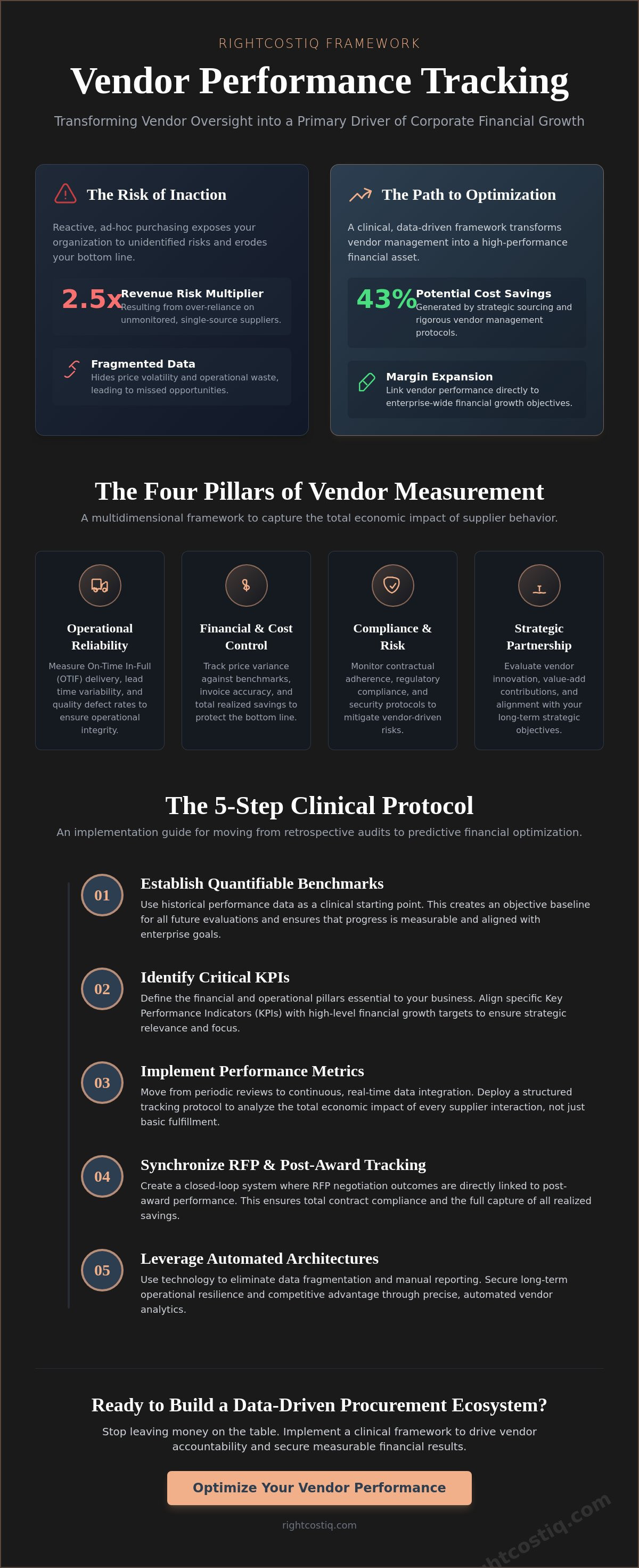
Strategic sourcing and rigorous vendor management generate cost savings of up to 43 percent compared to reactive, ad-hoc purchasing. Yet, most procurement leaders remain trapped by fragmented data and unidentified price volatility that erodes the bottom line. You've likely realized that without a clinical approach to measuring vendor performance metrics, your organization is exposed to a revenue risk multiplier of 2.5 times when over-reliant on single-source suppliers. This lack of visibility isn't just an operational hurdle; it's a direct threat to your margin expansion goals.
It's time to transition from retrospective audits to a strategic architecture for financial optimization. This article details an expert-led framework for vendor performance tracking designed to drive operational resilience and measurable cost savings. We'll analyze standardized metric frameworks, the impact of the updated $350,000 federal simplified acquisition threshold, and the precise analytics required to quantify vendor-driven ROI in the 2026 landscape. You'll gain the technical blueprint necessary to transform vendor oversight into a primary driver of corporate financial growth.
Key Takeaways
- Establish quantifiable benchmarks to link vendor performance directly to enterprise-wide margin expansion and strategic objectives.
- Identify the critical financial and operational pillars necessary for building a robust, data-driven vendor oversight framework.
- Implement a five-step clinical protocol for measuring vendor performance metrics that aligns specific KPIs with high-level financial growth targets.
- Synchronize RFP negotiation outcomes with post-award tracking to ensure total contract compliance and the capture of realized savings.
- Leverage automated tracking architectures to eliminate data fragmentation and secure long-term operational resilience through precise vendor analytics.
The Strategic Architecture of Measuring Vendor Performance Metrics
Modern procurement optimization requires a shift in perspective. Measuring vendor performance metrics is no longer a retrospective audit of past failures; it's a clinical framework for securing future enterprise-wide margin expansion. These metrics serve as quantifiable benchmarks for contractual and operational success, transforming vendor relationships into high-performance financial assets. In the 2026 landscape, high-level decision-makers must view performance tracking as the primary engine for supply chain resilience and aggressive cost containment.
Precise measurement eliminates the ambiguity that often hides price volatility and operational waste. When organizations deploy a structured tracking protocol, they move beyond simple fulfillment checks to analyze the total economic impact of every supplier interaction. This architectural approach ensures that every dollar spent aligns with broader financial growth objectives, effectively mitigating the 2.5 times revenue risk associated with unmonitored single-source dependencies. It's about building a data-driven ecosystem where vendor accountability is hard-coded into the procurement cycle.
The Shift from Tactical to Strategic Measurement
Traditional procurement often focuses on basic compliance, such as whether an order arrived on time. Strategic measurement, however, evaluates value-add metrics that directly influence the corporate bottom line. This involves integrating Key Performance Indicators (KPIs) that track realized savings against negotiated baselines. By utilizing sophisticated procurement analytics, firms can identify which vendors contribute to operational efficiency and which ones introduce hidden costs through invoice inaccuracies or lead-time variability. This level of governance is essential for maintaining a competitive advantage in a volatile market.
Defining the Clinical Standard for Metric Precision
Performance precision is the objective alignment of real-time vendor output against pre-negotiated financial and operational thresholds. Subjective evaluations have no place in a sophisticated procurement strategy. Instead, leaders must rely on objective, data-led benchmarks to drive vendor accountability. The RightCostIQ approach prioritizes clinical execution, ensuring that every data point is verified and actionable. This methodology links RFP management directly to post-award performance, creating a continuous loop of optimization. By establishing a clinical starting point through historical data baselines, organizations can ensure that their vendor performance tracking service delivers measurable financial results rather than just administrative reports.
- Baseline Establishment: Identifying historical performance data as a clinical starting point for all future evaluations.
- Metric Selection: Aligning specific KPIs with enterprise-level financial growth targets to ensure strategic relevance.
- Continuous Monitoring: Moving away from periodic reviews toward real-time data integration and risk management.
The Four Pillars of Sophisticated Vendor Performance Measurement
Architecting a resilient supply chain requires more than anecdotal feedback or annual reviews. High-level decision-makers must deploy a multidimensional framework that captures the total economic impact of supplier behavior. By measuring vendor performance metrics across four distinct pillars, organizations can identify hidden inefficiencies and secure aggressive margin expansion. This clinical approach ensures that every vendor relationship functions as a strategic asset rather than a liability.
Operational and Delivery Reliability
Operational integrity begins with On-Time In-Full (OTIF) delivery. This metric serves as the baseline for assessing a vendor's ability to meet contractual obligations without disrupting internal production cycles. Beyond simple delivery dates, procurement leaders must measure lead time variability. High variability forces organizations to carry excess safety stock, which ties up working capital and increases carrying costs. Additionally, quality defect rates act as a direct cost-driver. Even a minor uptick in defects can trigger significant manufacturing delays or expensive rework, eroding the financial gains achieved during the negotiation phase. Adopting vendor performance management best practices allows firms to visualize these operational trends through real-time dashboards, enabling rapid corrective action.
Financial Impact and Cost Benchmarking
Financial optimization hinges on the ability to bridge the gap between negotiated savings and realized value. Organizations should integrate procurement category cost benchmarking into their ongoing performance reviews to ensure they aren't falling victim to price creep. Tracking contract compliance is essential for eliminating "maverick spend," where decentralized purchasing occurs outside of pre-negotiated terms. Sophisticated tracking protocols evaluate the total cost of ownership (TCO). This analysis accounts for logistics, administrative overhead, and risk mitigation costs that often exceed the initial purchase price. By maintaining a relentless focus on these financial benchmarks, procurement departments become profit centers that drive enterprise-wide growth.
Risk, Compliance, and Strategic Innovation
The third pillar focuses on regulatory adherence and financial stability. Following the October 2025 updates to federal procurement thresholds, such as the $350,000 simplified acquisition limit, monitoring supplier compliance has become a high-stakes necessity. Organizations must conduct regular risk assessments covering cybersecurity and financial solvency to prevent catastrophic disruptions. Finally, the framework must quantify strategic innovation. This involves measuring a vendor's contribution to product development and process efficiency. Vendors who proactively suggest cost-saving technologies or material substitutions provide a competitive advantage that traditional metrics often overlook. Utilizing a professional vendor performance tracking service ensures these qualitative contributions are captured and weighed against hard financial data for a holistic view of supplier value.
Executing the Performance Tracking Protocol: A 5-Step Implementation
Deploying a clinical framework for measuring vendor performance metrics is a technical exercise that demands a rigid sequence of actions. It's not enough to simply observe supplier behavior; procurement leaders must architect a system where data flows seamlessly from operational activity to financial reporting. This protocol ensures that every interaction is captured, analyzed, and leveraged for margin expansion. Implementation follows a methodical five-step arc designed to eliminate data fragmentation and enforce vendor accountability.
- Step 1: Baseline Establishment. Identify historical performance data to serve as a clinical starting point for all future evaluations.
- Step 2: Metric Selection. Align specific supplier performance metrics, such as total cost of ownership and fulfillment accuracy, with enterprise-level financial growth targets.
- Step 3: Data Integration. Automate the flow of information from ERP systems directly to tracking platforms to ensure real-time accuracy.
- Step 4: Scorecarding. Create a rhythmic cadence for vendor reviews, using standardized reports to drive objective discussions.
- Step 5: Continuous Optimization. Refine metrics based on market price trending and forecasting to maintain a competitive advantage in shifting economic conditions.
Establishing the Data Baseline
A baseline is the prerequisite for any measurable improvement within a procurement ecosystem. Without a clear understanding of current performance, any subsequent tracking lacks a valid reference point. Organizations must audit existing contracts to extract service level agreements (SLAs) and historical fulfillment data. This audit provides the benchmarks needed to identify underperformance early. Utilizing a sophisticated spend analysis allows decision-makers to identify high-impact vendor categories where performance deviations cause the most significant financial leakage. This step transforms raw contract data into a strategic foundation for the entire tracking protocol.
Automated Scorecarding and Reporting
Manual tracking is a liability that introduces human error and delays. Sophisticated procurement departments design dashboards that provide real-time visibility into vendor compliance across all operational pillars. These systems should implement automated triggers for any performance deviations that fall below clinical thresholds. When a vendor's delivery reliability or quality score dips, the system alerts the procurement team immediately, enabling proactive intervention before the bottom line is impacted. These dashboards also facilitate C-suite reporting by condensing complex datasets into high-level procurement analytics summaries. This ensures that executive leadership has the intelligence required to make data-driven decisions regarding vendor retention and contract renewals.
Closing the Loop: Integrating RFP Outcomes with Performance Tracking
Procurement often fails because it treats the contract award as the finish line. In reality, the award is just the start of the clinical lifecycle. Measuring vendor performance metrics is the only way to ensure the promises made during negotiation materialize on the balance sheet. Linking RFP management to post-award tracking creates a closed-loop system where every contractual obligation is monitored with architectural precision. Negotiation outcomes serve as the "north star," providing the definitive benchmarks against which all subsequent vendor behavior is judged. Without this integration, negotiated savings remain theoretical and vulnerable to erosion.
The symbiotic relationship between sourcing and tracking isn't optional; it's a strategic necessity. Sourcing defines the potential value, while performance tracking secures it. When these functions are siloed, organizations lose the ability to hold vendors accountable to the very terms that won them the business. High-performance procurement requires a seamless transition where the data points gathered during the RFP phase become the active KPIs of the management phase. This ensures that the vendor's operational output remains strictly aligned with the organization's strategic intent throughout the contract term.
Negotiation Levers and Performance Clauses
Maximum leverage exists before the contract is signed. High-level decision-makers must bake specific performance metrics directly into the initial negotiation as enforceable clauses. This ensures that vendor incentives align perfectly with your organization's financial growth targets. Historical performance data acts as a clinical weapon during future RFP cycles. If a vendor failed to meet lead-time targets or quality thresholds in the previous term, that data dictates the negotiation strategy for the next cycle. This integration is foundational for sophisticated category management procurement, where category-wide performance informs every sourcing decision. By codifying service credits or liquidated damages into the contract, you transform the scorecard from a reporting tool into a financial enforcement mechanism.
Mitigating Financial Volatility
Resilience requires proactive monitoring of external market forces alongside internal performance data. Incorporating price risk management into the vendor scorecard allows organizations to identify "at-risk" suppliers before failures impact the bottom line. Leaders must monitor market price trending to verify if a vendor's pricing remains competitive relative to the broader industry. If a supplier's costs creep upward while market rates decline, the performance tracking framework triggers an immediate review. This proactive stance prevents price creep and identifies vendors whose financial stability may be wavering. It's about maintaining a constant state of market awareness to ensure that your supply chain remains both efficient and cost-effective. Secure your organization's financial future by deploying a professional Price Risk Management and Tracking Service today.
Leveraging RightCostIQ for Data-Driven Performance Architectures
RightCostIQ functions as the strategic architect for organizations demanding clinical precision in their procurement operations. We deliver a comprehensive infrastructure for measuring vendor performance metrics that translates complex supplier data into aggressive financial growth. Our framework integrates automated performance tracking with expert-led RFP management and negotiation assistance. This ensures that contractual value is both captured at the source and protected throughout the vendor lifecycle. We don't just provide tools; we build the technical foundation for operational resilience.
Our methodology relies on advanced procurement category cost benchmarking and analytics to establish objective truth in vendor relationships. By utilizing our market price trending and forecasting service, we enable procurement teams to anticipate volatility before it compromises the bottom line. This clinical approach replaces reactive management with predictive intelligence. It positions your organization at the intersection of technological innovation and financial optimization. Measuring vendor performance metrics becomes an automated, high-fidelity process that eliminates manual error and enforces total contract compliance.
The RightCostIQ Advantage in Metrics
The RightCostIQ advantage lies in our proprietary Price Risk Management and Tracking Service. Our analytics platform ingests disparate data streams to produce a single, high-fidelity view of vendor accountability. This transformation of raw data into strategic intelligence allows enterprise clients to realize the full potential of their procurement investments. Organizations adopting our clinical framework frequently secure cost savings of up to 43 percent compared to reactive purchasing models. This ROI isn't an accident; it's the result of a methodical architecture where performance tracking and negotiation are perfectly aligned. We empower decision-makers with the market intelligence required to maintain a dominant position in their respective categories.
Next Steps: Optimizing Your Supply Chain
Immediate optimization begins with a clinical audit of your current vendor performance tracking systems. Identifying gaps in your data baseline is the first step toward securing operational resilience and eliminating price creep. RightCostIQ analytics integrate seamlessly into existing enterprise infrastructure, providing a rapid path to sophisticated oversight without disrupting current workflows. We act as a sophisticated mentor for procurement teams, providing the technical upskilling and data-led sourcing strategies necessary for a sustained competitive advantage. Don't leave your margins to chance. Secure your financial future by scheduling a strategic consultation on RFP Management and Negotiation Assistance to begin your transition to a data-driven procurement architecture.
Securing Enterprise Resilience Through Performance Intelligence
Securing long-term margin expansion requires a shift from passive observation to active architectural control. By measuring vendor performance metrics with clinical precision, your organization can eliminate the data fragmentation that currently obscures price volatility and operational waste. We've established that integrating RFP outcomes with real-time tracking is the only way to transform theoretical savings into realized financial growth. This framework ensures that vendor accountability isn't a periodic exercise but a continuous driver of supply chain resilience. Technical excellence is mandatory.
RightCostIQ stands as the strategic architect for enterprise procurement teams seeking a definitive competitive advantage. Our proprietary price risk forecasting models and clinical precision in RFP management provide the intelligence needed to navigate the 2026 regulatory landscape with confidence. Data doesn't lie. It's time to replace reactive purchasing with a data-driven protocol that protects your bottom line.
Optimize your vendor performance architecture with RightCostIQ and secure the operational integrity your organization demands. Your path to optimized procurement starts with a commitment to technical excellence. You're ready to lead the shift toward a more resilient future.
Frequently Asked Questions
What are the most critical vendor performance metrics for cost optimization?
Critical metrics include Total Cost of Ownership (TCO), realized savings, and fulfillment accuracy. Measuring vendor performance metrics allows procurement leaders to identify hidden costs such as logistics overhead or quality defects that erode margins. These data points ensure that every supplier relationship contributes directly to enterprise financial growth and operational efficiency. It's about moving from simple invoice checks to total economic impact analysis.
How often should a business perform a clinical review of vendor metrics?
High-impact vendors require continuous monitoring through real-time data integration, while standard categories should undergo a clinical review quarterly. This rhythmic cadence ensures that performance deviations are identified before they impact the bottom line. Frequent reviews allow organizations to pivot quickly in response to market volatility or supplier instability. This approach maintains supply chain resilience and ensures that vendor accountability remains a permanent fixture of the procurement cycle.
Can vendor performance metrics help in mitigating price risk?
Performance metrics mitigate price risk by tracking supplier pricing against market benchmarks and forecasting trends. By monitoring price creep and contract compliance, organizations can identify at-risk vendors whose costs are diverging from competitive market rates. This proactive approach prevents financial leakage and ensures that procurement remains a profit center. It's a technical safeguard against the volatility inherent in modern global supply chains.
What is the difference between a KPI and a vendor performance metric?
A Key Performance Indicator (KPI) represents a high-level strategic objective, whereas a vendor performance metric is a granular, quantifiable data point used to track specific outcomes. For example, "Supply Chain Resilience" is a KPI, while "On-Time In-Full (OTIF) Delivery Rate" is the metric that informs it. Both are essential for a complete performance architecture. Metrics provide the raw data that determines if strategic KPIs are actually being met.
How do I handle a vendor that consistently fails to meet performance benchmarks?
Persistent failure requires immediate contractual enforcement through pre-negotiated service credits or liquidated damages. Procurement leaders must use historical performance data as a clinical basis for these discussions. If performance doesn't align with enterprise targets after formal intervention, the organization should initiate a new RFP cycle. Replacing the underperforming vendor with a more reliable partner is often necessary to protect long-term operational integrity and financial growth.
Is automated performance tracking necessary for small to mid-sized enterprises?
Automated tracking is essential for enterprises of all sizes to eliminate manual error and data fragmentation. Automation provides real-time visibility into vendor compliance without the administrative burden of manual spreadsheets. This technical efficiency allows small to mid-sized teams to focus on strategic negotiation and cost benchmarking rather than repetitive data entry. It scales the procurement function without requiring a proportional increase in headcount.
How does measuring vendor performance impact the RFP management process?
Measuring vendor performance metrics directly informs the RFP management process by providing the historical benchmarks needed for aggressive negotiation. It allows procurement teams to set realistic service level agreements based on proven supplier capabilities. This closed-loop system ensures that the next sourcing cycle is driven by objective data rather than anecdotal feedback. It transforms the RFP from a speculative exercise into a data-driven selection process focused on long-term value.
What role does procurement analytics play in vendor scorecarding?
Procurement analytics act as the engine for vendor scorecarding by transforming raw operational data into strategic intelligence. These analytics condense complex fulfillment and financial datasets into high-level summaries suitable for C-suite decision-making. This visibility ensures that executive leadership can see the direct link between vendor performance and corporate financial growth. It's the primary tool for maintaining objective accountability across the entire supplier base.


