
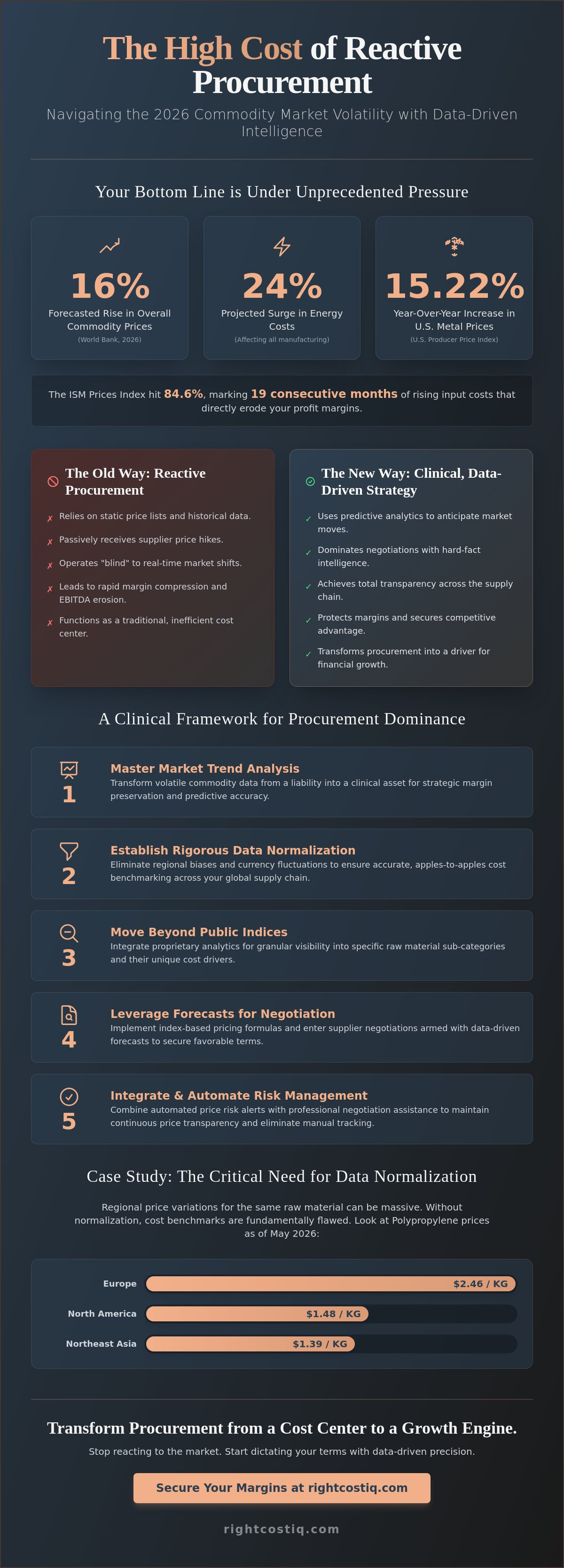
With the World Bank forecasting a 16% rise in overall commodity prices for 2026 and energy costs projected to surge by 24%, your current procurement strategy is likely underperforming. You've likely felt the impact of the ISM Prices Index hitting 84.6% in April 2026, marking 19 consecutive months of rising input costs that erode your bottom line. It's frustrating to enter negotiations without the data-driven leverage required to counter aggressive supplier price hikes, especially when the U.S. Producer Price Index for metals is up 15.22% year-over-year and North American polypropylene prices have climbed to $1.48 per kilogram.
This article provides a clinical framework for market price trend analysis for raw materials to help you reclaim your margins and secure a competitive procurement advantage. You'll master the architectural execution of price forecasting to mitigate volatility before it impacts your financial statements. We'll examine how to integrate automated RFP cycles with real-time price risk management and category cost benchmarking to achieve total transparency across your entire supply chain. This methodology transforms raw market data into a predictive framework for negotiation dominance and sustained operational efficiency.
Key Takeaways
- Master the architectural execution of market price trend analysis for raw materials to transform volatile commodity data into a clinical asset for margin preservation.
- Establish a rigorous data normalization process that eliminates regional biases and currency fluctuations to ensure accurate cost benchmarking across global supply chains.
- Move beyond the limitations of public indices by integrating proprietary analytics that provide granular visibility into specific raw material sub-categories and cost drivers.
- Secure a competitive procurement advantage by utilizing data-driven forecasts to implement index-based pricing formulas and dominate supplier negotiations with hard-fact intelligence.
- Integrate automated price risk management with professional negotiation assistance to maintain continuous price transparency and eliminate the inefficiencies of manual tracking.
The Strategic Imperative of Market Price Trend Analysis for Raw Materials
Reactive procurement is a financial liability. It's a direct threat to corporate solvency in a sustained repricing environment. When organizations rely on static price lists or retrospective data, they're essentially flying blind through a storm of economic disruption. Market price trend analysis for raw materials must be redefined as a clinical procurement asset; it's a strategic weapon that prioritizes predictive accuracy over historical reporting. The economic cost of waiting for a supplier's price adjustment notification is measured in rapid margin compression and structural EBITDA erosion. You can't afford to be a passive recipient of market shifts when your competitors are using data to dictate terms.
Successful firms are transitioning from traditional, fixed-cost assumptions to dynamic, market-aligned models. This shift is mandatory as global Commodity Markets experience unprecedented volatility. The World Bank forecasts a 16% rise in overall commodity prices throughout 2026. If your procurement team isn't using a clinical framework to anticipate these moves, you're effectively subsidizing your supplier's risk. Establishing a robust market price trend analysis for raw materials allows for the architectural execution of contracts that adapt to reality rather than resisting it.
The Anatomy of Commodity Volatility in 2026
Volatility in 2026 is driven by a complex intersection of geopolitical instability and structural energy shifts. Brent crude oil settling near $108 per barrel in May 2026 creates a massive ripple effect across all manufacturing sectors. Energy prices are projected to surge by 24% this year, directly impacting the extraction and processing costs of industrial metals and polymers. These aren't isolated spikes. They're systemic adjustments. Supply chain bottlenecks continue to act as force multipliers for price trends, particularly in high-demand sectors like artificial intelligence and infrastructure. For instance, the demand for copper is being significantly driven by data center expansion, creating a bullish market that necessitates a clinical, data-first approach to sourcing.
Financial Growth Metrics and Procurement Alignment
Precision-led market intelligence isn't just a supply chain function. It's a C-suite imperative. Linking trend analysis to EBITDA protection allows for immediate bottom-line efficiency. When you utilize data-driven sourcing, you're mitigating financial risk before it hits the balance sheet. With the U.S. Producer Price Index for metals and metal products showing a 15.22% increase from one year ago as of May 13, 2026, the ROI of a clinical analysis framework is undeniable. It provides the necessary leverage for hard-fact negotiations and ensures that procurement acts as a primary driver for financial growth. This alignment transforms procurement from a traditional cost center into a sophisticated engine for competitive advantage and margin preservation.
A Clinical Framework for Executing Raw Material Price Analysis
Execution of a sophisticated market price trend analysis for raw materials requires a departure from passive observation. It demands a structured, five-step architectural process that converts raw data into actionable intelligence. First, procurement teams must aggregate diverse data streams, moving beyond simple price tracking to include geopolitical risk factors and energy cost correlations. This creates comprehensive market visibility. Second, data normalization is critical to eliminate statistical noise. You must adjust for currency fluctuations and regional biases, especially when sourcing across fragmented global markets. For example, as of May 2026, polypropylene prices reached $2.46/KG in Europe while remaining at $1.39/KG in Northeast Asia; failure to normalize these figures results in flawed cost benchmarks.
Third, establish correlation between macroeconomic indicators and category-specific cost drivers. Utilizing the Producer Price Index (PPI) as a primary baseline allows you to track the average change in selling prices received by domestic producers. Fourth, execute predictive modeling to forecast future price corridors. This involves using regression analysis to identify leading indicators, such as crude oil futures or energy index surges, which often precede spikes in plastics and chemical derivatives. Finally, integrate these findings into the strategic sourcing lifecycle. By embedding market intelligence into your RFP management and negotiation cycles, you ensure that every contract reflects current and projected market realities. Organizations seeking to automate this process can leverage advanced price risk management services to maintain continuous margin protection.
Data Normalization and Baseline Establishment
Selecting an appropriate baseline index is the foundation of clinical analysis. While many firms use the current year as a starting point, a more robust strategy involves benchmarking against a pre-volatility baseline, such as January 2019, to quantify the full extent of structural repricing. Adjusting for currency fluctuations is equally vital for global sourcing. A strengthening or weakening dollar can mask underlying commodity price movements, leading to suboptimal negotiation outcomes. Eliminating statistical noise from temporary market anomalies, such as short-term logistics disruptions, ensures your trend analysis reflects long-term structural shifts rather than transient volatility.
Advanced Predictive Modeling Architectures
Predictive modeling transforms retrospective data into a forward-looking strategic asset. By utilizing regression analysis, procurement architects identify the specific leading indicators that signal impending price shifts. In 2026, machine learning plays a pivotal role in forecasting commodity trends by processing vast datasets that human analysts might overlook. Validating these model architectures through historical back-testing is essential. This clinical verification ensures that your forecasting framework remains accurate and reliable, providing the C-suite with the confidence needed to make high-stakes procurement decisions. Effective market price trending and forecasting services provide this level of granular visibility, allowing for proactive margin preservation.
Evaluating Data Sources: Public Indices vs. Clinical Analytics
Public indices are sufficient for academic observation, but they're insufficient for tactical execution. High-level data from sources like the World Bank or FRED provides a broad macroeconomic view that often fails to capture the granular shifts required for precise procurement. While the FAO Food Price Index averaged 130.7 points in April 2026, representing a 2% monthly increase, this aggregate figure doesn't account for the specific regional volatility that impacts your localized supply chain. Relying solely on free, delayed data creates a strategic blind spot. Clinical analytics prioritize real-time data feeds and sub-category visibility to ensure your market price trend analysis for raw materials reflects current transaction realities rather than historical averages.
Proprietary analytics allow for the integration of internal spend data with external market movements. This alignment is critical because it reveals the delta between what you pay and what the market dictates. Utilizing specialized resources like USGS Commodity Statistics provides deep-dive intelligence into global mineral flows, yet even these authoritative sources require clinical interpretation to be useful in a negotiation. You need a system that identifies price shifts as they happen, not thirty days after they've already compressed your margins.
The Pitfalls of Over-Reliance on Macro Indices
Index lag is a silent margin killer. Global indices often mask regional price spikes, such as the 1.29% monthly jump in the U.S. Producer Price Index for plastics and rubber products manufacturing reported in May 2026. If your procurement team relies on quarterly or even monthly macro updates, they're negotiating with outdated information. This lack of transparency is especially dangerous in secondary material markets where pricing is less standardized. Without clinical visibility, you're unable to distinguish between a legitimate market-wide trend and a supplier-specific price hike designed to capture excess margin.
Architecting a Custom Benchmarking Strategy
Developing category-specific cost models is the only way to achieve true price transparency. This involves breaking down a raw material into its constituent cost drivers, from energy inputs to logistics overhead. Leveraging a category management procurement framework allows you to identify specific savings opportunities that high-level indices overlook. Vendor-neutral data is the cornerstone of this strategy. It ensures your benchmarks are based on objective market performance rather than the self-serving data provided by a primary supplier. This clinical approach transforms market price trend analysis for raw materials from a passive report into a dynamic negotiation asset that secures a definitive competitive advantage.
Leveraging Trend Analysis as a Clinical Negotiation Asset
Architecting a dominant negotiation position requires the clinical application of market price trend analysis for raw materials. High-level decision-makers don't enter vendor discussions with sentiment; they enter with hard-fact market forecasts and "should-cost" models. These models dismantle unjustified price hikes by isolating commodity movements from supplier-side inefficiencies. If the U.S. Producer Price Index for metals reflects a 0.75% monthly change while a vendor demands a 5% increase, the discrepancy becomes a clinical point of contention. This data-driven leverage ensures that price adjustments remain strictly aligned with actual market shifts rather than supplier margin capture.
Integrating Market Trends into RFP Management
Designing RFP management frameworks that account for volatility is essential for structural EBITDA protection. Clinical RFPs require suppliers to provide transparent price breakdowns that isolate raw material costs from labor and overhead. This transparency allows procurement architects to evaluate supplier risk through their own material hedging strategies. When you understand the underlying cost drivers, you identify which vendors are vulnerable to energy index surges and which have secured stable supply chains. It's a method of validating vendor performance through the lens of market intelligence.
Contractual Mechanisms for Price Risk Mitigation
Index-based pricing formulas transform long-term contracts into dynamic risk management instruments. Negotiating price caps and collars informed by predictive modeling prevents unforeseen spikes from devastating your bottom line. Clinical execution also requires the inclusion of clawback clauses. These ensure that when market trends move downward, such as the fall of polyethylene prices to 8080 CNY/T on May 15, 2026, your organization captures those savings immediately. Quarterly price reviews must be a mandatory contractual pillar, supported by professional negotiation assistance and real-time analytics to maintain continuous price transparency.
The ISM Prices Index reached 84.6% in April 2026, marking 19 consecutive months of rising input costs. In this environment, manual tracking is a liability. You need a system that integrates price risk management with automated RFP cycles. By utilizing clinical analytics to drive negotiation strategy, you transition from a reactive cost-taker to a proactive market leader. This strategic alignment ensures that every dollar spent is optimized against the most current market data available.
RightCostIQ: Precision Architectures for Price Risk Management
Operationalizing a market price trend analysis for raw materials requires more than just access to data; it demands a technical architecture that converts intelligence into EBITDA protection. RightCostIQ provides the clinical framework necessary to automate market price trending, ensuring your margin protection is continuous rather than periodic. Manual tracking is a structural liability in 2026. With overall commodity prices forecast to rise by 16%, organizations can't rely on fragmented spreadsheets to manage global volatility. Our platform integrates professional negotiation assistance with real-time analytics to provide high-level decision-makers with the hard-fact leverage required to dominate supplier discussions.
Achieving enterprise-wide cost transparency is the primary driver for procurement ROI. When your strategic forecasting is perfectly aligned with your sourcing lifecycle, procurement transitions from a cost center to a value-generation engine. Clinical execution means identifying the delta between market indices and your actual spend in real-time. This visibility allows for the immediate implementation of price risk management and tracking services that protect your bottom line from unforeseen energy surges or geopolitical shifts. It's about establishing a relentless focus on financial growth through technical precision.
The RightCostIQ Procurement Analytics Advantage
Moving beyond rudimentary spreadsheets is essential for maintaining a competitive advantage. RightCostIQ delivers a sophisticated procurement and vendor performance tracking service that identifies price deviations the moment they occur. We provide customized procurement category cost benchmarking and analytics for complex raw material categories, from industrial metals to specialized polymers. This granular visibility ensures that your data-driven sourcing is based on objective market performance. Our systems eliminate the statistical noise that often plagues internal reporting, providing a clean, clinical view of your category spend. Operational efficiency is maximized when every procurement decision is backed by verified market intelligence.
Securing Your 2026 Procurement Strategy
Securing your financial future requires an objective evaluation of your current price tracking infrastructure. We recommend requesting a clinical audit of your existing systems to identify gaps in your margin preservation framework. Implementing the RightCostIQ framework provides an immediate impact by integrating our market price trending and forecasting service into your active contract management. This ensures that your organization is positioned to capture downward trends while shielding itself from upward volatility. Don't leave your margins to chance. Contact our strategists for a professional consultation and discover how our request for proposal (RFP) management and negotiation assistance can transform your procurement outcomes today.
Mastering the Architectural Shift in Procurement Strategy
Securing margin stability in a sustained repricing environment requires an architectural shift from retrospective reporting to clinical execution. You've established that relying on lagging public indices is a strategic liability that invites margin compression. By implementing a rigorous framework for market price trend analysis for raw materials, you transform commodity volatility into a quantifiable negotiation advantage. This transition ensures that your procurement department functions as a primary driver for financial growth rather than a passive cost center.
Effective margin preservation depends on the integration of real-time analytics with structured negotiation cycles. You now have the methodology to dismantle supplier price hikes using should-cost models and automated risk tracking. It's time to replace manual tracking with a technical architecture that prioritizes bottom-line efficiency and enterprise-wide transparency.
Optimize your procurement outcomes with RightCostIQ's clinical market intelligence. Our platform leverages proprietary market forecasting models and data-driven RFP negotiation frameworks to protect your interests. With specialized experts in price risk management at your side, you're equipped to dominate the 2026 market. Take control of your supply chain destiny today.
Frequently Asked Questions
What is the primary difference between a price index and a trend analysis?
A price index serves as a static benchmark or a historical snapshot of market value at a specific point in time. In contrast, market price trend analysis for raw materials is a longitudinal study of price momentum that identifies the velocity and direction of market shifts. This analysis allows procurement architects to move beyond simple tracking and establish predictive models for future cost corridors.
How often should raw material price trend analysis be performed for maximum efficiency?
High-volatility commodities require real-time monitoring to capture rapid shifts, such as the 6.5% North American polypropylene surge observed in May 2026. For general strategic benchmarking, a monthly analysis cycle is the clinical standard. This frequency ensures that your procurement strategy remains aligned with the latest Producer Price Index data without being overwhelmed by daily statistical noise.
Can market price trends be used to justify price increases to end customers?
Clinical trend analysis provides the objective data required to justify necessary price adjustments to end customers through transparent "should-cost" models. By demonstrating that input costs, like the 24% projected energy price surge in 2026, are systemic rather than operational, you maintain customer trust. This data-driven approach transforms a difficult conversation into a fact-based business discussion.
What are the most reliable data sources for global raw material price tracking in 2026?
The most reliable sources include the U.S. Bureau of Labor Statistics for Producer Price Index data and the USGS for specialized mineral intelligence. Additionally, the FAO Food Price Index and the World Bank's commodity forecasts provide essential macroeconomic context. Organizations seeking a competitive advantage integrate these public streams with proprietary clinical analytics to achieve granular visibility into specific sub-categories.
How does price risk management differ from traditional procurement?
Traditional procurement focuses on transactional efficiency and localized cost savings during a specific RFP cycle. Price risk management is a strategic architecture that prioritizes long-term margin preservation through predictive modeling and contractual safeguards. It shifts the focus from reactive buying to proactive financial growth by mitigating the impact of unforeseen commodity spikes.
What role does technology play in automating market price trend analysis?
Technology automates the aggregation and normalization of vast global data streams to eliminate manual tracking errors. Advanced architectures use regression analysis and machine learning to identify leading indicators, such as energy futures, that signal impending material price shifts. This automation allows procurement teams to focus on high-stakes negotiation strategy rather than data entry.
Is it possible to predict raw material price spikes with clinical accuracy?
Predicting exact price points is impossible, but achieving clinical accuracy in forecasting price corridors is entirely feasible through advanced regression modeling. By analyzing the correlation between energy inputs and manufacturing indices, procurement teams can identify high-probability price movements. This predictive capability allows for the execution of material hedging and index-based contracts that shield the organization from volatility.
How can small to mid-sized enterprises compete with global firms in price risk management?
Small to mid-sized enterprises compete by leveraging specialized market price trend analysis for raw materials through third-party clinical partners. These firms gain access to the same proprietary forecasting models and negotiation expertise used by global corporations. By utilizing outsourced analytics and expert negotiation assistance, SMEs achieve the data-driven leverage necessary to secure favorable terms from large-scale suppliers.


