
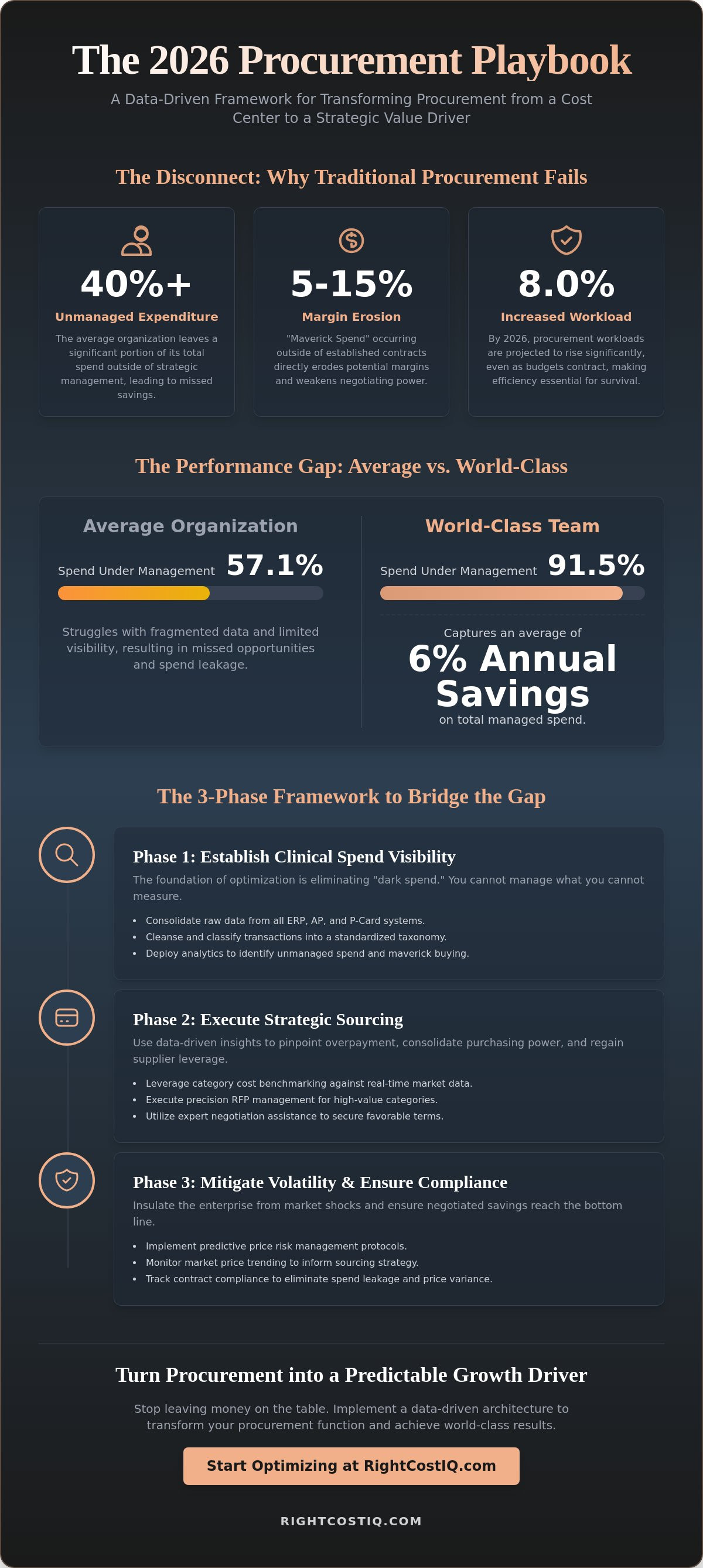
In 2026, world-class procurement teams capture 6% savings on total managed spend annually, while the average organization leaves over 40% of its expenditure unmanaged. Determining how to reduce procurement spend requires more than tactical negotiation; it demands a clinical approach to fragmented data across multiple ERPs and a lack of market price benchmarks. It's a common frustration when savings identified during the RFP process never actually hit the bottom line. This disconnect often stems from a lack of visibility into market price trending and volatile forecasting cycles.
This article details a data-driven architecture designed for the current fiscal environment. You'll master a structured framework for spend analysis that increases your spend under management ratio toward the 91.5% benchmark set by industry leaders. We'll examine the specific mechanics of category cost benchmarking, price risk management, and the execution of strategic RFP management. By the end of this guide, you'll have a 2026-ready roadmap for turning procurement into a predictable driver of enterprise financial growth.
Key Takeaways
- Identify and neutralize margin erosion caused by "Maverick Spend" through systematic data classification and clinical spend visibility.
- Master the methodology of how to reduce procurement spend by leveraging category cost benchmarking to pinpoint overpayment across fragmented ERP environments.
- Execute high-precision strategic sourcing through professional RFP management and expert negotiation assistance to regain leverage over dominant suppliers.
- Insulate the enterprise from market volatility by implementing predictive price risk management and clinical market price trending services.
- Transition from transactional expense management to a strategic procurement architecture that utilizes performance tracking to ensure identified savings hit the bottom line.
The Architecture of Procurement Spend: Why Traditional Cost-Cutting Fails
Strategic spend optimization isn't a one-time negotiation event. It's the clinical alignment of sourcing protocols, financial reporting, and operational execution. Understanding how to reduce procurement spend requires a move away from fragmented, siloed data toward a unified architecture. Traditional cost-cutting fails because it targets visible surface costs while ignoring the systemic inefficiencies that drain capital. In a 2026 market where procurement workloads are projected to increase by 8.0% while budgets contract, efficiency isn't optional. It's a survival metric.
The "Maverick Spend" trap remains a primary threat to corporate profitability. Unmanaged tail spend, occurring outside of established contracts, typically erodes 5% to 15% of potential margins. Without a rigorous procurement process, these leaks go unnoticed until they've significantly impacted the bottom line. By 2026, the baseline for success has shifted. Manual spreadsheets can't track global spend with the precision required to compete in high-volatility environments. High-performing teams now rely on automated data ingestion to distinguish between Hard Savings and Soft Savings. Hard Savings represent direct, measurable budget reductions that appear on the P&L statement. Soft Savings focus on strategic cost avoidance and value-add improvements that don't always result in immediate cash-flow changes but protect long-term margins.
The Economic Impact of Inefficient Category Strategy
Poor category management creates a landscape of redundant suppliers and fragmented purchasing power. When organizations fail to consolidate spend, they lose the leverage necessary for aggressive negotiation. Achieving enterprise-wide ROI is directly correlated to spend visibility. If you can't see the spend, you can't manage the risk. For a deeper analysis of these frameworks, consult our guide on Category Management in Procurement. This strategic alignment ensures that every dollar spent is optimized against current market benchmarks.
Identifying the Root Causes of Spend Leakage
Spend leakage occurs when the execution of a contract fails to match its intent. Contract non-compliance often results in price variance, where different business units pay varying amounts for the identical SKU. This inconsistency signals a breakdown in centralized control and a lack of standardized vendor performance tracking. Spend leakage is the delta between the contracted price and the actual invoice price. Eliminating this gap requires continuous data cleansing and clinical audit protocols to ensure that negotiated savings actually materialize as realized financial gains. Organizations must move toward a model where how to reduce procurement spend is answered by data-driven compliance rather than occasional discounts.
Phase 1: Establishing Spend Visibility Through Clinical Data Analytics
Clinical visibility is the prerequisite for any cost optimization initiative. You can't optimize what you can't measure. When analyzing how to reduce procurement spend, the first objective is the elimination of "dark spend" through rigorous data cleansing. This process involves mapping raw transaction data from multiple ERPs to a standardized taxonomy like UNSPSC or a custom internal hierarchy. This classification isn't merely administrative; it's a strategic requirement for identifying where capital is leaking through unmanaged channels.
The primary efficiency metric for this phase is Spend Under Management (SUM). Current data indicates the average organization manages roughly 57.1% of its spend, while best-in-class entities achieve 91.5%. Bridging this gap requires moving beyond static reporting to active procurement category cost benchmarking and analytics. By centralizing visibility, procurement leaders can finally track if "identified" savings actually materialize on the balance sheet.
A Methodical Approach to Spend Analysis
Achieving total visibility requires a three-step data architecture:
- Step 1: Data Extraction: Consolidate raw transaction files from all ERP, AP, and P-Card systems to capture every dollar leaving the enterprise.
- Step 2: Supplier Normalization: Group parent and child entities. If "IBM" and "International Business Machines" aren't consolidated, you lose the ability to leverage total volume during negotiations.
- Step 3: Categorization: Segment data into strategic vs. tactical spend. This allows teams to prioritize high-value categories that offer the greatest margin expansion potential.
Advanced Benchmarking: Identifying Category Savings
Benchmarking turns subjective negotiation into an objective data exercise. It uses external market intelligence to validate whether current supplier pricing aligns with real-world standards. For high-volatility categories, integrating a Price Risk Management and Tracking Service is essential to prevent price "creep" during inflationary cycles. Without this external lens, procurement teams often celebrate "savings" that are actually just market-driven price drops.
Integrating a Market Price Trending and Forecasting Service allows the organization to differentiate between internal performance and broader market shifts. If global prices for a commodity drop 10% but your internal costs only decrease by 2%, your strategy is failing despite the nominal reduction. This clinical level of detail ensures that how to reduce procurement spend becomes a repeatable, data-driven process rather than a reaction to budget pressure.
Phase 2: Executing Strategic Sourcing via Precision RFP Management
Executing a clinical RFP lifecycle is the primary lever for organizations seeking how to reduce procurement spend with permanent results. The transition from decentralized ad-hoc purchasing to a structured Request for Proposal (RFP) architecture provides the discipline required for enterprise-wide cost optimization. Ad-hoc buying often leaves the organization vulnerable to supplier-driven pricing models. By contrast, a precision-led RFP process shifts leverage back to the buyer by creating a competitive environment where vendors must align with specific technical and financial requirements.
Successful execution requires moving beyond simple unit price comparisons. A clinical sourcing strategy utilizes the Total Cost of Ownership (TCO) model, which accounts for logistics, maintenance, risk, and disposal costs. A lower unit price is often a deceptive metric if it's accompanied by high failure rates or hidden service fees. In the current 2026 regulatory environment, including the May 2026 Executive Order prioritizing fixed-price contracts, shifting financial risk to the contractor has become a standard requirement for protecting margins. Professional negotiation assistance ensures these risk-transfer mechanisms are embedded into the final agreement.
The RFP Lifecycle: From Intake to Award
The RFP process begins with rigid requirement definitions to prevent scope creep and subsequent price inflation. When technical specifications are vague, suppliers build "risk premiums" into their pricing, which artificially inflates the total cost. Utilizing competitive bidding through a strategic RFP management framework ensures that the organization receives market-optimal pricing based on current intelligence. This methodical approach eliminates the "incumbent advantage," forcing existing suppliers to remain competitive with emerging market entrants.
Data-Driven Negotiation Tactics
Professional negotiation assistance transforms the sourcing event from an emotional discussion into a technical data exercise. By using procurement category cost benchmarking as a "Batna" (Best Alternative to a Negotiated Agreement), procurement teams can challenge supplier quotes with objective market facts. Negotiations should extend beyond the base price to include payment terms and volume rebates that enhance organizational cash flow. The clinical execution of a structured RFP cycle represents the highest ROI activity in the procurement lifecycle due to its immediate impact on contractually locked-in margins.
Finalizing the award is only the beginning of the savings lifecycle. To ensure that negotiated discounts actually reach the bottom line, organizations must implement a Procurement and Vendor Performance Tracking Service. Without continuous monitoring, "identified" savings often erode through contract non-compliance or unapproved price adjustments. Realized savings require a closed-loop system where vendor performance is audited against the original RFP benchmarks.
Phase 3: Mitigating Volatility with Price Risk Management and Market Trending
Reactive procurement is a primary driver of cost overruns and margin erosion. Organizations seeking how to reduce procurement spend must move beyond historical data analysis into the realm of predictive intelligence. Utilizing a Market Price Trending and Forecasting Service prevents the "reactive" trap where sourcing decisions are made under market duress. By identifying price cycles before they peak, procurement leaders can execute strategic "forward buying" or adjust contract timing to lock in rates when market conditions are most favorable.
The 2026 fiscal environment demands a sophisticated approach to contract structures. Following the May 2026 Executive Order that established fixed-price contracts as the default method for federal purchasing, private sector entities are increasingly mirroring this shift to transfer financial risk to the contractor. Implementing clinical Price Risk Management for commodities and high-value components ensures that market volatility doesn't erode the savings achieved during the initial RFP stage. This strategic posture transforms procurement from a cost center into a risk-mitigation engine.
Market Price Trending as a Negotiation Lever
Market intelligence serves as an objective shield against arbitrary supplier price hikes. When a vendor requests a price increase citing "macroeconomic conditions," clinical trending data allows procurement to verify if that claim aligns with actual index shifts. If the market trend for a specific raw material has only risen by 2%, a supplier's 7% increase request is exposed as an attempt at margin expansion. Implementing index-based pricing ensures that the organization captures automatic savings when market rates drop, rather than waiting for the next manual negotiation cycle.
Managing Supply Chain Resilience and Compliance
Spend reduction is inextricably linked to supply chain resilience. Vendor performance tracking acts as a critical spend reduction tool by identifying early signs of supplier instability or contract non-compliance. Mitigating these risks prevents the need for emergency "spot buying" at premium rates, which typically occurs when a primary supplier fails to meet obligations. To maintain predictable cost structures despite global market fluctuations, organizations should integrate a Price Risk Management and Tracking Service. This proactive posture ensures that the question of how to reduce procurement spend is answered by strategic foresight rather than emergency response.
Scaling Efficiency: Integrating Procurement Infrastructure for Sustainable Savings
Sustainable cost optimization requires a fundamental shift from transactional expense management to strategic procurement analytics. While expense management focuses on the historical recording of spend, strategic analytics utilizes data to dictate future sourcing behavior. Determining how to reduce procurement spend at scale involves moving away from manual, spreadsheet-based tracking and toward a clinical infrastructure that integrates market intelligence with operational execution. This transition is critical in a 2026 landscape where procurement workloads are rising by 8.0% while staffing levels continue to contract.
The ROI of professional RFP management services significantly outpaces manual in-house efforts. Internal teams often lack the specialized category benchmarks and the dedicated bandwidth required to execute a high-precision sourcing event. By contrast, a clinical approach utilizes automated vendor performance tracking to reduce administrative overhead and ensure contract compliance. This infrastructure ensures that the savings identified during the negotiation phase are actually realized as bottom-line growth. The RightCostIQ methodology bridges the gap between high-level financial strategy and technical sourcing execution, providing a repeatable framework for margin expansion.
The Role of Professional Negotiation Assistance
External expertise often yields 10% to 20% higher savings than internal teams due to the depth of specialized category knowledge and proprietary market intelligence. Professional negotiators operate with a clinical understanding of supplier cost structures and margin thresholds that internal generalists may overlook. In complex RFPs involving high-value components or global logistics, this level of technical precision is the difference between a standard discount and a market-optimal agreement. Leveraging external negotiation assistance allows the organization to maintain strategic leverage even when dealing with dominant, incumbent suppliers.
Next Steps for Enterprise Cost Optimization
Achieving a 2026-ready procurement posture requires an immediate audit of current capabilities and data readiness. Most organizations struggle with fragmented data across multiple ERPs, which masks the true extent of spend leakage and maverick purchasing. To master how to reduce procurement spend permanently, leadership must prioritize the following tactical actions:
- Conduct a clinical spend analysis to identify immediate category savings and consolidate fragmented supplier redundancies.
- Implement a Procurement and Vendor Performance Tracking Service to eliminate the delta between contracted prices and actual invoice totals.
- Integrate market price trending and forecasting to move from reactive buying to proactive, risk-adjusted sourcing.
The path to sustainable savings begins with a data-driven assessment of your current sourcing architecture. Schedule a consultation with RightCostIQ for a clinical spend analysis to identify hidden margin opportunities and scale your procurement efficiency.
Advancing Toward a Clinical Procurement Architecture
Mastering how to reduce procurement spend in 2026 requires a departure from tactical, reactive purchasing toward a model of clinical execution. We've established that sustainable cost optimization relies on the integration of three critical pillars: total spend visibility, precision-led RFP management, and proactive price risk mitigation. Organizations that fail to bridge the gap between identified and realized savings will continue to see margins eroded by market volatility and non-compliant maverick spend. It's no longer enough to negotiate a lower unit price; you must architect a system that sustains those gains through every market cycle.
The transition to high-performance procurement is an operational necessity. By leveraging proprietary procurement category cost benchmarking and specialized price risk management services, your team can transform from a cost center into a strategic driver of enterprise growth. Precision matters. Optimize your procurement outcomes with RightCostIQ RFP Management to secure your competitive advantage. It's time to replace fragmented data with clinical certainty and start delivering predictable financial results.
Frequently Asked Questions
What is the most effective way to reduce procurement spend quickly?
The most immediate method to reduce procurement spend is identifying and consolidating fragmented tail spend through clinical visibility. By aggregating data across multiple ERPs, organizations can execute rapid sourcing events on high-volume categories. This approach leverages consolidated purchasing power to extract immediate price concessions from suppliers without altering operational requirements.
How does spend analysis differ from expense management?
Spend analysis is a strategic function that classifies procurement data to identify future sourcing opportunities, while expense management is a transactional record of historical payments. While expense management ensures accounting accuracy, spend analysis utilizes taxonomy and clinical benchmarking to drive margin expansion. It focuses on the strategic allocation of future capital rather than just the reconciliation of past expenditures.
What is maverick spend and how does it affect the budget?
Maverick spend refers to unauthorized purchasing conducted outside of established corporate contracts or procurement protocols. This behavior typically erodes 5% to 15% of potential margins by bypassing negotiated volume discounts and favorable payment terms. Controlling maverick spend requires rigorous vendor performance tracking and the implementation of centralized RFP management to ensure compliance across all business units.
Can small businesses benefit from RFP management services?
Small businesses derive significant value from RFP management services by gaining access to the same clinical negotiation tactics used by enterprise-level entities. Professional assistance helps smaller firms mitigate supplier leverage and secure competitive pricing that matches market benchmarks. This strategic support is vital for managing high-value components where price risk management is essential for protecting thin margins.
How do you measure the success of a procurement spend reduction program?
Success is quantified through the Spend Under Management (SUM) ratio and the delta between identified savings and actual realized bottom-line impact. A best-in-class program targets a SUM ratio of roughly 91.5% according to 2026 industry benchmarks. Additional KPIs include contract compliance rates and the reduction of price variance across different business units for identical SKUs.
What is procurement category cost benchmarking?
Procurement category cost benchmarking is the clinical process of comparing internal supplier pricing against external market intelligence and industry standards. This objective data exercise identifies overpayment and provides a factual baseline for negotiations. It transforms subjective discussions into data-backed technical sourcing events, ensuring that the organization pays the market-optimal rate for every category.
How does market price forecasting help in contract negotiations?
Market price forecasting provides the predictive intelligence required to move from reactive buying to proactive, risk-adjusted sourcing. By understanding future price trajectories, procurement leaders can time contract renewals or execute strategic buying to lock in favorable rates. This forecasting acts as a critical negotiation lever, allowing teams to challenge supplier price increases that exceed actual market trends.
What role does vendor performance tracking play in cost savings?
Vendor performance tracking serves as the final audit mechanism to ensure that negotiated RFP savings are actually realized as financial gains. Continuous monitoring prevents price creep and identifies contract non-compliance that would otherwise lead to spend leakage. By maintaining visibility into supplier delivery and pricing accuracy, organizations protect the margins established during the strategic sourcing phase.


