
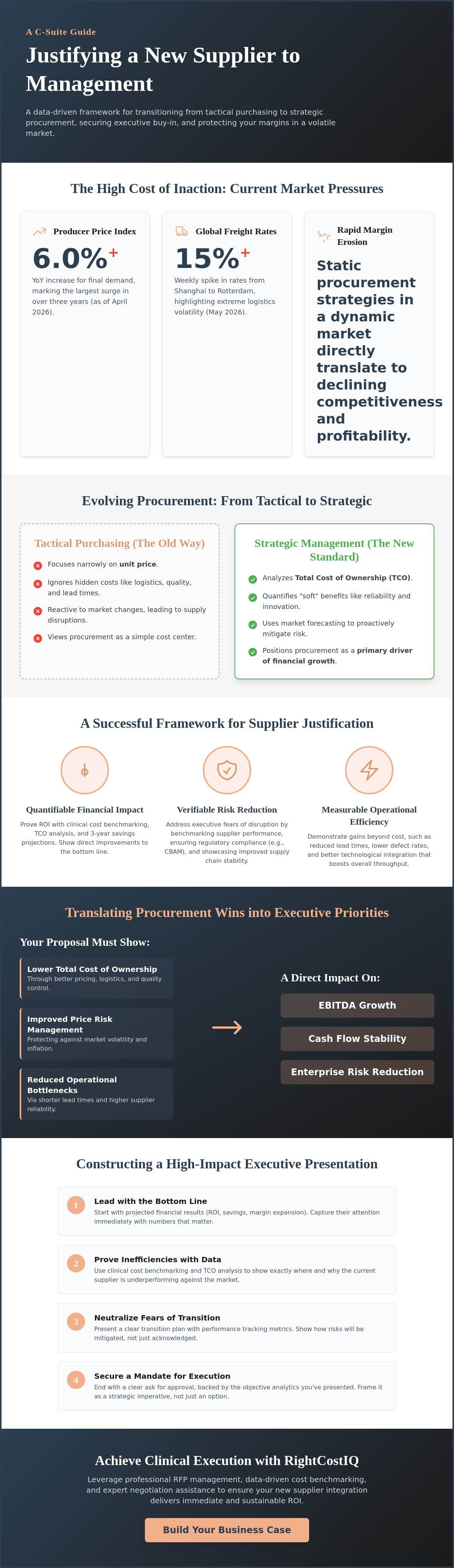
The U.S. Producer Price Index for final demand surged 6.0% in the twelve months ending April 2026, the largest increase in over three years. This inflationary pressure, combined with a 15% weekly spike in freight rates from Shanghai to Rotterdam in May 2026, creates an environment where static procurement strategies lead to rapid margin erosion. You likely recognize the need for a transition, but executive leadership often views supplier switching through a lens of risk and disruption. Mastering how to justify a new supplier to management requires a clinical audit of risk mitigation and long-term margin protection rather than a simple comparison of features.
We'll bridge the gap between procurement technicalities and C-suite financial goals by providing a structured framework for securing executive buy-in. You'll learn to quantify soft benefits like reliability and navigate complex regulatory requirements, such as the EU Carbon Border Adjustment Mechanism reporting mandates. This guide outlines the data-driven methodology needed to prove ROI through cost benchmarking and market price forecasting, ensuring your proposal for a more efficient procurement infrastructure is met with approval instead of skepticism.
Key Takeaways
- Learn to transition procurement from tactical purchasing to strategic category management by building a formal business case for optimization.
- Utilize clinical cost benchmarking and Total Cost of Ownership analysis to prove current supplier inefficiencies and highlight margin expansion opportunities.
- Master the specific data points required for how to justify a new supplier to management while neutralizing fears of transition failure through performance tracking metrics.
- Discover how to construct a high-impact executive presentation that leads with bottom-line financial results and supports claims with objective analytics.
- Leverage professional RFP management and negotiation assistance to ensure your new supplier integration delivers immediate and sustainable ROI.
The Strategic Framework for Supplier Justification
Supplier justification isn't an administrative formality; it's a rigorous business case designed to optimize procurement infrastructure. Management often perceives supplier switches as disruptive overhead that threatens operational stability. To overcome this skepticism, you must frame the transition as a strategic necessity. A successful framework relies on three distinct pillars: quantifiable financial impact, verifiable risk reduction, and measurable operational efficiency. By presenting the switch as a clinical audit of value rather than a mere change in vendor, you position yourself as a strategic architect of the company's bottom line.
Maintaining the status quo in a volatile market is a high-risk financial strategy. With the Producer Price Index for final demand increasing 6.0% year-over-year as of April 2026, passive vendor management leads to immediate margin contraction. Executives need to see that sticking with an underperforming legacy supplier isn't the safe choice; it's a choice to accept declining competitiveness and rising intermediate demand costs. When you're determining how to justify a new supplier to management, the objective is to prove that the cost of complacency far outweighs the temporary friction of a transition.
Moving Beyond Tactical Vendor Selection
Effective procurement requires a shift from simple transactional buying to a comprehensive category management procurement strategy. Tactical selection focuses narrowly on unit price, but strategic justification utilizes a Strategic Sourcing Framework to evaluate the lowest total cost of ownership. This clinical approach identifies hidden inefficiencies in legacy contracts. If a current supplier hasn't adjusted to current market intelligence or technological integration, they're likely a bottleneck to your growth. You aren't just looking for a new vendor; you're auditing your supply chain for precision and long-term viability.
Identifying the Executive Priorities
Understanding how to justify a new supplier to management starts with aligning your proposal with C-suite metrics. Management prioritizes EBITDA, cash flow, and enterprise risk. Your justification must explicitly state how the new supplier improves these specific figures. Will the switch reduce days payable outstanding? Does the new partner offer better price risk management to stabilize cash flow against the 1.4% monthly PPI increases seen in April 2026? Before presenting, establish a baseline of current performance metrics. Use objective data points to show where the current infrastructure fails to meet corporate financial goals. This alignment transforms procurement from a cost center into a primary driver of financial growth.
Quantifying the Value Proposition: Beyond Price Points
Management demands empirical evidence before authorizing a supplier transition. Mastering how to justify a new supplier to management requires shifting the conversation from invoice line items to total value extraction. Unit prices often mask systemic inefficiencies; therefore, a clinical audit must utilize cost benchmarking to prove when current rates exceed market averages. By calculating the Total Cost of Ownership (TCO), you expose the impact of secondary variables like logistics volatility. For instance, with global container freight rates increasing 6% in late May 2026, a supplier with a lower unit price but inefficient shipping routes may actually represent a net loss.
A comprehensive 3-year ROI projection provides the longitudinal view executives require. This projection must account for "hidden" savings, including reduced lead times and lower defect rates, which directly impact operational throughput. Transitioning to a partner with superior quality control reduces the rework costs that often plague legacy contracts. Utilizing data-driven cost benchmarking allows you to present these findings with the surgical precision necessary for approval.
Leveraging Procurement Analytics for Justification
Market price trending and forecasting services allow procurement teams to model future savings against inflationary benchmarks. With the Producer Price Index for final demand rising 1.4% in April 2026 alone, the "cost of doing nothing" over a 12-month period becomes a measurable financial liability. Spend analytics identify category-wide inefficiencies that occur when legacy suppliers fail to innovate. By quantifying these missed opportunities, you transform the procurement department into a proactive engine for margin protection.
The ROI of Superior Terms and Conditions
Financial justification extends into the optimization of strategic supplier relationships. Negotiating payment term extensions acts as a direct lever for cash flow optimization, allowing the organization to deploy capital more effectively elsewhere. You should also quantify the value of volume rebates and tiered pricing structures that reward organizational growth. Historical performance data from current vendors serves as a baseline; comparing this against the projected performance of a new, vetted partner provides the objective evidence needed to secure executive buy-in. This methodical approach ensures that every contractual detail contributes to the company's broader financial objectives.
Risk Mitigation and Performance Benchmarking
Management's primary objection to procurement optimization is the perceived risk of transition failure. Executives often view switching costs as an immediate financial hit without guaranteed returns. To overcome this, you must present a clinical risk-mitigation strategy that treats the transition as a controlled deployment rather than a leap of faith. Proposing a pilot phase allows the organization to validate the new supplier’s operational capacity without fully decoupling from legacy systems. This phased approach effectively neutralizes the "all-or-nothing" fear that often stalls executive approval.
Learning how to justify a new supplier to management involves demonstrating that the new partner isn't just cheaper, but structurally more stable. In the current 2026 regulatory environment, compliance is a non-negotiable risk factor. New EU Machinery Regulations and CBAM reporting mandates require suppliers to provide verified carbon and cybersecurity data. A supplier lacking these capabilities represents a looming liability. By choosing a partner with superior compliance frameworks, you're protecting the enterprise from future regulatory fines and supply chain disruptions.
Benchmarking Vendor Performance
Objective benchmarking transforms subjective vendor evaluations into a clinical performance audit. You must compare the incumbent against the proposed supplier using specific Key Performance Indicators (KPIs):
- Quality Consistency: Analyze historical defect rates and compare them against the new supplier’s verified quality management systems.
- Delivery Precision: Measure on-time-in-full (OTIF) rates, especially critical given the 8.1% increase in truck transportation freight prices reported in April 2026.
- Innovation Output: Evaluate the supplier's ability to integrate modern technology, such as AI-driven inventory management, into your existing workflow.
Utilizing a professional Procurement and Vendor Performance Tracking Service ensures these metrics remain transparent and automated. This reduces the administrative burden on internal management and provides the third-party validation necessary to confirm the new supplier’s market standing.
Price Risk Management as a Competitive Advantage
Stabilizing margins in an inflationary economy requires more than just a low starting price. You need to highlight how the new supplier offers superior protection against market volatility. Contracts should include specific transparency clauses that link pricing to objective market benchmarks rather than arbitrary vendor increases. Highlighting a new partner's willingness to engage in a Price Risk Management and Tracking Service demonstrates a commitment to long-term stability. This link between supplier reliability and supply chain resilience is a powerful argument when explaining how to justify a new supplier to management. It proves that you're prioritizing the organization's long-term financial health over short-term tactical gains.
Constructing the Management Presentation
The final stage in the procurement optimization workflow is the construction of a high-stakes executive presentation. This is the definitive moment for how to justify a new supplier to management. A successful pitch avoids narrative fluff and focuses on strategic financial alignment. Start with a punchy Executive Summary that links the supplier switch directly to EBITDA growth. Management shouldn't have to hunt for the value proposition; it should be the first data point they encounter. By leading with the bottom-line impact, you establish immediate professional authority and set a results-oriented tone for the remainder of the session.
Present the Evidence section as a clinical comparison of cost benchmarking and RFP results. Highlight the variance between current legacy rates and the optimized market benchmarks identified through your analysis. This isn't just about saving money; it's about correcting a market misalignment. Address Risk Assessment with the same precision. Proactively detail the switching costs and the mitigation plans you've engineered, such as the pilot phase discussed previously. An Implementation Roadmap should follow, providing a granular timeline of resource requirements and integration milestones. Finally, provide "The Ask," a clear, binary decision that forces a resolution based on the data provided.
Visualizing the Data for C-Suite Clarity
C-suite executives prioritize high-density information delivery. Utilize waterfall charts to show the specific bridge from current spend to projected savings. A side-by-side performance matrix comparing the incumbent's delivery precision against the new supplier’s verified metrics provides immediate clarity. One single sentence must encapsulate the net financial gain of the switch, acting as the linguistic anchor for the entire session. Visualizing these metrics removes ambiguity and allows management to focus on the strategic necessity of the transition.
Handling Difficult Questions and Objections
Preparation for management pushback is essential for success. When asked "Why now?", point to the accelerating inflationary trends and regulatory shifts that make delay a financial liability. If the question of failure arises, point back to your risk-mitigation framework and the use of professional RFP Management to ensure a superior selection process. Using data-driven forecasting to answer timeline-related queries removes emotion from the discussion. To ensure your data is ironclad before the meeting, consider leveraging our Procurement Category Cost benchmarking and Analytics to validate your financial projections.
Clinical Execution with RightCostIQ
RightCostIQ delivers the analytical precision required to transform procurement from a functional task into a strategic growth driver. When you're determining how to justify a new supplier to management, the burden of proof rests on objective data points that legacy internal systems often fail to provide. Our Procurement Category Cost benchmarking and Analytics platform offers the clinical baseline needed for ironclad justification. By utilizing real-time market intelligence, you provide management with a verified audit of current overspending versus optimized market rates. This evidence-based approach removes the emotional friction often associated with vendor transitions.
Securing executive buy-in is only the first phase; maintaining post-transition margins requires a relentless focus on efficiency. Our Price Risk Management and Tracking Service protects your organization from the market volatility highlighted by the 6.0% PPI increase ending April 2026. We integrate automated Procurement and Vendor Performance Tracking Services to ensure long-term compliance with evolving global mandates like the EU CBAM reporting requirements. This ensures that the justification you presented remains valid throughout the entire contract lifecycle, preventing the margin leakage that typically occurs in unmonitored supplier relationships.
The Power of Professional Negotiation Assistance
RightCostIQ functions as a high-level extension of your procurement team, providing Request For Proposal (RFP) Management and Negotiation Assistance that ensures a superior selection process. Having a third-party expert validate your supplier choices adds a layer of professional authority that internal teams often lack. Our proprietary tracking architectures identify efficiency gains that standard procurement software misses. This expert-led validation is a critical component of how to justify a new supplier to management, as it signals that the transition is backed by deep industry expertise and clinical analysis rather than internal preference.
Next Steps: Securing Your Competitive Edge
The transition to a high-performance procurement infrastructure begins with a clinical audit of your current category spend. We provide the frameworks necessary for immediate spend analysis and market price trending and forecasting. This objective transparency allows you to identify which legacy contracts represent the highest risk to your 2026 financial targets. It's time to replace management skepticism with data-driven confidence by utilizing a methodology built for the modern production economy. Contact RightCostIQ to optimize your procurement outcomes and secure the data-driven methodology required for executive approval.
Securing Your Strategic Procurement Advantage
Effective supplier justification requires a shift from transactional vendor selection to a clinical audit of long-term financial impact. By utilizing Total Cost of Ownership models and objective benchmarking, you transform procurement into a primary driver of EBITDA growth. Mastering how to justify a new supplier to management ensures that your organization remains resilient against inflationary pressures and evolving regulatory mandates. High-stakes decision-making demands the technical precision provided by proprietary market trending and automated performance tracking.
RightCostIQ specializes in healthcare financial analytics, providing the data-driven methodology needed to secure executive buy-in. Our proprietary cost benchmarking and market trending models offer the transparency required for ironclad justification. We deliver professional RFP management and negotiation assistance to ensure your new partner integration is seamless and profitable. Optimize your supplier justification process with RightCostIQ analytics. You're now equipped with the framework to lead your organization toward a more efficient and competitive procurement future.
Frequently Asked Questions
What is the most important metric for justifying a new supplier?
Total Cost of Ownership (TCO) is the definitive metric for any strategic justification. It aggregates unit price, logistics, and risk-adjusted transition costs into a single financial figure. By focusing on TCO, you prove that the new supplier protects the organization's bottom line more effectively than a vendor offering a lower sticker price with higher hidden inefficiencies.
How do I calculate the 'cost of doing nothing' in procurement?
Calculate this cost by measuring the variance between your current legacy contract rates and real-time market benchmarks. This spread represents the immediate margin erosion the organization accepts by maintaining the status quo. Projecting this delta over a 12-month horizon exposes the financial liability of sticking with an unoptimized supply chain.
How can I address management's fear of switching costs?
Neutralize the fear of switching costs by presenting a clinical ROI projection that shows exactly when the transition pays for itself. Mastering how to justify a new supplier to management involves proving that the long-term margin expansion outweighs the one-time resource outlay. A phased implementation roadmap further reduces perceived risk by ensuring operational continuity during the switch.
Should I use an RFP to justify a new supplier?
A formal RFP is a non-negotiable tool for objective justification. It creates a competitive environment that forces transparency and validates your selection through a structured scoring matrix. This process ensures the selection is legally and financially defensible while removing the perception of internal bias or subjective preference.
How does cost benchmarking improve my negotiation leverage?
Cost benchmarking provides the empirical market intelligence needed to identify pricing misalignments in your current contracts. This shifts the negotiation from a tactical request for discounts to a clinical audit of market reality. When you present data-driven benchmarks, you force the supplier to justify their rates against objective industry standards.
What role does vendor performance tracking play in supplier justification?
Performance tracking provides the longitudinal data required to prove an incumbent's failure to meet critical KPIs. It transforms a subjective desire for change into an objective operational necessity. Using historical performance data makes how to justify a new supplier to management a matter of correcting documented service failures rather than pursuing unverified alternatives.
How do I present a new supplier to a CFO vs. a COO?
Target the CFO by focusing on EBITDA impact, cash flow optimization, and enterprise risk reduction. For the COO, pivot the discussion toward operational throughput, supply chain resilience, and the mitigation of production bottlenecks. Tailoring the data to their specific functional priorities ensures that your proposal aligns with their unique strategic objectives.
Can I justify a more expensive supplier if they offer better quality?
A more expensive supplier is justifiable if their higher quality lowers the Total Cost of Ownership. You must quantify how superior quality reduces defect rates, rework costs, and downstream operational delays. If the net financial gain from these efficiencies exceeds the increase in unit price, the more expensive supplier is the more profitable choice.


