
Strategic sourcing delivers 43% higher cost savings than reactive purchasing, yet many procurement teams still treat vendor meetings as social check-ins rather than high-stakes audits. If your sessions yield fragmented performance data and zero leverage in contract negotiations, you're sacrificing corporate capital and increasing your risk profile. Mastering how to conduct a vendor quarterly business review (QBR) with clinical precision is now a baseline requirement for operational excellence and long-term financial stability.
You've likely experienced the frustration of inefficient meetings that fail to produce actionable cost savings or mitigate supply chain disruptions. This article provides a repeatable, clinical framework designed to transform passive check-ins into high-impact strategic audits that drive measurable cost optimization. We'll examine a systematic approach to vendor performance tracking, price risk management, and compliance alignment with 2026 mandates like the new FAR Part 40 security requirements and the EU AI Act's transparency standards.
Replace passive relationship check-ins with a clinical strategic audit framework that prioritizes financial benchmarks and supply chain compliance.
Learn how to conduct a vendor quarterly business review (QBR) by integrating procurement category cost benchmarking and market price trending to validate pricing accuracy.
Transition from basic operational KPIs to sophisticated financial risk mitigation metrics that track cost variance and total value of ownership.
Utilize a rigid, action-oriented agenda and expert negotiation assistance to convert performance data into tangible contract improvements.
Scale procurement operations by replacing manual spreadsheets with automated performance tracking architectures and predictive market forecasting.
The Vendor Quarterly Business Review (QBR) as a Strategic Performance Audit
A Vendor Quarterly Business Review (QBR) is a systematic evaluation of vendor delivery against predefined financial and operational benchmarks. It is not a casual relationship-building exercise. It functions as a mandatory mechanism for supply chain compliance and risk management. Many procurement teams fail because they confuse "soft" relationship check-ins with "hard" clinical audits. Learning how to conduct a vendor quarterly business review (QBR) requires a transition from conversational warmth to data-driven precision. This process acts as a prerequisite for contract renewal and serves as the primary driver for negotiation leverage.
A clinical audit focuses on hard data points, identifying variances between contractual obligations and actual performance. In an era of tightening regulations, such as the FAR Case 2026-001 overhaul that consolidates security requirements into FAR Part 40, these reviews are essential for maintaining federal and commercial eligibility. Without a structured audit framework, organizations remain blind to hidden financial leakages and escalating supply chain vulnerabilities.
The Shift from Relationship Management to Strategic Optimization
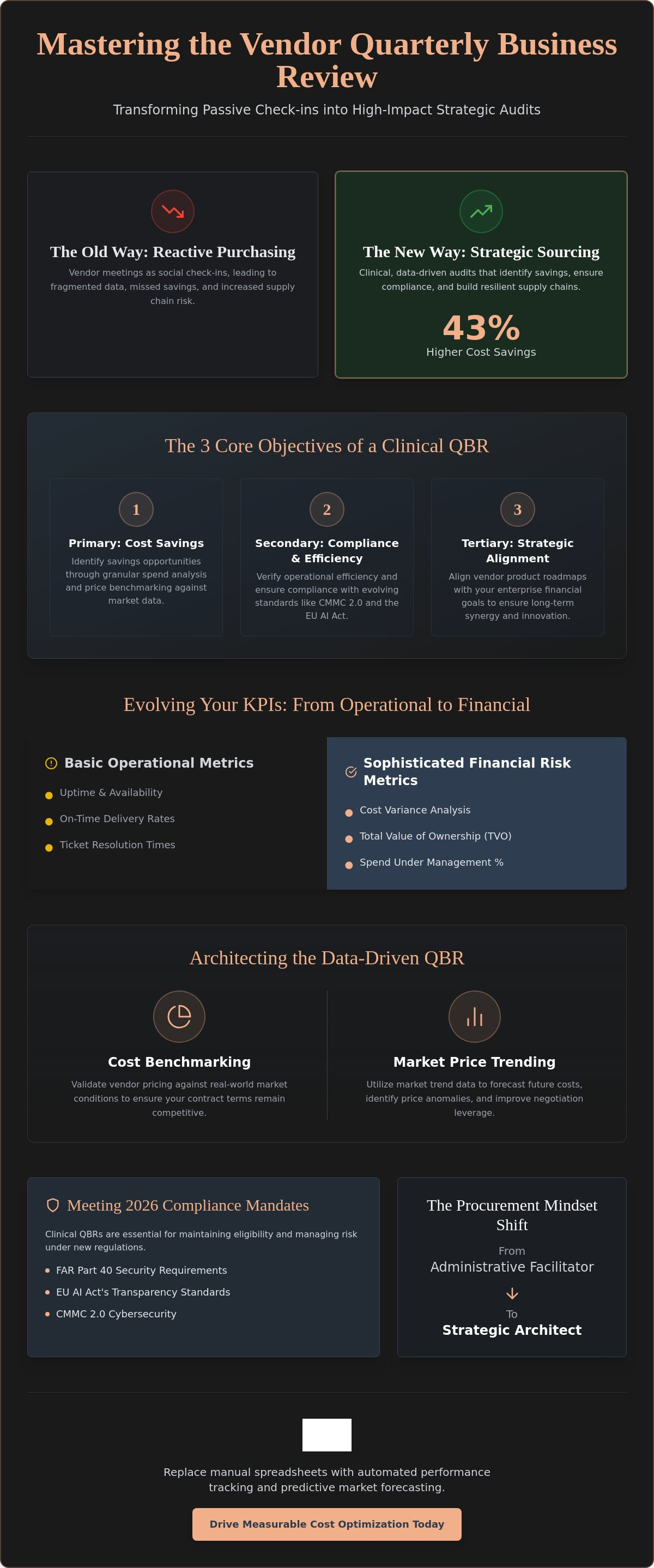
Treating QBRs as informal updates creates a hidden economic cost through uncaptured savings and unmitigated risks. Modern Supplier Relationship Management demands professional authority to manage high-value partnerships effectively. Strategic sourcing can lead to cost savings of 43% compared to reactive purchasing, according to Digital Applied data from January 2026. This efficiency requires a results-oriented emotional style that prioritizes bottom-line metrics over social rapport. Procurement leaders must position themselves as strategic architects rather than administrative facilitators. This shift ensures that every vendor interaction contributes directly to financial growth and operational resilience.
Defining the Core Objectives of a Clinical QBR
Clinical QBRs operate with three distinct layers of objectives to ensure comprehensive oversight. These objectives move beyond simple "uptime" metrics to address the pragmatic realities of business finance and corporate management.
- Primary Objective: Identifying cost-saving opportunities through granular spend analysis and price benchmarking.
- Secondary Objective: Verifying operational efficiency and ensuring compliance with evolving standards like CMMC 2.0 cybersecurity requirements.
- Tertiary Objective: Aligning vendor product roadmaps with enterprise financial goals to ensure long-term strategic synergy and innovation.
By establishing these objectives early, procurement teams can maintain a relentless focus on delivering specific business solutions. This structured approach prevents meetings from devolving into aimless discussions and ensures that every session produces a measurable reduction in financial volatility.
Architecting the Data-Driven QBR: Benchmarking and Analytics
A clinical QBR requires a foundation of empirical data rather than anecdotal feedback. High-level decision-makers must integrate procurement category cost benchmarking to validate current vendor pricing against real-world market conditions. This data-driven approach ensures that contract terms remain competitive throughout the lifecycle of the agreement. When reviewing how to conduct a vendor quarterly business review (QBR), the focus must remain on objective metrics that prove financial efficiency. Utilizing market price trending data allows procurement teams to forecast future costs and identify anomalies before they impact the bottom line.
Effective procurement analytics serve as a diagnostic tool for identifying category savings that often remain hidden in fragmented data sets. Evaluating 'spend under management' serves as a primary metric for procurement success, reflecting the maturity of the organization's sourcing strategy. Organizations that fail to track this metric often suffer from tail spend leakage, where small, unmanaged purchases aggregate into significant financial loss. For those establishing the basics of how to conduct a QBR, the transition from gathering data to analyzing it marks the difference between a routine meeting and a strategic audit.
Utilizing Should-Cost Models for Pricing Validation
A should-cost analysis provides the definitive baseline for fair market pricing. By comparing vendor invoices against market price trending benchmarks, procurement professionals can identify 'price creep' in long-term service contracts. This clinical precision prevents vendors from implementing incremental price hikes that aren't supported by underlying market shifts. Validating these costs ensures that every dollar spent is optimized for maximum return on investment. It's a proactive defense against margin erosion that maintains financial discipline across the supply chain.
Aggregating Vendor Performance Tracking Data
Sophisticated procurement operations move beyond surface-level metrics to granular performance indicators. This involves the automated tracking of several critical vectors:
- Delivery Timelines: Measuring variance between promised and actual fulfillment dates.
- Quality Standards: Tracking defect rates or service level agreement (SLA) breaches.
- Compliance: Ensuring adherence to ESG mandates and cybersecurity standards like CMMC 2.0.
Using data-driven sourcing insights allows you to challenge vendor assumptions with assertive, evidence-based arguments. This relentless focus on specific business solutions transforms the vendor from a simple service provider into a high-performance strategic partner. To identify specific areas where your current vendor stack may be underperforming, consider utilizing a performance diagnostic tool to baseline your existing partnerships.
KPI Selection: Transitioning from Operational Metrics to Financial Risk Mitigation
Standard procurement meetings often fail because they prioritize the wrong variables. Uptime and usage metrics are baseline expectations; they don't drive strategic advantage or margin expansion. To truly understand how to conduct a vendor quarterly business review (QBR), you must shift the focus toward cost variance and price risk. This transition allows procurement leaders to establish a framework for measuring price risk management outcomes rather than just service availability. Tracking market price trending is essential to mitigate financial volatility across the supply chain. It ensures that vendor performance is evaluated through the lens of enterprise risk management, identifying vulnerabilities before they manifest as budgetary overruns.
Clinical KPI selection requires a focus on financial growth metrics and operational efficiency. By moving beyond tactical performance, you position the procurement department as a high-level consultant to the executive team. This data-driven demeanor suggests reliability and deep industry expertise, ensuring that vendor reviews are treated as high-stakes corporate presentations rather than routine check-ins.
Strategic KPIs for High-Value Procurement
CFOs require metrics that directly impact the balance sheet. This means clearly distinguishing between cost savings, which represent an actual reduction in spend, and cost avoidance, which involves preventing projected price increases. A Price Volatility Index serves as another critical metric. It measures a vendor's ability to maintain price stability despite global market fluctuations. When preparing your data, look for Tips for a Compelling QBR Presentation to ensure these financial insights are communicated with professional authority. Compliance scorecards should also be integrated to quantify adherence to regulatory standards, turning qualitative risk into quantitative data. In 2026, this includes tracking vendor adherence to "Unbiased AI Principles" for LLM procurement or meeting the 65% domestic content threshold for critical items.
Operational Efficiency and Tail Spend Impact
Operational friction often hides within unmanaged spend categories. Analyzing the impact of tail spend management on overall category performance reveals where administrative costs are eroding margins. While high-value contracts receive the most attention, the aggregation of small, unmanaged purchases can multiply revenue risk by a factor of 2.5 if left unchecked. Sophisticated vendor performance tracking reduces this friction by identifying hidden costs in logistical workflows, such as excessive lead times or redundant shipping fees. By addressing these granular issues, procurement architects ensure that every vendor relationship is optimized for both operational flow and long-term financial growth.
Executing the Clinical QBR: Agenda, Negotiation, and Strategic Alignment
Mastering how to conduct a vendor quarterly business review (QBR) requires moving beyond the meeting room and into the negotiation theater. The execution phase is where data transforms into leverage. A successful session depends on a rigid, action-oriented agenda that prioritizes financial outcomes over operational anecdotes. By formalizing action items with specific owners and clinical execution timelines, procurement leaders ensure that the review produces tangible business results. This structured approach prevents the session from devolving into a passive status update and maintains the strategic urgency required for high-stakes corporate management.
Strategic architects align vendor roadmaps with enterprise-level market price forecasting to ensure long-term synergy. This alignment allows the organization to anticipate market shifts and adjust procurement strategies accordingly. When a vendor's future direction conflicts with your financial goals, the QBR serves as the primary forum to rectify the discrepancy. Without this clinical focus on future alignment, organizations risk being locked into legacy service models that no longer provide a competitive advantage.
The Strategic QBR Agenda
A clinical agenda must be segmented into distinct phases of analysis and action. This structure ensures that every critical component of the partnership is audited within the allotted time.
- Performance Audit vs. Contractual SLAs: A direct comparison of actual delivery against hard contractual obligations.
- Cost Benchmarking and Market Trend Analysis: Validating current spend against real-world market intelligence and should-cost models.
- Risk Mitigation and Compliance Review: Assessing adherence to evolving mandates like the 65% domestic content threshold or CMMC 2.0 cybersecurity standards.
- Strategic Roadmap and Negotiation for Renewal: Aligning future vendor capabilities with enterprise financial growth targets.
Using the QBR as a Negotiation Lever
The QBR is your most powerful tool for contract optimization. By applying market intelligence, you can aggressively contest unjustified price increases. If a vendor's performance data shows consistent SLA breaches, you have the leverage to secure financial credits or service expansions. Utilizing professional negotiation assistance allows you to turn these performance gaps into permanent contract improvements.
Data-driven sourcing insights also play a critical role in RFP management. When you hold vendors accountable to clinical benchmarks, you establish a precedent that carries into future bidding cycles. This relentless focus on specific business solutions ensures that the vendor remains a high-performance asset rather than a financial liability. To determine if your current vendor performance warrants a contract renegotiation, use a procurement health diagnostic to assess your baseline leverage.
Scaling Procurement Excellence: Integrating Performance Tracking Architectures
Achieving procurement maturity requires a departure from static data collection. Manual spreadsheets represent a significant operational bottleneck and a source of financial risk. To truly master how to conduct a vendor quarterly business review (QBR) across a global supplier base, organizations must transition to automated vendor performance tracking systems. These architectures provide the clinical precision necessary to monitor hundreds of concurrent contracts without administrative bloat. Integrating market price trending and forecasting into the permanent procurement workflow ensures that your team remains proactive rather than reactive to market shifts.
Enterprise resilience is built on continuous price risk management. Depending on a single source for a critical supply chain component can multiply revenue risk by a factor of 2.5, according to Digital Applied data from January 2026. Scaling your excellence means diversifying these risks and standardizing how you evaluate every participant in your ecosystem. Utilizing professional RFP management services allows you to standardize vendor selection and auditing processes, ensuring that every new partnership begins with a baseline of high-performance expectations.
The Role of Technology in Modern QBRs
Technology acts as the primary engine for redesigning procurement workflows. Automating data aggregation removes human bias and ensures that every report reflects objective reality. Real-time cost benchmarking provides a continuous stream of intelligence, replacing the outdated model of quarterly manual snapshots. This shift toward AI-native procurement allows for the immediate identification of cost variances. Technology-focused prefixes applied to traditional functions signify a specialized intersection of innovation and financial optimization; this allows strategic architects to focus on high-level decision-making rather than data cleaning.
Next Steps: Professionalizing Your Vendor Review Cycle
The transition to a clinical QBR framework begins with an audit of your current internal processes. Identify areas of 'soft' metric leakage where relationship-based anecdotes are displacing hard financial data. Establishing a center of excellence for procurement analytics ensures that your team has the technical upskilling required for competitive advantage. Engaging with strategic architects to optimize your negotiation outcomes will transform your procurement department from a cost center into a primary driver of financial growth. This relentless focus on efficiency and the bottom line is the hallmark of a sophisticated procurement operation.
Achieving Clinical Precision in Vendor Governance
Transitioning from manual oversight to automated performance tracking architectures is the definitive step in professionalizing your procurement department. You've mastered how to conduct a vendor quarterly business review (QBR) by prioritizing financial risk mitigation over basic operational metrics. This clinical approach ensures that every session delivers measurable cost optimization and strengthens your supply chain resilience against 2026 market volatility. By shifting the focus to objective data, you transform passive vendors into high-performance strategic partners.
Organizations that integrate advanced cost benchmarking and proprietary price risk management tracking consistently outperform reactive competitors. By applying expert negotiation assistance to high-value contracts, you turn vendor underperformance into strategic financial credits. It's time to redefine your procurement strategy and secure your margin expansion through data-driven precision. Optimize your next vendor negotiation with RightCostIQ's clinical procurement frameworks to ensure your organization remains a leader in operational efficiency.
Frequently Asked Questions
What is the primary difference between a vendor QBR and a standard check-in?
A QBR is a clinical strategic audit, while a check-in is a tactical relationship update. The QBR prioritizes financial benchmarks and contractual compliance over conversational rapport. It utilizes hard data to validate vendor performance against predefined KPIs. This methodical approach ensures that the meeting functions as a high-stakes corporate presentation focused on delivering specific business solutions.
How much time should procurement teams dedicate to QBR preparation?
Procurement teams should dedicate approximately 10 to 15 hours of data aggregation and analysis per high-value vendor QBR. This time is required to synthesize internal performance tracking data with external market price benchmarks. Precise preparation ensures the meeting remains focused on strategic optimization rather than data discovery. It allows the team to enter the negotiation with professional authority and expert-led insights.
Who should attend a vendor quarterly business review from the client side?
Attendance should be restricted to high-level decision-makers, including the Category Manager, a Finance representative, and the primary internal stakeholder. Limiting the group maintains a serious, business-oriented demeanor. Including a finance professional ensures that every discussion remains anchored in financial growth metrics and operational efficiency. This strategic alignment prevents the session from devolving into a casual partner discussion and maintains focus on the bottom line.
Can a QBR be used to negotiate price reductions mid-contract?
Yes, a QBR is a primary mechanism for securing mid-contract price reductions when market conditions or performance data justify the change. By presenting should-cost models and market price trending data, you create the leverage necessary to contest current pricing. This clinical approach allows for contract improvements without waiting for a formal renewal cycle. It demonstrates a sophisticated understanding of price risk management and strategic sourcing.
What are the most critical KPIs for a procurement-focused QBR?
The most critical KPIs focus on financial risk mitigation and cost variance rather than simple operational uptime. Tracking the Price Volatility Index and cost avoidance provides the CFO with tangible evidence of procurement success. These metrics allow you to evaluate how to conduct a vendor quarterly business review (QBR) through a lens of enterprise resilience. They shift the focus from surface-level usage to deep financial impact.
How do I handle a vendor that consistently fails QBR performance benchmarks?
Vendors that consistently fail performance benchmarks should be placed on a formal Performance Improvement Plan (PIP) with clinical execution timelines. If the vendor fails to meet these specific corrective actions, procurement architects must initiate an RFP process to find a more reliable partner. Maintaining a relentless focus on results prevents underperforming vendors from eroding your bottom line. It reinforces the brand's commitment to operational efficiency and strategic growth.
What role does market price trending play in a quarterly review?
Market price trending provides the external validation required to challenge vendor pricing assumptions during the review. It allows procurement teams to forecast future costs and identify anomalies in current invoicing. This data ensures that your understanding of how to conduct a vendor quarterly business review (QBR) includes a proactive defense against price risk. It bridges the gap between traditional business functions and cutting-edge digital innovation in supply chain management.
Is it necessary to conduct QBRs for tail spend vendors?
While full QBRs are reserved for strategic partners, tail spend vendors require automated performance audits to prevent fragmented data leakage. You don't need high-touch meetings for every supplier; instead, use automated performance tracking to maintain oversight. This ensures enterprise-wide compliance without over-allocating human resources to low-value categories. It allows procurement teams to scale their excellence while focusing manual efforts on high-impact, strategic partnerships.


