
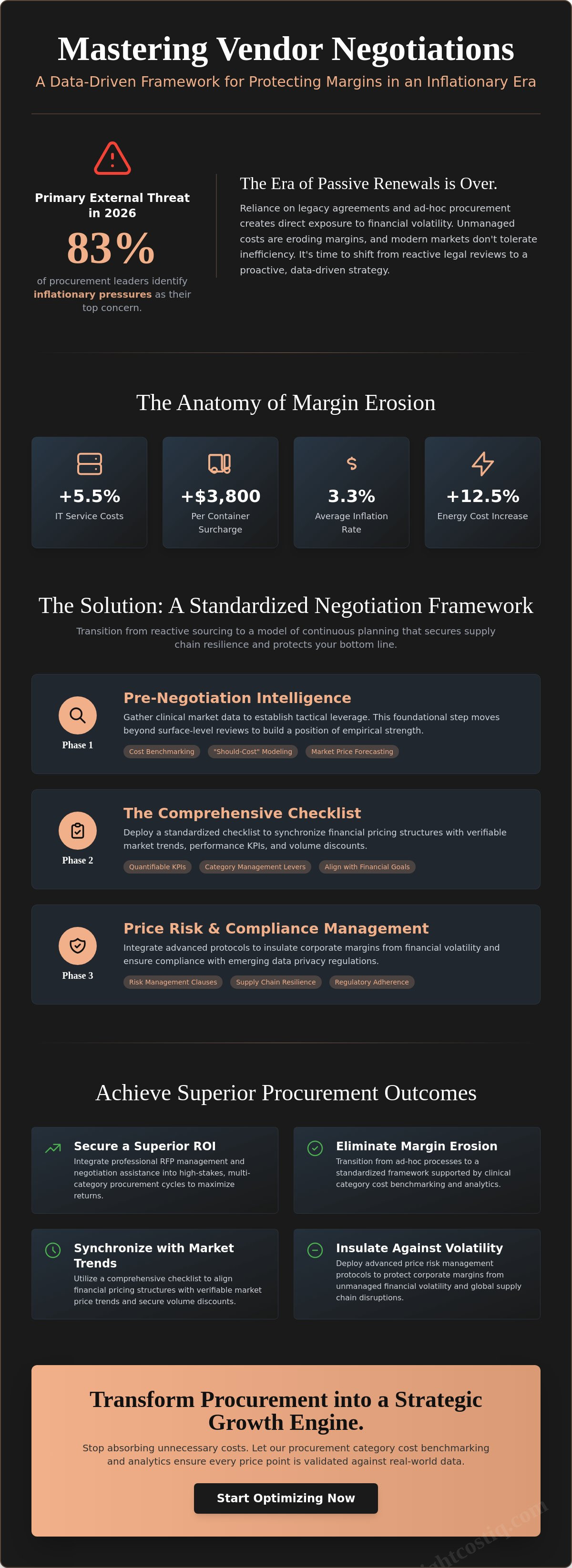
83% of procurement leaders identify inflationary pressures as their primary external threat in 2026, signaling that the era of passive renewals is over. You've likely seen margin erosion firsthand as IT service costs climb by 5.5% and shipping surcharges reach $3,800 per container. Reliance on legacy agreements creates exposure to financial volatility that modern markets don't tolerate. To maintain operational efficiency, you need a rigorous vendor contract negotiation checklist that prioritizes data-driven market intelligence over traditional legal reviews.
This framework provides the technical architecture required to standardize negotiation cycles and identify cost savings through precise benchmarking. You'll learn to integrate price risk management clauses that account for the current 3.3% inflation rate while ensuring compliance with new regulations like the Maryland Data Privacy and Protection Act of 2026. We'll analyze how to transition from reactive sourcing to a model of continuous planning that secures supply chain resilience and protects the bottom line against global economic shifts.
Key Takeaways
- Eliminate margin erosion by transitioning from ad-hoc procurement to a standardized framework supported by clinical category cost benchmarking and analytics.
- Utilize a comprehensive vendor contract negotiation checklist to synchronize financial pricing structures with verifiable market price trends and volume discounts.
- Deploy advanced price risk management protocols to insulate corporate margins from the impact of unmanaged financial volatility and global supply chain disruptions.
- Secure a superior ROI by integrating professional RFP management and negotiation assistance into high-stakes, multi-category procurement cycles.
The Strategic Necessity of a Standardized Vendor Negotiation Framework
Standardizing negotiation cycles isn't just an administrative preference; it's a financial imperative. Ad-hoc procurement leads to catastrophic margin erosion because it lacks the data-driven architecture required to counter aggressive vendor-side pricing. Procurement leaders who operate without a standardized vendor contract negotiation checklist find themselves reacting to supplier terms rather than dictating them. Clinical precision in this phase establishes immediate sourcing authority, transforming procurement from a back-office function into a strategic engine for financial growth. Moving beyond a legal-only mindset allows for a holistic strategy where technical performance and price risk management are prioritized alongside liability protection.
The Economic Impact of Negotiation Inefficiency
Inefficiency in high-value contracts often stems from a lack of market price transparency. When benchmarking opportunities are missed, organizations absorb unnecessary costs that compound throughout the contract lifecycle. Inconsistent terms across different vendors create fragmented data sets; this makes performance tracking nearly impossible. This fragmentation leads to leaky contracts where negotiated value isn't fully realized. A centralized framework provides C-Suite leaders with the granular visibility needed to report on cost avoidance and realized savings with absolute certainty. Given that the 2025 Contracting Benchmark Report indicates 70% of vendor agreements involve active negotiation strategies, the absence of a structured process represents a severe financial liability.
Aligning Sourcing Strategy with Corporate Financial Goals
Successful procurement requires the clinical integration of analytics into the initial drafting phase. It's not enough to review standard clauses. Teams must establish quantifiable KPIs for vendor performance before any formal discussion begins. Leaders should utilize category management procurement to identify specific negotiation levers that align with broader corporate financial objectives. This methodology ensures that every requirement in the vendor contract negotiation checklist serves a specific growth metric. By mapping procurement outcomes to the bottom line, organizations achieve a level of strategic alignment that traditional, siloed methods can't replicate. This alignment is critical when managing the 3.3% average inflation projected for indirect spend in 2026.
Phase 1: Pre-Negotiation Intelligence and Cost Benchmarking
Pre-negotiation intelligence represents the clinical gathering of market data to establish tactical leverage. It's the foundational step. Every effective vendor contract negotiation checklist requires this data-driven start. Procurement leaders must move beyond surface-level legal reviews to conduct rigorous category cost benchmarking. This process identifies current market price trends, such as the 12.5% increase in energy costs observed in early 2026. By analyzing internal spend data, teams determine the total spend under management for a specific vendor. This isn't just about the current contract; it's about the entire footprint. This data allows for the construction of "should-cost" models based on historical market price trending. It ensures that the negotiation begins from a position of empirical strength rather than anecdotal assumptions.
Leveraging Procurement Analytics for Market Insight
Market price forecasting is essential for timing negotiation cycles effectively. Organizations shouldn't enter renewals blindly. IT services are projected to rise by 5.5% in 2026, creating a high-risk environment for unmanaged renewals. Analytics identify price variance across geographic regions and business units, exposing hidden inefficiencies that vendors rarely disclose. Data-driven sourcing challenges vendor pricing assumptions by providing a granular view of cost drivers. When negotiating with powerful suppliers, these insights rebalance the power dynamic. Utilizing procurement category cost benchmarking and analytics ensures that every price point is validated against real-world volatility. This level of insight transforms procurement from a reactive cost center into a strategic architect of financial growth.
Establishing the Negotiation Baseline
Defining a Best Alternative to a Negotiated Agreement (BATNA) requires robust RFP data. This evaluates competitive options in real-time. Internal stakeholders must align on mandatory versus negotiable financial terms before the first meeting occurs. This alignment prevents internal friction. Vendors often exploit these communication gaps to push through unfavorable terms. A "fact-based" negotiation deck serves as the primary tool to counter unjustified price increases. It should include shipping cost data, which has risen by over 20% on key global routes as of April 2026. The deck must also account for emergency surcharges ranging from $1,800 to $3,800 per container. This tactical preparation ensures the vendor contract negotiation checklist translates into measurable margin protection and operational efficiency.
The Comprehensive Vendor Contract Negotiation Checklist
The execution of a high-stakes agreement requires a multi-pillar architecture that addresses financial, operational, and legal vulnerabilities simultaneously. An enterprise-grade vendor contract negotiation checklist serves as the strategic blueprint for this execution. It ensures that no variable is left to vendor discretion. By categorizing requirements into distinct pillars, procurement leaders maintain control over the total cost of ownership while insulating the organization from systemic supply chain risks. This structured approach moves the conversation beyond simple price points to a comprehensive evaluation of long-term value and compliance.
Financial and Commercial Clauses
Pricing structures must be scrutinized for hidden escalators and lack of transparency. Audit rights are essential; they allow for the clinical verification of billing accuracy in cost-plus models. Payment terms should be negotiated to optimize cash flow; moving from Net-30 to Net-60 or Net-90 can provide significant working capital advantages. Given the 3.2% rise in Core PCE Inflation in early 2026, price adjustment formulas must be linked to objective market price indices rather than arbitrary vendor increases. Volume discounts should be tiered and automated, ensuring that as the enterprise scales, the unit cost decreases without requiring manual renegotiation.
Operational Excellence and Performance Metrics
Operational success depends on defining clear, measurable Service Level Agreements (SLAs) with rigorous penalty and reward structures. These metrics must be quantifiable. Vague language regarding "best efforts" should be replaced with specific uptime, delivery, or quality percentages. Establishing a methodical cadence for vendor performance tracking ensures that deviations from the contract are identified and corrected in real-time. Procurement leaders should prioritize negotiating for implementation to ensure the transition from the signing table to daily operations is seamless. Scalability clauses are also vital; they must allow for the expansion or contraction of services based on fluctuating business requirements without punitive fees.
Risk, Compliance, and Data Sovereignty
Compliance is a moving target in 2026. The vendor contract negotiation checklist must account for the Maryland Data Privacy and Protection Act of 2026, which imposes strict security requirements on third-party contractors handling personal data. Similarly, the UK Procurement (Amendment) Regulations 2026 necessitate greater transparency in contract payment reporting. Risk management protocols should extend beyond the primary vendor to include Tier 2 and Tier 3 suppliers; 65% of large companies currently identify these sub-layers as primary cybersecurity vulnerabilities. Finally, the exit strategy must be defined with clinical precision. This includes data ownership rights, transition assistance obligations, and the guaranteed return of all intellectual property upon contract termination.
Mitigating Financial Volatility through Price Risk Management
Managing contract pricing in a volatile global market represents the primary strategic challenge for modern procurement. Static pricing models fail when energy costs surge by 12.5% or shipping rates jump 20% within a single quarter. A robust vendor contract negotiation checklist must incorporate price risk management protocols to insulate the organization from these fluctuations. These services utilize predictive analytics to forecast future costs, allowing leaders to shift from reactive purchasing to proactive margin protection. Implementing index-based pricing ensures that risk and reward are shared equitably, preventing vendors from capturing windfall profits during market downturns while protecting the enterprise during inflationary spikes.
Forecasting as a Strategic Negotiation Lever
Predictive analytics anticipate shifts in commodity and service prices before they manifest in vendor invoices. This foresight allows procurement teams to negotiate specific "price caps" based on historical volatility data. Market intelligence acts as a shield against surprise price hikes, providing the empirical evidence needed to challenge vendor claims of "unforeseen costs." When market price trending indicates a period of sustained volatility, short-term contracts may offer the flexibility required to pivot. Conversely, identifying a price floor allows for the execution of long-term agreements that lock in favorable rates. This data-driven approach ensures that contract duration is a tactical choice rather than an administrative default.
Clinical Execution of Price Protection Clauses
Drafting Most Favored Nation (MFN) clauses requires clinical precision to ensure they're enforceable and meaningful. These clauses should be paired with cost-savings sharing agreements that incentivize vendors to improve operational efficiency. Integration of RFP Management into the procurement lifecycle ensures that price protection is baked into the initial bid process. This systematic approach ensures that every agreement adheres to the vendor contract negotiation checklist standards for financial security. Organizations that ignore these safeguards risk significant margin erosion as Core PCE Inflation continues to fluctuate. To secure your margins against 2026 market fluctuations, leverage our Price Risk Management and Tracking Service for a data-driven defense.
Optimizing Procurement Outcomes with Professional Assistance
High-stakes enterprise procurement in 2026 demands more than a static document. While a vendor contract negotiation checklist provides the necessary structural foundation, clinical execution at scale requires a specialized technical architecture. The complexity of managing multi-category vendor performance across global business units often exceeds the capacity of internal teams relying on manual processes. Professional RFP management and negotiation assistance deliver a measurable ROI by closing the gap between theoretical negotiated savings and actual realized margin. This transition from administrative oversight to strategic architecture ensures that every contract serves as a driver for financial growth rather than a source of unmanaged risk.
The RightCostIQ Approach to Negotiation Excellence
We integrate clinical precision into every stage of the procurement lifecycle. By utilizing proprietary procurement category cost benchmarking and analytics, we secure pricing that consistently outperforms market averages. Our price risk management services act as a strategic buffer, protecting your bottom line from the 3.3% projected inflation in indirect spend and the volatility of global shipping markets. This data-driven sourcing model replaces vendor-supplied narratives with empirical market intelligence. We ensure your organization doesn't just sign a contract but executes a strategic financial instrument designed for maximum efficiency.
Securing Long-Term Value and Resilience
Strategic resilience is achieved by establishing a repeatable framework for future contract renewals. The vendor contract negotiation checklist must be paired with continuous procurement and vendor performance tracking services post-signature. This is the only clinical method to verify that SLAs are met and volume discounts are applied automatically. Moving from fragmented manual tracking to automated monitoring eliminates the "negotiation leakage" that often erodes margins over time. This approach maintains a constant state of audit-readiness and compliance.
The next step for procurement leaders is the design of a custom optimization roadmap. This roadmap aligns technical execution with corporate financial goals, ensuring that sourcing functions operate with maximum authority. By integrating market price trending and forecasting services, your team can anticipate shifts in the economic landscape before they impact the P&L. This proactive stance is the hallmark of a modern, efficient procurement department. It secures long-term value while insulating the enterprise from the systemic disruptions that define the current global trade environment.
Securing Procurement Authority in a Volatile 2026 Market
The implementation of a standardized vendor contract negotiation checklist transforms procurement from a back-office necessity into a clinical driver of enterprise margin. By prioritizing pre-negotiation intelligence and category cost benchmarking, leaders can effectively neutralize the 3.3% average inflation projected for indirect spend. Success in this landscape requires moving beyond legal compliance to embrace a holistic strategy focused on price risk management and operational transparency. Organizations that fail to adapt these data-driven methodologies risk significant financial exposure as global trade conditions continue to fluctuate.
RightCostIQ provides the technical architecture necessary to execute these high-stakes agreements with surgical precision. Our proprietary cost benchmarking analytics and expert-led RFP management frameworks ensure that your organization captures maximum value at every renewal cycle. By leveraging our specialized price risk management services, you insulate your bottom line from the unpredictability of global trade and rising shipping surcharges. Optimize your next negotiation with RightCostIQ assistance to secure the financial growth and operational resilience your enterprise demands. Your transition to a data-driven sourcing model is the most effective path toward long-term margin protection.
Frequently Asked Questions
What are the most important clauses to negotiate in a vendor contract?
The most critical clauses center on financial control and risk mitigation. Audit rights, price adjustment formulas, and data sovereignty requirements should be prioritized to ensure long-term transparency. Including these technical descriptors in your vendor contract negotiation checklist prevents margin erosion by establishing clear boundaries for billing accuracy and regulatory compliance from the start.
How do I use market benchmarking to lower vendor pricing?
Market benchmarking identifies price variance across different geographic regions and business units to expose hidden inefficiencies. By presenting vendors with objective "should-cost" models derived from empirical data, procurement leaders force a shift from anecdotal pricing to market-aligned rates. This clinical approach provides the necessary leverage to challenge unjustified premiums and secure competitive unit costs.
What is the difference between a Master Service Agreement and a Statement of Work?
A Master Service Agreement (MSA) establishes the overarching legal and financial framework for the entire relationship. It covers broad terms like indemnification and liability caps. Conversely, a Statement of Work (SOW) defines the specific technical deliverables, timelines, and project-based KPIs. The MSA acts as the strategic foundation while the SOW governs tactical execution.
How can I protect my company against vendor price increases?
Protection requires the implementation of index-based pricing and "Most Favored Nation" clauses. These mechanisms link future cost adjustments to objective market indices rather than arbitrary vendor discretion. Drafting these clauses with precision ensures that your organization captures cost savings when market prices drop while establishing firm caps during periods of high economic volatility.
How often should vendor performance be tracked and reviewed?
High-value enterprise contracts require quarterly business reviews supported by continuous data monitoring. Waiting for annual renewals to address performance gaps leads to significant operational leakage. Methodical tracking identifies service level deviations in real-time, allowing for immediate corrective action and the clinical verification of negotiated value throughout the entire contract lifecycle.
What role does procurement analytics play in contract negotiation?
Procurement analytics serve as the primary engine for market price trending and predictive forecasting. This intelligence allows teams to time their negotiation cycles based on anticipated commodity or service price shifts. Integrating these analytics into your vendor contract negotiation checklist transforms the process into a data-driven exercise that secures market-leading pricing and protects corporate margins.
How do I negotiate better terms if I am a smaller client for a large vendor?
Smaller clients must leverage operational transparency and volume growth projections to rebalance the power dynamic. Focus on reducing the vendor's cost-to-serve through streamlined procurement processes and long-term commitment stability. Highlighting your organization's strategic value or potential for multi-category expansion can often secure concessions that aren't available through spend volume alone.
What are the red flags to look for in a vendor contract proposal?
Red flags include vague Service Level Agreements, the absence of audit rights, and hidden price escalators. Proposals that lack specific penalty structures for non-performance suggest an unacceptable level of operational risk. Any attempt to obscure price risk management or data ownership should be viewed with strategic suspicion and addressed during the initial negotiation phase.


