
A procurement business case is not a request for permission; it is a financial architecture designed to de-risk enterprise sourcing. Most proposals fail because they lack the clinical precision required to bridge the gap between operational needs and C-suite financial metrics. You've likely experienced the difficulty of quantifying soft savings or justifying spend when core PCE inflation sits at 3.3% and the federal funds rate remains at 3.5% to 3.75%. Developing a procurement business case requires more than intuition; it demands a data-driven model that prioritizes margin expansion and operational efficiency.
You'll master the methodical process of architecting a document that withstands rigorous executive scrutiny through advanced cost benchmarking and risk mitigation. This guide provides a clinical framework for aligning procurement activities with enterprise-wide value maximization, moving from market price trending to repeatable sourcing cycles. We'll explore how to transform raw sourcing goals into a rigorous, data-backed document that ensures your next proposal is both unassailable and strategically aligned with the bottom line.
Key Takeaways
- Re-engineer procurement strategy by moving beyond simple cost avoidance to document tangible EBITDA impact through high-precision financial modeling.
- Master a clinical, 5-step execution roadmap for developing a procurement business case that secures executive buy-in using data-driven market intelligence.
- Establish an unassailable savings baseline by integrating procurement category cost benchmarking and advanced spend analytics into your strategic framework.
- Neutralize internal resistance and resource constraints by quantifying the financial cost of inaction against enterprise margin expansion goals.
- Translate strategic business case objectives into actionable RFP requirements to ensure seamless vendor performance tracking and verified ROI throughout the sourcing cycle.
The Strategic Architecture of a Procurement Business Case
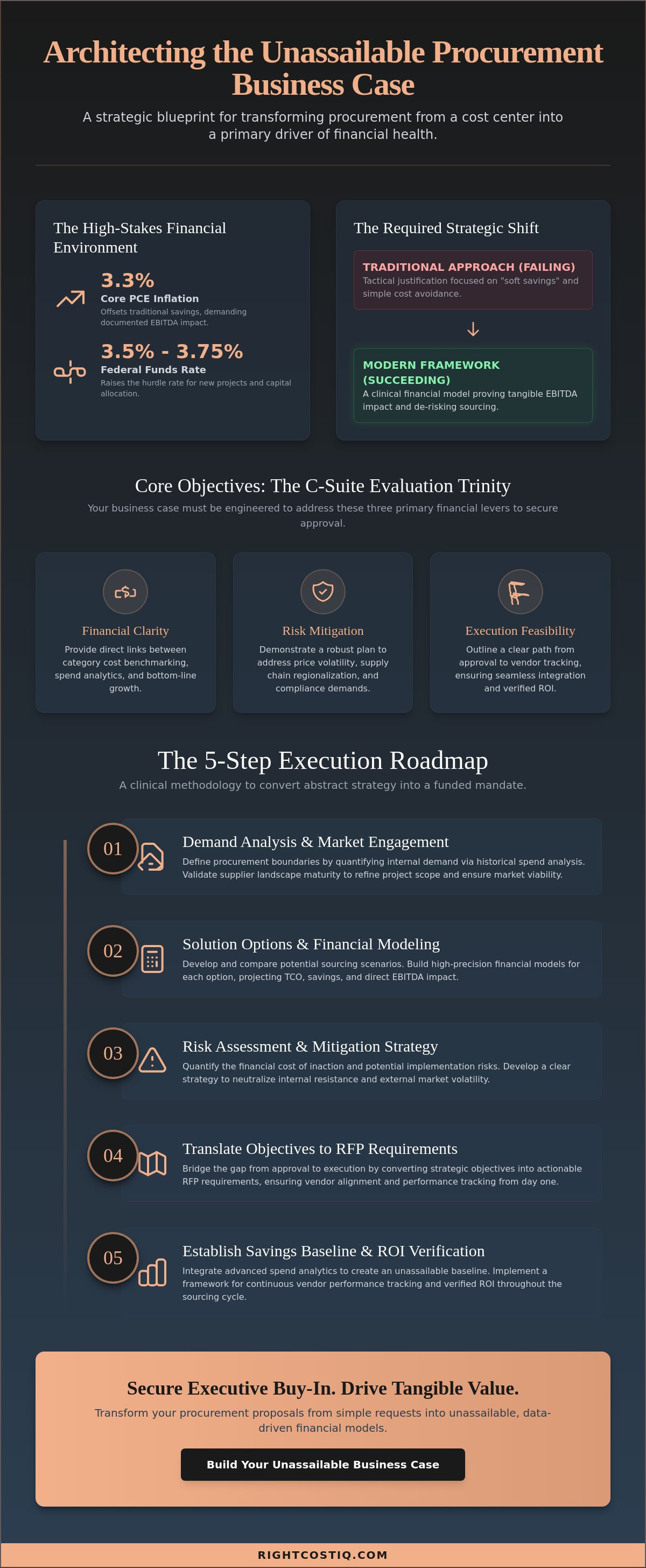
Developing a procurement business case is a clinical exercise in financial engineering. It functions as a high-precision roadmap for margin expansion, moving far beyond the administrative mentality of previous sourcing cycles. A standard Business case often focuses on simple cost avoidance. However, executive leadership in 2026 demands a documented, tangible impact on EBITDA. This shift requires procurement leaders to act as strategic architects who link specific sourcing activities to enterprise-wide profitability.
Static templates no longer suffice in an environment characterized by 3.3% core PCE inflation and persistent geopolitical volatility. Modern business cases must be dynamic analytical models. They establish a clinical audit trail for compliance while proving that every dollar spent is an investment in operational efficiency. This architecture ensures that procurement isn't just spending a budget; it's optimizing capital. It transforms the department from a cost center into a primary driver of financial health.
The Shift from Tactical to Strategic Justification
Traditional business cases often fail because they lack the data-driven depth required to secure funding in high-volatility markets. When federal interest rates remain between 3.5% and 3.75%, the hurdle rate for new projects is high. Tactical justifications focusing on "better service" or "easier processes" don't move the needle for CFOs. They need to see how a project offsets inflationary pressure.
Strategic justification requires a rigorous gap analysis that establishes a clear "Case for Change." You must demonstrate the delta between current performance and the potential gains achieved through advanced analytics. This process bridges the gap between procurement strategy and corporate financial goals by identifying exactly where market intelligence can prevent margin erosion. It's about proving that the current status quo is more expensive than the proposed solution.
Core Objectives: What Your C-Suite Actually Evaluates
The C-suite evaluates a proposal based on three primary financial levers: cost reduction, risk mitigation, and operational efficiency. Your document should define the scope across goods, services, or infrastructure with surgical precision. It's not enough to suggest a new RFP. You must prove how the initiative aligns with category management procurement standards to ensure long-term value. Alignment with these standards signals that the department is operating with professional maturity.
Executives look for specific markers of success:
- Financial Clarity: Direct links between category cost benchmarking and bottom-line growth.
- Risk Management: How the plan addresses price volatility and supply chain regionalization.
- Execution Feasibility: A clear path from approval to vendor performance tracking.
Developing a procurement business case is the only way to transform these high-level objectives into a repeatable, data-backed framework for strategic approval. It ensures that every sourcing decision is rooted in financial reality rather than operational convenience.
How to Develop a Procurement Business Case: A 5-Step Execution Roadmap
Developing a procurement business case requires a structured methodology to convert abstract strategy into a funded mandate. This isn't a speculative exercise. It's a rigorous sequence of analytical gates designed to filter out inefficiencies and prove financial viability. By following a clinical roadmap, procurement leaders can ensure their proposals survive the high-stakes environment of front-end decision-making where capital is prioritized for the highest-impact initiatives. Each step must build upon the previous one to create an unassailable argument for investment.
Step 1 & 2: Demand Analysis and Market Engagement
Success begins with a clinical needs assessment to define the procurement boundary. You must quantify internal demand by interrogating historical spend analysis data. This identifies volume patterns and spend leakage that often remain hidden in decentralized systems. Once internal demand is established, use preliminary market engagement to refine the project scope. Validating the maturity of the supplier landscape ensures that your proposed solution is feasible and that the market can support competitive bidding. Organizations often find that a market price trending and forecasting service provides the necessary external intelligence to calibrate these early expectations against real-world economic conditions.
Step 3 & 4: Financial Modeling and Risk Architecture
The financial model is the heartbeat of the business case. You must move beyond simple price comparisons to build a Total Cost of Ownership (TCO) model. This accounts for hidden lifecycle costs, implementation friction, and maintenance. In an economy where the federal funds rate sits at 3.5% to 3.75%, your Net Present Value (NPV), ROI, and Payback Period calculations must be airtight to justify the cost of capital.
Simultaneously, you must architect a risk profile that categorizes threats into financial, operational, and reputational buckets. Quantifying the risks of both action and inaction is critical. For instance, failing to address a contract with a value exceeding the $350,000 Simplified Acquisition Threshold without proper competition represents a significant compliance risk. Mitigation strategies developed here serve as the foundation for future contract terms and performance tracking.
Step 5: Finalizing the Executive Summary
The final step in developing a procurement business case is the synthesis of all data into a high-impact executive summary. This section should be characterized by clinical precision, focusing on the bottom-line results: margin expansion, risk reduction, and operational efficiency. It should present the "Case for Change" as a logical inevitability rather than a request. When the executive summary mirrors the financial rigor of a corporate investment prospectus, approval becomes a matter of strategic alignment rather than departmental persuasion.
Integrating Procurement Analytics and Category Benchmarking
Data is the connective tissue between a theoretical proposal and a funded mandate. Integrating procurement analytics into the architecture of your proposal transforms subjective claims into clinical financial projections. While many procurement teams rely on historical internal data, developing a procurement business case that survives executive scrutiny requires external validation. You must establish a realistic savings baseline by triangulating internal spend against objective market realities. This process ensures that your projected ROI is not merely an aspiration but a mathematically defensible outcome rooted in current economic conditions.
Spend analytics allow you to identify leakage and consolidate volume with surgical precision. By interrogating fragmented data sets, you can pinpoint maverick spend and contract non-compliance that erode enterprise margins. This level of detail is essential for the Victorian Government's guide to creating a procurement business case, which emphasizes market analysis and delivery planning as core pillars of a successful submission. Transforming raw spend data into a persuasive narrative requires you to move beyond "what happened" to "what is possible" through optimized category management.
Leveraging Benchmarking for Credibility
Credibility in the C-suite is built on external benchmarks. Comparing internal pricing against industry-standard category benchmarks allows you to move from "estimated savings" to "guaranteed outcomes." When you can prove that your current pricing sits in the 75th percentile of the market, the case for change becomes a financial necessity. This data-driven approach significantly accelerates the approval cycle. Some industry professionals report that analytics-driven cases reduce the time-to-approval by up to 40% because they pre-emptively answer the CFO's most difficult questions regarding market competitiveness.
Incorporating Market Price Trends
Static business cases fail because they ignore the temporal nature of pricing. Forecasting future price volatility is essential to justify long-term contract structures or the timing of a specific sourcing event. In an environment where headline CPI reached 3.8% in early 2026, understanding the trajectory of specific categories is a critical requirement for developing a procurement business case. This market intelligence serves as a powerful lever for negotiation assistance preparation, ensuring that your team enters the RFP phase with a clear understanding of supplier margin buffers.
Market price trending de-risks the business case by aligning procurement timing with favorable market cycles to prevent budget overruns. By integrating these trends, you shift the conversation from simple cost reduction to strategic capital preservation. This ensures that the finalized document is not just a request for spend but a sophisticated tool for financial optimization.
Addressing Executive Objections: Risk and Resource Allocation
Executives often view procurement initiatives through the lens of potential disruption. To overcome this, you must quantify the "Cost of Inaction" (COI). When core PCE inflation remains at 3.3%, every month of delay represents a direct erosion of enterprise margin. Developing a procurement business case that addresses these fears requires a clinical shift from defensive justification to offensive value creation. You aren't just asking for resources; you're proposing a mechanism to capture lost value. The COI is the most powerful lever for strategic approval. If your organization operates without real-time market data, you're likely paying an "ignorance tax" to suppliers who have better visibility into cost-input fluctuations.
The Risk Management Framework
A robust proposal includes a risk-adjusted ROI model. This provides a realistic financial outlook by accounting for potential supply chain regionalization and geopolitical instability. Resilience is now a financial metric. By integrating compliance requirements and diversity goals into the initial justification, you ensure the project aligns with broader corporate governance standards. This is where price risk management and tracking services become essential. They provide a structural safeguard against market volatility, ensuring that business case promises remain valid despite external economic shifts. Quantifying these "difficult" risks requires a data-driven methodology that links volatility directly to budget variance.
Demonstrating Resource Efficiency
Resource constraints are the most common objection to new sourcing cycles. You must prove that the activity won't disrupt core operations. Utilizing automated RFP management reduces internal labor costs by streamlining the vendor evaluation process. This efficiency allows the procurement team to focus on strategic decision-making rather than administrative data entry. Approval requires more than optimism; it requires evidence of operational continuity. Showing that external expertise will handle the heavy lifting of data normalization and vendor outreach often removes the final barrier to project kickoff.
Professional negotiation assistance maximizes the final contract value by leveraging expert market intelligence. This ensures that the savings identified during the benchmarking phase actually materialize in the signed agreement. Finally, establishing a procurement and vendor performance tracking service creates a closed-loop system. It guarantees that the C-suite sees the promised results in real-time, effectively neutralizing objections regarding implementation friction. By tracking performance against the original business case metrics, you build the internal credibility required for future sourcing cycles.
From Approval to Execution: Bridging the Business Case and RFP
Approval is merely the starting line. The primary failure point in strategic sourcing occurs when the clinical precision of the business case is lost during the transition to procurement execution. Developing a procurement business case should result in a living document that dictates the parameters of the subsequent Request for Proposal. You must ensure that the "Value for Money" (VFM) promised to the C-suite is captured during the negotiation phase. Without this continuity, the data-driven financial modeling used to secure buy-in becomes academic rather than operational.
The business case serves as the definitive benchmark for vendor performance tracking. It establishes the KPIs that will determine the success of the partnership over the next three to five years. By maintaining this clinical audit trail, you ensure that the strategic intent of the project isn't diluted by supplier-led negotiation tactics. This transition requires a relentless focus on the bottom line, ensuring that every contractual clause supports the overarching goal of margin expansion.
Aligning the RFP with the Business Case
Effective execution requires mapping your specific financial targets directly to the scoring criteria in the sourcing event. If the business case identified a specific margin expansion through volume consolidation, the RFP must weight price and capacity accordingly. You use the market intelligence gathered during the initial phase to refine the bidder list; this prevents wasting resources on suppliers incapable of meeting the established benchmarks. The business case remains the "source of truth" throughout the contract lifecycle, providing the baseline against which all vendor performance is measured.
The RightCostIQ Advantage: Clinical Sourcing Precision
RightCostIQ’s precision frameworks accelerate the move from approval to contract by eliminating the ambiguity often found in traditional procurement. Our RFP management services ensure that the ROI identified during the phase of developing a procurement business case is fully realized in the final agreement. We don't just facilitate meetings; we enforce the clinical standards defined in your strategic roadmap. This includes the integration of price risk management into the final negotiation strategy, protecting your margins from the 3.8% headline CPI inflation currently impacting the market.
Capturing enterprise value requires a relentless focus on the bottom line. By utilizing our specialized analytics and negotiation assistance, you bridge the gap between high-level strategy and technical execution. The transition from a theoretical model to a signed contract should be seamless and data-backed. To secure your organization's competitive advantage and ensure your sourcing cycles deliver maximum impact, schedule a consultation for professional negotiation assistance today. Our framework ensures that the strategic architect's vision is translated into tangible financial growth.
Architecting a High-Yield Procurement Future
Executing a clinical procurement strategy requires more than a static document. It demands a dynamic framework that links market intelligence directly to enterprise margin expansion. By transitioning from tactical cost avoidance to documented EBITDA impact, you ensure your sourcing initiatives survive the highest levels of corporate scrutiny. Developing a procurement business case is the foundational step in this process; it establishes the financial baseline and risk parameters that will dictate your negotiation leverage.
The journey from strategic approval to realized ROI depends on maintaining a rigorous audit trail throughout the sourcing lifecycle. You've learned how to neutralize executive objections by quantifying the cost of inaction and aligning RFP requirements with validated benchmarking data. Now it's time to convert these insights into tangible results.
Optimize your sourcing outcomes with RightCostIQ’s RFP Management and Negotiation Assistance. Our approach provides clinical precision in cost benchmarking, specialized price risk management services, and data-driven vendor performance tracking to ensure your promised value is fully captured. Your next sourcing cycle is an opportunity to redefine your department's strategic value.
Frequently Asked Questions
What is the primary difference between a procurement plan and a business case?
A business case is a strategic justification for investment, while a procurement plan is an operational roadmap for execution. The business case focuses on financial viability, margin expansion, and the clinical "why" behind the spend. In contrast, the plan details the specific sourcing steps, timelines, and resource allocations required once the project secures executive approval.
How much detail is required for a low-value procurement business case?
The level of detail scales with the procurement's value and risk profile. For acquisitions below the $15,000 federal micro-purchase threshold, a brief memo documenting the need and cost-benefit might suffice. However, procurements approaching the $350,000 Simplified Acquisition Threshold require a more rigorous financial model to withstand departmental audit and ensure capital efficiency.
Can I use a business case to justify sole-source procurement?
You can use a business case to justify sole-source procurement if you provide a clinical audit trail proving no viable alternatives exist. It must demonstrate that the chosen vendor offers a unique technical advantage or that the cost of competition exceeds the potential savings. This justification must be data-driven to survive regulatory and internal compliance reviews.
What are the most common mistakes when developing a procurement business case?
Common mistakes when developing a procurement business case include ignoring implementation friction and failing to account for maverick spend leakage in projected savings. Many teams also neglect to align their objectives with C-suite financial metrics like EBITDA impact. This lack of precision often results in proposals that feel disconnected from the organization's broader financial goals.
How do I quantify "soft" savings like time efficiency in a business case?
Quantify time efficiency by converting labor hours into direct financial costs using Full-Time Equivalent (FTE) rates. If a new automated system reduces manual processing by 20 hours per week, multiply that by the average hourly labor rate to document a tangible gain. This transformation turns vague productivity claims into a clinical financial metric that executives can easily evaluate.
How often should a procurement business case be updated during a long-term project?
Update the business case quarterly or whenever significant market volatility occurs. With headline CPI reaching 3.8% in April 2026, static models quickly become obsolete. Regular updates ensure the project remains aligned with shifting economic realities and federal interest rates. This practice maintains the document's status as a reliable source of truth for vendor performance tracking.
Is a business case mandatory for all enterprise procurement activities?
Formal business cases are mandatory for high-value strategic spend, typically those exceeding the $350,000 Simplified Acquisition Threshold. While not strictly required for every minor transaction, developing a procurement business case for all mid-to-high-level spend ensures consistent financial discipline. It establishes a repeatable framework that protects the organization from unoptimized contract terms and unnecessary price risk.
How does market price trending affect the financial modeling of the case?
Market price trending acts as a clinical anchor for your financial modeling by preventing the use of outdated benchmarks. It allows you to forecast future price volatility and adjust your ROI projections based on real-world inflationary pressures. By accounting for these trends, you create a more resilient and defensible model that accurately reflects the current state of the supply chain.


