
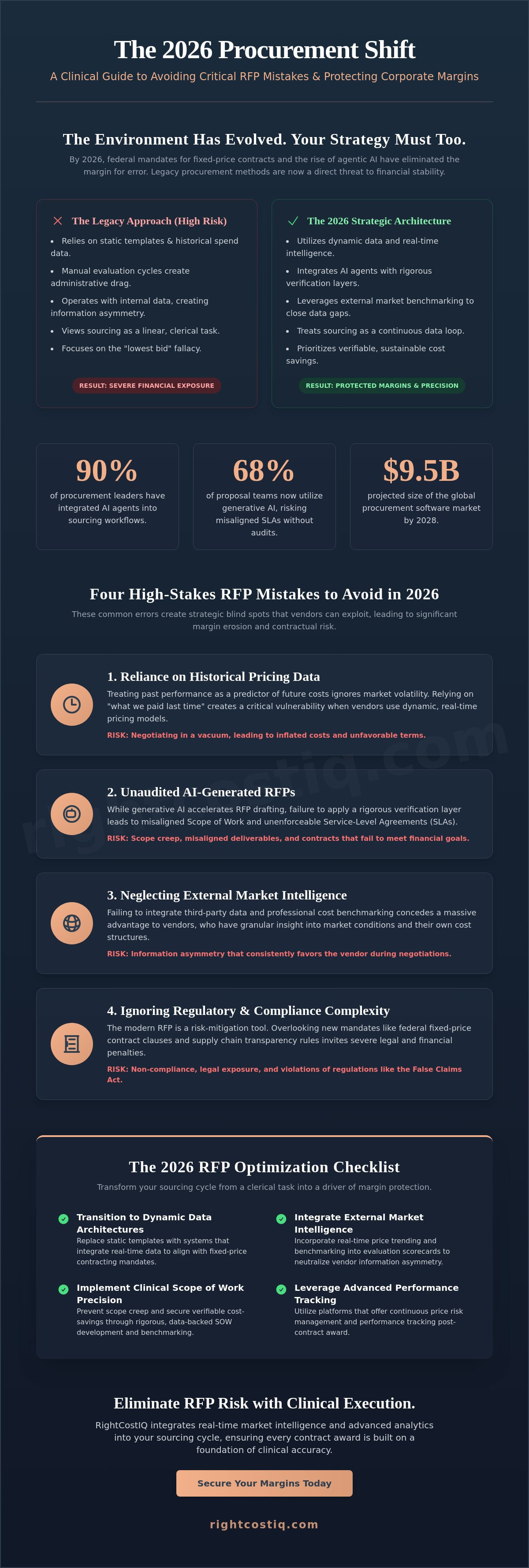
90% of procurement leaders have now integrated AI agents into their sourcing workflows, yet a significant portion of these organizations remains vulnerable to severe financial exposure. In 2026, the margin for clerical error has vanished. Identifying the common RFP mistakes to avoid 2026 is no longer a matter of administrative hygiene; it's a clinical necessity for protecting corporate margins. With federal mandates now defaulting to fixed-price contracts and the rapid acceleration of agentic AI, procurement teams using outdated manual evaluation cycles face unprecedented risk.
You likely recognize that opaque vendor pricing models and volatile market shifts are currently eroding your sourcing efficacy. This article provides a strategic architecture to eliminate high-stakes errors, ensuring your vendor selection is backed by verifiable cost-benchmarking and precise market forecasting. We'll examine the integration of real-time intelligence into your sourcing cycle to secure reduced procurement risk and clinical precision in every contract award.
Key Takeaways
- Transition from static procurement models to dynamic data architectures to align with the 2026 shift toward federal fixed-price contracting mandates.
- Identify and eliminate common RFP mistakes to avoid 2026, specifically the reliance on historical pricing data that creates significant financial exposure.
- Implement clinical precision in Scope of Work development to prevent scope creep and secure verifiable cost-savings through rigorous benchmarking.
- Integrate external market intelligence and real-time price trending into evaluation scorecards to neutralize vendor information asymmetry during negotiations.
- Leverage advanced performance tracking and price risk management to transform the sourcing cycle from a clerical task into a driver of margin protection.
The Evolution of RFP Failure: Why 2026 is Different
The procurement environment has evolved into a high-stakes data exchange where clerical errors result in immediate margin erosion. One of the common RFP mistakes to avoid 2026 involves the use of static, non-integrated sourcing templates. These legacy tools fail to account for the rapid shift toward fixed-price contract defaults mandated by recent federal executive orders. Success now requires a strategic architecture that prioritizes real-time market intelligence over historical spend data. Relying on outdated frameworks creates a structural vulnerability that vendors can exploit during price negotiations, leading to long-term financial exposure.
The traditional Request for Proposal (RFP) often focused on isolated vendor selection. Today, procurement demands comprehensive ecosystem management. This shift requires moving beyond basic cost-discovery to an architecture that manages price volatility and supply chain resilience. Procurement inertia in a volatile global economy is no longer a passive risk; it's an active drain on corporate capital. Strategic architects must now view the sourcing cycle as a continuous data loop rather than a linear administrative task.
The Shift Toward AI-Led Procurement Optimization
Automated platforms now accelerate sourcing cycles. Recent data indicates the average response time has dropped to 25 hours. However, this speed introduces the risk of algorithmic bias in automated scoring. Procurement architects must maintain clinical precision when using large language models for RFP drafting. 68% of proposal teams now utilize generative AI, but the failure to audit these outputs leads to misaligned service-level agreements. High-stakes sourcing requires a rigorous verification layer. This ensures AI-generated requirements align with specific financial growth metrics and operational realities.
Regulatory and Compliance Complexity
New global supply chain transparency mandates have transformed RFP requirements into complex regulatory hurdles. The April 2026 federal guidance regarding fixed-price contracts and anti-discrimination clauses necessitates real-time compliance tracking. It must begin at the initial sourcing phase. Organizations must integrate automated due diligence into their evaluation scorecards. This prevents the legal exposure seen in recent False Claims Act settlements regarding federal contract violations. The modern RFP functions primarily as a risk-mitigation instrument rather than a simple price-discovery tool.
Strategic Blind Spots: Common Data and Benchmarking Errors
One of the most pervasive common RFP mistakes to avoid 2026 is the reliance on internal historical data as a primary pricing benchmark. Procurement departments often treat past performance as a reliable predictor of future costs. This creates a strategic blind spot. In a global procurement software market projected to reach $9.5 billion by 2028, failing to leverage external, real-time data is a failure of leadership. Static spreadsheets cannot compete with the dynamic pricing models vendors now use. Relying on "what we paid last time" ignores the 12-15% of GDP that public procurement now represents, where market shifts happen in hours, not fiscal quarters.
Information asymmetry consistently favors the vendor. They possess granular, real-time insights into their operational cost structures and global supply chain shifts that the average procurement department can't replicate with internal tools. When you issue an RFP without external validation, you're negotiating in a vacuum. This lack of clinical data precision leads to unfavorable contract terms that lack the necessary flexibility for market fluctuations. Strategic architects must close this gap by integrating third-party intelligence into their sourcing architecture before the first bid is even received.
The Absence of Professional Cost Benchmarking
Professional procurement analytics are essential for identifying hidden savings in complex categories. The fallacy of the "lowest bid" persists when category-specific data is absent. A low bid often masks future change orders or unsustainable service levels. Utilizing market intelligence allows you to validate vendor cost structures against objective industry standards. This ensures the price is both competitive and sustainable. Evaluating your current benchmarking maturity through advanced procurement analytics ensures your next sourcing cycle is built on a foundation of clinical accuracy.
Neglecting Price Risk Management and Forecasting
Treating the RFP as a one-time price snapshot is a critical strategic error. Modern sourcing must integrate a market price trending and forecasting service to protect the bottom line over the entire contract lifecycle. Forecasting acts as a primary lever for strategic negotiation assistance. It allows you to build price risk management clauses directly into the contract architecture. By anticipating shifts rather than reacting to them, you ensure long-term margin protection. Organizations that ignore these trends find themselves locked into high-cost agreements while the market price drops, a mistake that is entirely preventable with the right tracking services.
Structural and Process Mistakes in Modern Sourcing Cycles
Structural integrity in procurement requires more than just high-quality data; it demands a process architecture that eliminates ambiguity. Identifying common RFP mistakes to avoid 2026 includes a critical evaluation of how Scope of Work (SOW) documents are drafted. Vague requirements are the primary drivers of scope creep and subsequent budget overruns. When an SOW lacks clinical precision, vendors often inflate their pricing to account for unknown risks or rely on aggressive change orders to recover margins post-award. A disciplined sourcing cycle treats the SOW as a technical blueprint, not a general guideline.
The failure to integrate professional RFP management services often stems from an undervalued perception of procurement as a clerical function. This perspective ignores the significant ROI generated through expert negotiation assistance and process optimization. In an era where 90% of leaders use AI agents for supplier due diligence, the traditional manual review model is obsolete. It introduces human bias and fails to process the volume of data required for modern vendor selection. Transitioning to a data-driven review framework ensures that every decision is verifiable and aligned with corporate financial objectives.
Undefined Vendor Performance Tracking
Post-award failure often traces back to inadequate vendor performance tracking metrics established during the RFP phase. You can't manage what you didn't measure during the selection process. Strategic architects must establish clear KPIs that align with enterprise financial growth metrics before the contract is signed. This includes setting automated compliance triggers within the initial response framework. By architecting these tracking services during the pre-award phase, you ensure that vendor performance remains high and that margin protection is maintained throughout the contract lifecycle.
The "Go/No-Go" Failure for Issuers
A common operational inefficiency is the failure of issuers to perform a rigorous "Go/No-Go" analysis before launching a sourcing event. Not every category requires a full-scale RFP. Issuing "fishing expedition" RFPs without a clear intent to award or a defined budget carries a heavy economic cost in terms of internal resource drain and market reputation. Optimizing the sourcing cycle requires a clinical assessment of whether an RFP is the most efficient route for the specific category. This ensures that internal teams focus their expertise on high-stakes negotiations where the potential for cost-savings is greatest.
The 2026 RFP Optimization Checklist: Precision over Volume
Transitioning from administrative sourcing to strategic architecture requires a methodical checklist that prioritizes technical validation. Addressing the common RFP mistakes to avoid 2026 starts with a comprehensive spend analysis executed before a single requirement is drafted. Organizations often skip this step, leading to misaligned objectives that fail to capture category-specific nuances. A clinical approach ensures that every sourcing event is grounded in internal financial realities and external market constraints. This checklist provides the framework for data-driven vendor selection and long-term margin protection.
- Step 1: Spend Analysis. Quantify historical consumption patterns and identify price variances across business units to establish a baseline for savings.
- Step 2: Intelligence Integration. Embed external market intelligence into the evaluation scorecard to neutralize vendor information advantages.
- Step 3: Negotiation Targets. Define granular, data-driven targets for the final selection phase based on real-time cost benchmarking.
- Step 4: Tracking Architecture. Establish a vendor performance tracking architecture within the contract language to ensure post-award compliance.
Architecting the Precision Scorecard
Modern procurement architects must move beyond qualitative gut feelings toward quantitative data points. A precision scorecard weights cost-transparency as a primary differentiator, forcing vendors to justify their pricing models against objective benchmarks. This shift eliminates the ambiguity that often plagues subjective evaluation cycles. A precision scorecard must directly map vendor operational capabilities to specific, quantifiable margin expansion goals to ensure total financial alignment. By quantifying technical competence alongside financial stability, you ensure the selected partner can meet the rigorous demands of a volatile global economy.
Strategic Negotiation and Price Risk Mitigation
Leveraging market price trending is the most effective way to counter aggressive vendor inflation claims. When vendors cite rising operational costs, your team must have the data to validate or refute these assertions with clinical precision. High-value procurement often necessitates third-party negotiation assistance to navigate complex contract structures. This ensures that financial volatility is shared between the buyer and seller through indexed pricing models rather than being absorbed entirely by your organization. You can secure these advantages by utilizing advanced price risk management and tracking services to maintain a competitive edge throughout the contract lifecycle.
Clinical Execution: How RightCostIQ Eliminates RFP Risk
RightCostIQ provides the technical architecture necessary to neutralize the common RFP mistakes to avoid 2026. Our methodology integrates advanced analytics with strategic negotiation to ensure your sourcing outcomes are verifiable and defensible. While many organizations struggle with opaque pricing models, we utilize procurement category cost benchmarking to expose hidden margins and identify specific savings opportunities. This clinical approach transforms the sourcing cycle from a clerical hurdle into a high-performance financial instrument that protects your organization's capital.
Our market price trending services act as a strategic shield against global economic volatility. By monitoring real-time shifts in supply chain costs, we protect your facilities' bottom line from unsustainable price hikes and vendor information asymmetry. In an environment where public procurement accounts for 12-15% of GDP in developed economies, the ability to utilize a market price forecasting service is a competitive necessity. We don't just identify errors; we eliminate them through a rigorous performance tracking architecture that ensures vendor compliance from day one of the contract award.
Request For Proposal (RFP) Management and Negotiation Assistance
Superior financial results require outsourcing the complexity of modern sourcing to dedicated strategic architects. Our approach to clinical precision in complex sourcing events involves a deep dive into vendor cost structures that goes far beyond surface-level bid comparisons. We provide the expert negotiation assistance needed to secure fixed-price contracts that align with the latest federal procurement mandates signed in early 2026. Optimize your next RFP cycle with RightCostIQ to ensure your organization captures maximum value and eliminates technical blind spots during every vendor selection phase.
Integrating Market Intelligence into Corporate Strategy
Strategic architecting replaces tactical purchasing when you integrate our price risk management services into your broader corporate strategy. We move beyond the outdated one-time price snapshot model to provide a continuous loop of intelligence and analytics. This ensures your contracts remain resilient and cost-effective even as market conditions fluctuate throughout the fiscal year. Our procurement and vendor performance tracking service creates a culture of strategic urgency, holding partners accountable to the granular KPIs established during the initial sourcing phase. Contact our team today for a diagnostic review of your procurement infrastructure to secure your organizational margins and achieve procurement excellence.
Architecting Procurement Resilience and Margin Protection
The 2026 procurement landscape demands a transition from administrative oversight to strategic architecture. Success depends on replacing historical data reliance with real-time intelligence and moving beyond the vague scope documents that drive budget overruns. Mastering the common RFP mistakes to avoid 2026 requires a clinical integration of price risk management and automated performance tracking directly into your contract frameworks. This structural shift ensures that your sourcing cycles deliver verifiable cost-savings and long-term margin protection.
RightCostIQ, founded in 2023 with a focus on healthcare financial analytics and precision execution, provides the expert-led negotiation assistance and proprietary benchmarking models required for high-stakes enterprise sourcing. Our methodology eliminates information asymmetry and secures your organization's competitive advantage in a volatile global market. You can now move from tactical purchasing to strategic architecting with a partner focused on your bottom line. Secure your procurement margins with RightCostIQ RFP Management and begin building a more efficient, data-driven future for your facilities today.
Frequently Asked Questions
What are the most common RFP mistakes for procurement departments in 2026?
The most common RFP mistakes to avoid 2026 include relying on manual evaluation cycles and failing to integrate real-time market intelligence into the initial sourcing architecture. Organizations often overlook the rapid shift toward agentic AI workflows and new federal requirements for fixed-price contracts. These errors create structural vulnerabilities that lead to price volatility and margin erosion. Professional RFP management ensures your sourcing cycle is built on a foundation of clinical data precision.
How does market price trending impact the RFP negotiation process?
Market price trending provides the objective data required to neutralize vendor information asymmetry during high-stakes negotiations. By monitoring global supply chain shifts, procurement architects can refute aggressive inflation claims with clinical accuracy. This intelligence allows for the creation of indexed pricing models that protect the bottom line throughout the contract lifecycle. It transforms the negotiation from a subjective debate into a data-driven validation of vendor cost structures.
Can procurement analytics really reduce the time-to-award in a sourcing cycle?
Procurement analytics significantly accelerate the sourcing cycle by automating the processing of complex vendor datasets. Recent industry reports indicate that digitalized processes can reduce response times to approximately 25 hours. By utilizing advanced analytics, teams eliminate the bottlenecks associated with manual spreadsheet reviews. This efficiency allows for faster vendor selection without sacrificing the clinical precision required for high-value enterprise contracts and complex service-level agreements.
What is the role of cost benchmarking in vendor selection?
Cost benchmarking acts as the primary validation tool to ensure vendor bids align with current market standards. It identifies outliers and hidden margins that are often obscured in complex pricing models. By comparing proposals against category-specific data, procurement leaders can verify that the lowest bid doesn't compromise service quality or long-term financial stability. It provides a technical blueprint for selecting partners who offer verifiable value and operational reliability.
How do we avoid hidden costs in multi-year vendor contracts?
Avoiding hidden costs requires the integration of rigorous performance tracking and price risk management clauses into the initial contract architecture. Strategic architects must establish clear KPIs and automated compliance triggers during the RFP phase. By utilizing price risk management services, organizations can hedge against future market volatility. This proactive approach ensures that the total cost of ownership remains transparent and manageable over the entire multi-year term of the agreement.
What is the difference between RFP management and simple procurement software?
Simple procurement software provides a digital repository for documents, whereas professional RFP management offers a strategic framework for negotiation and cost optimization. Management services integrate market intelligence and expert-led negotiation assistance to drive tangible financial outcomes. While software facilitates the process, management ensures clinical execution and margin protection. It bridges the gap between basic administrative functions and high-level financial strategy to maximize corporate growth.
How often should we update our procurement category benchmarking data?
Category benchmarking data should be updated quarterly at a minimum to account for the current pace of global economic volatility. In highly volatile sectors, real-time tracking is necessary to maintain a competitive edge. Static data becomes obsolete quickly in an environment where public procurement accounts for over $12 trillion across OECD countries. Continuous updates ensure that your sourcing decisions are always backed by the most current market price trending intelligence.
Is professional negotiation assistance worth the investment for mid-market firms?
Professional negotiation assistance delivers a high ROI for mid-market firms by securing contract terms that internal teams might overlook. These services provide access to proprietary cost benchmarking and market intelligence typically reserved for larger enterprises. By leveling the playing field against sophisticated vendors, mid-market organizations can achieve significant margin expansion. The investment pays for itself through reduced procurement risk and verifiable long-term cost-savings across all spend categories.


