
Relying on market intuition isn't a strategy; it's a financial liability that leaves your quarterly margins exposed to the relentless pressure of global volatility. You've likely realized that manual tracking of market trends lacks the clinical precision required to maintain a competitive edge during high-stakes supplier negotiations. A sophisticated commodity price forecasting service is not a tool for speculation, but a strategic architecture designed for systematic risk mitigation and procurement optimization. By shifting from reactive responses to data-driven foresight, your organization can reclaim control over fluctuating input costs and stabilize the bottom line.
This article demonstrates how to master the clinical execution of market intelligence to mitigate financial volatility and optimize procurement outcomes. You'll learn to move beyond basic data collection toward a framework that delivers predictable cost structures and data-backed negotiation positions. We will explore the specific architectures necessary for precise price risk management and the analytical models that transform market intelligence into a decisive budgetary advantage. This is the blueprint for turning market uncertainty into a structured, manageable variable.
Key Takeaways
- Transition from reactive procurement to a clinical market intelligence framework to navigate 2026's heightened global volatility.
- Architect high-precision cost trajectories by integrating advanced algorithmic modeling with historical price trending analysis.
- Evaluate the technical competency of a commodity price forecasting service through rigorous back-testing and forecast accuracy metrics.
- Transform predictive intelligence into an aggressive negotiation lever to dismantle supplier cost-plus models and secure optimized RFP outcomes.
- Leverage the synergy of predictive analytics and professional negotiation assistance to execute a clinical price risk management strategy.
The Strategic Necessity of a Commodity Price Forecasting Service
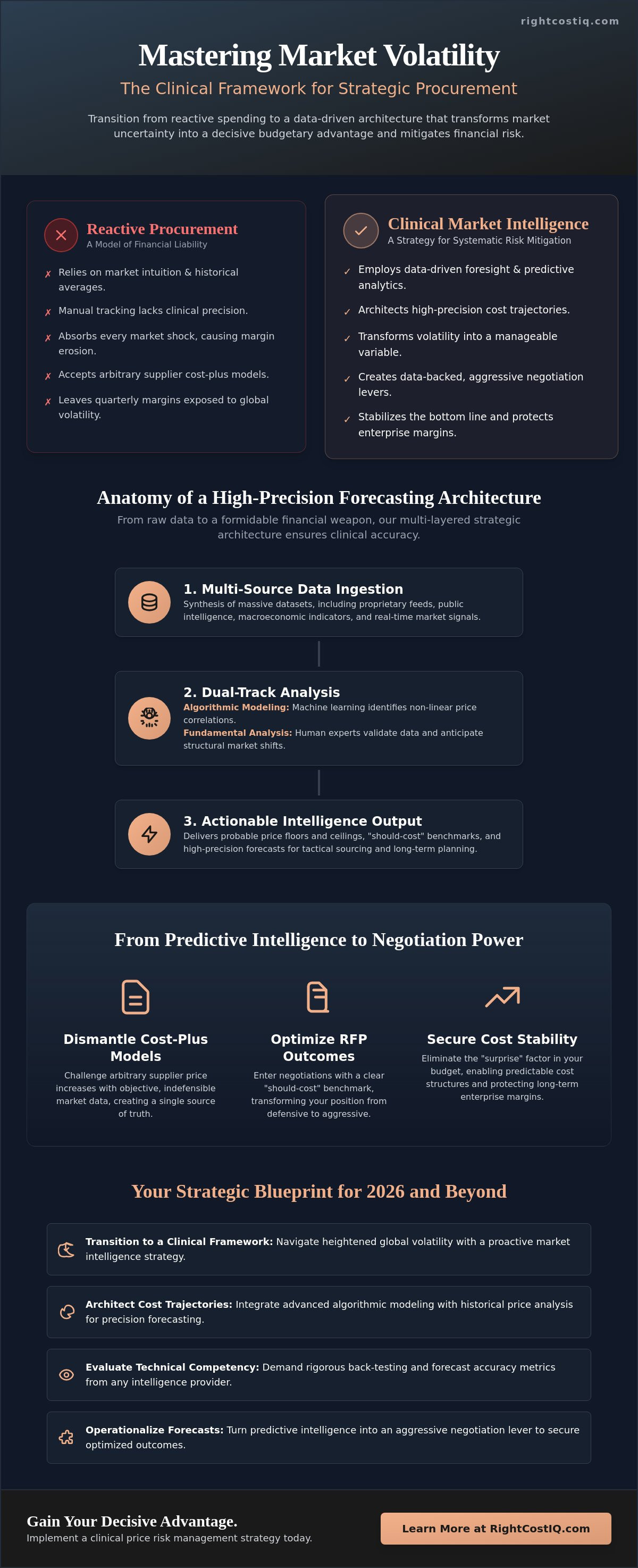
Static procurement models are obsolete in the volatile 2026 global market. Relying on historical averages or legacy supplier relationships creates a dangerous exposure to financial risk. Today's market volatility is driven by aggressive decarbonization policies, rapid supply chain reconfigurations, and regional protectionism. Organizations that fail to integrate a clinical market intelligence framework face immediate margin erosion when raw material costs spike unexpectedly. A commodity price forecasting service provides the necessary foresight to predict future cost trajectories, allowing procurement teams to move from reactive fire-fighting to proactive risk management.
The economic impact of unmanaged commodity exposure is often the difference between meeting quarterly earnings targets and significant financial underperformance. Without data-driven leverage, your organization absorbs every market shock. Clinical price risk management transforms these external variables into manageable components of your financial strategy. It's no longer enough to track what prices were yesterday; you must architect a strategy based on where they'll be in six months. This shift in operational philosophy ensures that enterprise margins remain protected regardless of global market shifts.
Defining the Clinical Forecasting Framework
A clinical forecasting framework distinguishes itself from basic market indices by focusing on predictive rather than descriptive data. While generic indices report past movements, specialized services utilize sophisticated forecasting methods to establish probable price floors and ceilings. These models integrate macroeconomic indicators, weather-driven disruptions, and shifting power demands from AI infrastructure to build a comprehensive view of supply and demand. A commodity price forecasting service acts as a strategic asset for margin expansion by transforming raw market data into actionable procurement intelligence. This precision allows decision-makers to identify the "should-cost" benchmark for any category, ensuring that every procurement outcome is optimized for the bottom line.
Strategic Drivers for Enterprise Adoption
The primary driver for enterprise adoption is the total elimination of the "surprise" factor in supplier price increases. When procurement teams operate with clinical market intelligence, they can challenge arbitrary cost-plus pricing models with objective data. This creates a single source of truth across finance, procurement, and operations, aligning departmental goals with corporate financial growth targets. Establishing this data-backed negotiation position ensures that your organization doesn't just respond to the market, but actively navigates it to secure a competitive advantage. By operationalizing these forecasts, you turn market intelligence into a decisive tool for budget planning and long-term cost stability.
Anatomy of High-Precision Forecasting Architectures
High-precision forecasting isn't a singular calculation; it's a multi-layered strategic architecture. To achieve clinical accuracy, an enterprise-grade commodity price forecasting service must synthesize massive datasets through both algorithmic filters and human expert validation. This dual-track approach ensures that models don't just echo historical price trending data but actively anticipate cyclical market shifts and structural supply changes. While basic models rely on linear projections, sophisticated architectures ingest real-time data to support short-term tactical sourcing decisions. This allows procurement teams to capitalize on transient market dips that generic indices often miss.
The integrity of your intelligence feed is a critical pillar of this architecture. Proprietary data sources often provide the "missing link" that public feeds lack, such as private transaction data or hyper-local inventory levels. Relying solely on public intelligence creates a parity with competitors that limits your strategic advantage. A clinical framework prioritizes proprietary feeds to ensure your negotiation position is backed by unique, high-fidelity insights that suppliers can't easily refute. This architectural rigor transforms raw market data into a formidable financial weapon.
Algorithmic vs. Fundamental Analysis
Machine learning excels at identifying non-linear price correlations that escape traditional statistical methods. These algorithms process thousands of variables simultaneously, from currency fluctuations to shipping lead times. However, research from the International Monetary Fund indicates that high-quality commodity price forecasts often require a blend of quantitative modeling and qualitative judgment. Geopolitical sentiment analysis is a primary example where human oversight remains critical. Algorithms track frequency, but experts interpret the intent behind policy shifts or "black swan" events like sudden trade embargoes. This hybrid model prevents over-reliance on historical data that no longer reflects 2026 geopolitical realities.
Data Granularity and Category Specificity
Effective forecasting requires deep segmentation across metals, energy, plastics, and agricultural softs. Global price trends provide context, but regional variances often dictate actual procurement costs due to logistical disruptions or local protectionism. Integrating category management procurement principles into the forecasting model ensures that every prediction aligns with specific business objectives. This level of granularity allows for the identification of category-specific "should-cost" benchmarks. Organizations that utilize a clinical Price Risk Management and Tracking Service gain the ability to challenge supplier pricing with surgical precision. This granular approach ensures that global trends don't obscure local opportunities for cost reduction.
Evaluation Criteria for Commodity Price Intelligence Providers
Selecting a commodity price forecasting service is a high-stakes decision that dictates the efficacy of your risk management strategy. It's not merely about data access; it's about the quality of decision support provided during volatile cycles. Clinical accuracy requires rigorous historical back-testing results to validate the provider's modeling precision. You must evaluate whether a provider offers the necessary breadth of coverage without sacrificing the specialized depth required for niche industrial inputs. While broad indicators like the World Bank Commodity Markets Outlook provide essential global context, enterprise procurement requires granular analysis tailored to specific regional markets and logistical constraints.
Scalability is another critical metric. As your organization's category requirements evolve, the service must adapt to cover new materials or shifting supply chain geographies. A provider that can't scale alongside your enterprise growth becomes a bottleneck, forcing a return to inefficient manual tracking. Look for a partner that offers a stable, data-driven framework that supports long-term budget planning and margin protection. The goal is to establish a permanent competitive advantage, not just solve a temporary data gap.
Technical Integration and Accessibility
Seamless technical integration is the hallmark of a sophisticated commodity price forecasting service. Manual data entry is a systemic point of failure. It introduces human error into financial planning and slows down response times. High-tier providers offer robust API capabilities for real-time data transmission directly into your ERP or procurement software infrastructure. This ensures that your internal cost models are always populated with the most current intelligence. Additionally, visual dashboarding is essential for translating complex price risk data for non-technical C-suite stakeholders. The frequency of updates also matters; while monthly reports provide strategic direction, real-time price alerts are necessary for short-term tactical sourcing execution.
Strategic Support and Advisory Services
Data alone doesn't win negotiations; the interpretation of that data does. Evaluate providers based on the availability of dedicated analysts who can handle bespoke category inquiries. This strategic support turns a standard subscription into a high-level consultancy. Training and upskilling initiatives are equally important to ensure your procurement team possesses the data literacy required to leverage these tools effectively. Finally, consider the provider's reputation in high-stakes negotiation assistance. A partner with a proven track record of helping clients challenge supplier cost-plus models provides far more value than a simple data aggregator. Your choice should reflect a commitment to technical upskilling and a ruthless focus on the bottom line.
Operationalizing Forecasts as a Negotiation Lever
Strategic foresight is only valuable if it's translated into tactical leverage at the bargaining table. A commodity price forecasting service shouldn't exist in a vacuum; it must function as the primary intelligence layer for your negotiation team. By utilizing clinical price trending, procurement professionals can effectively dismantle supplier cost-plus pricing models that often hide inefficient overhead or arbitrary margin padding. When a supplier cites "unavoidable market increases," your data-backed rebuttal transforms a subjective plea into an objective technical dispute. This shift in power dynamics ensures that your organization stops absorbing supplier inefficiencies and starts capturing market-aligned value.
Identifying a precise "should-cost" benchmark is the cornerstone of an aggressive RFP outcome. This benchmark acts as a clinical floor for competitive bidding, ensuring that initial quotes align with actual market trajectories rather than supplier-dictated premiums. Timing the market is equally critical. Launching an RFP during a predicted cyclical low, rather than a peak, can lock in structural cost advantages for the entire contract duration. Structuring flexible contracts with price adjustment clauses tied directly to forecast data ensures that your organization captures downstream market corrections without the need for constant renegotiation. This level of operational precision protects margins during the most volatile fiscal cycles.
Integrating Forecasting into the RFP Lifecycle
Pre-RFP intelligence sets the baseline for every successful engagement. By referencing established RFP Management frameworks, procurement teams can validate supplier quotes against independent market intelligence. This proactive approach neutralizes the information asymmetry that suppliers typically exploit during the bidding phase. Instead of accepting a quote as a fixed reality, you treat it as a variable that must be justified against clinical forecasting models. This level of scrutiny forces suppliers to offer their most competitive pricing from the outset. It eliminates the "guesswork" that often leads to budget overruns or mid-cycle price shocks.
Mitigating Volatility with Strategic Hedging
Determining when to fix prices through long-term agreements or when to ride market indices is a decision that requires technical precision. A commodity price forecasting service provides the visibility needed to execute these strategic hedges with confidence. In a stagflationary environment or during geopolitical disruptions, locking in costs early can prevent margin erosion. Conversely, if the forecast predicts a regional supply surplus, maintaining index-based pricing maximizes cost-saving opportunities. Data-driven negotiation positions deliver a measurable ROI by converting market volatility from a financial threat into a strategic procurement advantage. To secure these outcomes, organizations should leverage professional Request For Proposal (RFP) Management and Negotiation Assistance to bridge the gap between intelligence and execution.
The RightCostIQ Advantage: Precision Price Risk Management
RightCostIQ redefines the strategic importance of market intelligence within the procurement lifecycle. We don't just provide a commodity price forecasting service; we architect a comprehensive framework for clinical margin protection. Our methodology integrates high-fidelity market data with aggressive negotiation strategies to ensure market volatility becomes a driver for financial growth rather than a risk to enterprise stability. This clinical approach ensures every procurement decision is backed by objective, real-time analytics. We eliminate the information asymmetry that suppliers often exploit, providing your team with the data-driven leverage required to dominate the bargaining table.
We bridge the gap between predictive intelligence and tactical execution through a sophisticated synergy of services. Our "Procurement Category Cost benchmarking and Analytics" models are customized to your specific enterprise categories. We move beyond generic market indices to provide hyper-local cost visibility that reflects your actual supply chain realities. By combining these analytics with professional negotiation assistance, we empower procurement teams to challenge supplier cost-plus structures with surgical precision. This synergy transforms market intelligence into a tangible negotiation lever that secures superior RFP outcomes and long-term cost stability.
Results-Oriented Market Intelligence
Actionable strategic recommendations are the core of our "Price Risk Management and Tracking Service." We focus on delivering results that impact the bottom line directly rather than providing static data points. Our precision forecasting has enabled clients to identify cyclical market lows with high accuracy, allowing them to time high-volume RFPs for maximum cost reduction. These data-driven interventions protect bottom-line growth by neutralizing the inflationary pressure of unmanaged commodity exposure. Our clients don't just observe the market; they command it through technical upskilling and expert-led advisory. This results-oriented focus ensures that your investment in intelligence translates into measurable category savings and predictable budget planning.
Strategic Partnership for Global Supply Chains
Global market coverage is essential for navigating the regionalized supply chains of 2026. RightCostIQ provides a worldwide scope that integrates seamlessly into your existing procurement infrastructure through robust API capabilities and intuitive dashboarding. We automate the "Procurement and Vendor Performance Tracking Service" to ensure supplier compliance remains high and cost-savings are fully realized post-negotiation. This holistic integration ensures that high-level strategy and technical execution are perfectly aligned across all global categories. Our platform acts as a strategic architect for your procurement department, providing the tools necessary for clinical risk mitigation. It's time to move beyond reactive sourcing and adopt a clinical framework for margin expansion.
Optimize your price risk management with RightCostIQ.
Architecting a Defensible Procurement Strategy
Transitioning from reactive sourcing to a clinical risk management framework isn't optional for high-level decision-makers. It's a fundamental requirement for margin protection in an era of unprecedented market volatility. By integrating a sophisticated commodity price forecasting service into your core operations, you secure the data-backed leverage necessary to challenge supplier cost-plus models and optimize RFP outcomes. This strategic shift ensures that market fluctuations act as opportunities for efficiency rather than threats to your quarterly bottom line. Organizations that operationalize these architectures don't just survive market shifts; they dominate them through superior intelligence and execution.
RightCostIQ provides the technical infrastructure to transform raw data into a decisive financial weapon. We offer clinical precision in price risk management and expert-led negotiation assistance backed by global market intelligence coverage. Our framework ensures that your procurement strategy remains aligned with enterprise financial growth targets regardless of external disruptions. It's time to reclaim control over your supply chain costs and execute with absolute confidence. Your organization is now positioned to lead the market with data-driven authority.
Secure your margins with RightCostIQ's Market Price Forecasting Service.
Frequently Asked Questions
How does a commodity price forecasting service improve RFP outcomes?
A commodity price forecasting service improves RFP outcomes by establishing an objective "should-cost" baseline that prevents suppliers from padding margins under the guise of market volatility. It allows procurement teams to identify the optimal launch date for a bid cycle to capture cyclical lows. This data-driven approach shifts the power dynamic from subjective negotiation to technical validation. It ensures every quote is audited against clinical market intelligence rather than accepted at face value.
What is the typical accuracy rate for enterprise-level price forecasting?
Forecast accuracy depends on the specific modeling architecture and the inherent volatility of the underlying asset. High-precision services utilize back-testing against historical data to refine their predictive algorithms constantly. While no model predicts exact price points with absolute certainty, enterprise-level services focus on directional accuracy and volatility range prediction. This allows organizations to establish defensible price floors and ceilings for their internal budgeting and financial planning cycles.
Can commodity forecasting services be integrated into existing ERP software?
Integration occurs through robust API architectures that feed predictive data directly into enterprise ERP systems. This automation eliminates the human error associated with manual data tracking and ensures that internal cost models reflect current market realities. Real-time data ingestion allows procurement systems to trigger automated alerts when market conditions deviate from established benchmarks. It's a critical step for organizations seeking a seamless transition between intelligence and tactical execution.
Is price risk management necessary for non-industrial procurement categories?
Price risk management is essential for any category influenced by raw material inputs, including logistics, packaging, and facility management. These indirect categories often have hidden commodity exposures that can erode margins if left unmanaged. Utilizing a structured intelligence framework allows procurement teams to unbundle these costs effectively. It provides the visibility needed to challenge price increases in categories that aren't traditionally viewed as commodity-heavy but remain sensitive to global market shifts.
How often are commodity price forecasts updated for high-volatility markets?
Update frequency is dictated by market volatility and the specific needs of the procurement cycle. High-volatility markets often require real-time price alerts to support short-term tactical sourcing and immediate risk mitigation. Standard strategic planning typically utilizes monthly or quarterly deep-dive reports for long-term budget alignment. This tiered approach ensures that both immediate operational needs and long-term strategic targets are supported by the most current data available in 2026.
What is the difference between price trending and price forecasting?
Price trending is descriptive and focuses on historical data patterns to explain past market movements. In contrast, price forecasting is predictive and utilizes algorithmic modeling to project future cost trajectories. Trending identifies where the market has been, while forecasting identifies where the market is going. A commodity price forecasting service combines both to provide a comprehensive view of market dynamics and the specific risks associated with future supply disruptions.
How do I justify the cost of a forecasting service to the C-suite?
Justification centers on the measurable ROI achieved through margin protection and cost avoidance. By quantifying the financial impact of unmanaged market exposure, procurement leaders can demonstrate how predictive intelligence prevents significant budgetary overruns. It's a strategic investment in financial stability rather than a mere operational expense. The service cost is typically offset by the savings captured during a single high-stakes RFP cycle or through the successful prevention of a major price shock.
Can forecasting data be used in legal contract negotiations?
Forecasting data acts as a clinical foundation for structuring price adjustment clauses in multi-year supply agreements. It provides an objective third-party benchmark that both parties can agree upon to manage future uncertainty. Using predictive data in this way prevents the need for frequent, contentious renegotiations. It creates a transparent, data-backed mechanism for cost adjustments that protects both the buyer's margins and the supplier's operational viability over the long term.


