
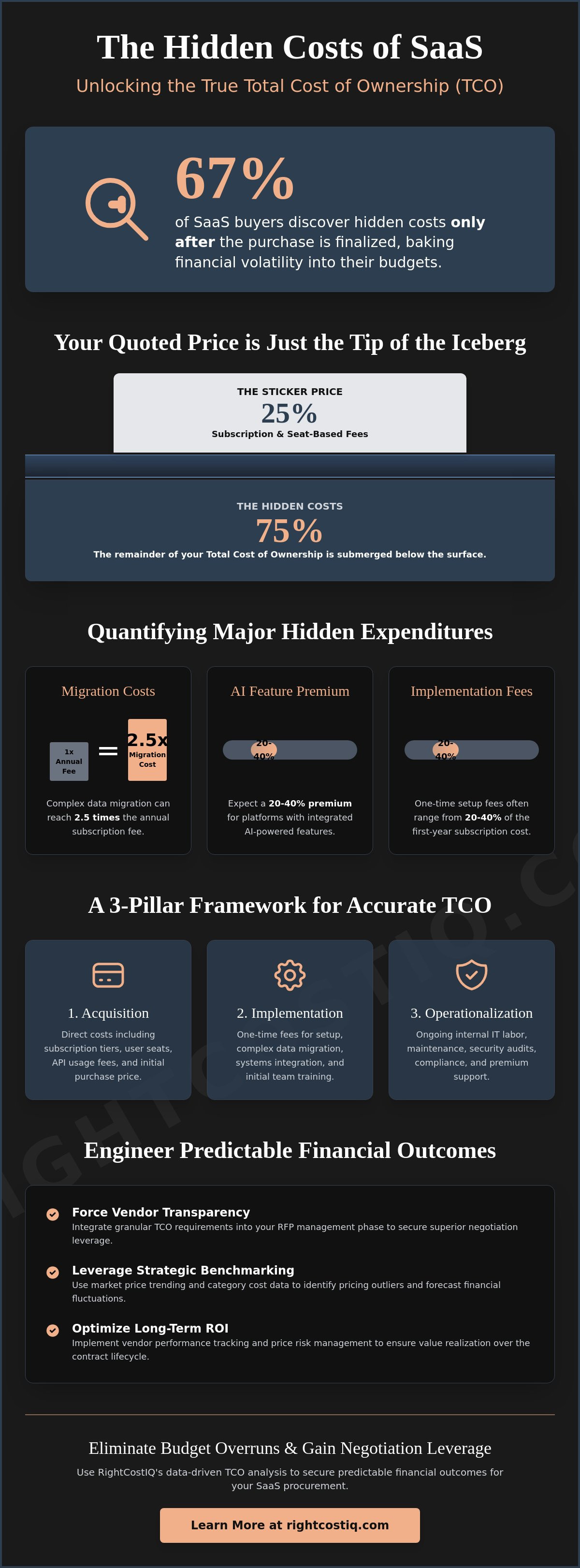
67% of SaaS buyers discover hidden costs only after the purchase is finalized. By then, the financial volatility is already baked into your budget. You likely recognize that a seat-based price tag is a deceptive metric for calculating total cost of ownership for SaaS. Subscription fees often account for as little as 25% of the total expenditure over a three-year lifecycle. This discrepancy creates significant risk for procurement leaders who rely on surface-level vendor quotes.
You'll master the quantitative methodology required to uncover hidden implementation fees and quantify internal labor costs for software maintenance. We'll examine how to account for the 20-40% premium currently driven by AI-powered features and the substantial migration costs that can reach 2.5 times the annual subscription fee. This analysis moves beyond accounting post-mortems to provide a strategic tool for engineering procurement outcomes during the sourcing phase.
We'll deconstruct the specific components of a standardized TCO template. You'll learn to utilize strategic benchmarking to validate vendor pricing and improve negotiation leverage during your next RFP cycle. By the end of this analysis, you'll possess the data-driven tools necessary to eliminate budget overruns and engineer predictable financial outcomes.
Key Takeaways
- Establish a precise financial architecture by distinguishing between superficial sticker prices and the fully loaded costs of the entire software lifecycle.
- Deploy a quantitative, three-pillar framework for calculating total cost of ownership for SaaS that accounts for acquisition, implementation, and ongoing operationalization.
- Leverage procurement category cost benchmarking and market price trending to identify pricing outliers and forecast future financial fluctuations.
- Force vendor transparency by integrating granular TCO requirements into the RFP management phase to secure superior negotiation leverage.
- Optimize long-term ROI through the strategic application of vendor performance tracking and price risk management services.
Defining SaaS TCO: A Precise Financial Architecture
SaaS procurement often fails because decision-makers mistake the vendor’s quote for the final financial obligation. Calculating total cost of ownership for SaaS requires a shift from passive accounting to active financial architecture. It's a comprehensive lifecycle assessment of every direct and indirect expenditure associated with a software asset from procurement to decommissioning. While the "sticker price" represents the visible subscription fee, the "fully loaded cost" encompasses the hidden layers of implementation, integration, and internal resource allocation. A precise Total cost of ownership (TCO) model exposes the true fiscal footprint of a platform before the first contract is signed.
In 2026, TCO has emerged as the primary driver for margin expansion in modern enterprise procurement. Sophisticated teams no longer accept static pricing models or opaque fee structures. They leverage AI-driven cost transparency and automated spend analysis to expose inefficiencies and identify price outliers. This evolution allows organizations to move beyond reactive budget management toward proactive financial engineering. By identifying every cost component early, firms can reduce the total spend profile and directly increase operational profit margins.
The Economic Impact of Underestimating TCO
Hidden fees aren't just minor budget leaks; they're structural failures that can degrade projected ROI by up to 40%. When implementation delays, data migration complexities, and training overhead aren't quantified, the initial business case collapses. Identifying price variance early in the lifecycle is a strategic urgency. It transforms TCO from a retrospective report into a defensive measure against financial volatility and supply chain non-compliance. Organizations that ignore these metrics remain vulnerable to the "SaaS tax," which is the cumulative weight of unmanaged, indirect costs.
TCO vs. ROI: Aligning Procurement and Finance
Cost containment and value realization are two sides of the same strategic coin. While ROI measures the return on an investment, TCO provides the essential denominator for that calculation. Without a precise TCO, ROI figures are purely speculative. Calculating total cost of ownership for SaaS ensures that the financial model accounts for every variable from API usage to advanced support premiums. TCO is the holistic sum of acquisition, implementation, and operational maintenance. By stabilizing the cost side of the equation, procurement enables finance to measure actual value realization with clinical accuracy.
The SaaS TCO Framework: A Quantitative Multi-Layered Approach
A rigorous three-pillar framework encompassing Acquisition, Implementation, and Ongoing Operationalization is required for calculating total cost of ownership for SaaS. Direct costs like subscription tiers, user seats, and API usage fees are the most visible, yet they rarely constitute the majority of the lifecycle expense. A comprehensive assessment of information technology assets must integrate indirect expenditures like internal IT labor for security compliance audits and complex data migration. Organizations often overlook the "Hidden 20%" of tail spend. This consists of fragmented, departmental software purchases that escape centralized oversight and inflate the overall spend profile without adding strategic value.
Internal IT labor costs represent a critical gap in traditional modeling. Quantifying the hours spent by engineering teams on software maintenance, integration, and security patching is essential for clinical precision. Without this data, the true burden on the organization remains obscured. Procurement architects must treat internal labor as a line-item expense to ensure the software's operational footprint aligns with the projected financial benefits. This granular visibility prevents the common scenario where a "low-cost" solution consumes a disproportionate share of expensive technical resources.
Acquisition and Setup: The Foundation of Cost
One-time implementation fees exert a heavy influence on year-one financial metrics. These charges often range from 20% to 40% of the first-year subscription cost for standard platforms, though complex enterprise systems can see these figures climb higher. Beyond vendor-facing fees, the cost of legal and procurement hours required for contract finalization must be accounted for. These internal resource allocations are non-negotiable costs of acquisition. Utilizing category management procurement during early-stage modeling allows teams to standardize these inputs and prevent unexpected budget overruns during the setup phase.
Operational Maintenance and Hidden Efficiencies
Ongoing operationalization requires a dedicated budget for continuous training and user adoption programs. Underutilized software is a primary driver of wasted capital. Evaluating the financial impact of a procurement and vendor performance tracking service ensures that service level agreements (SLAs) actually contribute to TCO optimization. Automated price risk management further reduces the "maintenance tax" of SaaS by shielding the organization from unforecasted renewal increases. Organizations can leverage market price trending and forecasting services to anticipate these fluctuations and secure more favorable long-term contract terms.
Benchmarking and Market Trending: Eliminating Price Variance
Information asymmetry is the vendor's greatest leverage in SaaS negotiations. Procurement leaders often lack the comparative data required to challenge high-tier quotes, leading to significant budget leakage. Category cost benchmarking eliminates this variance by identifying outliers in vendor pricing models against peer-group data. This process transforms subjective negotiation into a clinical exercise in cost validation. Calculating total cost of ownership for SaaS without external market benchmarks is essentially speculative. It leaves the organization vulnerable to "price creep" where initial discounts are offset by aggressive renewal increases or hidden service premiums.
Market price trending provides the forward-looking intelligence necessary to forecast future TCO fluctuations. By analyzing historical shifts and emerging pricing structures, procurement architects can anticipate when a category is likely to experience inflationary pressure or technological disruption. Data-driven sourcing acts as the primary antidote to market opacity. It ensures that every contract signature is backed by empirical evidence rather than vendor-supplied narratives. This proactive stance allows firms to lock in favorable rates before market conditions shift.
Utilizing Procurement Analytics for Cost Validation
Spend analytics reveal the true market rate for specific SaaS categories by aggregating transaction data across thousands of similar contracts. Normalizing vendor quotes against industry standard benchmarks ensures that you're comparing "all-in" costs rather than just surface-level seat prices. Forecasting models further mitigate the risk of mid-contract price escalations. These tools allow procurement teams to simulate various growth scenarios and their corresponding impact on the total financial commitment. It's about moving from a fixed-cost mindset to a dynamic, risk-adjusted financial model.
Identifying and Mitigating Price Risk
Price risk management is a strategic asset that protects the organization from external economic shocks. Global factors such as currency fluctuations and inflation have a direct, often unquantified, impact on global SaaS TCO. A rigorous risk assessment includes a checklist for vendor financial stability. Unstable providers often resort to aggressive fee restructuring or service degradation to maintain margins, creating long-term costs that far exceed the initial subscription. Consider these risk indicators during your evaluation:
- Revenue Diversification: Does the vendor rely on a single product or market segment?
- Retention Metrics: High churn rates often signal impending price hikes to recover lost revenue.
- Investment Velocity: A lack of R&D spend may indicate a "harvesting" phase where costs rise while value stagnates.
By integrating these analytics into the sourcing cycle, procurement departments function as high-level consultants that protect corporate margins. This clinical approach ensures that the total cost remains predictable throughout the entire asset lifecycle.
Strategic RFP Management: Capturing TCO During the Sourcing Cycle
Calculating total cost of ownership for SaaS must occur before the contract is drafted. If you wait until the implementation phase to identify cost drivers, you've already lost your primary negotiation leverage. Integrating TCO requirements directly into the RFP Management phase forces vendors to operate with financial transparency from the outset. You must demand granular cost breakdowns in standardized templates to prevent vendors from burying implementation or support premiums in "all-inclusive" bundles. A methodical scoring system that weights TCO alongside technical functionality ensures the most cost-effective solution wins, rather than the one with the most deceptive sticker price.
Modern procurement platforms allow teams to automate the comparison of TCO models across multiple bidders. This technological layer identifies price outliers that human analysis might overlook. By forcing vendors to provide multi-year cost projections, you eliminate the risk of the "SaaS tax" mentioned in previous sections. Strategic sourcing is the only stage where you can mandate these disclosures as a condition of participation. It transforms the RFP from a technical checklist into a clinical financial instrument.
Standardizing Vendor Responses for Clinical Comparison
Drafting RFP questions that expose hidden integration and data egress fees is a non-negotiable requirement. Vendors often omit the cost of middleware or the internal labor hours required to maintain complex API connections. You must demand multi-year cost transparency during the sourcing stage to account for the 67% of buyers who typically discover hidden costs post-purchase. Professional Request for Proposal (RFP) management and negotiation assistance refines these vendor-provided estimates. This ensures that the final TCO model reflects real-world operational burdens rather than sanitized marketing projections.
The Role of Technology in RFP Lifecycle Optimization
AI-led procurement optimization accelerates the TCO analysis of complex bids by instantly normalizing disparate pricing structures. This speed is critical when evaluating platforms that include a 20-40% premium for AI-powered features. Integrating vendor performance tracking into the final sourcing decision allows you to penalize providers with a history of unforecasted price escalations. Professional RFP management frameworks aim for a 95% accuracy rate in TCO forecasting by eliminating the data gaps that typically plague unmanaged sourcing cycles. This precision allows your organization to commit to software investments with absolute financial certainty.
Negotiation Architectures: Optimizing SaaS ROI and Risk Mitigation
Professional negotiation assistance serves as the final, critical mechanism for TCO optimization. While the previous frameworks establish a theoretical cost model, the negotiation phase is where those projections are codified into binding financial obligations. Calculating total cost of ownership for SaaS provides the empirical foundation required to challenge vendor assertions during high-stakes discussions. By entering a negotiation with a fully loaded cost profile, procurement leaders shift the conversation from price-per-seat to lifecycle value. This clinical approach ensures that the final contract reflects the organization's strategic objectives rather than the vendor's revenue targets.
Strategic architects use TCO data as a powerful lever to secure "Price Protection" clauses. These provisions are essential for capping future TCO growth by limiting annual price escalations to a fixed percentage or an agreed-upon market index. Without these protections, the initial savings achieved during sourcing are often erased by aggressive renewal hikes in subsequent years. Transitioning from procurement optimization to a long-term vendor performance tracking service ensures that the value negotiated at the start of the relationship is maintained throughout the software's entire lifecycle.
Leveraging Benchmarks in High-Value Negotiations
Presenting a vendor with data-driven market benchmarks creates an immediate psychological shift in the room. It signals that the buyer has eliminated information asymmetry and understands the true market rate for the category. This intelligence allows procurement teams to negotiate "all-inclusive" implementation packages that eliminate the risk of cost creep. By aligning contract terms with predicted market price trends, organizations can avoid locking themselves into long-term agreements for categories where prices are expected to decline. It's about maintaining agility while securing fiscal predictability.
Ensuring Long-Term Operational Efficiency
Ongoing vendor performance tracking is the only way to ensure TCO remains within the established budget. If a vendor fails to meet service level agreements or integration milestones, the resulting internal labor costs can quickly exceed the subscription price. Price risk management is equally vital when preparing for contract renewals in 2026, especially as AI-driven features continue to disrupt traditional pricing tiers. Proactive planning allows CIOs to evaluate alternatives well before the renewal window closes, maintaining maximum leverage until the final signature.
Optimizing your software spend requires more than a spreadsheet; it demands a clinical procurement strategy backed by real-time market intelligence. Secure your margins and eliminate financial volatility by leveraging RightCostIQ’s professional RFP management and negotiation assistance. Our data-driven sourcing models and market price forecasting services ensure you never overpay for SaaS again.
Engineering Predictable Procurement Outcomes
Master the quantitative methodology of calculating total cost of ownership for SaaS to eliminate unforecasted budget volatility and secure your corporate margins. As established, the 2026 shift toward AI-driven transparency requires a multi-layered framework that accounts for hidden implementation fees, internal labor, and ongoing operational overhead. Leveraging market benchmarks and clinical RFP management transforms procurement from a technical function into a strategic architect of corporate profit. This transition ensures that every software investment is backed by empirical data rather than vendor narratives.
Your organization's financial stability depends on the ability to forecast price risk and track vendor performance with absolute precision. Optimize your SaaS TCO with RightCostIQ’s professional negotiation and benchmarking services to gain access to proprietary market price trending models and expert sourcing assistance. Our clinical frameworks provide the data-driven leverage necessary to outperform the market and reduce financial volatility in every software category. You're now equipped to lead your organization toward a more efficient and resilient fiscal future.
Frequently Asked Questions
How do I calculate SaaS TCO for a 3-year contract?
Aggregate the initial acquisition fee, annual subscription costs, and estimated implementation expenses over the 36-month period. You must also factor in renewal price escalations and potential API overages to ensure the model accounts for the entire lifecycle. This comprehensive approach prevents the common mistake of focusing exclusively on the year-one budget while ignoring downstream financial obligations.
What are the most commonly missed hidden costs in SaaS TCO calculations?
Data egress fees, middleware integration costs, and advanced support premiums are frequently overlooked during the sourcing phase. Many organizations also fail to account for the internal resource drain during security audits and compliance certifications. These unquantified expenses often inflate the total expenditure by 20% to 40% beyond the base license fee, significantly degrading the projected ROI.
Can I use TCO to negotiate better pricing with my current SaaS vendors?
Yes, presenting a fully loaded TCO model during contract renewals shifts the leverage away from the vendor. By exposing the total cost burden, including maintenance and integration, you can force vendors to justify their pricing against market benchmarks. This clinical data makes it difficult for providers to maintain high margins on underperforming or high-maintenance assets during renewal discussions.
How does procurement analytics improve the accuracy of TCO models?
Procurement analytics provide the empirical data needed for calculating total cost of ownership for SaaS by normalizing disparate vendor quotes. These tools aggregate historical spend data to identify patterns in pricing outliers and hidden service fees. This analysis replaces speculative estimates with data-driven projections, ensuring that your financial architecture remains resilient and accurate across the entire enterprise.
Is TCO more important than ROI when evaluating new software?
TCO is the essential denominator required to calculate an accurate ROI. While ROI measures the projected return, TCO quantifies the actual investment required to achieve that return. Evaluating software based on ROI alone is dangerous because it ignores the structural costs that can erode profit margins over time. You can't have a reliable ROI without a precise TCO.
What role does market price trending play in SaaS cost forecasting?
Market price trending identifies historical price shifts and predicts future fluctuations based on technological disruption or economic changes. This intelligence allows procurement leaders to time their sourcing cycles and lock in favorable rates before inflationary pressures take effect. It's a proactive measure that prevents the organization from being blindsided by sudden market shifts or aggressive vendor price hikes.
How can RFP management services reduce the total cost of ownership?
RFP management services force vendor transparency by mandating granular cost breakdowns as a condition of participation. These frameworks standardize responses, making it easier to identify hidden premiums and integration gaps before a contract is signed. By automating the comparison of complex bids, these services ensure that the most cost-efficient solution is selected during the sourcing phase.
What is the impact of internal labor on SaaS TCO?
Internal IT labor is often the single largest indirect expense in calculating total cost of ownership for SaaS. The hours your team spends on implementation, security patching, and user support represent a real financial commitment that must be quantified. Failing to account for this labor leads to an underestimated TCO and a distorted view of the software's true operational impact.


