
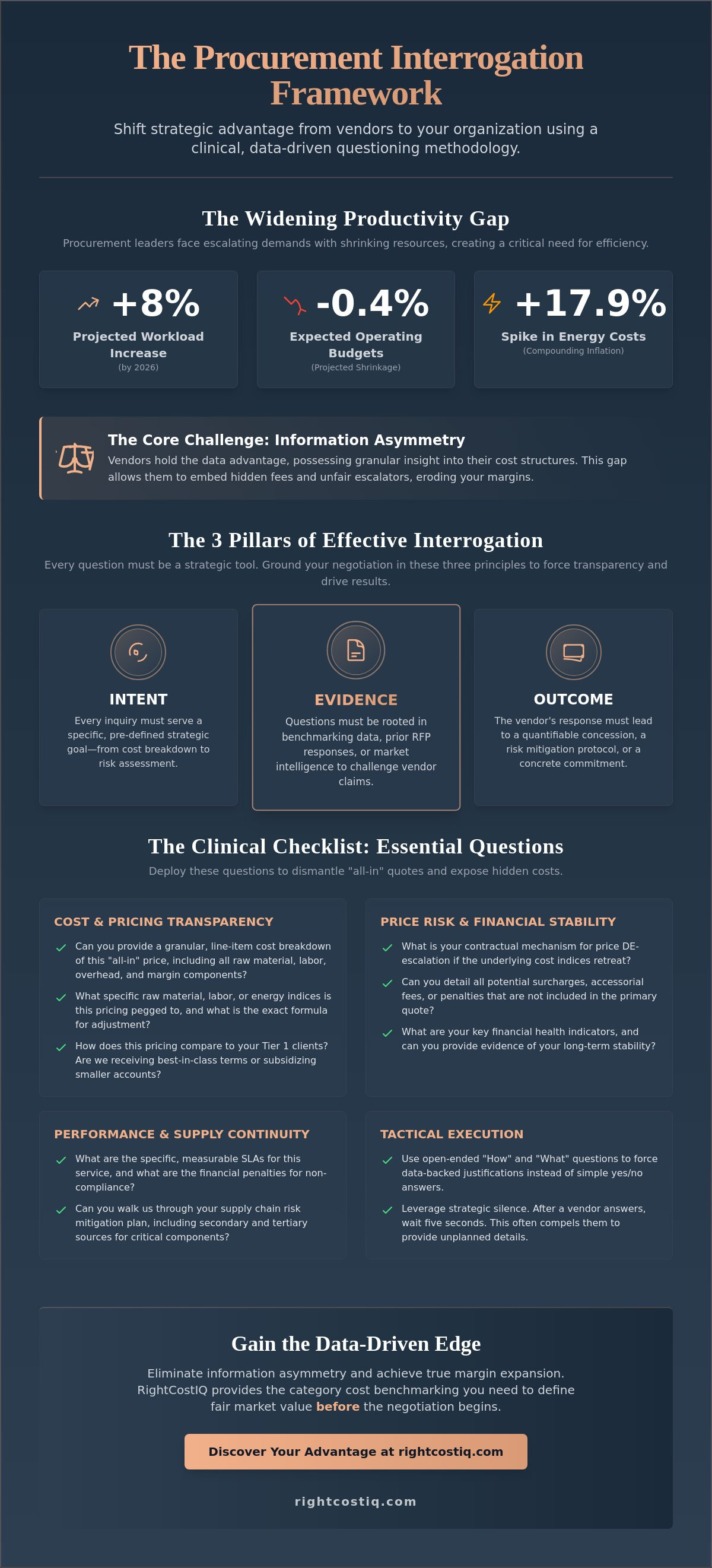
Procurement workloads are projected to increase by 8% in 2026, yet operating budgets are expected to shrink by 0.4%. This widening productivity gap forces leaders to operate with surgical efficiency while facing a 3.8% annual inflation rate and a 17.9% spike in energy costs. You likely recognize the disadvantage of information asymmetry where vendors hold the data edge, making it nearly impossible to verify fair market value or detect hidden escalators. You don't need better rapport; you need a data-driven interrogation framework. Identifying the right questions to ask vendors during negotiation is the primary lever for shifting strategic advantage back to your organization.
This article provides a clinical checklist designed to expose hidden costs and maximize margin expansion through absolute price transparency. We'll show you how to dismantle vendor margins by targeting specific price risk management and supply continuity metrics. You'll gain a structured 25-question framework to mitigate long-term financial risk and ensure your procurement strategy remains resilient against the current market volatility.
Key Takeaways
- Utilize interrogation as a precision tool to eliminate information asymmetry and protect enterprise margins against vendor-favored data gaps.
- Identify the critical questions to ask vendors during negotiation to unbundle "all-in" quotes into transparent, granular cost components.
- Shift negotiation objectives from simple price reduction to comprehensive price risk management and long-term supply chain resilience.
- Standardize your procurement process using a clinical 25-question checklist covering pricing, performance metrics, and financial risk factors.
- Establish data-driven leverage through procurement category cost benchmarking to define fair market value before the negotiation begins.
The Strategic Framework: Why Questions are Your Primary Procurement Lever
Information asymmetry is the primary driver of margin erosion in modern procurement. While vendors possess granular insight into their own cost structures and market positioning, procurement teams often operate within a vacuum of verified data. This Information Gap allows suppliers to bury escalators and hidden fees within "all-in" pricing models. To counter this, you must treat the negotiation table as a diagnostic environment. Interrogation is a tool for clinical execution, not a casual exchange of pleasantries; it's the mechanism that forces transparency.
Effective questions to ask vendors during negotiation rest on three pillars. First, Intent: every inquiry must serve a specific strategic goal. Second, Evidence: questions should be rooted in benchmarking data or prior RFP responses. Third, Outcome: the response must lead to a quantifiable concession or a risk mitigation protocol. This approach aligns with a sophisticated Strategic Sourcing Process, where the objective is long-term value rather than just transactional savings. A precise sourcing definition ensures that your interrogation is grounded in a framework that prioritizes operational efficiency over surface-level price tags.
The Psychology of Tactical Interrogation
Tactical interrogation relies on the psychological pressure of open-ended inquiry. "How" and "What" questions force vendors into a defensive analytical state, requiring data-backed justifications for their claims. Avoid loaded questions that trigger emotional defensiveness. Maintain professional authority and use silence as a primary tool. After a vendor answers, wait five seconds. This vacuum often compels the vendor to provide unplanned details that reveal their actual cost floors.
Setting the Interrogation Roadmap
Success requires an interrogation roadmap established before the meeting. Categorize requirements into "Must-haves" and "Nice-to-haves" to prevent tactical concessions on core needs. Use early-stage RFP data to flag inconsistencies between written and verbal claims. These discrepancies are the primary pivot points for your questions to ask vendors during negotiation. A unified front is mandatory. If multiple stakeholders are present, assign specific roles to prevent the vendor from exploiting internal divisions.
Interrogating the Cost Structure: Benchmarking and Pricing Transparency
Dismantling a vendor's "all-in" quote requires a shift from passive review to active deconstruction. When a supplier presents a consolidated price, they're often masking inefficiencies or padding margins. To achieve true margin expansion, you must apply category management procurement standards that demand a granular breakdown of every cost driver. This clinical approach forces the vendor to justify their pricing against objective market benchmarks rather than subjective "value-add" claims. Using the Federal Acquisition Regulation (FAR) Part 15 as a conceptual gold standard for proposal analysis ensures your interrogation remains rooted in rigorous source selection protocols.
The "Benchmarking Trap" occurs when procurement teams accept a discount relative to the vendor's list price without verifying where that price sits in the broader market. You must determine if you're receiving Tier 1 pricing or if you're subsidizing the vendor's smaller accounts. Strategic questions to ask vendors during negotiation should focus on the underlying raw material and labor indices. For instance, with energy costs rising by 17.9% as of May 2026, you need to know exactly how much of that volatility is baked into your fixed fee and what happens when those indices retreat. Utilizing category cost benchmarking allows you to walk into the room with the "Right Cost" already identified.
Uncovering Hidden Volatility
Protecting your margins requires identifying which external factors trigger price escalators. Don't accept vague "inflationary adjustments." Demand specificity.
- "What specific market indices drive your annual price escalators, and is there a symmetrical de-escalation clause if those indices fall?"
- "Can you provide a transparent breakdown of the labor vs. material cost ratio in this quote to justify the 3.8% inflationary surcharge?"
- "How does your current margin compare to your three-year historical average for this specific service category?"
Interrogating Renewal and Growth Levers
Negotiation isn't a one-time event; it's a long-term financial strategy. You must interrogate the vendor’s willingness to reward your enterprise scale over time.
- "How is your pricing model structured to reward our enterprise scale over a 3-year horizon through compounding efficiency gains?"
- "What usage metrics trigger the next tier of volume-based discounting, and can we audit those metrics quarterly?"
- "Why should we renew when our internal market price trending suggests a 15% variance in your competitors' favor for this volume?"
By forcing the vendor to defend their cost structure with data, you eliminate the "standard discount" narrative. This level of transparency is only possible when you leverage market price trending and forecasting to validate every claim made at the table.
Mitigating Price Risk: Questions for Long-Term Financial Stability
Strategic leverage is built on the mitigation of future volatility. While previous sections focused on deconstructing the initial quote, long-term margin protection requires shifting the focus from "lowest price" to "lowest risk." In a climate where annual inflation reached 3.8% in May 2026, failing to interrogate a vendor’s financial health and supply chain resilience creates systemic vulnerability. You must utilize questions to ask vendors during negotiation that address price caps and "Most Favored Nation" clauses to ensure your enterprise isn't left absorbing market shocks.
Integrating market price trending and forecasting data allows you to challenge the vendor’s future cost assumptions with clinical precision. If a supplier predicts sustained increases in overhead, you must counter with objective data regarding the SOFR, which stood at 3.51% in May 2026, and energy market corrections. This interrogation ensures that price risk management is embedded into the contract structure from day one. You don't just want a deal; you want a hedge against the 17.9% spike in energy costs that recently disrupted global supply chains.
Interrogating Supply Chain Compliance
Supply continuity has officially surpassed cost reduction as the top procurement objective in 2026. Your questioning must reflect this shift.
- "What is your specific protocol for notifying us of upstream price volatility 90 days in advance of a contractual adjustment?"
- "How do you track and report on vendor performance metrics that impact our bottom line when disruptions occur?"
- "Can you provide a Total Cost of Ownership (TCO) model that accounts for logistics volatility and potential tariffs?"
Contractual Safeguards and Exit Leverage
Flexibility is a financial asset. You must interrogate the vendor's willingness to accept accountability for performance failures.
- "What are the financial penalties for failure to meet SLA-driven performance benchmarks, and how are these credited back to our account?"
- "How does this agreement protect our facility from surprise inflationary adjustments in Year 2 if the national inflation rate exceeds 4%?"
- "Regarding the 'Termination for Convenience' clause: what is the specific cost of flexibility in this agreement if we identify a more efficient market alternative?"
Successful price risk management requires constant vigilance. Implementing a robust procurement and vendor performance tracking service ensures that the answers provided at the negotiation table remain grounded in reality throughout the contract lifecycle. This data-driven approach transforms the contract from a static document into a dynamic tool for margin expansion.
The Procurement Checklist: 25 Essential Questions for the Negotiation Table
Strategic leverage requires a structured progression of inquiry. You must sequence your questions to ask vendors during negotiation to build strategic urgency, forcing the supplier to commit to data-backed cost structures before discussing final concessions. Every inquiry in this diagnostic framework links directly to a tangible business outcome, ensuring that the negotiation remains focused on margin expansion rather than tactical pleasantries. Use this high-density checklist to dismantle vendor-favored information asymmetry.
The Pricing & Benchmarking Block
Cost transparency is a mandatory negotiation prerequisite that establishes the baseline for all subsequent margin expansion discussions. These questions target the vendor’s internal efficiencies and market alignment.
- What specific operational efficiencies have you introduced this year that will directly lower our unit costs?
- How does this pricing model reflect the 17.9% energy cost spike versus your historical procurement norms?
- Can you provide a cost-plus breakdown that isolates your net margin from operational overhead?
- Which specific market index do you utilize to benchmark your raw material acquisition?
- How is the 3.51% SOFR integrated into your financing or inventory carrying cost assumptions?
- Which line items in this proposal are fixed versus variable based on quarterly market fluctuations?
- What is the specific labor-to-material ratio for this service category?
- How does this proposal align with current Tier 1 market benchmarks for our specific enterprise volume?
The Performance & Risk Block
This block moves beyond the price tag to interrogate the vendor's reliability and your facility's protection. It utilizes the vendor’s own performance tracking mechanisms as a leverage point.
- 9. In the event of a force majeure, where does our facility rank in your priority fulfillment hierarchy?
- 10. How do you track and report on internal performance metrics that deviate from our agreed SLAs?
- 11. What is your documented protocol for mitigating upstream supply chain disruptions?
- 12. Can we audit your Tier 2 and Tier 3 suppliers for compliance with our risk management standards?
- 13. What specific financial penalties are triggered by a 5% deviation from lead-time commitments?
- 14. How do you ensure cybersecurity parity across all software integrations in our supply chain?
- 15. What is the "Total Cost of Ownership" (TCO) including logistics volatility and handling fees?
- 16. What percentage of your current capacity is dedicated to our account?
- 17. How do you manage and report on the price risk of your primary sub-components?
The Future Growth & Flexibility Block
The final questions address long-term stability and the vendor's commitment to innovation. They ensure your agreement remains resilient against market shifts and corporate restructuring.
- 18. How will your recent or pending M&A activity impact our support infrastructure and pricing stability?
- 19. What percentage of our annual spend is reinvested into R&D for the specific services we consume?
- 20. What is the technological roadmap for the automation of our current manual touchpoints?
- 21. What is the specific financial cost of flexibility if we exercise a "Termination for Convenience" clause?
- 22. How do you guarantee data portability and transition support if we migrate to a competitor?
- 23. What volume-based discounting tiers are available if our enterprise scale increases by 20%?
- 24. How do you protect our pricing from surprise inflationary adjustments during Year 2 and Year 3?
- 25. What specific innovation incentives can you offer to drive mutual margin expansion?
Executing this checklist requires a baseline of objective market data to verify the vendor's responses. To gain the necessary leverage for these inquiries, utilize Request For Proposal (RFP) Management and Negotiation Assistance to ensure your team walks into the room with clinical precision.
Clinical Execution: Leveraging RightCostIQ for Data-Driven Leverage
Identifying the right questions to ask vendors during negotiation is only the initial phase of margin protection. Strategic leverage requires the integration of high-fidelity data into the live negotiation environment. RightCostIQ’s RFP Management and Negotiation Assistance provides the analytical foundation needed to move from tactical questioning to clinical execution. By utilizing Procurement Category Cost Benchmarking, you identify the "Right Cost" before the meeting begins, ensuring your interrogation is grounded in objective market reality rather than vendor-supplied narratives.
Price transparency is the primary driver for margin expansion. When a vendor cites general economic volatility as a reason for price hikes, our Market Price Trending and Forecasting service turns that "inflation" excuse into a data-driven rebuttal. We provide the specific indices and cost-component analysis required to challenge arbitrary escalators. This level of precision shifts the power dynamic, forcing suppliers to defend their margins against your verifiable market intelligence. Professional negotiation assistance acts as a catalyst for financial growth, transforming procurement from a cost center into a strategic architect of enterprise value.
From Interrogation to Optimization
Strategic sourcing doesn't end when the contract is signed. Our Vendor Performance Tracking Service ensures that the concessions won at the table are actually delivered throughout the contract lifecycle. Professional negotiators often identify 10-20% in additional savings through data-led questioning and technical cost analysis. RightCostIQ integrates advanced technology into traditional procurement functions to deliver clinical financial growth. This approach ensures that the questions to ask vendors during negotiation result in enforceable, trackable performance standards rather than empty promises.
Your Next Strategic Move
The transition from manual, intuition-based negotiation to an automated, data-driven procurement infrastructure is no longer optional. As operating budgets shrink and workloads increase, the ability to audit your current vendor list against real-time market benchmarks becomes a core competitive advantage. You must move beyond the "standard discount" and demand absolute price transparency. Audit your existing agreements to identify where information asymmetry is currently eroding your margins.
Contact RightCostIQ for a clinical audit of your procurement strategy.
Securing Strategic Advantage Through Clinical Interrogation
Strategic leverage isn't found in rhetorical skill but in the systematic application of data-driven inquiry. By standardizing your questions to ask vendors during negotiation, you transform the procurement process into a clinical diagnostic exercise. This framework forces suppliers to justify their cost structures against objective market benchmarks, effectively neutralizing the information asymmetry that historically favors the vendor. You've now seen how to unbundle "all-in" quotes and mitigate price risk through structured interrogation that prioritizes long-term financial stability.
Founded in 2023, RightCostIQ specializes in healthcare financial analytics to provide decision-makers with the transparency required for authentic margin expansion. Our proprietary Procurement Category Cost Benchmarking platform and expert-led RFP Management and Negotiation Assistance ensure your team operates with surgical precision. We bridge the gap between traditional sourcing and advanced financial optimization, turning complex data into actionable negotiation leverage. You don't have to accept opaque pricing or hidden escalators as the unavoidable cost of doing business. Take control of your enterprise margins today.
Optimize Your Next Negotiation with RightCostIQ Analysis
Frequently Asked Questions
What are the most important questions to ask a vendor during an RFP process?
The most critical RFP questions target cost-plus transparency and specific performance penalties. You must ask how the vendor isolates their net margin from operational overhead and what their documented protocol is for notifying you of price volatility 90 days in advance. This ensures your initial source selection is based on verifiable risk management rather than marketing claims. High-fidelity responses here set the baseline for all future margin expansion.
How do I ask for a price reduction without sounding aggressive?
Frame price reduction requests as a clinical alignment with objective market benchmarks rather than a personal demand. Use data-driven questions to ask vendors during negotiation to highlight discrepancies between their quote and current market price trending. When you present a 3.8% national inflation rate against a proposed 10% hike, the data creates the pressure. This allows you to maintain professional authority while demanding financial efficiency.
Can I negotiate a contract after it has already been signed?
Contractual renegotiation is possible through performance-based triggers or material market shifts. If a vendor fails to meet SLA-driven benchmarks, you possess the leverage to reopen pricing discussions immediately. Use a vendor performance tracking service to document these failures with precision. Significant changes in market indices, such as the 17.9% energy cost spike seen in May 2026, also provide a legitimate basis for requesting a mid-term cost audit.
What should I ask about a vendor's supply chain risk?
Inquire about the vendor's Tier 2 and Tier 3 supplier visibility and their specific priority fulfillment hierarchy. You need to know where your facility ranks in their fulfillment list during a force majeure event. Ask for their documented protocol for mitigating upstream disruptions. In 2026, supply continuity has surpassed cost reduction as the top procurement priority, so these responses must be granular, verifiable, and contractually binding.
How do I use market benchmarking data in a live negotiation?
Introduce benchmarking data to challenge the vendor's "standard discount" narrative with objective market floors. Present specific category cost benchmarking to show exactly where the vendor’s quote sits relative to Tier 1 enterprise pricing. This forces the supplier to justify their premium with data. It transforms the discussion from a subjective value debate into a clinical analysis of market alignment and margin expansion.
What are the red flags to look for in a vendor's response to pricing questions?
Watch for vague qualifiers like "industry standard" or a refusal to unbundle "all-in" pricing into granular cost components. An inability to link price escalators to specific market indices is a primary red flag. If a vendor cannot explain how their pricing reflects the current 3.51% SOFR, they're likely masking inefficient capital management or hidden margins. These inconsistencies suggest a lack of cost transparency and high long-term financial risk.
How often should I re-negotiate with a long-term sole-source supplier?
Perform a clinical audit of sole-source agreements at least annually or whenever primary market indices shift by more than 2%. Long-term suppliers often develop "margin creep" where operational efficiencies aren't passed down to the client. Use market price trending and forecasting to verify that your fixed costs remain competitive. Regular interrogation prevents complacency and ensures the supplier continues to earn their status through documented performance and price alignment.
What is the difference between a 'soft' negotiation and a 'clinical' procurement audit?
Soft negotiation focuses on relationship preservation and subjective compromises. A clinical procurement audit utilizes data-led questions to ask vendors during negotiation to achieve quantifiable margin expansion. It treats the contract as a financial asset to be optimized through price risk management and performance tracking. While soft negotiation seeks a "fair" deal, a clinical audit demands the absolute market floor justified by hard data and forensic cost analysis.


