
A vague scope of work isn't just a project management oversight; it's a direct leak in your corporate treasury. You've likely experienced the frustration of paying premium market rates for results that fail to move the needle on your core business objectives. When writing a statement of work for consultants, the objective must shift from mere task description to high-level financial engineering to prevent these budget overruns. Most procurement leaders agree that this misalignment leaves the organization vulnerable to market volatility and unmanaged financial risk.
This article provides the clinical framework necessary to transform your procurement process into a driver of measurable ROI. You'll master the architectural precision required to define deliverables with absolute clarity and integrate rigorous vendor performance tracking into your contracts. We'll examine how to leverage market price trending and cost benchmarking to ensure every consulting engagement is optimized for financial growth. This guide serves as a technical manual for drafting SOWs that function as precision-engineered instruments of financial accountability. It's time to align technical execution with high-level strategy.
Key Takeaways
- Transition from descriptive scope documents to precision-engineered procurement contracts that mandate financial accountability and risk mitigation.
- Master the technical distinction between activity-based milestones and tangible business outcomes when writing a statement of work for consultants.
- Utilize procurement category cost benchmarking and market price trending to validate consultant rates against real-time industry data.
- Integrate automated vendor performance tracking and clinical KPIs to ensure continuous alignment between consultant output and organizational goals.
- Optimize the entire procurement lifecycle by linking SOW drafting with sophisticated RFP management and negotiation assistance frameworks.
The Strategic Architecture of a Consultant Statement of Work (SOW)
In high-stakes procurement, the document acts as the primary engine for financial accountability and outcome precision. Writing a statement of work for consultants requires far more than a simple list of activities; it demands a technical blueprint that mandates performance. A well-constructed Statement of Work serves as the baseline for all subsequent cost analysis and vendor performance tracking. Without this architectural foundation, organizations face unmanaged price risk and the inevitable erosion of project margins. Clinical precision during the drafting phase is the only reliable defense against the financial volatility inherent in professional services engagements.
SOW vs. Scope of Work: Why the Distinction Matters
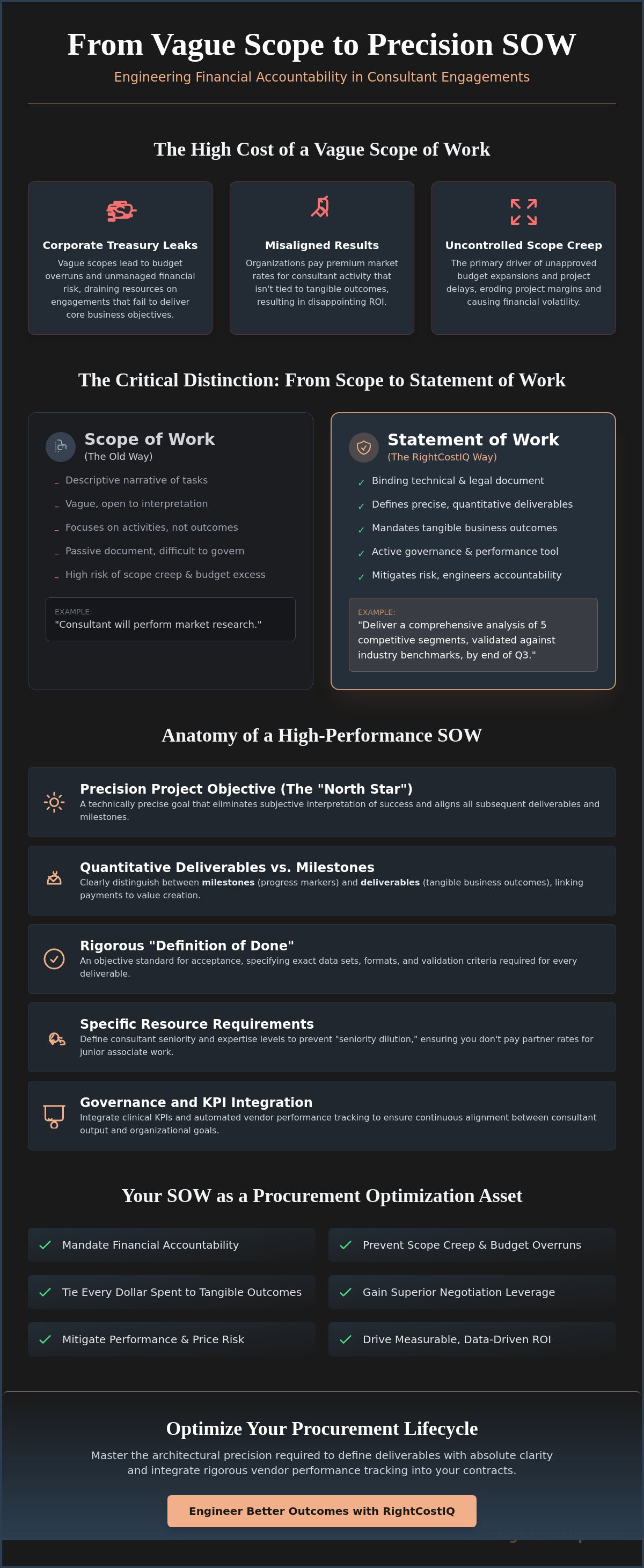
Industry professionals often use these terms interchangeably, but the operational and legal distinctions are critical for procurement optimization. A generic "Scope of Work" is typically a descriptive narrative of tasks and responsibilities. In contrast, a high-performance "Statement of Work" is a binding technical document that specifies exact requirements, rigorous timelines, and quantitative deliverables. While a scope document might vaguely outline "market research," a rigorous SOW mandates "a comprehensive analysis of five competitive segments delivered by the end of Q3."
This level of detail is essential for effective RFP management. It transforms the document from a passive record into an active governance tool. By defining the exact parameters of success, procurement teams can benchmark consultant performance against market trends and internal performance data. It also provides the necessary framework for automated performance tracking systems to flag deviations before they impact the bottom line. It's the difference between hoping for results and mandating them through structural design.
The SOW as a Procurement Optimization Asset
SOW architecture directly influences enterprise-level financial growth metrics by establishing "spend under management" protocols at the point of inception. By embedding specific performance triggers and cost-benchmarking clauses, you mitigate the risk of financial volatility. This prevents "scope creep," the primary driver of unapproved budget expansions and project delays. A strategic SOW is a data-driven contract that aligns consultant incentives with client ROI. It ensures that every dollar spent is tied to a tangible business outcome rather than subjective billable hours. Integrating these documents into a broader procurement analytics framework allows for real-time price risk management and superior negotiation leverage. When writing a statement of work for consultants, you're engineering a financial outcome rather than just documenting a project.
Clinical Components of a High-Performance Consulting SOW
A high-performance SOW functions as a technical specification for service delivery. Writing a statement of work for consultants requires a granular breakdown of every operational variable to ensure the engagement remains within the defined financial parameters. The project objective must act as a "North Star," defined with such technical precision that it eliminates subjective interpretation of project success. This objective dictates the alignment of all subsequent deliverables and milestones, providing a clear trajectory for the entire engagement.
Distinguishing between milestones and deliverables is a prerequisite for financial accountability. Milestones represent chronological progress markers, such as the completion of a discovery phase or a technical audit. Deliverables are tangible business outcomes, such as a finalized strategic roadmap or a validated cost-reduction model. Quantifying these outcomes ensures that payments are linked to value creation rather than time elapsed. By specifying resource requirements, such as consultant seniority and expertise levels, procurement leaders prevent "seniority dilution" where junior associates perform work billed at partner rates.
Quantifying Deliverables for Maximum Accountability
Effective SOW architecture moves beyond qualitative descriptions to embrace quantitative performance indicators. A robust "Definition of Done" serves as the objective standard for acceptance, specifying the exact data sets, formats, and validation criteria required for every asset. By integrating negotiation coach principles into these acceptance terms, procurement leaders can secure specific concessions regarding quality and rework. This clinical approach ensures that the organization only pays for work that meets the pre-defined architectural standards of the project. It removes the ambiguity that often leads to budget overruns and project delays.
The Governance Framework: Managing the Engagement
Governance is the operational heartbeat of the SOW. It establishes the reporting frequency and data requirements necessary for effective vendor performance tracking. Clear escalation paths for project risks and financial variances must be documented to prevent minor issues from becoming structural failures. This framework ensures the SOW supports automated procurement systems, allowing for real-time monitoring of consultant output against contractual obligations. Status reporting should not be a narrative summary but a data-driven report of progress against KPIs.
Maintaining this level of oversight requires a systematic approach to contract management. To evaluate your current SOW maturity and identify hidden performance gaps, you might consider a technical assessment of your procurement processes. Establishing these governance protocols from day one ensures that consultant performance remains aligned with enterprise-level ROI targets. This clinical structure transforms the SOW from a simple agreement into a powerful tool for procurement optimization.
Benchmarking and Negotiation: Pricing the SOW for Efficiency
Pricing is often the most volatile variable in consultant engagements. Relying on a supplier's initial quote as the baseline for a project's cost is a fundamental procurement error. When writing a statement of work for consultants, you must apply clinical cost benchmarking to validate every line item against real-time market data. This data-driven approach removes the subjectivity from rate discussions and ensures your organization isn't paying a "brand premium" that doesn't translate to superior output. Effective negotiation begins with a technical audit of the proposed fee structure to ensure it reflects the current market intelligence.
Selecting the appropriate fee structure is a strategic decision that dictates the project's risk profile. While Time & Materials (T&M) models offer flexibility, they often incentivize activity over results; Fixed Fee models provide budget certainty but require the "Definition of Done" established in previous sections to be airtight. Value-Based pricing, though complex to draft, aligns consultant compensation directly with your enterprise-level financial growth. The goal is to select a structure that minimizes financial exposure while maximizing consultant performance.
Leveraging Market Intelligence in SOW Drafting
Market price trending identifies the optimal window for consultant engagement by analyzing seasonal fluctuations and demand-side pressures. By integrating procurement analytics into the SOW drafting process, procurement leaders can identify category-specific savings that remain hidden in generic contracts. This level of analysis is particularly vital when managing "tail spend" consultants. These smaller, specialized engagements often escape rigorous scrutiny, yet they represent a significant opportunity for aggregate cost reduction when benchmarked against industry standards. Data-driven sourcing ensures competitive pricing across the entire vendor ecosystem.
Negotiating the Financial Terms
Negotiation should move beyond a simple debate over hourly rates to focus on outcome-based pricing and risk mitigation. Multi-year consulting SOWs must include price risk management clauses to protect the organization from unforeseen market volatility. Utilizing professional negotiation assistance transforms the SOW from a static cost center into a dynamic value driver. This assistance allows procurement teams to leverage benchmarking data as a clinical lever, securing concessions that junior buyers might overlook. By anchoring the negotiation in market realities rather than supplier narratives, you ensure that every dollar committed is optimized for maximum ROI. A well-negotiated SOW doesn't just save money; it engineers a more profitable outcome.
Mitigating Performance Risk: Governance and KPI Integration
Performance risk represents a significant financial liability when left unmanaged within a consulting engagement. Writing a statement of work for consultants requires a structured approach to risk mitigation that extends beyond simple project descriptions. To ensure consultant accountability, procurement leaders must implement a four-step governance framework that links contractual obligations to measurable business data. This clinical integration ensures that the organization maintains control over project trajectories and financial outlays from inception to completion.
- Step 1: Identifying Critical KPIs. Define the specific indicators that signal project health and success. These must be quantifiable metrics that leave no room for subjective interpretation.
- Step 2: Linking Milestones to Automated Tracking. Integrate SOW milestones directly into your procurement software. This allows for real-time monitoring of consultant progress against the agreed-upon timeline.
- Step 3: Establishing Financial Adjustments. Build clear financial penalties for underperformance and incentives for exceeding target outcomes. This aligns the consultant's profit motive with your project's success.
- Step 4: Creating a Clinical Audit Trail. Document every deliverable, approval, and change order. A rigorous audit trail is essential for compliance and provides the necessary data for end-of-project ROI analysis.
Designing Robust Key Performance Indicators (KPIs)
Effective KPI design differentiates between "leading" indicators, which predict future success, and "lagging" indicators, which confirm past results. Leading indicators might include the timely completion of technical audits, while lagging indicators focus on final margin expansion or cost savings. These metrics must remain aligned with your broader category management procurement goals to ensure the consulting engagement supports enterprise-level strategy. KPIs in an SOW serve as the foundation for vendor performance tracking, providing the data necessary to trigger automated governance protocols. To identify gaps in your current tracking capabilities, you can perform a technical diagnostic of your procurement performance.
Risk Mitigation and Compliance Clauses
Non-negotiable SOW components must include rigorous data security protocols and explicit IP ownership terms. These clauses protect the organization's intellectual capital and ensure compliance with global supply chain standards. Managing "price risk" is equally critical; this requires clear change-order protocols that mandate executive approval for any budget expansion. By codifying these requirements, procurement teams prevent the unauthorized "scope creep" that often erodes project value. A clinically drafted SOW functions as a legal and operational shield, ensuring that consultant engagements remain focused, compliant, and financially optimized. It's the primary mechanism for transforming high-level strategy into technical execution without the risk of financial volatility.
Optimizing the SOW Lifecycle with RightCostIQ Frameworks
Manual SOW creation is a source of operational friction and financial leakage. Integrating SOW drafting into a centralized RFP management workflow ensures that the technical requirements and pricing concessions secured during negotiation are codified without loss of fidelity. This integration transforms writing a statement of work for consultants from a siloed administrative burden into a strategic extension of the sourcing process. RightCostIQ frameworks provide the analytical infrastructure to benchmark every consulting engagement against enterprise-level cost models and market intelligence.
Automated performance tracking ensures that SOW compliance is no longer a manual sampling exercise but a continuous, data-driven mandate. By linking deliverable acceptance to automated procurement triggers, organizations can enforce contractual obligations at scale. This shift moves the SOW from a static legal document to a dynamic performance asset that actively manages vendor behavior. Real-time data visibility allows procurement leaders to identify underperforming consultants before financial variances impact the quarterly bottom line. It's the most effective way to maintain strategic control over high-value professional services spend.
Centralizing SOW Management for Enterprise Efficiency
Managing complex consulting contracts across diverse business units requires a unified procurement platform to maintain absolute version control. Centralization eliminates the risks associated with outdated templates and inconsistent deliverable definitions. It also reduces administrative friction during the consultant onboarding process, accelerating time-to-value for critical projects. Standardized SOW architectures lead to higher "spend under management" by providing the visibility necessary for aggregate cost analysis and strategic category optimization. This structural consistency is the primary driver of enterprise-level procurement efficiency.
Conclusion: The Future of Data-Driven SOWs
The evolution of procurement demands a transition from descriptive narrative to clinical, precision-led contract engineering. As AI and advanced analytics become standard, the ability to predict consultant performance based on historical SOW data will distinguish high-performing procurement teams from their peers. Organizations that adopt a rigorous, data-driven framework for SOW drafting will secure a sustainable competitive advantage through superior resource allocation and risk mitigation. Precision in the SOW is the ultimate safeguard for your corporate treasury. Optimize your consultant procurement with RightCostIQ RFP Management.
Engineering a High-Performance Consultant Governance Framework
The transition from descriptive task lists to outcome-based mandates is the primary driver of procurement efficiency. By prioritizing clinical precision when writing a statement of work for consultants, organizations eliminate the financial volatility associated with unmanaged scope creep. You've learned how to leverage market price trending and rigorous KPI integration to ensure every engagement aligns with enterprise-level ROI targets. This architectural approach transforms the SOW from a passive record into an active instrument of financial accountability.
Achieving this level of optimization requires a sophisticated technological foundation. RightCostIQ delivers strategic price risk management and advanced procurement category benchmarking to validate consultant performance at scale. Our global RFP management expertise ensures your contracts are engineered for maximum margin expansion. It's time to move beyond manual oversight and embrace a data-driven sourcing strategy that mandates results. Master your consulting procurement with RightCostIQ RFP Management. Your path to optimized vendor performance and clinical financial control starts with a technical assessment of your current frameworks.
Frequently Asked Questions
What is the difference between an SOW and a Master Service Agreement (MSA)?
The MSA functions as the primary legal contract establishing the overarching relationship, while the SOW acts as the project-specific technical blueprint. While the MSA covers broad liabilities, indemnification, and intellectual property rights, the SOW defines the actual work, timelines, and specific costs. This hierarchical structure allows for multiple project engagements under a single legal umbrella without renegotiating core business terms for every new project.
How detailed should a Statement of Work for a consultant be?
A Statement of Work must be granular enough to function as a technical manual for project execution. When writing a statement of work for consultants, you should specify exact deliverables, data standards, and quantitative acceptance criteria. Vague descriptions lead to scope creep; clinical precision ensures that both parties share an identical understanding of project success and eliminates subjective interpretation of "done."
Can I change the Statement of Work after the consulting project has started?
Modifications are permissible but must follow a formal change-control protocol documented in the original agreement. Any adjustment to the scope, timeline, or budget requires a signed amendment to prevent unapproved budget expansions. This process ensures that every variance is scrutinized for its impact on the overall project ROI and financial trajectory, maintaining accountability throughout the engagement lifecycle.
How do I handle "out of scope" requests in a consulting engagement?
Manage these requests through the pre-defined governance framework and change-order process. Consultants shouldn't execute work outside the SOW without a formal amendment that details the revised cost and schedule. This rigorous approach prevents "scope creep" and maintains the integrity of the procurement budget. It ensures that any additional resources are justified by a corresponding increase in business value.
What are the most common mistakes when writing an SOW for consultants?
Failure to define the "Definition of Done" and neglecting rate benchmarking are the most critical oversights. Many procurement teams also fail to integrate automated performance tracking, which makes compliance monitoring impossible at scale. These gaps often result in significant budget overruns and a lack of alignment between consultant output and the organization's core financial goals.
How does an SOW help in managing price risk for long-term projects?
SOWs mitigate price risk by embedding market-driven cost benchmarking and performance-linked payment schedules. These clauses allow the organization to adjust engagement terms if market conditions or consultant performance deviate from the baseline. It's a strategic mechanism for maintaining financial control over multi-year professional services contracts, protecting the treasury from unforeseen market volatility and unmanaged cost premiums.
Should I use a template for my consulting SOW or write it from scratch?
Utilize a standardized organizational framework to maintain architectural consistency across all engagements. Starting from a proven SOW structure reduces administrative friction while ensuring all essential risk-mitigation clauses are present. This approach allows for technical customization of the work requirements while preserving the clinical precision of the procurement governance, resulting in higher "spend under management" across the enterprise.
How do I link SOW deliverables to consultant payments?
Tie financial disbursements to the objective verification of tangible deliverables rather than billable hours. Payments should reflect the successful completion of milestones as defined in the SOW’s rigorous acceptance criteria. This alignment ensures that consultant incentives remain focused on delivering the specific business outcomes mandated by the project strategy, transforming the SOW into a driver of measurable ROI.


