

With enterprise technology RFPs now scaling to 500 discrete data points and response windows collapsing to two weeks, the era of subjective vendor selection is over. You've likely seen how inconsistent evaluation across stakeholder groups leads to fragmented decision-making and increased financial risk. It's difficult to quantify intangible assets like innovation or cultural alignment without a rigorous, objective framework that satisfies both technical and financial stakeholders. This guide enables you to master the clinical precision required to evaluate RFP scoring criteria for IT services through data-driven scoring models and risk-adjusted procurement frameworks. We'll outline a repeatable, objective scoring matrix that integrates 2026 mandates like CMMC 2.0 compliance and Zero Trust architecture. You'll learn to transform procurement from a back-office function into a primary driver of financial growth. By the end of this analysis, you'll have the tools to secure C-suite alignment and drive operational efficiency through superior vendor benchmarking and cost-analysis protocols.
Key Takeaways
- Transition from subjective evaluation to a clinical analytical framework that quantifies IT vendor capabilities with mathematical precision.
- Categorize your RFP scoring criteria for IT services into three critical pillars: technical architecture, financial viability, and operational risk management.
- Engineer a weighted scoring matrix that aligns vendor performance with specific business-critical outcomes and high-stakes financial metrics.
- Establish decision integrity through blind scoring protocols and cross-functional evaluation committees to eliminate brand bias and ensure objectivity.
- Integrate procurement category cost benchmarking and analytics to validate vendor pricing against current market intelligence and risk-adjusted forecasts.
Beyond Technical Compliance: The Strategic Requisite for RFP Scoring Precision
The Request for Proposal (RFP) process often degrades into a subjective exercise in vendor popularity. This lack of clinical precision is a primary driver of technical debt and operational friction. Effective RFP scoring criteria for IT services act as a rigorous analytical framework that quantifies vendor capabilities against specific business outcomes. By adopting a "Strategic Architect" approach, procurement leaders transform sourcing from a reactive administrative task into a proactive driver of financial growth. This methodology prioritizes data over intuition, ensuring that every selection decision aligns with the enterprise's long-term operational resilience and bottom-line efficiency. Inefficient selection processes don't just lead to poor service; they create systemic financial leakage that erodes corporate margins through hidden integration costs and service-level failures.
The Failure of Conventional Vendor Selection
Traditional IT sourcing frequently falls victim to the "demo-trap," where high-quality sales presentations mask severe operational deficiencies. Relationship-based selection models create systemic vulnerabilities, leading to cost overruns and misaligned service delivery. When organizations rely on price-centric evaluation, they fail to account for the Total Cost of Ownership (TCO). High-performing teams recognize that a low initial bid often hides expensive technical debt. In 2026, where enterprise technology RFPs average 200 to 500 questions, "gut-feel" models cannot process the complexity required for secure, high-performance IT environments. This failure results in fragmented stakeholder alignment and significant financial risk across the contract lifecycle. Objective quantification is the only defense against the cognitive biases that typically plague large-scale procurement decisions.
Shifting from Cost-Centric to Value-Adjusted Models
Modern procurement requires a transition to value-adjusted scoring models. This framework integrates clinical procurement analytics into the initial evaluation phase, allowing decision-makers to weigh technical innovation against financial risk. Strategic urgency now dictates the granularity of your RFP scoring criteria for IT services. Organizations must move beyond binary "met/not met" checklists toward weighted matrices that reward operational efficiency and risk mitigation. High-performing teams utilize specialized RFP management and negotiation assistance to benchmark vendor responses against real-time market intelligence. This shift ensures that selection is based on a vendor's ability to drive efficiency and technological optimization rather than just meeting a baseline price point. Integrating cost benchmarking at the scoring stage allows for a more sophisticated analysis of a vendor's long-term economic value and performance potential.
The Three Pillars of Modern IT Service Evaluation Criteria
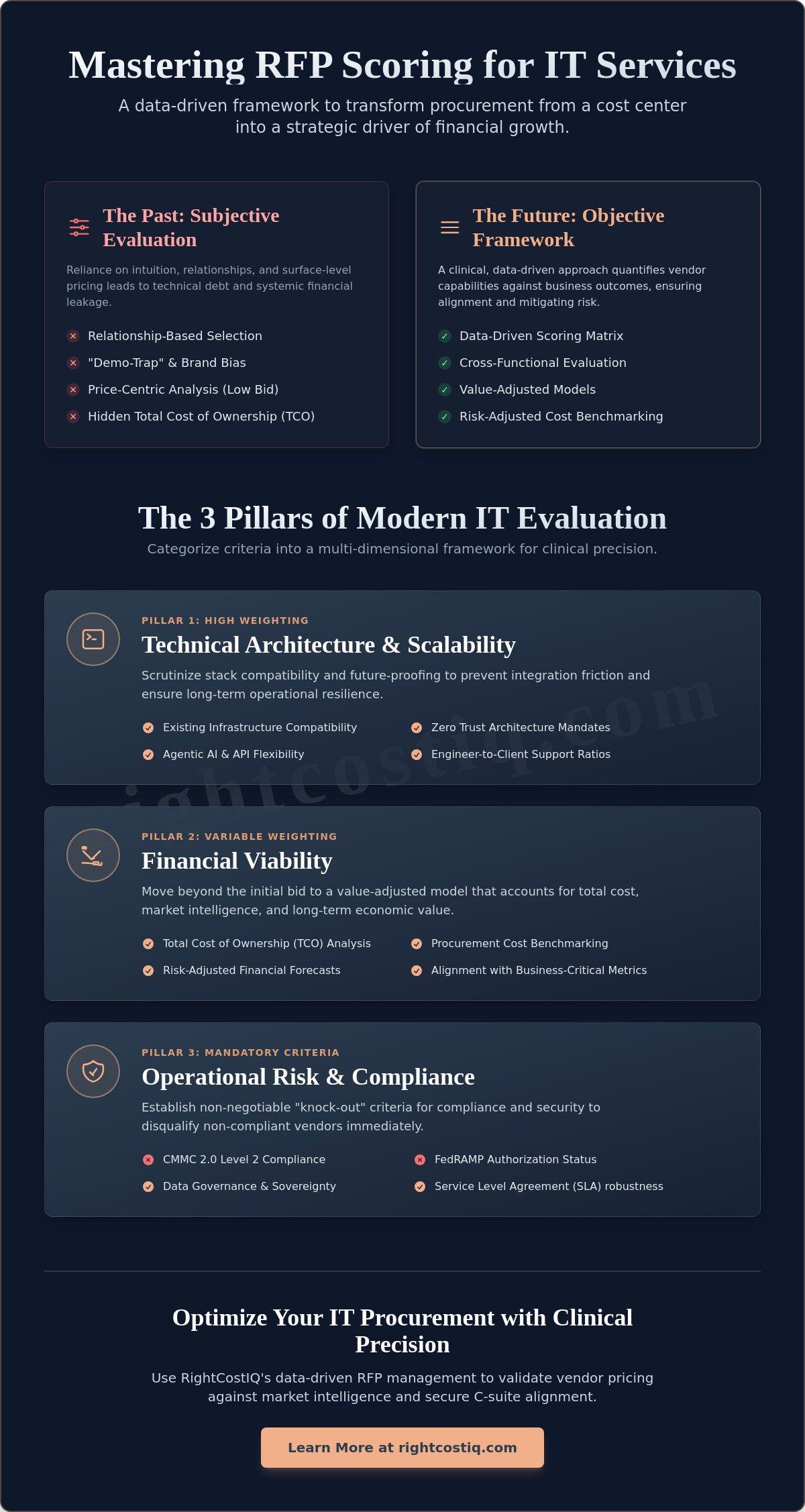
A sophisticated strategic approach to tech procurement requires a multi-dimensional framework that moves beyond binary compliance. High-stakes IT sourcing necessitates a clinical categorization of RFP scoring criteria for IT services into three distinct pillars: Technical Architecture, Financial Viability, and Operational Risk. Within this framework, certain parameters function as mandatory "knock-out" criteria. For instance, failure to demonstrate CMMC 2.0 Level 2 compliance or FedRAMP authorization immediately disqualifies a vendor from consideration in regulated sectors. Weighting these pillars must reflect specific strategic outcomes; a mission-critical infrastructure overhaul demands higher technical weighting, while a commoditized SaaS integration may prioritize financial efficiency.
Technical Architecture and Scalability
Technical evaluation must scrutinize stack compatibility with existing enterprise infrastructure to prevent costly integration friction. In 2026, scoring models must account for future-proofing by assessing a vendor's Agentic AI capabilities and API flexibility. You should evaluate the depth of technical support by demanding specific engineer-to-client ratios. This ensures the vendor can sustain operational loads during peak demand. A vendor's ability to execute entire workflows through AI, rather than just generating text, is now a critical differentiator for top-performing teams. It's no longer enough to support legacy systems; vendors must demonstrate a clear roadmap for autonomous workflow integration.
Financial Viability and Total Cost of Ownership (TCO)
Line-item pricing is a deceptive metric that ignores the long-term economic reality of IT contracts. Your financial pillar should utilize procurement category cost benchmarking to validate quotes against current market intelligence. This analysis must include implementation, maintenance, and hidden exit costs to establish a true TCO. Incorporating price risk management metrics allows you to forecast volatility and protect enterprise margins. For a deeper analysis of your current sourcing efficiency, consider a specialized RFP management and negotiation assessment to identify cost-saving opportunities and benchmark vendor performance against industry standards.
Operational Resilience and Cyber-Risk Mitigation
Operational scoring must prioritize Zero Trust architecture and SOC2 compliance to mitigate the increasing frequency of supply chain attacks. You must audit data encryption protocols and disaster recovery timelines with clinical precision. Evaluation should extend to third-party dependency risks, ensuring that a vendor's own subcontractors don't introduce vulnerabilities. Don't overlook cultural alignment; scoring for project management methodology ensures the vendor's execution style matches your internal operational cadence. This holistic view reduces the risk of post-award friction and service-level degradation. When vendors manage critical data, their internal security culture becomes as important as their software code.
Engineering the Weighted Scoring Matrix for IT Complexity
Developing a robust RFP scoring criteria for IT services requires more than a simple spreadsheet; it demands a multi-factor weighting model engineered to prioritize business-critical outcomes. You must differentiate between mandatory pass/fail requirements and qualitative scored components. Mandatory criteria, such as CMMC 2.0 compliance or specific insurance thresholds, act as the first gate. If a vendor fails these, they're immediately eliminated. The remaining qualitative requirements are then evaluated on a standardized 0-10 scale. Clinical definitions for each tier are essential to ensure consistency. For example, a score of 10 represents a solution that exceeds all technical requirements and offers documented cost-optimization features, while a 5 indicates a baseline functional fit without additional strategic value.
To maintain statistical integrity, you must normalize scores across your cross-functional evaluation committee. Evaluators from Finance, IT, and Legal often perceive value through different lenses. Normalization involves adjusting individual scores to a common mean to prevent a single aggressive or lenient scorer from skewing the final vendor selection. This mathematical rigor ensures the final decision is defensible to the C-suite and grounded in collective data rather than individual preference. It's a clinical approach that transforms procurement into a predictable, repeatable science.
Calculating Weight Distribution for Service Level Agreements (SLAs)
Weight distribution must reflect the operational reality of your enterprise. Assign higher weights to SLAs that directly impact revenue-generating systems. A 99.99% uptime guarantee for a primary e-commerce gateway carries more strategic weight than the response time for a back-office ticketing system. You must also calculate a "risk-weight" for vendors with limited market history or smaller balance sheets. Balancing innovation scores against operational stability is a critical task for the strategic architect. While cutting-edge AI features are attractive, they shouldn't compromise the core stability of mission-critical infrastructure.
The Role of Subjective vs. Objective Scoring Metrics
Precision in procurement relies on distinguishing between what can be measured and what must be interpreted. Objective metrics include uptime guarantees, SOC2 certification levels, and category cost benchmarking data. Objective scoring is the elimination of evaluator bias through data-driven benchmarks. Conversely, subjective metrics like "innovation" or "ease of use" require clinical standards to remain useful. To quantify these, create specific rubrics that define innovation through tangible deliverables, such as a documented roadmap for agentic AI integration or a proven history of reducing technical debt for similar clients. This approach ensures that even qualitative assessments contribute to a rigorous, data-backed selection process.
Executing the Evaluation Cycle: Best Practices for Decision Integrity
Assembling a cross-functional evaluation committee is the foundational step toward clinical procurement precision. This group must include stakeholders from IT, Finance, and Legal to ensure that every selection decision aligns with broader enterprise goals and C-suite expectations. Blind scoring protocols for technical sections are essential to prevent brand name bias from influencing the results. By removing identifying vendor information during the initial review, you ensure that technical merit remains the primary driver of the score. Utilize a centralized RFP management platform to aggregate scores in real-time and maintain a single source of truth for all stakeholder inputs. A rigorous vendor debrief process, anchored in your RFP scoring criteria for IT services, provides the transparency required for defensible decision-making and long-term vendor accountability.
Eliminating Cognitive Bias in Stakeholder Scoring
Evaluators must be trained to recognize and mitigate the "halo effect," where a vendor's excellence in one specific area incorrectly inflates their scores across unrelated categories. Establish a formal "consensus meeting" protocol to resolve significant score variances between different departments. These sessions force evaluators to justify their scores using data-driven benchmarks rather than subjective impressions. Documenting every scoring justification ensures audit-ready compliance and protects the organization from potential procurement challenges. This methodical approach transforms the evaluation from a series of opinions into a structured, analytical exercise that prioritizes operational resilience.
Post-Scoring Analytics and Shortlisting Architecture
Sensitivity analysis is a powerful tool for determining how slight adjustments in criteria weighting might shift the top-tier rankings. This identifies which vendors are truly robust across multiple scenarios and which are dependent on specific weighting biases. You should look for the "efficient frontier," the point where technical quality and total cost of ownership intersect to provide maximum value. High-scoring vendors should then transition into the negotiation phase with data-backed leverage derived from your scoring analytics. This ensures that the final contract terms reflect the specific strengths and weaknesses identified during the evaluation cycle.
Optimize your selection process by accessing our free diagnostic tool to identify gaps in your current procurement framework and drive immediate efficiency gains.
Optimizing IT Procurement with RightCostIQ RFP Management
Strategic procurement doesn't end with a completed matrix. RightCostIQ serves as the sophisticated partner for clinical RFP execution, transforming raw data into long-term financial growth. By integrating advanced analytics directly into your RFP scoring criteria for IT services, you ensure every selection decision is backed by real-time market intelligence. Our framework ensures that vendor performance tracking remains a continuous process, verifying that the selected partner delivers on every RFP promise. This clinical approach links initial scoring to sustained operational efficiency and bottom-line optimization, moving procurement from a cost center to a strategic driver.
Clinical RFP Management and Negotiation Coach Integration
Precision-engineered requirements are the bedrock of successful IT sourcing. RightCostIQ assists in drafting these requirements to eliminate ambiguity and force vendor transparency. Once scoring is finalized, our Negotiation Coach converts those objective scores into tangible contract savings. This tool identifies specific areas where a vendor's score indicates a premium price point that isn't justified by technical superiority. For deeper lifecycle insights, explore our analysis on RFP Management: Strategic Frameworks for AI-Led Procurement Optimization. This integration bridges the gap between evaluation and execution, ensuring your scoring informs every aspect of the final agreement.
Leveraging Cost Benchmarking for Precise Scoring
Objective quantification requires a baseline of truth. RightCostIQ utilizes category cost benchmarking to identify price outliers before they impact your budget. This should-cost analysis allows you to challenge vendor quotes that deviate from market norms with mathematical certainty. Additionally, our market price trending data dictates contract duration decisions, helping you lock in favorable rates or maintain flexibility in volatile categories. This level of data-driven sourcing eliminates the "gut-feel" risks that lead to technical debt. We invite you to conduct a clinical audit of your current procurement framework. Access our RFP management and analytics platform to begin optimizing your vendor selection process and securing C-suite alignment through data-backed precision.
Driving Financial Growth Through Clinical Selection Precision
Transitioning from subjective vendor selection to a data-driven framework is a strategic necessity for the modern enterprise. You've seen how a rigorous RFP scoring criteria for IT services eliminates cognitive bias and ensures that technical architecture, financial viability, and operational risk are quantified with mathematical accuracy. This methodology transforms procurement from an administrative hurdle into a powerful tool for risk mitigation and cost optimization. By engineering weighted matrices that prioritize business-critical outcomes, you secure C-suite alignment and ensure long-term operational resilience across the entire technology lifecycle.
RightCostIQ provides the sophisticated infrastructure required to execute these frameworks at scale. Our platform integrates a proprietary cost benchmarking database with clinical negotiation assistance frameworks to convert your evaluation scores into tangible contract savings. Through continuous data-driven vendor performance tracking, we ensure your selected partners remain accountable to their RFP promises long after the contract is signed. Take the first step toward procurement optimization by using our diagnostic tools to identify efficiency gaps in your current process. Optimize your vendor selection with RightCostIQ RFP Management and lead your organization toward a more profitable, resilient future.
Frequently Asked Questions
What are the most important RFP scoring criteria for IT services?
The primary RFP scoring criteria for IT services must prioritize technical capability, cybersecurity compliance, and verified past performance. In 2026, technical fit typically accounts for 30-50% of the total evaluation. Security is now a non-negotiable gate, requiring specific certifications like CMMC 2.0 Level 2 for regulated sectors or SOC2 Type II for enterprise environments. Past performance should be quantified through documented case studies rather than subjective references to ensure clinical reliability.
How should RFP evaluation criteria be weighted for a software-as-a-service (SaaS) contract?
SaaS evaluation weighting should prioritize security and data sovereignty at 30-40% and total cost of ownership (TCO) at 25-35%. Unlike traditional hardware procurement, SaaS weighting must account for hidden integration costs and long-term exit barriers. Technical scalability and API flexibility usually carry a 20-30% weight. This distribution ensures that immediate financial efficiency doesn't compromise the enterprise's long-term operational resilience or data integrity.
What is the difference between mandatory and scored RFP criteria in IT procurement?
Mandatory criteria are binary pass/fail requirements that act as the initial gate for all vendor submissions. These include essential legal compliance, specific insurance minimums, or mandatory certifications like FedRAMP. Scored criteria are qualitative differentiators that receive numerical values based on performance quality. A vendor who fails a single mandatory requirement is immediately disqualified, regardless of how high they score in qualitative categories like innovation or user experience.
How can I ensure my RFP scoring process is objective and fair?
Ensuring objectivity requires the implementation of blind technical scoring and mathematical normalization across the entire evaluation committee. Blind scoring removes vendor identities from technical responses to eliminate brand bias. Normalization adjusts individual scores to a common mean, preventing an overly aggressive or lenient evaluator from skewing the final selection. This methodical approach ensures the final decision is defensible to the C-suite and grounded in data-driven benchmarks.
What is a typical RFP scoring scale for technical vendor evaluations?
A standard technical evaluation utilizes a 0-10 scale with clinical definitions for each numerical tier. A score of 0 indicates a complete failure to address the requirement, while a 5 represents a functional fit that meets baseline standards. A 10 is reserved for solutions that exceed requirements and offer documented strategic advantages, such as automated technical debt reduction or agentic AI integration that optimizes existing enterprise workflows.
How does weighted scoring help in selecting the right IT vendor?
Weighted scoring prevents lower-priced, technically inferior solutions from winning based on cost alone. It allows procurement leaders to mathematically prioritize business-critical outcomes over commoditized features. By assigning higher weights to high-impact SLAs and security protocols, you ensure the selected vendor aligns with the enterprise's risk tolerance and financial growth targets. This creates a risk-adjusted ROI that justifies strategic, high-tier investments.
Can AI be used to score RFP responses for IT services?
Yes, 68% of proposal teams now utilize AI to assist in the RFP process. As of June 2026, the industry has shifted toward agentic AI, which executes entire workflows like compliance cross-referencing and document analysis. These tools can rapidly identify inconsistencies in vendor responses and flag potential security risks. Final strategic scoring still requires clinical human oversight to ensure stakeholder alignment and long-term operational fit.
What should be included in an IT RFP evaluation scorecard?
An IT evaluation scorecard must include technical architecture fit, financial viability, and operational risk metrics. It should detail specific sub-categories like data encryption protocols, disaster recovery timelines, and implementation costs. Each category requires a raw score, a specific weight, and a final weighted value. This structured format enables a holistic comparison that accounts for both immediate technical execution and the long-term economic impact of the partnership.


