
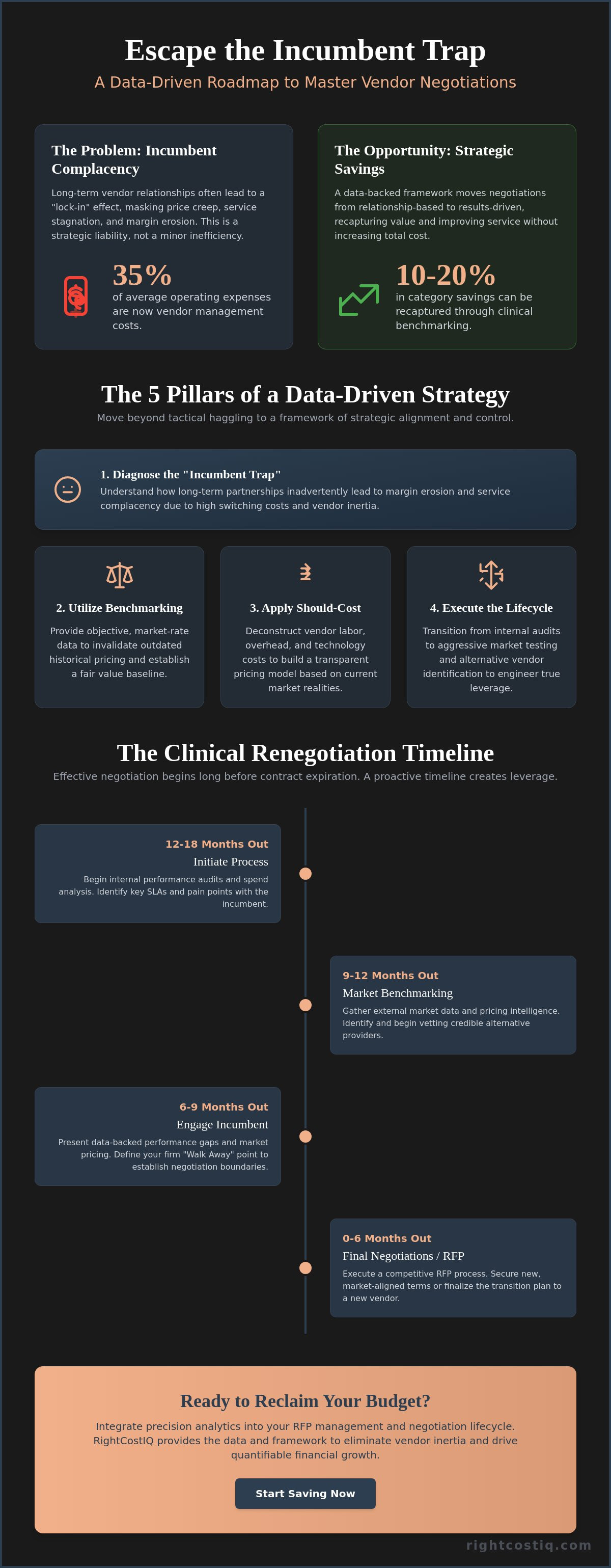
Vendor management costs now account for nearly 35% of average operating expenses, which means the financial impact of incumbent complacency is no longer a minor inefficiency; it's a strategic liability. You've likely experienced the "lock-in" effect where high switching costs and a lack of transparent market pricing data allow existing partners to implement steady price creep. This environment often leaves procurement leaders feeling forced to accept suboptimal terms simply to maintain operational continuity. It's a common frustration that stems from a perceived lack of leverage against essential service providers.
Successfully managing incumbent vendor negotiations requires moving beyond the relationship and into a framework of clinical, data-backed analysis. By implementing a strategic approach to benchmarking and performance tracking, you can recapture 10% to 20% in category savings while improving service level agreements without increasing your total cost of ownership. This article provides a sophisticated roadmap for using market intelligence and automated tracking to eliminate vendor inertia. We will examine how to engineer leverage through precise cost analytics and standardized performance metrics to ensure your incumbents remain competitive in an evolving 2026 market.
Key Takeaways
- Diagnose the "Incumbent Trap" to understand how long-term partnerships inadvertently lead to margin erosion and service complacency.
- Utilize category cost benchmarking to provide the objective data needed for managing incumbent vendor negotiations without relying on historical pricing.
- Apply a should-cost framework to deconstruct vendor labor and overhead, effectively invalidating outdated pricing models through market price trending.
- Execute a clinical renegotiation lifecycle that transitions from internal performance audits to aggressive market benchmarking and alternative vendor identification.
- Integrate advanced analytics into your RFP management process to standardize performance tracking and secure quantifiable financial growth metrics.
The Strategic Architecture of Incumbent Negotiation
The "Incumbent Trap" is a systemic failure in procurement where the familiarity of a long-term relationship masks significant margin erosion. Vendors often rely on high switching costs and operational integration to maintain leverage, leading to price creep that quietly outpaces market efficiency. Managing incumbent vendor negotiations requires a total departure from traditional relationship management. It demands a clinical architectural approach that prioritizes data over history. When a vendor assumes their position is secure, their incentive to optimize costs or innovate service delivery evaporates. This complacency directly impacts your bottom line.
Transitioning from tactical haggling to strategic alignment involves quantifying the vendor's value proposition against current market benchmarks. Identifying the optimal window for renegotiation is critical. You shouldn't wait for the contract expiration date. Instead, initiate the process 12 to 18 months in advance to ensure you have sufficient time to identify and vet alternative providers. This lead time strengthens your position and signals to the incumbent that their contract is not guaranteed. Effective negotiation strategies depend on a credible threat of exit. Without this, you lack the leverage needed to challenge entrenched pricing structures.
Procurement analytics provide the precision required to establish a firm "Walk Away" point. By analyzing internal spend data alongside external market trends, you can define the exact threshold where the cost of staying with an incumbent outweighs the cost of switching. This data-driven boundary prevents emotional decision-making. It ensures that your team remains focused on objective financial growth metrics throughout the negotiation lifecycle. Managing incumbent vendor negotiations is not about maintaining a friendship; it's about enforcing market-level performance and pricing.
The Economic Cost of Incumbent Complacency
Price creep usually manifests through compound annual escalators that ignore market deflation or technological gains. With the U.S. Federal Funds Effective Rate at 3.63% as of June 2026, the cost of capital and market volatility necessitate a more agile approach to pricing. Stagnant service delivery models lead to hidden operational costs that compromise the resilience of your entire supply chain. If an incumbent hasn't updated their delivery models to reflect current industry automation standards, you're effectively subsidizing their technical debt. Stale Service Level Agreements (SLAs) are a primary indicator of this stagnation.
Defining Successful Outcomes Beyond Unit Price
Successful negotiation isn't limited to lowering the unit price. It's about engineering a partnership that prioritizes innovation and efficiency. By utilizing negotiation assistance and performance tracking, you can force incumbents to adopt modern automation tools that reduce your internal overhead. This strategy balances immediate financial growth with long-term risk mitigation. It ensures that every dollar spent drives measurable enterprise value. Success is defined by a contract that evolves with market conditions, rather than one that remains anchored in the past.
Data-Driven Benchmarking: Quantifying Incumbent Performance
Objective data acts as the primary equalizer when managing incumbent vendor negotiations. Relying on historical pricing or "partnership value" often results in significant margin loss. Procurement teams must instead utilize category cost benchmarking to establish a baseline of what the market currently demands for specific services. This process involves stripping away the incumbent's proprietary justifications and replacing them with clinical market realities. By quantifying performance through an objective lens, you move the conversation from subjective satisfaction to verifiable fiscal efficiency.
Analyzing internal spend data is the next critical step in identifying volume-based discount opportunities. Most large enterprises suffer from fragmented purchasing across different departments, which obscures the true scale of their vendor footprint. A comprehensive competitive vendor analysis reveals where consolidated volume can be leveraged to drive down unit costs. When you link these benchmarking results directly to margin expansion, you create a compelling financial case that incumbents can't easily ignore. It forces them to justify their pricing against top-tier industry standards rather than their own internal margins.
The Role of Spend Analytics in Negotiation Prep
Data hygiene is essential to eliminate noise and identify "Tail Spend" leakage. These small, unmanaged transactions often occur outside of core contract terms and uncover significant hidden costs that erode your bottom line. Utilizing spend analytics allows your team to forecast future demand with high precision. This foresight provides the leverage needed to negotiate tiered pricing structures that reward your organization for its total spend commitment. You can begin this process by conducting a preliminary spend audit to identify immediate cost-saving opportunities.
Benchmarking Against Market Price Trends
Market volatility demands that you track real-time trends to challenge fixed-price escalators that no longer reflect the current economic environment. Applying should-cost modeling exposes the specific areas where an incumbent has padded their margins, such as labor or material overheads. By establishing a competitive price floor based on current market trending, you invalidate outdated pricing models. This data-driven approach ensures that your renegotiated terms are grounded in current economic reality, providing a superior foundation for managing incumbent vendor negotiations over the long term.
The Should-Cost Framework: Reclaiming Price Transparency
Managing incumbent vendor negotiations requires dismantling the information asymmetry that vendors use to protect their margins. A should-cost framework provides the clinical breakdown of labor, materials, and overhead necessary to challenge non-transparent pricing. By deconstructing the incumbent’s cost structure, procurement leaders can identify exactly where price creep has decoupled from market reality. This isn't a suggestion; it's a strategic requirement for recapturing lost margin. Successful execution transforms the negotiation from a defensive posture into an offensive, data-backed pursuit of fiscal efficiency.
Utilizing should-cost modeling allows you to invalidate outdated pricing models that incumbents often defend with anecdotal evidence. For instance, if an incumbent justifies a price hike based on financing costs, you can counter with the current U.S. Federal Funds Effective Rate of 3.63% or the Bank Prime Loan Rate of 6.75% to ensure their claims align with June 2026 economic data. Positioning this data as a collaborative tool for value engineering shifts the focus toward mutual operational optimization. It forces the vendor to justify their "proprietary" costs against objective market standards, effectively neutralizing the "lock-in" effect of complex service agreements.
Market Price Trending and Forecasting
Precise price risk management involves forecasting commodity and labor shifts to preempt vendor price hikes before they reach the billing stage. Automated cost transparency tools provide the market intelligence needed to negotiate dynamic pricing clauses. These clauses ensure that your organization benefits from market deflation rather than being trapped in fixed-price escalators. By reducing financial volatility through rigorous price trending, you maintain a competitive price floor that reflects real-time economic conditions. This proactive stance is essential for maintaining supply chain resilience in a volatile global trade environment.
Exposing Hidden Margins in Complex Services
Complex service contracts often hide significant operational inefficiencies within billed rates that don't reflect actual delivery costs. Analyzing the gap between a vendor's internal operational model and their market-facing price is critical for identifying margin padding. You can use a Category Management framework to optimize the service mix and eliminate redundant functions that no longer provide enterprise value. This clinical analysis exposes where the incumbent has allowed service stagnation to occur. It provides the leverage needed to demand either a reduction in cost or a significant increase in service delivery standards without increasing spend. Managing incumbent vendor negotiations through this lens ensures that every dollar spent is directly linked to a tangible business outcome.
Clinical Execution: The Renegotiation Lifecycle
Managing incumbent vendor negotiations moves from theoretical analysis to clinical execution through a structured five-phase lifecycle. This methodical progression ensures that no tactical leverage is left unutilized. The process begins with Phase 1: internal audit and performance data aggregation to establish a baseline of existing vendor behavior. Phase 2 involves market benchmarking and alternative vendor identification to define the competitive landscape. These initial steps provide the data necessary to challenge the incumbent's status quo without relying on subjective relationship metrics.
Phase 3 introduces the "Shadow RFP," a critical maneuver that tests market pricing and service levels without prematurely terminating the incumbent relationship. This provides the objective data required for Phase 4: direct negotiation using negotiation coach frameworks. The lifecycle concludes with Phase 5, the implementation of performance-linked contract terms that ensure long-term accountability. This structured approach eliminates the "lock-in" effect by maintaining a constant, data-backed threat of competitive displacement.
The RFP as a Strategic Negotiation Lever
Executing a clinical RFP process serves as a primary driver for creating credible competitive pressure. It's not merely a tool for vendor selection but a strategic instrument to invalidate the incumbent's assumption of safety. By standardizing bid responses, procurement teams can conduct a direct, side-by-side comparison of incumbent terms against market-leading alternatives. This transparency eliminates the vendor's ability to obscure costs within complex service bundles. Managing transition risk is equally vital. You must develop a robust migration plan to maintain a credible "Walk Away" threat. If the incumbent perceives that switching is impossible, your leverage disappears regardless of the data you present.
Finalizing Terms: Performance and Compliance
The final contract must move beyond static pricing to include precision SLAs supported by automated performance tracking. Securing explicit audit rights and price transparency clauses protects your organization from future price creep. Vendor payments should be strictly linked to verifiable KPIs and specific business outcomes. This performance-based model shifts the operational risk back to the vendor and incentivizes continuous efficiency gains. Standardizing these metrics across your vendor portfolio allows for clinical performance comparison and long-term margin protection. Every contract term should serve as a driver for financial growth and operational excellence.
To evaluate your current negotiation leverage and identify immediate savings, access our free procurement diagnostic tool.
RightCostIQ: Precision Negotiation and RFP Management
RightCostIQ integrates advanced analytics into traditional procurement functions to eliminate the guesswork from managing incumbent vendor negotiations. While previous sections detailed the strategic frameworks of should-cost modeling and the renegotiation lifecycle, RightCostIQ provides the technical infrastructure to execute these moves with clinical precision. It identifies hidden savings in incumbent contracts that manual audits often miss. By automating vendor performance tracking, the platform ensures that margin optimization doesn't end with a signed contract but continues throughout the vendor relationship. This technical layer transforms procurement from a back-office function into a strategic architect of enterprise value. It replaces the ambiguity of relationship-based sourcing with the certainty of data-driven execution.
Empowering procurement leaders with clinical market intelligence is essential for maintaining a competitive edge in 2026. RightCostIQ acts as a high-level consultant and a powerful tool, bridging the gap between high-level financial strategy and granular technical execution. The platform's ability to standardize vendor performance tracking allows for a relentless focus on the bottom line. It doesn't just manage contracts; it engineers leverage. By moving quickly from broad strategic promises to granular service details, RightCostIQ ensures your organization captures every possible efficiency gain from its vendor portfolio.
The RightCostIQ Advantage in Negotiation
Accessing proprietary cost benchmarking and market price trending data is the primary differentiator for elite procurement teams. RightCostIQ empowers leaders with market intelligence that invalidates generic vendor justifications for price increases. For complex, high-value contracts, leveraging professional negotiation assistance ensures that your team maintains the upper hand. This data-driven approach reduces procurement risk through precise price forecasting, allowing you to secure dynamic pricing clauses that reflect June 2026 economic realities. It's about moving from a position of relative weakness to one of absolute data-backed authority. You aren't just asking for better terms; you're demanding them based on verifiable market truths.
Next Steps for Enterprise Cost Optimization
The path to enterprise cost optimization begins with a category-level spend audit to pinpoint the highest-impact renegotiation targets. Transitioning from reactive haggling to a standardized RFP management framework creates a repeatable cycle of savings. Procurement leaders should contact RightCostIQ for a clinical assessment of their vendor landscape to uncover immediate opportunities for margin expansion. This isn't just about reducing costs; it's about re-engineering your procurement department into a primary driver of financial growth. Start the audit. Implement the framework. Secure the margin. By taking these methodical steps, you ensure that managing incumbent vendor negotiations remains a source of continuous competitive advantage rather than a recurring operational hurdle.
Strategic Dominance in Vendor Renegotiation
Transitioning from passive relationship management to active margin reclamation is the primary driver for procurement excellence in 2026. Successfully managing incumbent vendor negotiations requires a clinical focus on objective data rather than historical familiarity. By integrating proprietary category cost benchmarking with a clinical RFP management lifecycle, you eliminate the information asymmetry that incumbents exploit to maintain price creep. This strategic shift ensures that every contract renegotiation serves as a catalyst for financial growth and operational resilience.
The implementation of automated vendor performance tracking provides the continuous oversight needed to prevent service stagnation and recapture lost margin. Stagnant contracts represent a significant enterprise risk that requires immediate architectural intervention. You now have the methodical framework to redefine your vendor landscape through precision analytics and methodical execution. It's time to enforce market-level performance across your entire supply chain. Secure the financial transparency and competitive advantage your organization demands.
Optimize your next incumbent negotiation with RightCostIQ’s precision frameworks
Frequently Asked Questions
How do you negotiate with an incumbent vendor who has a monopoly?
Negotiating with a monopoly incumbent requires leveraging should-cost modeling to challenge their internal cost structure rather than relying on market benchmarking. Since alternative vendors aren't available, you must focus on total cost of ownership and operational efficiency gains. Demand transparency into their labor and overhead costs to identify margin padding. This clinical approach forces the vendor to justify price increases against objective economic indicators like the current Bank Prime Loan Rate of 6.75%.
When is the best time to start renegotiating an expiring contract?
Initiate the renegotiation process 12 to 18 months before the contract expiration date. This timeframe allows sufficient room to execute a clinical RFP process and establish a credible "Walk Away" point. Starting early prevents the vendor from using time pressure as leverage against your operations. It ensures your procurement team has the necessary window to conduct deep spend analytics and market benchmarking before the incumbent assumes a renewal is guaranteed.
Can vendor performance tracking actually lead to price reductions?
Vendor performance tracking directly facilitates price reductions by identifying service level failures and operational inefficiencies that justify fee credits or price restructuring. When managing incumbent vendor negotiations, documented proof of service stagnation provides the leverage needed to demand better terms. Linking payments to verifiable KPIs ensures you only pay for delivered value. This data-driven accountability eliminates the "incumbent trap" where costs remain high despite declining service quality.
What is the difference between should-cost modeling and market benchmarking?
Should-cost modeling is a bottom-up analysis that deconstructs a vendor's internal costs, including labor and materials, to determine a fair price. Market benchmarking is a top-down comparison that evaluates your current contract terms against industry standards. While benchmarking tells you what others are paying, should-cost modeling reveals the vendor's actual margin padding. Using both frameworks provides a clinical view of exactly where an incumbent is overcharging for their services.
How do you maintain a good relationship with a vendor during tough negotiations?
Maintain vendor relationships by framing the negotiation as a clinical, data-driven alignment of mutual business interests. Focus on objective market intelligence and performance metrics rather than adversarial haggling. This professional demeanor suggests reliability and deep industry expertise, signaling that your organization prioritizes results and efficiency. By positioning should-cost data as a tool for value engineering, you move the conversation toward long-term operational optimization that benefits both parties.
What are the most common pitfalls in incumbent vendor negotiations?
The most common pitfalls include starting the process too late and relying on historical relationships rather than current market data. Many procurement leaders fail to establish a credible alternative, which eliminates their negotiation leverage. Another critical error is accepting annual escalators that outpace market reality. Managing incumbent vendor negotiations without clinical benchmarking often results in price creep that compounds over several contract cycles, leading to significant margin erosion.
How can procurement software improve negotiation outcomes in 2026?
In 2026, procurement software utilizes AI and real-time market price trending to automate the identification of hidden savings. Tools like SAP Ariba’s Joule AI copilot assist with RFP generation, while advanced autonomous agents streamline spend analytics. These technologies provide procurement leaders with the clinical market intelligence needed to invalidate outdated pricing models. Automation ensures that performance tracking is continuous, allowing for real-time margin optimization rather than waiting for annual reviews.
Should I always run an RFP before renewing an incumbent contract?
Executing a "Shadow RFP" before every major renewal is a strategic requirement to maintain competitive pressure. This process tests the market without prematurely terminating the incumbent relationship. It provides the objective data needed to verify if your current terms are still competitive. Even if you intend to stay with the incumbent, a clinical RFP process ensures they remain aware that their position is earned through performance and market-aligned pricing.


