
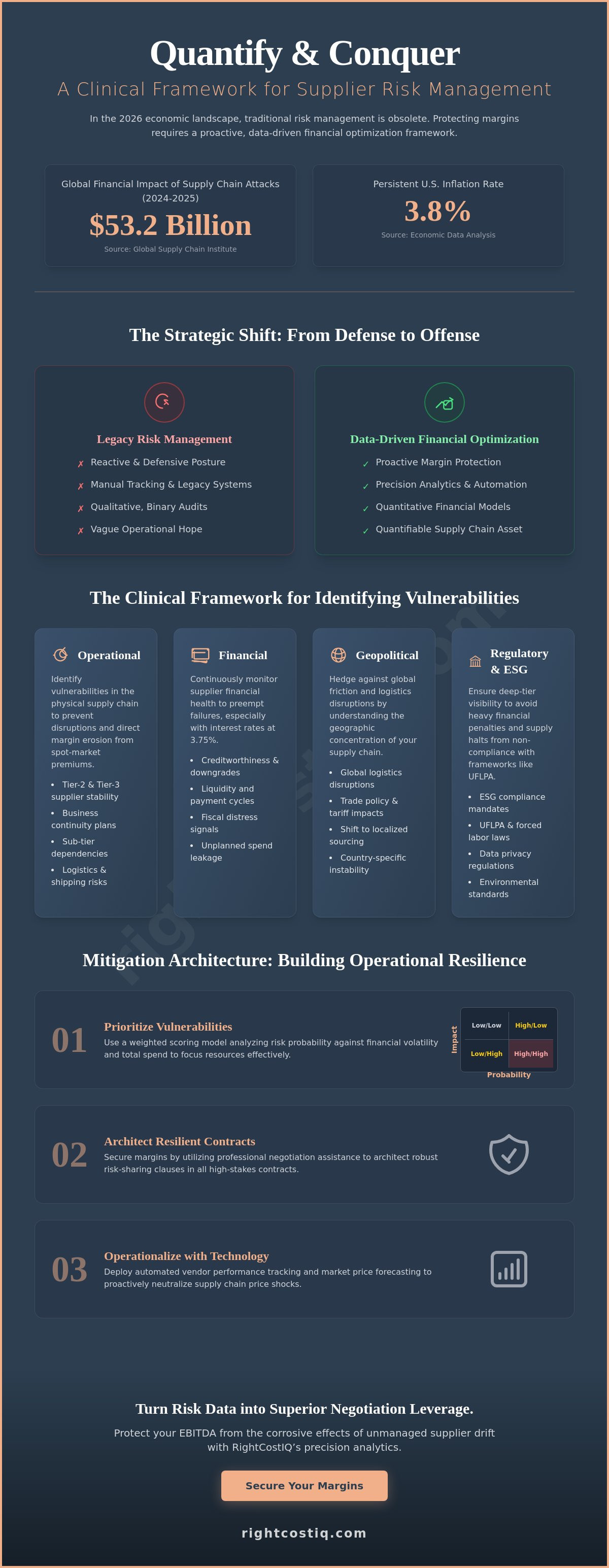
Globally, supply chain attacks inflicted a $53.2 billion financial impact between 2024 and 2025, and these costs are accelerating as we move through 2026. This massive margin erosion often stems from a fundamental failure in identifying and mitigating supplier risk through legacy, manual tracking systems. You've likely experienced the frustration of unexpected price volatility or the sudden realization that you lack visibility into Tier-2 and Tier-3 supplier stability. In an economy where the U.S. inflation rate persists at 3.8%, operating without real-time intelligence is a strategic liability.
We agree that traditional risk management is now obsolete. You need a system that functions with the precision of a financial instrument. This article provides a clinical framework to master a data-driven methodology for identifying vulnerabilities and implementing mitigation strategies that protect your capital. We'll outline how to integrate market price forecasting and category cost benchmarking to reduce financial exposure. You'll learn to turn risk data into superior negotiation leverage and operational resilience through advanced procurement analytics.
Key Takeaways
- Quantify supplier risk as a primary financial metric to move beyond qualitative assessments toward data-driven optimization.
- Deploy a clinical framework for identifying and mitigating supplier risk across operational, financial, geopolitical, and regulatory dimensions.
- Prioritize vulnerabilities using a weighted scoring model that analyzes risk probability against financial volatility and total spend under management.
- Secure your margins by utilizing professional negotiation assistance to architect robust risk-sharing clauses in all high-stakes contracts.
- Operationalize resilience through automated vendor performance tracking and market price forecasting to proactively neutralize supply chain price shocks.
The Strategic Imperative: Quantifying Supplier Risk as a Financial Metric
Supplier Risk Management (SRM) is traditionally viewed as a defensive posture. In 2026, sophisticated organizations redefine Supplier Risk Management as a proactive financial optimization framework designed to capture margin. Identifying and mitigating supplier risk requires moving beyond binary qualitative audits. Instead, procurement leaders must adopt quantitative models that translate operational vulnerabilities into specific financial probabilities. This transition allows firms to treat supply chain stability as a quantifiable asset rather than a vague operational hope.
Unmitigated volatility acts as a silent tax on enterprise EBITDA. When a Tier-2 supplier fails, the resulting spot-market premiums and expedited shipping costs represent direct margin erosion. This financial reality makes risk identification a core component of category management procurement. High-performing teams don't just source for price; they source for risk-adjusted value. By integrating risk data into category strategies, organizations can anticipate price shocks before they materialize in the profit and loss statement. It's no longer enough to react to disruptions. You must price them into your sourcing strategy from the outset.
Beyond Continuity: Risk as a Cost Driver
Supplier instability manifests through hidden costs that bypass standard accounting. These include procurement leakage, unplanned spend outside of negotiated contracts, and the administrative overhead required to manage vendor underperformance. Implementing a rigorous price risk management strategy stabilizes outcomes by locking in predictability. It's not just about keeping the lights on. It's about ensuring every dollar of spend remains protected from the corrosive effects of unmanaged supplier drift. Performance tracking must be clinical and continuous to prevent these micro-losses from compounding into significant financial exposure.
The 2026 Risk Landscape: Volatility and Complexity
The 2026 economic environment is defined by a 3.8% annual inflation rate and persistent geopolitical friction. These factors drive modern market price trending, forcing a strategic shift toward localized sourcing as a hedge against global logistics disruptions. Beyond price, ESG and compliance risks now carry heavy financial penalties. Regulatory frameworks like the UFLPA require deep-tier visibility, making compliance a mandatory pillar of vendor selection. Organizations that fail to map these complexities find themselves exposed to both legal repercussions and sudden supply halts. Precision in risk identification is the only viable path to long-term operational resilience.
A Clinical Framework for Identifying Supplier Vulnerabilities
Identifying and mitigating supplier risk requires a surgical approach to data acquisition across the entire vendor lifecycle. This process begins during the initial sourcing phase and continues through ongoing performance monitoring. By categorizing risks into operational, financial, geopolitical, and regulatory silos, procurement leaders can apply clinical precision to their due diligence. This granular oversight ensures that Tier-1 and Tier-2 vulnerabilities are captured before they disrupt the bottom line. It's not just about risk avoidance; it's about building a transparent, quantifiable map of your entire supply network.
Leveraging advanced RFP Management is the most effective method for extracting critical risk data during the sourcing phase. Standard questionnaires are insufficient. You must design RFPs that force transparency regarding a supplier's sub-tier dependencies and business continuity plans. This proactive data gathering transforms the RFP from a price discovery tool into a risk-neutralization mechanism. It allows you to vet vendors based on their resilience as much as their cost structure.
Financial and Operational Risk Assessment
Evaluating a supplier's creditworthiness is no longer a quarterly task. In 2026, with the benchmark interest rate at 3.75%, financial liquidity is a volatile variable. You should utilize continuous monitoring to detect early signs of fiscal distress, such as slowing payment cycles or credit downgrades. Operational bottlenecks are best identified through integrated vendor performance tracking data. This allows you to assess capacity constraints and dependency ratios objectively. If a supplier allocates 80% of their capacity to a single client, your exposure increases. Identifying these ratios helps you diversify spend and prevent single-point-of-failure scenarios.
Strategic and Compliance Risk Factors
Geopolitical exposure remains a primary driver of disruption in global procurement, making the process of identifying and mitigating supplier risk a continuous strategic necessity. Organizations must evaluate the stability of sourcing regions, especially as trade policy shifts affect over 80% of companies. Compliance is equally critical. Laws like the Uyghur Forced Labor Prevention Act (UFLPA) now demand clear evidence of supply chain integrity. Your vetting process must include deep-tier tracing to avoid reputational damage and legal seizure of goods. Aligning brand values with supplier diversity programs ensures that your procurement strategy supports broader enterprise ESG goals while maintaining clinical efficiency.
For teams looking to modernize their sourcing protocols, utilizing an automated RFP platform can streamline the collection of these complex data points and simplify vendor comparison.
Evaluating Risk Impact: Probability vs. Financial Volatility
Quantifying risk is a prerequisite for financial stability. Procurement leaders must move beyond the basic likelihood-versus-impact heatmaps that offer only surface-level insights. A high-resolution approach requires calculating the Value at Risk (VaR) for every critical category. This metric represents the maximum potential loss over a specific timeframe at a defined confidence level. By establishing a baseline for acceptable risk within sourcing portfolios, you can identify which vulnerabilities require immediate capital allocation and which only necessitate passive monitoring. This clinical prioritization prevents the misdirection of resources toward low-impact anomalies.
Differentiating between high-probability operational glitches and low-probability catastrophic failures is essential for identifying and mitigating supplier risk. A minor delay from a high-frequency component supplier might seem negligible, but if it impacts a strategic production line, the cumulative financial volatility is massive. Conversely, a one-time geopolitical event may have a lower probability but could result in a total supply halt. Clinical evaluation ensures that your mitigation resources aren't wasted on frequent but low-impact noise. You're building a defense against volatility, not just managing a checklist.
The Risk Scoring Matrix: A Precision Tool
A robust matrix assigns numerical values to qualitative factors like geopolitical stability or regulatory compliance. These scores must be weighted against their specific impact on procurement category cost benchmarking. For instance, a 10% increase in raw material costs due to a supplier's regional instability carries more weight than a minor administrative compliance gap. By integrating real-time market price trends into your probability calculations, you create a dynamic scoring system that reflects current economic realities. This ensures your risk profile remains accurate as market conditions shift.
Prioritizing Mitigation Efforts
Resource allocation must focus on critical path suppliers where failure directly correlates to enterprise-wide revenue loss. While managing tail spend is necessary for operational efficiency, it shouldn't distract from the strategic partner vulnerabilities that threaten your core margins. Effective prioritization involves mapping spend under management to specific risk tiers and identifying single-source dependencies with high financial impact. You must allocate your most intensive negotiation and tracking resources to the top 20% of high-risk zones. This methodical distribution of effort ensures that your team remains focused on protecting the bottom line rather than chasing marginal gains in low-impact categories.
Mitigation Architectures: From Contractual Levers to Price Risk Management
Mitigation is not merely a defensive tactic; it's a primary driver for margin expansion. In a 2026 economic environment characterized by 3.8% inflation, effective architectures treat risk as a variable to be actively managed rather than an external threat to be feared. Identifying and mitigating supplier risk requires the deployment of multi-layered strategies that align with enterprise efficiency goals. This transition from passive monitoring to active intervention is essential. High-level decision-makers must leverage professional negotiation assistance to embed risk-sharing clauses directly into the contractual foundation. These clauses ensure that vendors share the burden of market volatility, effectively protecting your bottom line.
Price risk management services function as a critical financial hedge against procurement price shocks. By utilizing sophisticated tracking and forecasting, organizations can anticipate cost spikes and adjust procurement cycles accordingly. Cost benchmarking remains equally vital. It ensures your pricing remains competitive even when regional disruptions occur. If a supplier attempts to pass on excessive costs during a volatility event, benchmarking data provides the clinical evidence required to maintain leverage. This data-driven approach transforms procurement from a transactional function into a strategic architect of financial stability.
The RFP as a Mitigation Instrument
The sourcing process serves as your primary line of defense. Precision drafting of RFP questions forces transparency in supplier risk profiles, revealing vulnerabilities in their sub-tier dependencies. This stage allows you to use competitive bidding to identify alternative sourcing routes, reducing dangerous reliance on single-source regions. Integrating supplier diversity requirements into the selection criteria further strengthens resilience. It ensures a broader, more robust vendor base capable of withstanding localized shocks. Using an automated RFP platform can streamline this data collection and provide a standardized framework for risk evaluation.
Contractual Safeguards and Performance Incentives
Contracts must be dynamic to be effective. Implementing Service Level Agreements (SLAs) with clear financial penalties ensures that vendor underperformance has a direct, quantifiable cost for the supplier. You should also design dynamic pricing models linked to real-time market price trending. This prevents your organization from being locked into inflated rates when market conditions improve. Finally, establish "Exit Architectures." These are pre-defined protocols for a rapid transition from high-risk vendors to vetted alternatives. Having a clear exit strategy reduces the friction of switching and maintains operational continuity during a crisis.
To evaluate your current mitigation readiness, you can access a precision procurement diagnostic to identify hidden vulnerabilities in your contract portfolio.
Operationalizing Resilience with RightCostIQ’s Precision Analytics
Resilience isn't a static state but an operational outcome of continuous data integration. Identifying and mitigating supplier risk requires moving beyond periodic, manual reviews into a state of permanent supply chain readiness. By integrating automated vendor performance tracking into daily procurement operations, teams eliminate the analytical lag between a risk event and its identification. This real-time visibility ensures that category optimization remains dynamic. It allows for the immediate reallocation of spend when vendor health metrics deteriorate, protecting the organization from sudden service failures.
Utilizing market price forecasting allows organizations to stay ahead of supply chain price shocks. With the U.S. inflation rate at 3.8% in 2026, precision in forecasting acts as a primary driver for financial growth. Maintaining a continuous loop of data-driven benchmarking ensures that pricing remains optimal despite external volatility. This methodical approach transforms procurement into a high-precision financial function. Every sourcing decision is backed by granular market intelligence, ensuring that your organization never overpays for stability in a volatile market.
Automated Tracking and Intelligence
RightCostIQ’s platforms provide real-time visibility into supplier health by aggregating financial, operational, and geopolitical data signals. Advanced analytics identify early warning signs of vendor distress, such as deteriorating service levels or shifting financial liquidity indicators, before they impact Tier-1 operations. Leveraging analytics to detect these patterns is a prerequisite for identifying and mitigating supplier risk at scale. Streamlining these insights into automated reporting provides the C-suite with surgical visibility into risk exposure. This transparency facilitates faster decision-making and ensures that risk mitigation remains a top-level strategic priority.
The Role of Professional Sourcing Partners
Expert-led negotiation assistance is indispensable in high-risk environments where contractual precision is the only safeguard. Professional sourcing partners use external benchmarking data to validate supplier cost claims during negotiations, ensuring total transparency. This clinical validation prevents procurement leakage and reinforces the strategic integrity of your sourcing portfolio. By leveraging these professional levers, organizations can secure favorable terms even in the face of significant market volatility. You're not just buying a service; you're acquiring a strategic architect for your supply chain's financial future.
Optimize your risk architecture with RightCostIQ to secure your margins and drive operational efficiency.
Architecting a Resilient Financial Future
Managing supply chain vulnerabilities is no longer an exercise in disaster recovery. It's a fundamental pillar of margin protection. By treating risk as a quantifiable financial variable, you've moved beyond qualitative guesswork into a realm of clinical precision. We've established that permanent readiness requires multi-tier visibility and the integration of real-time market price trending. Identifying and mitigating supplier risk requires a sophisticated intersection of technology and strategic negotiation. This methodology ensures your bottom line remains insulated from the volatility of the 2026 economic landscape.
You can now leverage proprietary price risk management frameworks and advanced procurement category cost benchmarking to validate every sourcing decision. Expert-led RFP and negotiation assistance provide the final layer of defense. These tools ensure that risk-sharing is embedded into the very fabric of your vendor contracts. It's time to transform your procurement department into a strategic architect of enterprise growth. Secure your supply chain with RightCostIQ’s precision risk analytics. Your path to optimized operational efficiency starts with data.
Frequently Asked Questions
What is the difference between supplier risk identification and assessment?
Identification involves the clinical discovery of potential threats within the vendor lifecycle. Assessment is the subsequent process of assigning numerical values to the probability and financial impact of those threats. While identification maps the landscape, assessment prioritizes which vulnerabilities require immediate capital allocation. Both are essential components of identifying and mitigating supplier risk to ensure enterprise stability and long-term margin protection.
How does price risk management differ from traditional procurement?
Traditional procurement focuses on transactional cost reduction and unit price negotiation. A price risk management and tracking service utilizes market price trending and forecasting to hedge against future volatility. It treats price as a dynamic variable rather than a static contract point. This methodology allows organizations to stabilize margins even during periods of high inflation or regional supply shocks. It transitions the procurement function into a strategic financial architect.
Can RFP management really reduce long-term supplier risk?
RFP management reduces risk by institutionalizing transparency during the sourcing phase. Precision RFP drafting forces vendors to disclose sub-tier dependencies and business continuity protocols. This proactive approach allows you to vet suppliers based on resilience metrics before a contract is signed. It prevents high-risk vendors from entering your supply chain in the first place. You're effectively building a defense at the point of entry.
What are the most critical KPIs for measuring supplier risk in 2026?
Value at Risk (VaR) remains the primary KPI for quantifying potential financial exposure in 2026. Other critical metrics include supplier financial liquidity ratios and category-specific regional exposure scores. Organizations also track the percentage of spend under management covered by multi-layered mitigation architectures. These KPIs provide a clinical view of your total risk-adjusted procurement value and help justify strategic investments in resilience.
How do I identify risks in my tier-2 and tier-3 supplier base?
Identifying and mitigating supplier risk in sub-tier layers requires the integration of external data signals and forced transparency. You should mandate that Tier-1 suppliers provide detailed mapping of their raw material origins and critical sub-components during the RFP process. Automated tracking platforms then cross-reference this data with geopolitical and financial health indicators. This allows you to detect vulnerabilities deep within the supply network before they cascade upward.
Why is cost benchmarking essential for risk mitigation?
Procurement category cost benchmarking provides the clinical baseline required to validate or reject supplier price increases during market disruptions. Without objective benchmarking data, organizations often accept inflated rates under the guise of market volatility. Benchmarking allows you to distinguish between legitimate cost drivers and opportunistic price gouging. it maintains your negotiation leverage when supply chains are under pressure and ensures pricing remains competitive.
How often should a supplier risk assessment be conducted?
Risk assessments should be conducted continuously through an automated procurement and vendor performance tracking service. Static annual or quarterly reviews are inadequate in the 2026 economic environment where market conditions shift in real-time. Continuous monitoring identifies early warning signs of distress immediately. This allows for proactive intervention before a supplier failure impacts your operational continuity or your bottom line.
What role does supplier diversity play in risk management?
Supplier diversity serves as a strategic hedge against regional and single-source dependencies. A diverse vendor base reduces the financial impact of localized geopolitical events or regulatory shifts by providing alternative sourcing routes. By diversifying your sourcing portfolio, you create a more resilient network capable of absorbing shocks. This strategic redundancy is a core requirement for any robust risk-mitigation architecture in a complex global market.


