

Treating the RFP Q&A phase as a mere administrative formality is a strategic failure that invites vendor bias and procurement litigation. With 77% of proposal professionals stating their current processes are not ideal, the requirement for a clinical communication protocol is urgent. Mastering how to handle vendor questions during an RFP transforms a chaotic inquiry period into a high-precision diagnostic event. This approach prevents the leakage of confidential strategic data and ensures that no vendor gains an unfair advantage through unequal information distribution.
You've likely experienced the inefficiency of repetitive email chains and the drain on internal resources they cause. This article provides a strategic framework to optimize vendor communication and maintain absolute neutrality. We will detail a standardized protocol for managing inquiries, leveraging the 86% trend toward AI-driven procurement automation to improve bid quality. You will learn to execute the Q&A phase with the precision required to reduce litigation risk and secure comparable, high-value responses.
Key Takeaways
- Implement a Single Point of Contact (SPOC) architecture to eliminate unauthorized stakeholder interaction and maintain absolute process hygiene.
- Master how to handle vendor questions during an RFP by deploying a clinical protocol that prevents information leakage and ensures total bid parity.
- Transition from fragmented email chains to centralized response frameworks to generate ironclad audit trails and mitigate the risk of post-award protests.
- Establish specialized protocols for managing non-standard inquiries, including vendor-proprietary data and technical specification errors identified by participants.
- Utilize procurement analytics to transform vendor inquiries into diagnostic data points that optimize future sourcing events and negotiation leverage.
The Strategic Importance of the RFP Q&A Phase
The Q&A phase of a Request for Proposal (RFP) acts as a critical checkpoint for procurement precision and bid parity. It's the final opportunity to calibrate vendor understanding before formal submission. Data ensures parity. High-stakes enterprise sourcing requires a clinical execution of this stage. When teams master how to handle vendor questions during an RFP, they eliminate the variables that lead to non-comparable bids. Structured communication isn't just an administrative task; it's a core risk-mitigation strategy. Maintaining a level playing field is a legal requirement in many jurisdictions and an operational necessity for every organization seeking financial growth. Inconsistent data distribution results in skewed cost analysis and potential procurement litigation.
Mitigating Information Asymmetry
Unequal information distribution is the primary driver of procurement failure. If one vendor gains unique insights through informal channels, the integrity of the final selection is compromised. These informal chats create a bias that prevents objective evaluation. Precision matters. Procurement leaders must establish a clinical objective: every vendor must operate from the same data set. This requires a rigid architecture for information flow. By centralizing all inquiries and responses, organizations ensure that technical descriptors and strategic requirements are interpreted consistently across the entire vendor pool. This level of control is essential for accurate RFP management and negotiation assistance.
Q&A as a Diagnostic Tool
Vendor inquiries provide immediate feedback on the quality of your procurement documents. They serve as early indicators of RFP document ambiguity or technical gaps in your Scope of Work (SOW). When multiple vendors request clarification on the same technical specification, it reveals a flaw in your strategic architecture. Effective protocols for how to handle vendor questions during an RFP turn reactive responses into proactive market intelligence. Bias destroys value. These inquiries also allow you to gauge vendor sophistication and technical readiness. A vendor that identifies a critical technical oversight demonstrates a higher level of competence than one focused on administrative minutiae. RFP Q&A management functions as a strategic feedback loop for procurement optimization.
- Identify repetitive inquiries to pinpoint document ambiguity.
- Use vendor technical questions to assess market intelligence.
- Standardize all responses to eliminate information silos.
- Document every interaction to build an ironclad audit trail.
Establishing a Clinical Protocol for Inquiry Management
Execution requires a rigid communication architecture. Direct contact between vendors and internal stakeholders creates a high risk of strategic data leakage. To eliminate this, organizations must implement a Single Point of Contact (SPOC) system. This SPOC acts as the sole gateway for all incoming and outgoing data, ensuring process hygiene and absolute neutrality. Efficiency demands strict timelines. Inquiries must be restricted to a specific window, typically closing 10 to 14 days before the bid deadline, to prevent late-stage disruptions that compromise bid quality. Mastering how to handle vendor questions during an RFP involves transforming these inquiries into a blinded Q&A log that maintains vendor anonymity while distributing technical clarifications to all participants.
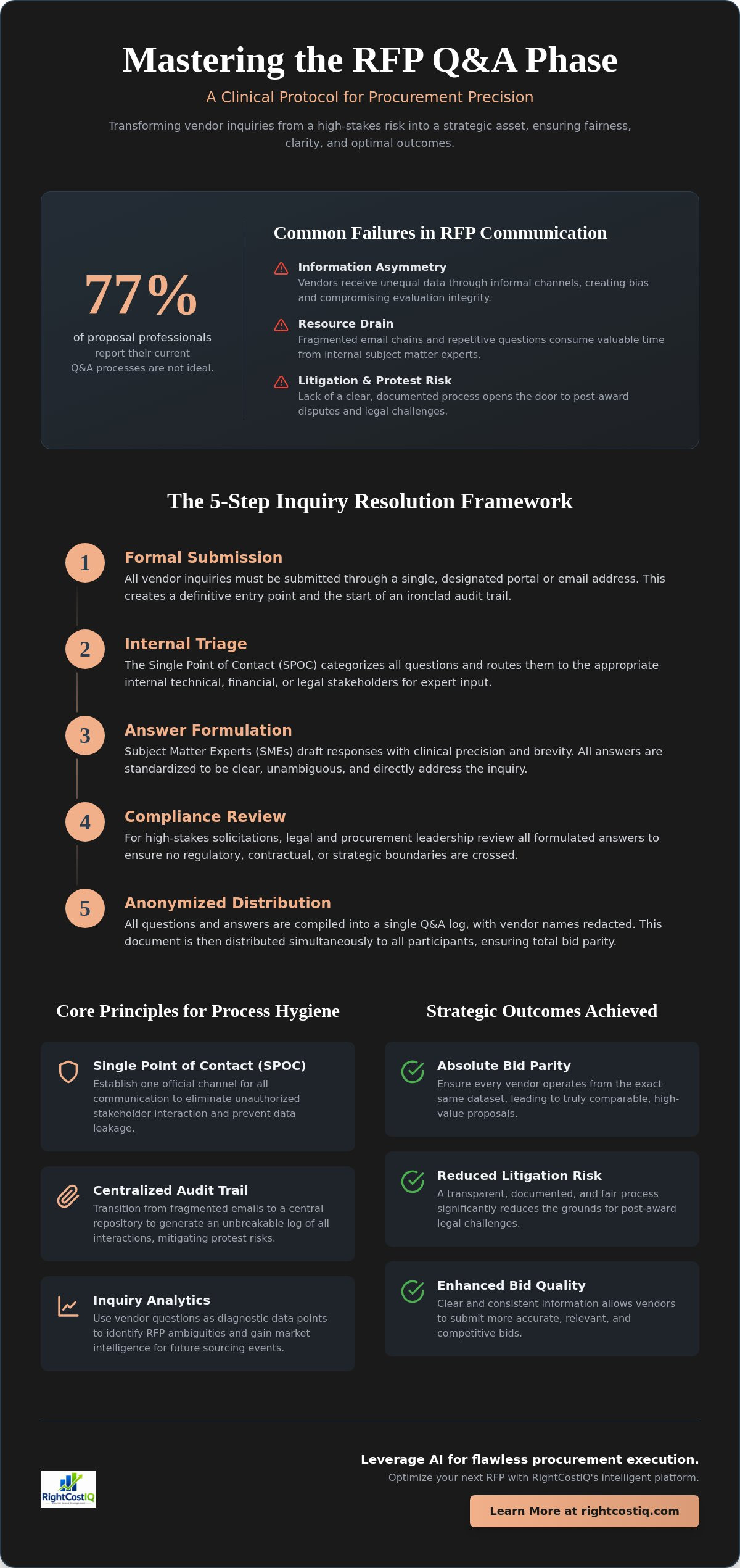
The 5-Step Inquiry Resolution Framework
Precision in procurement requires a methodical approach to question resolution. This framework ensures every response is vetted, accurate, and distributed without bias. Organizations that fail to follow a structured sequence often suffer from contradictory answers that confuse vendors and degrade bid comparability. Adopting this sequence is fundamental to professional RFP management and negotiation assistance.
- Step 1: Formal Submission. All inquiries must arrive via a centralized portal or a designated procurement email to ensure an audit trail.
- Step 2: Internal Triage. The SPOC categorizes questions and assigns them to the relevant technical or financial stakeholders for expert input.
- Step 3: Answer Formulation. Subject matter experts draft responses with a focus on clinical precision and brevity, avoiding unnecessary qualifiers.
- Step 4: Compliance Review. Legal and procurement leadership review high-stakes solicitations to ensure no regulatory or contractual boundaries are crossed.
- Step 5: Synchronized Distribution. The SPOC releases the consolidated Q&A log to all registered participants simultaneously, maintaining a level playing field.
Standardizing the Q&A Log Template
A standardized template is the primary tool for maintaining transparency and operational control. The log should feature specific columns: Question ID, Category, Redacted Question, and Formal Response. Redaction is critical. It removes proprietary vendor information that might reveal a competitor's strategy. When multiple vendors ask similar questions, the SPOC should group them into a single, comprehensive answer to reduce administrative bloat. Version control is also essential. In high-volume RFP cycles, each update to the Q&A log must be clearly timestamped and numbered. This systematic approach to how to handle vendor questions during an RFP ensures that every participant operates from the most current data set, reducing the risk of post-award protests.
Centralized vs. Decentralized Response Frameworks
Centralization is the only path to procurement precision. Decentralized communication, characterized by fragmented email threads and disparate spreadsheets, is the primary driver of non-compliance. It invites human error. It compromises audit trails. When organizations evaluate how to handle vendor questions during an RFP, they must choose between administrative chaos and automated control. Fragmented systems create information silos that lead to inconsistent messaging and unequal vendor treatment. This inconsistency often forms the basis for post-award protests and procurement litigation. High-stakes sourcing demands a unified architecture that provides a single version of truth for all participants.
Manual Management: The Risks of the "Excel and Email" Model
Manual systems fail under pressure. Consolidating dozens of inquiries via email is a massive time-drain that diverts resources from high-level cost analysis. Research indicates that teams spend between 25 and 33 hours on a single RFP response; issuers face a similar administrative burden when managing Q&A manually. A single "Reply-All" error can expose confidential strategic data or reveal a competitor's identity. This risk is unacceptable in modern enterprise sourcing. Manual logs often lack the rigid version control required for external audits or C-suite reporting. They offer no protection against claims of favoritism or data leakage.
Automated Precision: The Digital Sourcing Advantage
Automated RFP Management services eliminate these vulnerabilities. Real-time Q&A portals ensure 100% distribution accuracy. Every registered vendor receives the same data at the same time. This level of synchronization is impossible with manual methods. Automation also enforces deadlines. It sends reminders to internal stakeholders, keeping the procurement schedule on track. Integrating this data into a Negotiation Coach framework provides long-term leverage. It transforms Q&A records into diagnostic assets for future contract renewals. This shift from reactive management to proactive sourcing optimization is a defining characteristic of top-tier procurement departments.
- Eliminate "Reply-All" risks through secure, centralized portals.
- Ensure 100% parity by synchronizing data distribution to all vendors.
- Build ironclad audit trails that withstand legal and internal scrutiny.
- Reduce administrative overhead by 40% to 70% through workflow automation.
Mastering how to handle vendor questions during an RFP requires a departure from legacy manual processes. By adopting a centralized digital framework, procurement leaders secure the integrity of their sourcing events and drive superior financial outcomes.
Handling Complex and Non-Standard Inquiries
Standard protocols often fail when faced with non-standard inquiries. Complex questions require a strategic filter to distinguish between technical clarification and competitive maneuvering. Mastering how to handle vendor questions during an RFP involves identifying "loaded" inquiries designed to steer requirements toward a specific vendor's strengths. These tactical questions often attempt to disqualify competitors by emphasizing niche certifications or proprietary features. Procurement precision requires stripping away this bias. Responses must remain focused on functional outcomes rather than specific brand methodologies. This ensures the integrity of the RFP management lifecycle and prevents vendor-led scope creep.
The Proprietary Information Protocol
Vendors frequently ask questions that inadvertently reveal their unique methodologies or intellectual property. If a procurement team publishes these questions verbatim, they risk leaking a participant's competitive advantage. A clinical protocol for these instances involves redacting the proprietary elements before distribution. In rare cases, a "Confidential Clarification" may be issued solely to the inquiring vendor, provided it doesn't alter the core requirements for others. Legal safeguards must be active. Protecting vendor IP isn't just a courtesy; it's a critical component of maintaining a trustworthy sourcing environment. If a question reveals a fundamental flaw in the RFP that affects everyone, the specific vendor's identity must still remain protected during the general addendum release.
Correcting RFP Errors Post-Release
Errors in technical specifications or pricing sheets are inevitable in complex solicitations. When a vendor identifies a critical inaccuracy, the response must be immediate and transparent. An official RFP Addendum is the only valid corrective mechanism. This document must clearly state the error, the correction, and any resulting changes to the evaluation criteria. Fairness dictates that significant changes require a bid deadline extension. If a correction alters a material portion of the scope of work, a deadline extension is required to maintain bid quality. These interactions are diagnostic. They reveal where your internal data might be outdated or where market realities have shifted. Use these insights to build leverage during the final selection phase.
Every complex inquiry is a signal. It reveals vendor sophistication and potential negotiation pain points. To transform these signals into actionable strategy, consider a comprehensive procurement diagnostic to identify gaps in your current communication architecture.
- Redact proprietary vendor data before releasing general Q&A logs.
- Issue formal addenda for all technical specification corrections.
- Enforce rigid cutoffs for late submissions to maintain process hygiene.
- Identify loaded questions designed to steer the RFP outcome.
Integrating Technology for Automated RFP Precision
Technology transforms the Q&A phase from a defensive administrative hurdle into a proactive sourcing asset. While previous sections established the clinical protocol for communication, the integration of advanced analytics provides the final layer of procurement precision. Mastering how to handle vendor questions during an RFP requires more than just timely responses. It requires the ability to analyze the underlying data within those questions to identify market shifts and vendor positioning. By 2026, 86% of organizations plan to scale AI in their procurement processes, signaling a definitive move toward data-driven decision-making. This technological shift allows procurement leaders to move beyond reactive management and focus on strategic financial growth.
Using Analytics to Debunk Vendor Claims
Vendors frequently use the Q&A phase to challenge the feasibility of technical requirements or to signal upcoming price increases. Utilizing a Should-Cost analysis allows procurement teams to verify these claims against objective market data. If a vendor questions material costs or labor rates, analytics provide the necessary counter-narrative to maintain negotiation leverage. Identifying "Price Risk" signals within these inquiries early in the process prevents budget overruns during the final award stage. Aggregated Q&A data informs the final negotiation strategy by highlighting where vendors are most concerned about margin or delivery constraints.
Optimizing the Path to Award
The conclusion of the Q&A phase marks the transition into formal evaluation. All inquiry data must be archived to ensure total procurement transparency and to protect against potential protests. This digital archive serves as a primary reference during final contract negotiations, ensuring that all verbal or written clarifications are legally binding. Organizations that utilize automated platforms maintain a superior audit trail compared to those relying on manual email consolidation. This level of operational control is essential for high-stakes enterprise sourcing. Elevate your sourcing precision with RightCostIQ RFP Management to ensure every vendor interaction contributes to a superior financial outcome.
- Transition from reactive answering to proactive data analysis.
- Use cost benchmarking to validate or debunk vendor market claims.
- Identify hidden price risks within technical inquiries.
- Archive all Q&A logs as legally binding contract references.
Effective procurement requires a holistic approach where technical execution and high-level strategy are perfectly aligned. By integrating technology into the Q&A workflow, procurement departments stop being administrative cost centers and start functioning as primary drivers of corporate financial efficiency. The framework for how to handle vendor questions during an RFP concludes with this shift toward analytical precision, ensuring that the final selection is based on verified data rather than vendor-led narratives.
Driving Procurement Excellence Through Strategic Communication
Mastering how to handle vendor questions during an RFP marks the definitive transition from administrative oversight to strategic sourcing leadership. It's no longer enough to simply manage email chains; you must implement a clinical protocol that eliminates information asymmetry and secures absolute parity for all participants. Centralizing these workflows through automated platforms ensures total transparency, creating an ironclad audit trail that protects your organization against litigation and post-award protests.
This phase provides a critical diagnostic window into vendor technical readiness and shifting market pricing trends. Integrating these data points into your broader evaluation framework transforms reactive clarifications into powerful negotiation levers. High-stakes procurement demands this level of operational control to drive financial growth and category efficiency. Every inquiry is an opportunity to refine your scope and maximize value delivery.
Elevate your sourcing precision and secure a competitive advantage today. Optimize your RFP lifecycle with RightCostIQ Management Services to leverage global procurement benchmarking and our clinical negotiation coach. Achieve the precision your organization requires for superior sourcing outcomes.
Frequently Asked Questions
How long should the Q&A period be in a standard RFP?
Standard Q&A windows range from 5 to 10 business days for mid-level solicitations, extending to 14 days for complex technical requirements. This period must conclude at least 10 days before the final bid submission. This buffer allows vendors to integrate clarified data into their pricing models. Setting a rigid timeline prevents late-stage disruptions and ensures all participants have sufficient time to calibrate their responses based on the final Q&A log.
Can I answer a vendor question over the phone during an active RFP?
Direct verbal communication with vendors during an active solicitation is a violation of procurement neutrality. All inquiries must be submitted in writing through the established Single Point of Contact (SPOC). Verbal responses create information asymmetry and increase the risk of procurement protests. If a vendor attempts to call, direct them back to the formal portal to maintain process hygiene and ensure an ironclad audit trail for future compliance reviews.
What happens if a vendor misses the deadline for submitting questions?
Organizations must strictly enforce the inquiry deadline to maintain the procurement schedule and ensure process integrity. Allowing exceptions for one vendor creates a perceived bias that can lead to legal challenges. If a vendor misses the cutoff, their questions remain unanswered unless the procurement lead determines that the inquiry identifies a critical technical error that necessitates a general addendum for all participants. Consistency is the only defense against claims of favoritism.
Do I have to share every vendor question with all participants?
Every substantive question must be shared with all participants to maintain a level playing field. However, you must redact proprietary vendor information before distribution. Mastering how to handle vendor questions during an RFP involves stripping out competitor-specific methodologies while providing the underlying technical clarification to the entire group. This synchronized distribution ensures that no participant gains an unfair advantage through unique insights or private clarifications.
How should I handle questions that reveal a mistake in the RFP document?
Mistakes identified by vendors require the immediate release of a formal RFP addendum. This document should detail the correction and be distributed to all registered participants simultaneously. If the error is material or significantly alters the scope of work, you must extend the bid deadline. This clinical approach to how to handle vendor questions during an RFP protects the organization from awarding a contract based on flawed or outdated technical specifications.
Is it legal to change the RFP requirements based on vendor questions?
It's legally and operationally permissible to modify RFP requirements based on vendor feedback, provided the changes are documented via a formal addendum. Vendor questions often act as diagnostic indicators of market realities that your internal team might have overlooked. Updating the requirements ensures the final contract reflects current industry standards and technical feasibility, which ultimately leads to higher quality bids and better long-term vendor performance.
How do I handle a vendor that asks too many irrelevant questions?
Procurement leads should consolidate repetitive inquiries and ignore questions that don't impact the scope of work or bid quality. You aren't obligated to provide deep consulting or educational support during the Q&A phase. Focus on clinical precision. If a vendor's inquiries are excessively administrative or irrelevant, provide a concise response directing them back to the original RFP instructions to preserve internal resources for high-level cost analysis and strategic evaluation.
Should I use a portal or email for RFP question management?
Organizations should utilize a centralized procurement portal rather than fragmented email chains for all Q&A management. Portals provide automated version control, synchronized distribution, and 100% audit accuracy. Email management is the primary driver of data leakage and "Reply-All" errors. Transitioning to a digital sourcing framework eliminates these risks and ensures that the Q&A phase contributes to a sophisticated, data-driven negotiation strategy and superior financial outcomes.


