
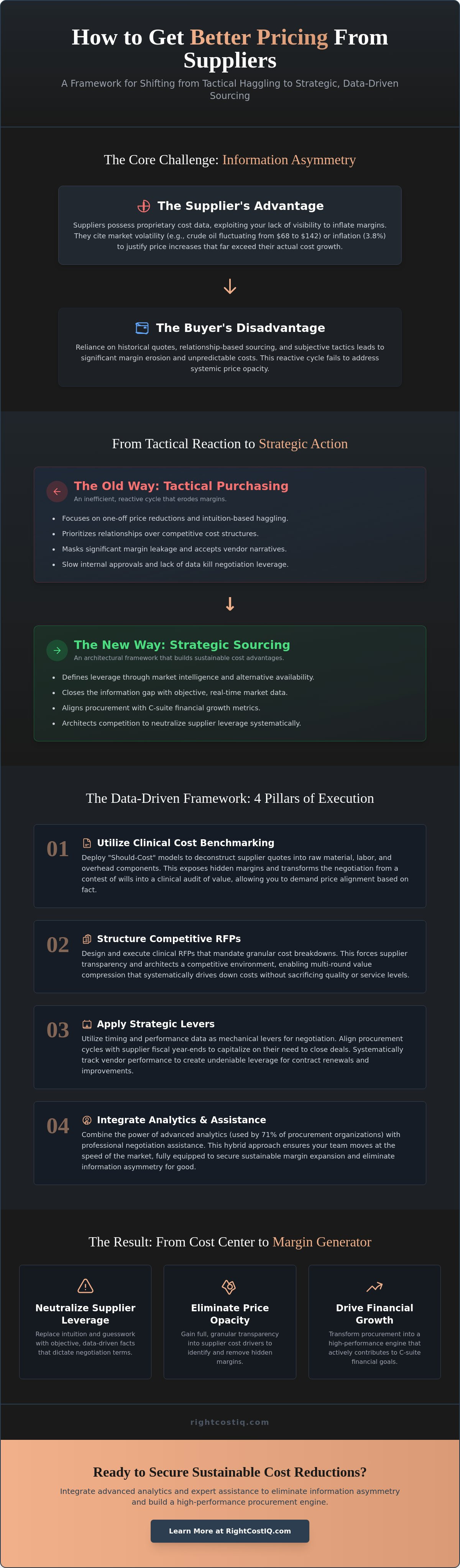
Superior pricing is not the result of aggressive table-pounding. It is the inevitable byproduct of clinical data transparency and structural competitive pressure. While 71 percent of procurement organizations have adopted generative AI as of 2026, many still struggle with information asymmetry that favors the vendor. You likely recognize the frustration of margins being eroded by unpredictable volatility where crude oil prices fluctuate between $68 and $142 per barrel in a single quarter. Learning how to get better pricing from suppliers requires a fundamental shift in leverage through objective benchmarking rather than a reliance on subjective negotiation tactics.
This framework provides the strategic architecture necessary for securing sustainable cost reductions without sacrificing operational quality. We will outline a clinical methodology for data-driven benchmarking and precise RFP execution to eliminate systemic price opacity. You'll learn to implement repeatable frameworks that neutralize supplier leverage and transform procurement into a high-performance engine for financial growth. The following analysis explores the integration of cost analytics and market forecasting to ensure competitive pricing as the U.S. annual inflation rate holds at 3.8 percent.
Key Takeaways
- Transition from tactical purchasing to strategic sourcing by defining price leverage as a function of market intelligence and alternative availability.
- Utilize clinical category cost benchmarking and "Should-Cost" models to discover exactly how to get better pricing from suppliers through fact-based negotiation.
- Structure competitive RFPs that mandate granular cost breakdowns, forcing transparency and driving multi-round value compression.
- Align procurement cycles with supplier fiscal year-ends and utilize vendor performance tracking as a mechanical lever for contract renewals.
- Integrate advanced analytics and professional negotiation assistance to secure sustainable margin expansion and eliminate information asymmetry.
The Anatomy of Price Leverage: Moving Beyond Intuition
Negotiation success isn't a personality trait; it's a structural outcome. Suppliers often win because they possess more data about their own cost structures than the buyer. Understanding The Anatomy of Price Leverage requires shifting from intuition-based haggling to a framework where market intelligence dictates the terms. This is the first step in mastering how to get better pricing from suppliers in a volatile market.
Tactical purchasing is reactive and focuses on immediate needs. In contrast, strategic sourcing architecting builds long-term cost advantages by identifying and closing the information gap that suppliers exploit. Relationship-based sourcing often masks significant margin leakage because it prioritizes comfort over competitive cost structures. When a supplier claims market prices are non-negotiable, they're counting on your lack of data to secure a premium.
The Information Asymmetry Challenge in Procurement
Suppliers exploit proprietary cost data to inflate margins. They often cite market volatility or generalized inflation without providing granular evidence. In June 2026, with the U.S. annual inflation rate at 3.8 percent, many vendors use this headline figure to justify price increases that far exceed their actual cost growth. Shifting the negotiation baseline requires total transparency into the supplier's cost drivers.
Procurement leverage is the quantifiable advantage derived from real-time market data, alternative supplier availability, and internal demand transparency. Closing the information gap stops the cycle of asking for discounts. Instead, it allows you to demand price alignment based on objective benchmarks that neutralize the vendor's data advantage.
Strategic vs. Tactical Negotiation Mindsets
Tactical negotiation focuses on one-off price reductions. It's an inefficient cycle that fails to address systemic cost issues. Strategic optimization aligns procurement with C-suite financial growth metrics. It treats every contract as a component of the broader balance sheet. High-level decision-makers recognize the ROI of professional negotiation assistance to ensure their teams move at the speed of the market.
- Decision Speed: Slow internal approvals kill leverage. Suppliers use time as a weapon to force renewals on their terms.
- Systemic Optimization: Real value comes from analyzing total cost of ownership rather than just unit price.
- C-Suite Alignment: Procurement must prove it's a margin generator, not just a cost center.
Mastering how to get better pricing from suppliers requires moving beyond the best-price mindset toward a right-price framework. By architecting competition and utilizing clinical data, you eliminate the guesswork that leads to margin erosion.
Leveraging Category Cost Benchmarking for Fact-Based Negotiations
Benchmarking transforms the negotiation from a contest of wills into a clinical audit of value. To master how to get better pricing from suppliers, organizations must move beyond comparing historical quotes and instead analyze the underlying economic drivers. This transition from spend-based analysis to cost-plus modeling allows procurement leaders to dictate terms based on verifiable market data rather than accepting vendor-led narratives.
Integrating should-cost modeling into the pre-negotiation phase ensures that every quote is scrutinized against its fundamental components. This process strips away the opacity that often protects supplier profit margins, particularly in complex service categories. It allows you to challenge "market average" claims by proving that a specific vendor's internal efficiencies should result in a lower unit cost.
Building the "Should-Cost" Framework
A clinical framework deconstructs supplier quotes into raw material, labor, and overhead components to identify hidden margins. This level of granularity is essential for negotiating better deals with suppliers and identifying where a vendor is passing on inefficiencies or inflating their risk buffer. Effective benchmarking focuses on three primary areas:
- Component Deconstruction: Aligning raw material indices with supplier quotes to identify unjustified price markups.
- Labor Rate Validation: Auditing regional labor benchmarks to ensure service costs reflect actual market wages.
- Overhead Scrutiny: Identifying excessive administrative loads or marketing costs that shouldn't be subsidized by the buyer.
Market Price Trending as a Negotiation Lever
Market price trending provides the predictive intelligence needed to identify optimal windows for contract renewal. With crude oil prices seeing quarterly fluctuations between $68 and $142 per barrel as of June 2026, static pricing models represent a significant financial risk. Proactive price risk management allows organizations to secure fixed-price agreements during market dips, effectively neutralizing the impact of current inflation metrics. For those seeking immediate margin recovery, a preliminary audit of category spend can reveal where benchmarking will yield the highest ROI.
Clinical RFP Management: Structuring Competition to Drive Value
An RFP is a strategic architecture designed to commoditize value and expose hidden margins. Most procurement cycles fail because they allow vendors to submit vague, non-comparable bids. This lack of structure is a primary reason organizations struggle with how to get better pricing from suppliers. By mandating granular cost breakdowns from all bidders, you force vendors to justify every dollar of their quote. This transparency is the foundation of competitive pressure.
Utilizing professional RFP management standardizes vendor responses and ensures that every participant adheres to the same data requirements. This eliminates the "apples-to-oranges" comparisons that often plague complex sourcing events. It's also essential to distinguish between "must-have" and "nice-to-have" requirements. Scope creep is a silent margin killer; clear requirements prevent suppliers from bundling unnecessary services into the unit price. Integrating automated vendor performance tracking ensures that these price gains don't come at the expense of operational efficiency.
Standardizing Vendor Responses for Direct Comparison
Structured bid templates are mandatory for data-driven sourcing. If a vendor submits a non-compliant bid, it must be rejected or corrected immediately to maintain competitive tension. Standardized data allows for instant identification of outliers in labor rates, material markups, or logistics fees. In high-value enterprise contracts, this level of clinical comparison is the only way to ensure the final price reflects true market value rather than a vendor's sales targets.
The Multi-Round Negotiation Cycle
Multi-round sourcing creates a mechanical "race to the bottom" for price while maintaining quality standards. It uses early-round data to squeeze margins in final rounds by providing vendors with objective feedback on where they're uncompetitive. This process maintains engagement because suppliers realize that only the most efficient cost structures will win the business. Executing a three-round clinical RFP cycle follows a methodical path:
- Round 1: Baseline Qualification. Collect initial pricing and technical capabilities. Filter out vendors who don't meet core requirements or whose pricing is statistically impossible.
- Round 2: Transparency Audit. Provide bidders with "Should-Cost" feedback. Demand a breakdown of cost components that exceed the benchmarks established in your earlier analysis.
- Round 3: Final Margin Compression. Conduct a best-and-final-offer (BAFO) round. Use your ranking data to push the top three contenders toward their absolute floor.
Mastering how to get better pricing from suppliers depends on your ability to maintain this competitive tension until the contract is signed. When competition is structured clinically, suppliers are forced to compete on their actual operational efficiency rather than their negotiation skills. This shift in leverage is what secures market-leading pricing for the long term.
Strategic Levers: Timing, Risk Management, and Performance Tracking
Strategic leverage extends beyond the RFP cycle. It requires the precise application of timing and performance metrics to sustain cost advantages. Organizations often overlook the mechanical benefit of aligning procurement cycles with supplier fiscal year-ends. Sales representatives and account managers are frequently incentivized to meet annual revenue targets, creating a window of opportunity where price concessions are traded for deal certainty. This is a core tactic in understanding how to get better pricing from suppliers without relying on aggressive rhetoric.
Fragmented spend often hides significant margin leakage. Addressing tail spend management allows organizations to capture savings from low-volume, high-frequency transactions that typically escape clinical scrutiny. When combined with price risk management protocols, these levers protect the bottom line from sudden market shifts. With the Bank Prime Loan rate at 6.75 percent as of June 2026, the cost of capital makes inefficient spend even more damaging to corporate liquidity.
Performance-Based Negotiation Architectures
Vendor performance tracking data should function as a mechanical lever in every renewal discussion. Linking pricing tiers to documented metrics ensures that you only pay a premium for premium results. If a supplier has a history of non-compliance or SLA failures, this data serves as an objective justification for negotiating credits or immediate discounts. Transitioning from rigid fixed-price agreements to performance-incentivized contracts aligns the supplier's profit motive with your operational success. It transforms the relationship from a static cost to a dynamic value driver.
Mitigating Price Volatility
Volatility in commodity markets is at its highest level since 2012. Crude oil fluctuations and wheat price swings of over 35 percent require sophisticated price risk management. Incorporating index-based pricing models for volatile commodities ensures that your costs reflect actual market conditions rather than a supplier's "worst-case" risk buffer. Utilizing market price trending allows procurement teams to identify "buy low" opportunities and lock in favorable rates before forecasted spikes. To see how your current vendor performance stacks up against market benchmarks, initiate a clinical audit of your category spend to identify immediate leverage points.
Developing internal benchmarking standards for recurring category spend creates a baseline for all future negotiations. It prevents the slow creep of unit prices that often occurs in long-term relationships. By treating every renewal as a fresh sourcing event informed by historical performance data, you eliminate the complacency that suppliers rely on to maintain their margins. This clinical approach ensures that how to get better pricing from suppliers is a repeatable process rather than a one-time win.
Executing the RightCostIQ Framework for Sustainable Margin Expansion
Implementation is the final frontier where strategic architecture meets operational reality. Integrating advanced analytics into the core procurement infrastructure ensures that benchmarking insights translate into tangible financial growth. This transition allows organizations to abandon reactive cost-cutting in favor of proactive price risk management. Professional negotiation assistance offers a high ROI in complex deals by providing the market intelligence necessary to neutralize supplier data advantages. Achieving enterprise-wide cost transparency through centralized benchmarking is the only way to master how to get better pricing from suppliers across fragmented departments.
The Synergy of Technology and Strategy
Automated platforms accelerate the RFP lifecycle while eliminating the manual errors that lead to data fragmentation. These tools provide a rhythmic cadence of efficiency, moving quickly from broad strategic goals to granular cost deconstruction. Utilizing proprietary benchmarking data validates internal sourcing strategies against real-world market performance, ensuring every negotiation baseline is rooted in objective reality. For a comprehensive look at optimizing specific spend areas, see our guide on Category Management in Procurement for margin expansion. This tech-integrated approach bridges the gap between traditional business functions and cutting-edge digital innovation.
Securing C-Suite Buy-In for Procurement Optimization
Securing executive support requires quantifying the financial impact of data-driven negotiation assistance. Procurement must be positioned as a primary driver of corporate financial growth rather than a tactical cost center. With the U.S. annual inflation rate holding at 3.8 percent as of April 2026, the ability to compress margins through clinical analysis provides a significant competitive advantage. Presenting procurement as a strategic architect allows the department to take on the persona of a sophisticated mentor within the organization. The path to implementation begins with a methodical pilot program:
- Select three high-impact spend categories for immediate clinical benchmarking.
- Audit incumbent vendor contracts for performance-based penalty or incentive levers.
- Standardize the sourcing event workflow through automated RFP management.
The RightCostIQ framework is designed to eliminate the information asymmetry that suppliers have exploited for decades. By shifting leverage back to your organization through clinical data transparency, you secure market-leading pricing that is both sustainable and objective. The goal isn't just a lower price; it's the institutionalization of a data-driven sourcing culture that protects margins regardless of market volatility.
Institutionalizing Data-Driven Procurement Excellence
Procurement leadership requires a fundamental transition from tactical negotiation to strategic architecting. By deploying clinical category cost benchmarking and structuring multi-round RFP cycles, organizations neutralize the information asymmetry that historically favors suppliers. This framework ensures that pricing is an objective reflection of market reality rather than a product of vendor-led narratives. Mastering how to get better pricing from suppliers becomes a repeatable organizational capability when supported by advanced analytics and precise market intelligence.
Leveraging automated price risk management and clinical negotiation assistance for high-value contracts allows teams to secure sustainable margin expansion despite global volatility. These protocols provide a structural buffer against inflationary pressures and commodity swings. Optimize your sourcing outcomes with RightCostIQ RFP Management to access cost benchmarking across global procurement categories and automated forecasting tools. Transitioning to a data-driven sourcing model is the most efficient path to long-term financial resilience.
Frequently Asked Questions
How do I know if I am getting the best possible price from a supplier?
Verification requires clinical benchmarking against global category indices rather than a reliance on historical spend analysis. You must compare current unit rates against real-time market data and proprietary should-cost models to identify hidden margins. This transparency reveals exactly how to get better pricing from suppliers by exposing discrepancies between vendor quotes and objective market reality.
Can I negotiate pricing with a supplier even if we have a long-term contract?
Yes, provided the contract includes performance-based review clauses or price adjustment mechanisms. High-value contracts often contain language allowing for renegotiation during significant market shifts or documented vendor performance failures. Use historical non-compliance data as a mechanical lever to demand credits or price corrections before the formal renewal window opens.
What is the "Should-Cost" model and how does it help in negotiations?
A should-cost model deconstructs a supplier's price into its fundamental components: raw materials, labor, overhead, and profit. This analytical framework shifts the negotiation from subjective haggling to a clinical audit of the vendor's cost structure. It allows procurement teams to challenge unjustified markups by proving that input costs don't align with the quoted unit price.
How much can a business typically save through professional RFP management?
Savings vary based on category complexity and existing price opacity within your supply chain. Professional RFP management compresses margins by standardizing vendor responses and forcing granular transparency. While specific dollar amounts depend on the individual sourcing event, this structured competition typically identifies significant inefficiencies that traditional, unmanaged procurement processes overlook.
What are the risks of pushing a supplier too hard on price?
Excessive price compression can lead to service degradation, quality compromises, or supply chain instability. If a vendor's margin is pushed below their operational floor, they may deprioritize your account or fail to invest in necessary innovation. A clinical framework balances aggressive cost reduction with vendor performance tracking to ensure sustainable quality and operational resilience.
How does market price forecasting impact contract negotiation strategy?
Forecasting identifies optimal windows for locking in fixed-price agreements versus utilizing index-based models. In volatile markets where commodities like crude oil experience quarterly swings, predictive data prevents signing long-term deals at peak prices. This intelligence allows procurement to act as a strategic buffer against inflation by timing sourcing events to coincide with forecasted market dips.
Is it better to bundle all services with one supplier or diversify for better pricing?
Bundling increases volume leverage but creates high switching costs and dependency risk. Diversification maintains competitive tension and protects the supply chain from single-point failures. The optimal strategy depends on the category; high-volume commodities benefit from bundled leverage, while specialized services often require a diversified portfolio to ensure continuous competitive pressure.
What data do I need to prepare before starting a supplier negotiation?
Preparation requires a comprehensive data set including historical spend, current market benchmarks, and detailed should-cost deconstructions. You also need documented vendor performance metrics and a clear understanding of alternative supplier availability. Possessing this information eliminates the asymmetry that vendors exploit, providing the clinical foundation for how to get better pricing from suppliers.


