
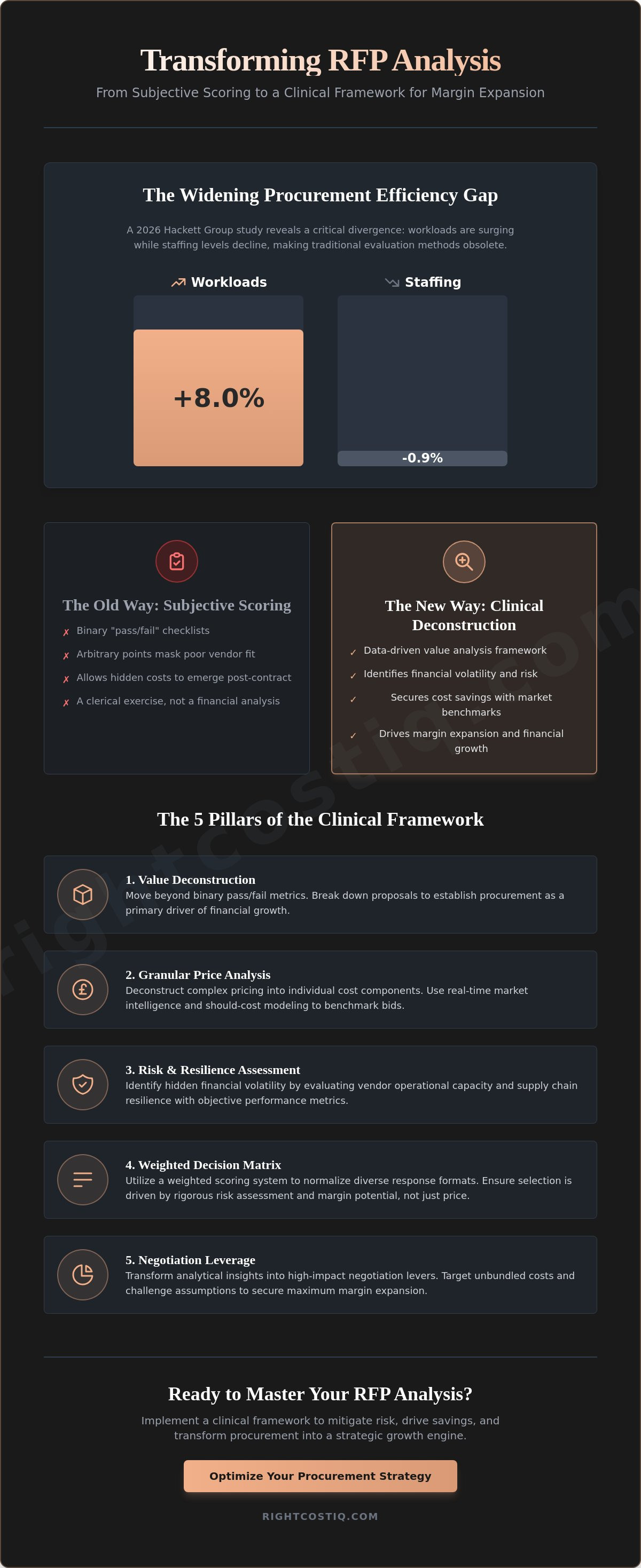
According to a 2026 Hackett Group study, procurement workloads are surging by 8.0 percent while departmental staffing is simultaneously declining by 0.9 percent. This widening efficiency gap means that traditional, subjective evaluation methods are no longer just inefficient; they are a direct threat to corporate financial health. Most procurement leaders understand that subjective scoring frequently masks poor vendor fit and allows hidden costs to emerge long after the contract signature. Learning how to analyze RFP responses effectively is the only way to bridge this gap and maintain operational control.
This guide provides a clinical framework designed to transform your sourcing process into a high-precision engine for margin expansion. You'll master a data-driven methodology to deconstruct vendor proposals, mitigate price risk, and secure cost savings through real-time market benchmarking. We will detail a repeatable analysis structure that identifies financial volatility before it strikes, ensuring your 2026 procurement strategy remains resilient against market fluctuations and new regulatory shifts like the EU AI Act. This transition from basic scoring to technical deconstruction is essential for any organization seeking to optimize its bottom line.
Key Takeaways
- Transition from binary "pass/fail" metrics to a clinical value deconstruction framework that establishes procurement as a primary driver of financial growth.
- Master how to analyze RFP responses effectively by breaking down complex pricing into granular cost components using real-time market intelligence and benchmarking.
- Identify hidden financial volatility by assessing vendor operational capacity and supply chain resilience through objective performance metrics.
- Utilize a weighted decision matrix to normalize diverse response formats, ensuring vendor selection is based on rigorous risk assessment and margin potential.
- Transform analytical insights into high-impact negotiation levers to target unbundled costs and secure maximum margin expansion in 2026.
Defining the Clinical Framework for RFP Response Analysis
Procurement optimization requires a fundamental pivot from clerical administration to financial architecture. The standard Request for proposal (RFP) process often degrades into a clerical exercise where teams settle for binary "pass/fail" checklists. These checklists fail to account for the nuanced financial variables that dictate long-term margin health. To master how to analyze RFP responses effectively, your organization must treat the evaluation phase as a clinical deconstruction of vendor viability. This shift transforms raw data into a strategic asset, aligning procurement outcomes directly with C-suite financial growth targets. By integrating automated data extraction, teams eliminate manual entry errors and ensure the analytical foundation is structurally sound from the start.
The Shift from Scoring to Strategic Deconstruction
Traditional scoring models are fundamentally flawed because they prioritize surface-level compliance over deep-seated price risk. Most legacy systems assign arbitrary points to vendor answers, creating a "score" that lacks any direct correlation to financial performance. A clinical, evidence-based evaluation mindset replaces these subjective points with hard data. It focuses on the total cost of ownership and the sustainability of the vendor's pricing model. The ROI of a high-precision analysis phase is significant. It prevents the emergence of hidden costs that typically surface 12 to 18 months after a contract is signed. High-stakes decision-makers don't need a "best guess" score; they need a rigorous deconstruction of how a vendor's proposal will impact the bottom line over a multi-year cycle.
Stakeholder Alignment and Analytical Objectives
Strategic alignment must occur long before the first response arrives. You need to identify cross-functional requirements and establish clear "deal-breakers" based on real-time market intelligence. This ensures that the analysis phase isn't just about comparing vendors against each other, but comparing all vendors against an objective market standard. Defining these analytical objectives early allows for seamless negotiation assistance once the data is finalized. Clarity in the evaluation stage provides the leverage required to challenge vendor assumptions during the final selection process. When stakeholders agree on the clinical metrics for success, the selection process moves faster and with greater confidence. This methodical approach reduces friction between departments and ensures that the final vendor choice supports the broader organizational mission of margin expansion and risk mitigation.
Quantitative Deconstruction: Benchmarking and Cost Modeling
Quantitative analysis is the core engine of the clinical framework. It demands the systematic isolation of granular cost components from bundled vendor quotes. This process reveals the underlying economics of a proposal, allowing procurement leaders to challenge artificial markups or unsustainable low-ball bids. Mastering how to analyze RFP responses effectively involves identifying outlier pricing that signals either unmanaged operational risk or superior technical efficiency. Utilizing should-cost modeling allows you to validate vendor margin transparency by comparing bid data against theoretical production and delivery costs. This level of scrutiny ensures that the final selection is based on financial reality rather than marketing-driven price points. By understanding how to analyze RFP responses effectively through cost modeling, you gain the clarity needed to demand absolute transparency from your supply base.
Market Price Trending and Forecasting
Bids must be evaluated against 2026 market price trends to anticipate future volatility and ensure long-term viability. A proposal that appears competitive today may become a strategic liability if it lacks a robust mechanism for price risk management. Price risk management is the mitigation of financial exposure to market fluctuations. Analyzing vendor responses against real-time forecasting data identifies opportunities to lock in favorable rates or implement indexed pricing models that protect the bottom line. This forward-looking analysis prevents budget overruns caused by unforeseen commodity price spikes or labor cost inflation. Organizations that fail to forecast these shifts often find their projected savings eroded within the first year of contract execution.
Cost Benchmarking for Sourcing Optimization
Comparing proposal data against procurement category cost benchmarking standards reveals exactly where a vendor sits in the competitive landscape. This benchmarking process is essential for uncovering hidden tail spend risks buried within "all-inclusive" pricing models. These bundled structures often hide inefficient service layers, inflated administrative fees, or redundant logistics costs. By applying clinical analytics to these specific segments, you can identify immediate savings opportunities that remain invisible in traditional scoring models. This methodical comparison ensures that every dollar spent aligns with current market standards for quality and delivery. Organizations that integrate these analytical insights can benchmark their category costs to secure a dominant negotiation position and drive significant margin expansion. This data-driven approach transforms procurement from a cost center into a strategic architect of corporate value.
Qualitative Assessment: Risk and Performance Metrics
Qualitative assessment must be stripped of subjective bias. It's a forensic audit of a vendor's operational architecture. When determining how to analyze RFP responses effectively, procurement teams must look past polished presentations to find clinical performance data. This involves deconstructing technical competence by demanding proof of past performance rather than accepting high-level marketing claims. Integrating vendor performance tracking metrics directly into your selection criteria ensures that your chosen partner can meet the rigorous demands of 2026 supply chains. A vendor who cannot provide granular data on their own efficiency is a high-risk candidate for future margin erosion. Marketing fluff is the enemy of financial precision. Your framework must prioritize evidence over promises to secure long-term operational stability.
Evaluating Operational Efficiency and Compliance
A vendor's response consistency serves as a reliable proxy for their broader operational discipline. Discrepancies between technical specifications and pricing schedules often signal a lack of internal coordination. You must also assess compliance with industry-specific price risk management standards to protect your organization from external shocks. Verifying these claims through independent benchmarking data removes the ambiguity that often plagues qualitative scoring. This clinical approach identifies vendors who possess the structural integrity required for high-stakes partnerships. High-performing vendors demonstrate their competence through transparent reporting and evidence-based compliance architectures.
Performance Forecasting and Scalability
Long-term reliability is predictable if you analyze the right data points within the RFP. You aren't just looking for a supplier for today; you're identifying a strategic partner capable of adapting to rapid market price trending shifts. Evaluate their scalability by analyzing their investment in technology and their history of resource allocation during market volatility. This differentiation separates transactional suppliers from strategic architects who can support your margin expansion goals. Understanding how to analyze RFP responses effectively means looking for indicators of agility and financial stability. This analysis transforms the RFP from a static document into a dynamic forecasting tool that secures your competitive advantage.
The Decision Matrix: Weighted Scoring and Selection
The decision matrix represents the mathematical culmination of the clinical framework. It functions as the primary mechanism for converting raw data and qualitative assessments into a definitive strategic choice. Mastering how to analyze RFP responses effectively requires a matrix that prioritizes clinical financial impact and risk mitigation over surface-level compliance. You must normalize scores across diverse vendor response formats to ensure an objective, apples-to-apples comparison. Vendors often use different pricing units or service models to complicate direct comparisons. Normalization strips away these distractions, preventing "optical savings" from masking long-term operational costs. Executing a sensitivity analysis is the final stress test for your model. By adjusting weights by small percentages, you can observe how the ranking shifts. This reveals which vendors are truly resilient across different strategic priorities and which ones only look good under specific, narrow conditions. Documenting this analytical trail is critical for internal audits and C-suite reporting, providing a transparent, data-backed record of how the final selection was architected.
Constructing the Weighted Scoring Architecture
Constructing a weighted scoring architecture demands a precise balance between technical requirements and procurement category cost benchmarking. You shouldn't let technical features overshadow the core financial objectives. Assign significantly higher weights to critical risk management components, such as price stability and supply chain transparency. Blinded scoring protocols further eliminate departmental bias by removing vendor names during the initial evaluation of technical responses. This forces evaluators to focus strictly on the data and performance claims provided. This rigorous structure ensures that the final selection isn't based on brand recognition or existing relationships, but on the vendor's ability to drive margin expansion.
Shortlisting and Finalist Identification
The matrix effectively narrows the field to the top two or three strategic fits. This shortlist isn't the conclusion of the process; it's the foundation for the final refinement phase. Use the matrix to identify specific "gap areas" where even the top-ranking proposals fall short of your ideal market benchmarks. These identified weaknesses become your primary levers during the final negotiation stage. Preparing this granular data for RFP management finalization ensures that the transition from analysis to contract execution is seamless and entirely data-backed. It's about maintaining the same level of clinical precision from the first response to the final signature. To identify where your current evaluation process might be leaking margin, run a free procurement diagnostic to uncover hidden risks in your selection criteria.
Leveraging Analytical Insights for Negotiation Execution
Analytical findings are only valuable when they are weaponized during the negotiation phase. Many procurement teams stop at selection, failing to realize that the deconstruction process has already identified the exact points where a vendor can concede margin. Understanding how to analyze RFP responses effectively translates directly into negotiation power, allowing you to challenge vendor cost structures with clinical precision. By targeting the unbundled costs identified during your initial quantitative deconstruction, you can systematically remove artificial markups. This ensures that the final price reflects the actual market value of the service rather than a vendor's desired profit margin.
Market price trending data serves as your primary defense against future financial volatility. In the 2026 landscape, characterized by rapid regulatory shifts like the EU AI Act and fluctuating labor costs, securing price-cap protections is a strategic necessity. Your analysis should dictate the specific indexation models and performance triggers embedded in the final contract. This clinical approach ensures that the performance tracking requirements identified during the qualitative assessment phase become legally binding obligations. A contract that lacks these data-driven safeguards is a liability that invites future budget overruns. Success in 2026 requires moving past simple price agreements toward complex, risk-adjusted financial architectures.
Negotiation Coaching and Data-Driven Levers
Professional negotiation assistance transforms complex analytical findings into bottom-line growth. By using cost benchmarking data, you can challenge vendor margin assumptions with objective evidence rather than subjective pressure. This technical approach forces vendors to justify price discrepancies against real-time market standards. Securing favorable terms requires closing the price risk management gaps identified earlier in the process. When a vendor realizes your team possesses a clinical understanding of their cost drivers, the dynamic of the negotiation shifts from transactional to architectural. This leverage is the direct result of knowing how to analyze RFP responses effectively from the outset.
Finalizing the Procurement Optimization Cycle
The conclusion of the RFP analysis marks the beginning of active vendor performance tracking. You must establish a clinical baseline for measuring procurement ROI based on the specific metrics validated during the selection process. This transition ensures that the promises made in the proposal are consistently delivered throughout the contract lifecycle. For a deeper understanding of how this fits into your long-term strategy, read more on Category Management in Procurement. This holistic cycle of analysis, negotiation, and tracking is the only way to secure sustainable margin expansion in an increasingly complex global market. Active management prevents the value leakage that typically occurs when procurement teams treat the contract signature as the finish line.
Architecting Financial Resilience Through Clinical Sourcing
Procurement success requires technical deconstruction. Implementing a clinical framework moves your organization beyond surface-level comparisons to identify true financial viability and operational resilience. Mastering how to analyze RFP responses effectively ensures every selection is backed by hard data and market-aligned benchmarks. This process effectively mitigates price risk. It prevents the value leakage that typically follows subjective decision-making. High-precision sourcing isn't just about selecting a vendor. It's about architecting a contract that secures long-term margin expansion.
Optimize your procurement outcomes with RightCostIQ's clinical RFP management. Our platform provides advanced cost benchmarking analytics, specialized price risk management forecasting, and professional negotiation assistance to ensure your strategy remains resilient against market volatility. Secure your competitive advantage by transforming your sourcing process into a clinical engine for financial growth.
Frequently Asked Questions
What is the most effective way to score RFP responses?
The most effective way to score RFP responses is through a clinical weighted matrix that assigns values based on financial impact and risk levels. This approach moves beyond binary compliance checks to evaluate how each proposal contributes to margin expansion. By focusing on total cost of ownership and operational efficiency, procurement leaders identify the vendor that offers the highest long-term value rather than just the lowest initial price.
How do I ensure my RFP evaluation process is objective?
Objectivity is secured by implementing blinded scoring protocols and normalizing data across diverse response formats. Removing vendor identities during the technical evaluation phase prevents established relationships or brand bias from influencing the results. Normalization ensures that all pricing and performance metrics are compared on an apples-to-apples basis, providing a structurally sound foundation for final selection.
What are the common mistakes in RFP response analysis?
Common mistakes include relying on subjective scoring and failing to deconstruct bundled pricing structures. Many teams settle for surface-level checklists that don't reveal hidden costs or unmanaged operational risks. Learning how to analyze RFP responses effectively requires a deep dive into granular cost components and a refusal to accept marketing fluff as proof of technical competence.
How can I use market price trending to evaluate a proposal?
Market price trending allows you to evaluate a proposal's sustainability against forecasted 2026 volatility. By comparing vendor bids to real-time market data, you can identify low-ball offers that may lead to future price hikes or service failures. This forward-looking analysis is essential for securing price-cap protections and ensuring the contract remains financially viable throughout its entire lifecycle.
Should I use weighted scoring for every RFP?
Weighted scoring is a strategic necessity for every RFP, but the specific weights must reflect the risk profile of the category. High-risk categories require heavier weighting on compliance and resilience metrics, while transactional categories may prioritize immediate cost savings. Tailoring the matrix ensures that the evaluation remains aligned with specific business outcomes and C-suite financial growth targets.
How does cost benchmarking improve RFP outcomes?
Cost benchmarking provides an objective market standard to validate vendor margin transparency and identify savings opportunities. It allows procurement teams to see exactly where a proposal sits relative to industry averages for specific categories. This clarity is a powerful negotiation lever, forcing vendors to justify any price discrepancies that don't align with verified market intelligence.
Can AI-led procurement platforms automate the analysis phase?
AI-led platforms automate the data extraction and initial benchmarking phases to eliminate manual entry errors. These systems are highly efficient at identifying outliers and comparing bids against historical data. However, the final strategic deconstruction still requires a human architect to interpret the findings and align them with the organization's broader financial and operational goals.
What is the role of stakeholder alignment in RFP analysis?
Stakeholder alignment establishes the cross-functional requirements and analytical objectives before the evaluation phase begins. It ensures that every department agrees on the clinical metrics for success and the specific deal-breakers that will disqualify a vendor. This early consensus prevents friction during the selection process and guarantees that the final choice supports the entire organization's strategic mission.


