
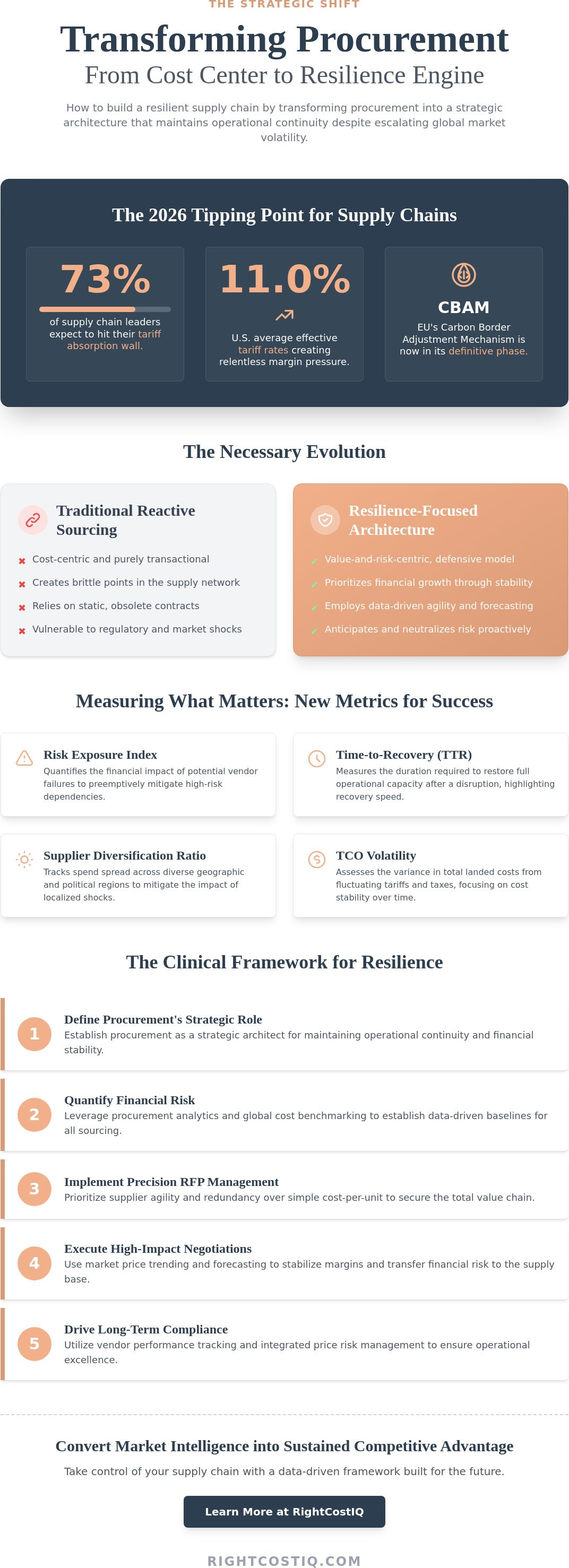
73% of supply chain leaders expect to reach their tariff absorption wall by the end of 2026, signaling a terminal point for traditional cost-absorption strategies. With U.S. average effective tariff rates reaching 11.0% and the definitive phase of the EU’s Carbon Border Adjustment Mechanism (CBAM) now in effect, your margins face relentless pressure. You likely recognize that unpredictable market price volatility and opaque vendor performance are no longer just operational hurdles; they're systemic threats to your bottom line. Understanding procurement's role in supply chain resilience is now the difference between financial stability and structural failure.
You'll learn how to transform procurement from a reactive back-office function into a strategic engine of resilience through data-driven RFP management and rigorous price risk analytics. This guide provides a clinical framework for sourcing designed to reduce financial exposure through precise price forecasting and enhanced vendor compliance. We'll outline a methodical approach to market price trending that replaces guesswork with objective data. By the end of this analysis, you'll have the tactical blueprint required to optimize category costs and ensure operational continuity in an increasingly volatile global trade environment.
Key Takeaways
- Define procurement's role in supply chain resilience as a strategic architecture for maintaining operational continuity despite escalating global market volatility.
- Quantify financial risk by leveraging procurement analytics and global cost benchmarking to establish data-driven baselines for all sourcing activities.
- Implement precision RFP management to prioritize supplier agility and redundancy, moving beyond simple cost-per-unit metrics to secure the total value chain.
- Execute high-impact negotiations using market price trending and forecasting to stabilize margins and transfer financial risk to the supply base.
- Drive long-term compliance through a clinical framework of vendor performance tracking and integrated price risk management services.
Redefining Procurement’s Role in Supply Chain Resilience
Resilience in the 2026 economic environment isn't a passive recovery state. It's the active maintenance of operational continuity despite extreme market volatility and geopolitical friction. Procurement's role in supply chain resilience has transitioned from a back-office transactional function to a high-stakes defensive architecture. With major disruptions now occurring on average every 3.7 years, organizations can no longer rely on reactive recovery. They must instead engineer systems that anticipate and neutralize risk before it impacts the bottom line.
This evolution demands a shift from cost-centric sourcing to a value-and-risk-centric model. Traditional cost-cutting often introduces brittle points in the network. In contrast, resilience-focused procurement prioritizes financial growth through stability. Modern success is measured by clinical metrics that go beyond the purchase price. These include:
- Risk Exposure Index: Quantifying the financial impact of potential vendor failures.
- Time-to-Recovery (TTR): The duration required to restore full operational capacity after a disruption.
- Supplier Diversification Ratio: The spread of spend across geographically and politically diverse regions to mitigate localized shocks.
- Total Cost of Ownership (TCO) Volatility: The variance in landed costs caused by fluctuating tariffs and carbon taxes.
The Strategic Intersection of Cost and Continuity
Balancing lean inventory with supply security requires a sophisticated understanding of supply chain management fundamentals. Excessive safety stock ties up working capital; however, insufficient redundancy leads to catastrophic bottlenecks. Procurement optimization drives enterprise-wide financial stability by aligning sourcing strategies with real-time market intelligence. Utilizing category management procurement frameworks allows decision-makers to stabilize margins even as U.S. average effective tariff rates reach 11.0%. This clinical approach ensures that every sourcing decision serves both short-term margin goals and long-term continuity requirements.
From Reactive Sourcing to Proactive Architecture
Traditional sourcing models are fundamentally vulnerable to the rapid regulatory shifts of 2026. The implementation of the EU’s Carbon Border Adjustment Mechanism (CBAM) and shifting Section 232 duties on steel and aluminum derivatives have rendered static contracts obsolete. 73% of supply chain leaders report reaching a tariff absorption wall, where costs can no longer be internalized. Proactive architecture replaces these vulnerabilities with data-driven agility. Clinical execution is now a prerequisite for risk management. It involves the integration of price risk analytics and automated performance tracking to ensure that vendor compliance remains absolute. This transformation ensures that procurement functions as a strategic engine, converting market intelligence into a sustained competitive advantage.
Step 1: Quantifying Risk through Procurement Analytics and Benchmarking
Quantification is the prerequisite for control. Without a granular spend analysis, resilience remains a theoretical concept rather than a functional reality. Procurement's role in supply chain resilience starts with establishing a clinical baseline of current expenditures across all categories. This process exposes the structural vulnerabilities inherent in traditional sourcing, such as over-reliance on single-region suppliers or unindexed price structures. By benchmarking category costs against global market standards, procurement leaders move from subjective negotiation to objective financial engineering.
Identifying hidden risks requires looking beyond primary materials into tail spend and non-core categories. These often-ignored segments can cause disproportionate operational paralysis if a tier-two or tier-three supplier fails. Integrating real-time market price trending into daily workflows ensures that the organization remains agile enough to pivot before volatility becomes a loss. A comprehensive benchmarking diagnostic often reveals that a significant portion of supply risk resides in the unmanaged tail spend that traditional models overlook.
Leveraging Market Price Trending and Forecasting
Predictive capability is the hallmark of a modern procurement function. Utilizing historical data to forecast future supply disruptions allows for the implementation of Resilient Emergency Procurement Strategies before a crisis peaks. High-level decision-makers use should-cost modeling to inform resilient pricing. This ensures that contract terms reflect the actual cost of production rather than arbitrary vendor markups. This data-driven approach to price risk management transforms procurement from a cost center into a strategic engine of enterprise-wide financial stability.
Benchmarking for Strategic Advantage
Benchmarking provides the necessary context for vendor performance tracking. It's not enough to know how a supplier performs in isolation; you must compare their efficiency against rigorous industry standards. Analytics identify high-risk supplier dependencies where the cost of a potential disruption outweighs the perceived savings of a low-cost contract. This analytical rigor is central to procurement's role in supply chain resilience, turning raw data into a shield against market instability. Quantifying these risks involves calculating the financial impact of a month-long shutdown. Research indicates such events happen, on average, every 3.7 years. By establishing these metrics, procurement architects build a defense-in-depth strategy that prioritizes continuity over temporary price advantages.
Step 2: Engineering Resilient Sourcing with Precision RFP Management
Precision in the RFP process is the bridge between strategic intent and operational reality. While benchmarking identifies the target, the RFP secures the outcome. Procurement's role in supply chain resilience is codified during this phase, transforming abstract risk management into legally binding service level agreements. Designing an RFP that prioritizes agility requires moving beyond the unit price to evaluate a vendor’s structural reliability and redundancy capabilities. Evaluation must incorporate resilience criteria such as lead-time consistency, capacity for rapid scale-up, and financial solvency under market stress.
Efficiency remains the primary operational anchor. Manual RFP cycles are often too slow to keep pace with the 6.1% growth in procurement technology spend projected for 2026. Organizations that fail to modernize their sourcing workflows risk missing critical market windows. Professional RFP management streamlines the transition from vendor selection to contract execution, ensuring that compliance is baked into the relationship from day one. Automated vendor performance tracking then monitors these commitments, providing the real-time visibility necessary to maintain a defensive supply posture.
The Clinical RFP Execution Framework
Requirements must be defined with technical precision to eliminate vendor ambiguity. Utilizing RFP management services accelerates sourcing cycles, allowing firms to pivot faster than competitors when market conditions shift. Scoring suppliers on risk-weighted performance metrics ensures that the lowest bid doesn't become the highest risk. This framework prioritizes objective data over subjective vendor claims, creating a structured environment where only the most resilient partners survive the selection process. It's a methodical approach that eliminates the inefficiency of traditional, price-only sourcing models.
Architecting Supplier Redundancy
Multi-source strategies are no longer a luxury for industrial companies where logistics costs represent 8 to 14% of revenue. Targeted RFPs should be used to develop a supplier base that balances global cost advantages with regional security. This architecture links RFP outcomes directly to long-term supply chain stability by diversifying geographic exposure. By engineering redundancy into the sourcing plan, procurement architects build a network that absorbs shocks rather than transmitting them. It's about creating a robust ecosystem where a single point of failure in one region doesn't trigger a total operational shutdown. This proactive redundancy is the ultimate expression of procurement's role in supply chain resilience.
Step 3: Executing High-Impact Negotiations for Supply Continuity
Negotiation serves as the primary mechanism for risk transfer and cost stabilization within the supply network. While previous stages focus on identification and selection, the negotiation phase codifies the financial and operational parameters of the partnership. Procurement's role in supply chain resilience is most visible here, as it requires converting market intelligence into enforceable contract terms. Effective negotiation ensures that the organization isn't merely a price taker but a strategic architect of its own supply security. This process demands a clinical focus on securing favorable terms that protect margins during periods of extreme market volatility.
Professional negotiation assistance is critical in managing complex, multi-tiered supply chains. Relying on internal teams without specialized support often leads to missed opportunities for risk mitigation. By leveraging granular cost data, procurement professionals can build flexibility into long-term vendor agreements. This flexibility is essential for navigating the shifting trade policies and regulatory requirements characteristic of the 2026 economy. High-impact negotiations prioritize supply continuity by ensuring that vendors are legally and financially incentivized to maintain performance during disruptions.
Negotiation Strategies for Volatile Markets
Utilizing price forecasting data provides a significant lever during vendor discussions. This objective intelligence allows procurement teams to challenge arbitrary price hikes and secure "most favored nation" status. Such status ensures the organization receives the most competitive rates and priority supply guarantees during shortages. Implementing negotiation coaching directly improves procurement ROI by upskilling teams in data-driven persuasion techniques. This expert-led approach replaces anecdotal bargaining with a methodical strategy rooted in market reality; it ensures every contract serves as a defensive barrier against external shocks.
Stabilizing Costs through Price Risk Management
Stabilizing costs in a high-inflation environment requires structuring contracts with sophisticated price-adjustment clauses. These clauses link contract prices to objective market indices, mitigating financial volatility for both parties. Price risk management services provide the tracking necessary to trigger these adjustments accurately. During high-stakes discussions, these tools ensure vendor alignment with enterprise resilience goals. This alignment isn't a matter of goodwill but a result of rigorous financial engineering. By integrating these mechanisms, procurement architects secure a predictable cost structure that supports long-term operational health. To evaluate your current negotiation maturity, consider a comprehensive procurement risk diagnostic.
The RightCostIQ Framework for Long-Term Operational Resilience
The RightCostIQ framework consolidates the tactical elements of sourcing into a unified strategic architecture designed for the 2026 economic environment. Integration of advanced analytics into traditional procurement functions is no longer a peripheral advantage; it's a structural necessity. 86% of organizations plan to implement or scale AI by 2026 to manage the complexity of global trade and regulatory shifts. Procurement's role in supply chain resilience depends on this technological transition, moving the department from a cost center to a driver of enterprise value. Precision RFP management acts as the primary engine of supply chain compliance, ensuring that vendor performance remains consistent even during extreme market shocks.
Scaling resilience across global enterprise infrastructures requires a continuous performance tracking service that identifies risks before they manifest as financial losses. This proactive mitigation strategy replaces the reactive "firefighting" that characterizes legacy procurement models. By utilizing market price trending and forecasting, organizations can anticipate cost fluctuations and adjust sourcing strategies with methodical precision. This framework ensures that every procurement decision is backed by granular data, protecting the organization from the 73% of leaders who expect to reach a tariff absorption wall by the end of the year.
Clinical Precision in Procurement Execution
Moving from broad strategy to granular technical execution requires a fundamental shift in operational focus. The impact of professional RFP management on sourcing speed is significant, allowing firms to respond to disruptions in real-time. RightCostIQ bridges the gap between raw data and high-level decision-making by providing actionable market intelligence. This clinical precision ensures that high-level financial growth metrics are supported by technical execution at every level of the supply chain. It's a sophisticated approach where high-level strategy and technical analysis are perfectly aligned to deliver specific business solutions.
Your Roadmap to a Resilient Supply Chain
Your roadmap to a resilient supply chain begins with an objective audit of your current procurement risk. Implementing a data-driven sourcing architecture is the next logical step to protect margins against the current 11.0% average effective tariff rate. Organizations must prioritize the following actions to secure their operational future:
- Audit: Conduct a comprehensive spend analysis to identify hidden vulnerabilities in tail spend.
- Benchmark: Utilize category cost benchmarking to ensure all vendor contracts align with global market standards.
- Implement: Deploy automated price risk management and tracking services to stabilize long-term landed costs.
- Scale: Integrate these processes across all global business units to ensure a consistent defensive posture.
By adopting these methodical frameworks, organizations transform procurement into a powerful tool for financial growth and stability. Optimize your procurement outcomes with RightCostIQ to secure your operational continuity and gain a decisive competitive advantage in a volatile market.
Architecting a Future-Proof Sourcing Strategy
The transition from traditional cost-cutting to a sophisticated risk-mitigation architecture is no longer optional. Organizations must leverage clinical execution of RFP cycles and proprietary market price trending models to withstand the volatility of the 2026 global economy. This systematic transformation centralizes procurement's role in supply chain resilience, ensuring that every sourcing decision acts as a defensive shield for your margins. The era of static, price-only sourcing has ended. Success now depends on your ability to convert market intelligence into enforceable operational continuity.
Implementing global vendor performance tracking and rigorous cost benchmarking provides the visibility required to neutralize disruptions before they impact your financial growth. You've seen how data-driven negotiation and precision RFP management convert raw data into a strategic competitive advantage. The path forward requires a relentless focus on efficiency and technical upskilling to maintain stability in an unpredictable trade landscape. Your organization’s long-term health depends on the precision of your procurement engine.
Take the first step toward securing your enterprise infrastructure. Secure your supply chain with RightCostIQ’s RFP Management today. It's time to transform your procurement function into a high-performance engine of resilience.
Frequently Asked Questions
How does procurement contribute to building a resilient supply chain strategy?
Procurement acts as the primary architect of supply continuity by diversifying the vendor base and implementing data-driven risk management. It transforms market intelligence into enforceable contract terms that protect enterprise margins. procurement's role in supply chain resilience involves moving from reactive purchasing to proactive network engineering. This ensures that the organization maintains operational capacity despite localized geographic shocks or rapid regulatory shifts.
What are the most effective procurement levers for supply chain risk management?
The most effective levers include category cost benchmarking, multi-source RFP strategies, and rigorous price risk management. Benchmarking identifies financial vulnerabilities by comparing internal costs against global market standards. Multi-sourcing reduces dependency on single-region suppliers; meanwhile, price risk tracking stabilizes landed costs against currency and tariff fluctuations. These levers provide a clinical framework for protecting enterprise-wide financial health through objective data analysis.
Why is RFP management critical for supply chain resilience in 2026?
RFP management is critical because it codifies resilience requirements into the initial supplier selection process. In 2026, static contracts can't keep pace with shifting Section 232 duties or the EU’s Carbon Border Adjustment Mechanism. Professional RFP management ensures that agility, redundancy, and financial solvency are weighted equally with unit price. This clinical execution secures vendors who can scale capacity during disruptions without compromising operational compliance.
How can market price trending help mitigate supply chain disruptions?
Market price trending provides the predictive intelligence required to anticipate supply shocks before they manifest. By tracking historical data and forecasting future price movements, procurement teams can secure inventory or hedge costs before a crisis peaks. This data-driven approach replaces anecdotal guesswork with objective analytics. It allows for the implementation of price-adjustment clauses that protect the organization’s bottom line during periods of extreme market volatility.
What is the difference between cost-saving and resilience-focused procurement?
Cost-saving procurement prioritizes the lowest unit price, which often creates brittle supply chains with single points of failure. Resilience-focused procurement prioritizes the total cost of ownership and long-term operational continuity. This model views procurement's role in supply chain resilience as a value-creation function rather than a simple cost-reduction exercise. It invests in redundancy and vendor reliability to avoid the catastrophic costs associated with supply bottlenecks.
How does vendor performance tracking improve supply chain compliance?
Vendor performance tracking provides a continuous audit of supplier adherence to risk-weighted service level agreements. It uses automated analytics to monitor lead-time consistency, quality standards, and regulatory compliance in real-time. This visibility allows procurement leaders to identify underperforming vendors and intervene before compliance failures trigger operational disruptions. It ensures that the entire supply base remains aligned with the organization’s high-level resilience and performance goals.
Can small procurement teams implement a resilient supply chain strategy?
Small teams can implement resilient strategies by leveraging specialized technology and external benchmarking services. Automation allows lean departments to scale their impact without increasing headcount. By focusing on high-impact categories and using market intelligence to drive negotiations, small teams can achieve the same clinical precision as large enterprises. Success depends on the integration of data-driven tools that replace manual, labor-intensive sourcing processes with efficient digital workflows.
What role does negotiation coaching play in supply chain risk mitigation?
Negotiation coaching upskills teams to convert market intelligence into favorable contract terms that effectively transfer financial risk. It provides a methodical framework for securing supply guarantees and priority status during high-stakes vendor discussions. Professional coaching ensures that negotiators focus on long-term stability and risk-adjustment clauses rather than just short-term price concessions. This expert-led approach maximizes the ROI of every vendor relationship through strategic persuasion.


