

With the average company now processing 166 RFP submissions per year, the margin for subjective error has vanished. You've likely felt the frustration of selecting a vendor based on qualitative "fit" only to watch total cost of ownership (TCO) erode your bottom line. It's nearly impossible to quantify risk when your current vendor evaluation criteria RFP relies on legacy templates rather than clinical precision. Subjective scoring doesn't just lead to poor vendor fit; it introduces financial volatility that modern procurement teams can't afford.
This article provides the strategic framework needed to transform procurement into a primary value driver for margin expansion. You'll master the data-driven precision required to score proposals and optimize outcomes through should-cost modeling and spend intelligence. We'll preview a standardized scoring matrix that integrates the latest 2026 regulatory shifts, including the $350,000 simplified acquisition threshold and CMMC 2.0 compliance, to ensure your selections are both defensible and profitable.
Key Takeaways
- Transition from subjective selection to a clinical framework where procurement functions as a primary driver for margin expansion.
- Move beyond simple line-item pricing by implementing a Total Cost of Ownership (TCO) model that accounts for hidden operational risks.
- Master advanced weighted scoring models to establish a vendor evaluation criteria RFP that quantifies the true economic impact of every proposal.
- Build a standardized scoring matrix using objective anchor definitions to eliminate bias and provide clear justification for C-suite procurement decisions.
- Integrate AI-led procurement analytics and spend intelligence to optimize high-stakes negotiation outcomes and reduce long-term financial volatility.
The Strategic Architecture of Vendor Evaluation Criteria in 2026
Vendor evaluation criteria are the clinical standards used to quantify proposal viability and ensure long-term fiscal health. In the high-stakes environment of 2026, these criteria serve as a defensive shield against financial volatility. Procurement has moved beyond its legacy as a back-office administrative function. It's now a primary value driver for the enterprise. By establishing a rigorous Request for Proposal (RFP) framework, organizations bridge the gap between operational needs and C-suite financial mandates. Precise criteria mitigate the low-bidder trap, where initial cost savings are quickly erased by poor vendor performance or hidden integration expenses. With the simplified acquisition threshold now at $350,000 as of October 1, 2025, the financial impact of a single procurement error is too significant to ignore.
Effective vendor evaluation criteria RFP development requires a shift in perspective. You aren't just buying a service; you're investing in a strategic partnership that must yield a measurable return. This alignment secures C-suite buy-in by framing procurement as an engine for margin expansion rather than a cost center. When criteria are mapped to specific financial outcomes, the selection process becomes an objective exercise in risk management and profit optimization.
The Evolution of Strategic Sourcing
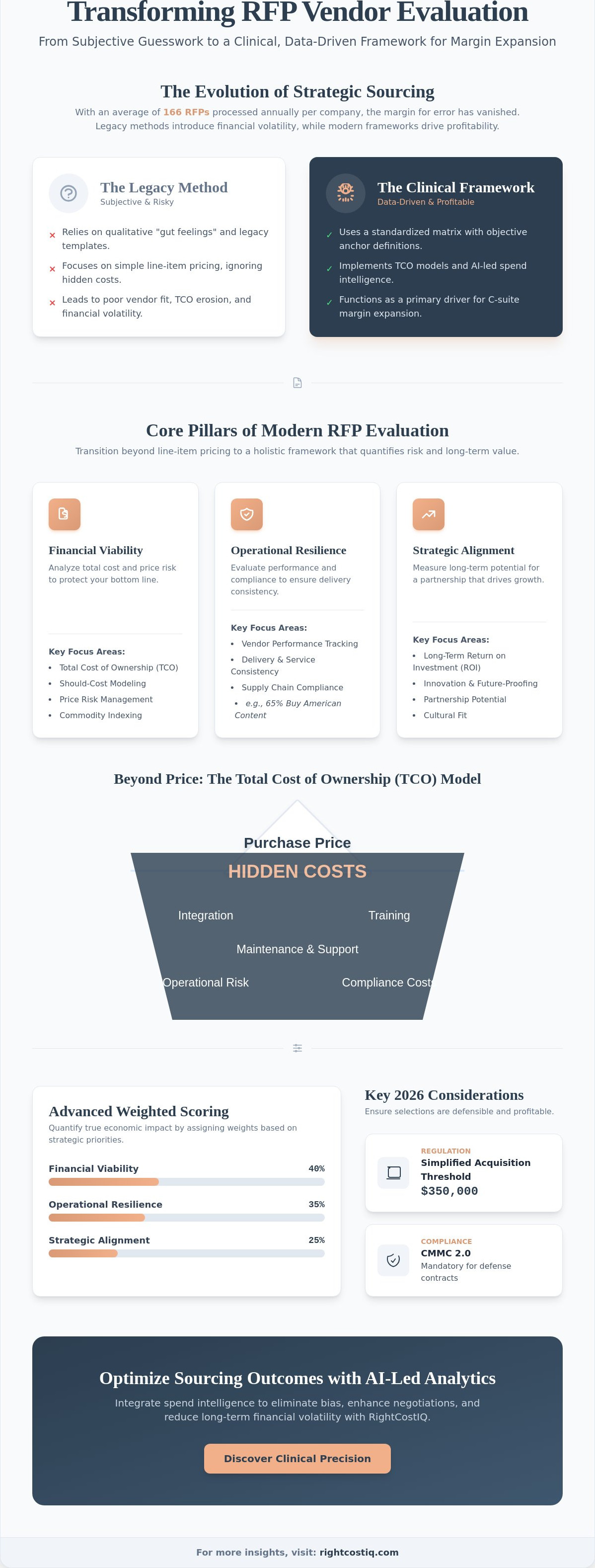
Traditional administrative checklists fail in volatile 2026 markets. With the average company now submitting 166 RFPs annually, qualitative gut feelings lead to catastrophic misalignments. The transition to quantitative, data-driven scoring is no longer optional. Modern sourcing utilizes spend intelligence to set baseline evaluation benchmarks. This ensures every vendor evaluation criteria RFP component is measured against real-world market performance. This clinical approach removes subjectivity and allows procurement teams to focus on high-impact variables that drive efficiency.
Aligning RFP Criteria with Corporate Financial Objectives
Every vendor selection must map directly to enterprise margin expansion targets. RFP management significantly impacts Spend Under Management metrics, which serve as a critical KPI for financial leadership. To maintain clinical precision, organizations should categorize criteria into specific pillars:
- Financial Viability: Analyzing total cost of ownership (TCO) and price risk management.
- Operational Resilience: Evaluating vendor performance tracking and delivery consistency.
- Strategic Alignment: Measuring long-term ROI and innovation potential.
By integrating rigorous vendor performance tracking into the initial evaluation phase, organizations ensure that operational efficiency isn't just a promise but a contractual certainty. This alignment transforms the RFP from a procurement document into a strategic roadmap for sustained corporate growth.
Core Pillars of Enterprise RFP Evaluation: Beyond the Price Point
Legacy procurement models fail because they over-index on line-item pricing while ignoring the systemic risks that erode margins. To achieve clinical precision, your vendor evaluation criteria RFP must transition to a Total Cost of Ownership (TCO) framework. This model accounts for the 70% of the purchasing journey buyers now complete before initial contact, ensuring that pre-selection data reflects actual market conditions. By categorizing criteria into three distinct tiers, organizations can quantify vendor risk and operational viability with mathematical certainty.
Establishing a rigorous scoring architecture requires more than a checklist. It demands a historical analysis of vendor performance tracking to validate claims made during the proposal phase. This approach ensures that supply chain compliance, particularly the 65% domestic content threshold required under the 2024-2028 Buy American regime, is a prerequisite rather than an afterthought. Integrating these Vendor Selection Guidelines into your enterprise strategy mitigates the financial volatility common in unoptimized sourcing events.
Tier 1: Financial Viability and Price Risk Management
Assessment of vendor health must include should-cost modeling to identify artificial price padding. High-performing vendors demonstrate a sophisticated ability to handle commodity indexing and market price trending. You should prioritize contract flexibility and price-protection clauses that shield your organization from sudden inflationary spikes. Effective price risk management during the evaluation phase ensures that the selected partner can maintain margin stability throughout the contract lifecycle.
Tier 2: Operational Competence and Scalability
Operational readiness is now defined by tech stack compatibility and cybersecurity maturity. Following the November 2025 implementation of CMMC 2.0, vendors must prove they can register systems in the Supplier Performance Risk System (SPRS). You need to quantify lead-time reliability and quality assurance protocols using historical benchmarks. If a vendor's infrastructure doesn't integrate seamlessly with your procurement platform, the resulting manual friction will quickly offset any perceived cost savings.
Tier 3: Strategic Alignment and Innovation
Strategic fit is the final differentiator in complex enterprise sourcing. Evaluate the vendor's roadmap to ensure it aligns with your long-term corporate financial objectives. With AI-powered RFP automation tools now claiming 95% accuracy, you should favor partners who invest in AI-led optimization to drive continuous efficiency. Supplier diversity and ESG standards should be treated as core strategic metrics, providing a clear justification for C-suite procurement decisions while fostering a resilient, innovative supply base.
Advanced Weighted Scoring Models for Margin Expansion
Static scoring is a financial liability. Treating your vendor evaluation criteria RFP as a fixed checklist ignores the reality of 2026 market volatility. To drive margin expansion, you must transform your scoring into a dynamic financial instrument. Weighted scoring allows procurement leaders to prioritize high-impact variables that directly correlate with bottom-line results. By assigning mathematical weight to specific outcomes, you ensure that the final selection isn't just the most convenient option, but the most profitable one.
Calculating the Economic Impact Score (EIS) is the primary method for quantifying proposal viability. The EIS isn't a simple average; it's a weighted calculation that subtracts quantified risk and implementation friction from the proposed cost savings. This clinical approach exposes vendors who offer low initial prices but carry high long-term operational costs. We utilize AI-led analytics to identify hidden cost drivers within vendor responses, such as ambiguous service level agreements or unindexed commodity fees. With AI-powered tools now reaching 95% accuracy in response analysis, manual review is no longer sufficient for enterprise-grade sourcing.
To maintain agility, we implement RFQ Sprints. These are rapid, iterative cycles where scoring models are tested against real-world data before the final evaluation phase. This prevents the traditional "wait and see" approach that often leads to poor vendor fit. By iterating on your scoring logic in a high-speed environment, you can adjust for sudden shifts in market price trending or regulatory changes, such as the 2026 FAR overhaul, ensuring your selection remains strategically sound.
Designing the Weighting Framework
Precision in weighting prevents "Score Dilution," a common failure in multi-stakeholder committees where conflicting priorities wash out critical financial metrics. Your framework should establish a clear hierarchy. For example, a 40/30/30 split between financial impact, operational resilience, and strategic innovation provides a balanced foundation. However, these weightings must remain fluid. If your category-specific market price trending indicates high volatility, the weighting for price risk management should increase proportionally to shield the organization from margin erosion.
The Role of Spend Analytics in Scoring
Spend intelligence is the baseline for all credible evaluation. You can't score a vendor proposal accurately without validating their claims against historical spend data. We use clean-sheet cost models to benchmark proposal data against industry standards. This transparency allows you to quantify the potential ROI of each vendor through predictive forecasting. When you can demonstrate a 15% reduction in total cost of ownership through data-driven selection, you provide the clear justification required for C-suite procurement decisions.
Implementing Clinical Precision in the RFP Scoring Matrix
Building a matrix is an architectural task. You should implement a 0 to 10 scale where every integer is tied to an objective anchor definition. This prevents the central tendency bias where evaluators default to safe, middle-ground scores. Consider these clinical anchor benchmarks:
- Score 0: Response is missing or non-compliant with core requirements.
- Score 5: Meets baseline technical requirements without providing additional value.
- Score 10: Exceeds performance benchmarks with quantified, AI-led cost-reduction innovation.
By codifying your vendor evaluation criteria RFP into these rigid anchors, you create a defensible data set that withstands C-suite scrutiny. The Blind Scoring technique is another critical layer of the Strategic Architect's toolkit. During technical evaluations, the committee reviews responses without knowing the vendor's identity. This removes the halo effect associated with legacy incumbents or high-profile brands. It forces the team to score based on technical merit and tech stack compatibility rather than marketing influence. Only after the technical scores are finalized should the commercial and brand data be unmasked for the final Economic Impact Score calculation.
Drafting Objective Questionnaires
Your questionnaire must pivot from open-ended narratives to binary and quantitative data requests. Questions should require a Yes/No or a specific numerical value, such as "Does your system handle CMMC 2.0 automated reporting?" rather than "Tell us about your security." Every criterion must be SMART. To ensure consistency, write a single sentence defining the Perfect Response for every high-weight variable. This serves as the benchmark for all evaluators, ensuring a 9 in Operations is identical to a 9 in Finance. This level of detail is essential when refining your vendor evaluation criteria RFP for high-stakes sourcing.
Managing the Stakeholder Consensus Process
Discrepancies between departments are inevitable. Finance prioritizes price risk management, while Operations focuses on lead-time reliability. When scoring gaps exceed 20%, you should utilize Spend Intelligence reports as the objective tie-breaker. These reports provide the market-validated data needed to resolve internal conflicts without resorting to political compromise. Documenting every step of this consensus process is vital for maintaining audit trails and ensuring supply chain compliance in the 2026 regulatory environment. For organizations seeking to streamline this process, our RFP management and negotiation assistance provides the analytical framework to maintain clinical objectivity across all stakeholders.
Optimizing Sourcing Outcomes with RightCostIQ RFP Management
Procurement is the new value driver. At RightCostIQ, we don't just facilitate transactions; we engineer margin expansion. Our firm functions as a sophisticated partner for decision-makers who require clinical precision in their sourcing events. By integrating AI-led procurement analytics into every stage of the lifecycle, we transform the vendor evaluation criteria RFP process from a static document into a dynamic financial lever. This methodology ensures that every selection is backed by spend intelligence and market-validated benchmarks. We assume a knowledgeable reader who understands that 70% of the purchasing journey is completed before direct contact. Our role is to provide the spend intelligence required to influence that journey through data-driven authority.
Our approach centers on Procurement Category Cost Benchmarking. We use clean-sheet cost models to identify artificial price padding before negotiations begin. This level of spend intelligence allows your team to enter sourcing events with a definitive "should-cost" target. Combined with our Price Risk Management services, we provide the long-term contract stability needed to navigate 2026 market volatility and the recent FAR overhaul. We bridge the gap between traditional procurement and cutting-edge SaaS innovation, ensuring your tech stack functions as an active participant in financial optimization.
The RightCostIQ Advantage: Precision and Analytics
Precision is our primary signature. Through proprietary RFQ Sprints, we accelerate the sourcing cycle by 40% while increasing scoring accuracy. Our should-cost modeling identifies the "Right Cost" by analyzing commodity indexing and historical market price trending. In a recent May 2026 engagement, an enterprise client utilized our refined vendor evaluation criteria RFP to achieve a 22% margin expansion within a single fiscal quarter. We replaced their subjective checklists with our data-driven matrix, eliminating the high win-rate variance previously seen in their legacy process. This focus on the bottom line is what distinguishes a Strategic Architect from a general consultant.
Next Steps: Elevating Your Procurement Strategy
The selection of a vendor is merely the starting point for value creation. Sustained margin health requires ongoing vendor performance tracking and continuous price risk monitoring. We move quickly from broad strategic promises to granular execution details. Our team provides the negotiation assistance and forecasting services necessary to maintain your competitive advantage in a relentless business environment. If your current procurement outcomes lack mathematical certainty, it's time to upgrade your framework. Contact us today for a clinical assessment of your procurement infrastructure.
Driving Continuous Margin Expansion
Transitioning from administrative overhead to strategic value requires a clinical overhaul of your sourcing architecture. You've seen how a standardized vendor evaluation criteria RFP framework bridges the gap between operational needs and C-suite financial mandates. By implementing advanced weighted scoring and blind evaluation techniques, organizations eliminate the subjective bias that historically erodes bottom-line results. Precision in selection is the only defense against the financial volatility of 2026.
The integration of should-cost modeling and spend intelligence ensures that every contract is anchored in market reality rather than vendor marketing. With the 2026 regulatory environment demanding higher transparency and compliance, legacy procurement methods are no longer viable. Success now depends on your ability to quantify risk and optimize total cost of ownership with mathematical certainty. RightCostIQ stands as your Strategic Architect in this transition.
As an AI-Driven Margin Expansion Firm, we provide the technical expertise and professional negotiation assistance required for high-value contracts. We specialize in should-cost modeling to ensure you never overpay for enterprise services. Optimize your sourcing outcomes with RightCostIQ RFP Management and turn your procurement department into a primary engine for corporate growth. Your path to clinical procurement precision starts here.
Frequently Asked Questions
What are the most critical RFP evaluation criteria for enterprise procurement?
The most critical criteria are Financial Viability, Operational Resilience, and Strategic Alignment. In 2026, this includes specific compliance markers like CMMC 2.0 registration and SPRS status. You must move beyond simple checklists to clinical standards that quantify risk. Effective vendor evaluation criteria RFP development prioritizes the vendor's tech stack compatibility to ensure seamless integration with your existing procurement infrastructure.
How do you calculate weighted scoring in an RFP matrix?
Calculate weighted scoring by assigning percentage values to high-impact variables that total 100%. Multiply each raw score, typically on a 0 to 10 scale, by its assigned weight to determine the Economic Impact Score. This mathematical approach prevents "Score Dilution" in multi-stakeholder committees. It ensures that critical financial metrics, such as price risk management, carry more weight than secondary qualitative factors.
Is price always the most important factor in vendor evaluation?
Price is rarely the most important factor when analyzed through a Total Cost of Ownership (TCO) model. While initial bids are visible, hidden costs like integration friction or supply chain disruptions often erode margins. Evaluation should prioritize price risk management and contract flexibility instead. High-performing organizations focus on the "Right Cost" identified through should-cost modeling rather than the lowest line-item bid.
How can AI-led analytics improve the RFP selection process?
AI-led analytics improve selection by identifying hidden cost drivers and achieving up to 95% accuracy in response analysis. These tools flag outdated content and analyze complex service level agreements that manual reviews might miss. By utilizing agentic AI for compliance checks, procurement teams reduce the average 25-hour drafting and submission time. This technology transforms raw data into actionable spend intelligence for faster decision-making.
What is the difference between an RFP and an RFQ in terms of evaluation?
RFP evaluation focuses on complex strategic solutions, whereas RFQ evaluation is strictly price-oriented for standardized commodities. RFPs require a multi-tiered vendor evaluation criteria RFP matrix to assess innovation and long-term ROI. RFQs typically use a lowest-price technically acceptable model. Selecting the wrong request type leads to significant administrative waste and poor vendor fit in complex enterprise sourcing events.
How do you ensure vendor compliance with RFP evaluation standards?
Ensure compliance by mandating registration in the Supplier Performance Risk System (SPRS) and verifying CMMC 2.0 status as a prerequisite. You must use binary questions for regulatory requirements to eliminate ambiguity. Following the 2026 FAR overhaul, vendors must also meet the 65% domestic content threshold for federal procurements. Standardized scoring anchors provide the audit trail necessary for internal and external compliance reviews.
Can vendor performance tracking influence future RFP criteria?
Historical vendor performance tracking acts as the primary data source for refining future evaluation benchmarks. If a vendor fails to meet lead-time reliability targets, those specific criteria should receive higher weighting in subsequent RFPs. This continuous feedback loop ensures that your sourcing strategy evolves based on real-world operational data. It prevents the repetition of poor selection decisions by grounding criteria in verified performance metrics.
How do you handle stakeholder disagreement during the scoring phase?
Resolve stakeholder disagreement by using spend intelligence reports as objective tie-breakers. When Finance and Operations scores diverge by more than 20%, market-validated data must override subjective opinions. Establishing clear "anchor" definitions for every score on your 0-10 scale minimizes these discrepancies before they occur. This clinical approach maintains the integrity of the selection process and secures C-suite buy-in for the final decision.


