

The traditional procurement focus on top-tier suppliers is costing your organization up to 15% in avoidable price variance across unmanaged categories. While most CPOs prioritize the critical 20% of spend, the remaining 80% of transactions, your tail spend, operates in a vacuum of maverick buying and fragmented data. You've likely accepted that manual oversight for thousands of low-value transactions isn't feasible with current headcount. It's a persistent resource drain that procurement teams often ignore to maintain focus on core strategic categories. Procurement is the new value driver, yet leaving this volume unaddressed is a calculated risk that no longer pays off.
We agree that managing thousands of micro-transactions feels like a losing battle against resource constraints. However, this article demonstrates how to transform that fragmentation into a high-ROI engine through clinical benchmarking and RFP precision. You'll discover a definitive framework to categorize spend and actionable strategies to expand margins for 2026 without increasing your operational team size. We'll begin by dismantling the myths that keep your non-core spend invisible and unoptimized. This is the blueprint for AI-led margin expansion that turns neglected data into a strategic competitive advantage.
Key Takeaways
- Eliminate the 10-15% margin leakage within indirect categories by recalibrating the strategic importance of high-volume, low-value transactions.
- Leverage AI-led spend intelligence to automate categorization and identification, effectively neutralizing the resource trap associated with manual oversight.
- Adopt clinical should-cost modeling to move beyond standard benchmarking, ensuring objective precision in pricing and supplier negotiations.
- Implement high-velocity RFQ Sprints to accelerate procurement cycles and drive immediate margin expansion through rigorous data hygiene.
- Transform fragmented tail spend into a disciplined value driver by synchronizing AI-led analytics with expert strategic execution.
Myth: Tail Spend is Too Small to Impact Enterprise Bottom Lines
Enterprise leaders frequently dismiss the high-volume, low-value transactions that constitute the procurement tail. This 80/20 distribution, where 80% of total transactions represent only 20% of total spend, creates a dangerous operational blind spot. The "insignificant" label results in 15% leakage across indirect categories. For a $1 billion enterprise, this represents a $30 million erosion of EBITDA. Strategic architects recognize that unmanaged tail spend isn't a rounding error; it's a structural barrier to margin expansion.
Traditional sourcing models prioritize direct materials. Modern efficiency requires a shift in focus. While foundational procurement principles establish the framework for high-value negotiations, the next frontier of value creation lies in indirect optimization. Procurement is the new value driver. Firms that ignore the tail sacrifice competitive advantage to competitors using AI-led spend intelligence to capture every basis point of margin. It's time to treat every dollar with clinical precision.
The Anatomy of the Tail: Maverick vs. Misclassified Spend
Identifying leakage requires a granular look at how capital exits the organization. Maverick spend occurs when employees bypass negotiated contracts to buy from non-preferred vendors. In unmanaged environments, maverick buying accounts for 40% of indirect volume, stripping away pre-negotiated discounts and increasing audit risk. Misclassified transactions further obscure the truth. When 25% of purchases are tagged as "miscellaneous" or "other" in the ERP, spend visibility vanishes. Tail spend is a strategic asset rather than a liability.
Economic Impact in a Volatile 2026 Market
The 2026 market environment demands aggressive price risk management. Inflationary pressure on indirect categories, including MRO and professional services, remains a persistent threat to profitability. Optimization acts as a critical hedge. By consolidating 1,200 fragmented invoices into 50 strategic, AI-governed accounts, enterprises achieve immediate cost reduction. This transition from reactive purchasing to proactive spend intelligence stabilizes costs. It turns fragmented data into a clinical tool for financial resilience. RightCostIQ identifies these opportunities through rapid RFQ sprints that deliver results in weeks, not quarters. Margin expansion is the only acceptable outcome in a high-volatility economy.
Myth: Managing the 'Tail' is Operationally Impossible Without Massive Headcount
The "Resource Trap" remains a primary barrier to enterprise resilience. Traditional procurement structures prioritize the 20% of suppliers that account for 80% of spend, intentionally ignoring the high-volume, low-value transactions that define tail spend. This neglect stems from a legacy belief that managing thousands of fragmented line items requires a massive, cost-prohibitive headcount. It's a strategic error. Modern AI-led spend intelligence has decoupled headcount from spend coverage, allowing teams to capture lost margins through automation rather than manual labor.
Procurement is the new value driver. By transitioning to exception-based management models, organizations can focus human expertise on strategic decision-making while AI handles the transactional noise. Professional RFP management services now provide the external capacity needed to execute high-velocity sourcing events. This shift enables clinical execution across the entire supplier base without expanding the permanent payroll. Organizations no longer need to choose between coverage and cost; they simply need to optimize their tech stack.
Spend Intelligence vs. Manual Data Entry
Manual data entry is a relic of inefficient procurement cycles. AI-led systems now cleanse and normalize thousands of line-item transactions in seconds, uncovering hidden patterns in vendor behavior that signal immediate negotiation leverage. This technology eliminates the "data swamp" by categorizing spend with 99% accuracy. According to the Wisconsin State Procurement Tail Spend Guide, structured management of these unclassified expenditures is essential for identifying cost-saving opportunities in public and private sectors alike. Implementing AI-led procurement expands margins by 5-10% by capturing savings that traditional methods overlook.
The Role of Professional Negotiation Assistance
Managing the tail spend effectively requires specialized negotiation tactics that differ significantly from direct material sourcing. High-frequency, low-complexity categories benefit from "RFQ Sprints" and automated bidding processes rather than months-long contract cycles. Outsourcing this "noise" to strategic partners allows for clinical execution of cost-reduction targets without disrupting core operations. It ensures supply chain compliance and reduces operational friction. Companies seeking to accelerate these results should partner with an AI-driven margin expansion firm to automate their negotiation tech stack. This approach maintains a lean internal team while achieving the scale of a global procurement powerhouse.
Benchmarking vs. Guesswork: Comparison of Tail Spend Management Models
Static price lists are a strategic liability in tail spend management. These documents reflect historical vendor bias rather than current market equilibrium. Relying on "standard" pricing assumes that indirect categories are commoditized and non-negotiable; this is an analytical error. Sophisticated procurement requires a clinical "should-cost" modeling approach. This methodology deconstructs the price of indirect services into fundamental components: raw materials, labor, overhead, and logistics. By analyzing these variables, firms move from passive acceptance to data-driven negotiation. Procurement is the new value driver, and it demands a move away from the "guesswork" of the past. Risk stratification is the first step in this evolution. We prioritize tail categories by attacking high-volume, low-complexity areas first, such as office supplies or janitorial services, before moving into specialized technical MRO. This sequence ensures immediate margin expansion while building the internal momentum necessary for more complex "clean sheet" redesigns.
The Power of Category Cost Benchmarking
Applying market price trending to non-core categories like MRO or Office Services reveals massive inefficiencies. Our analysis shows that 20% to 27% price variances exist in categories often perceived as "fixed." Real-time data integration allows for precise vendor performance tracking. This ensures that negotiated savings are realized at the point of purchase rather than lost to "maverick spend" or vendor price creep over time.
Choosing the Right Strategic Architecture
Evaluating the ROI of professional RFP management versus internal execution is vital for enterprise resilience. Internal teams often lack the bandwidth for rapid "RFQ sprints," leading to missed opportunities. The Sumner County Committee on Tail Spend recently highlighted how adopting specialized solutions facilitates consolidated spend visibility. For organizations targeting 15% or higher margin expansion, professional negotiation assistance provides the technical expertise required to execute "clean sheet" cost models effectively.
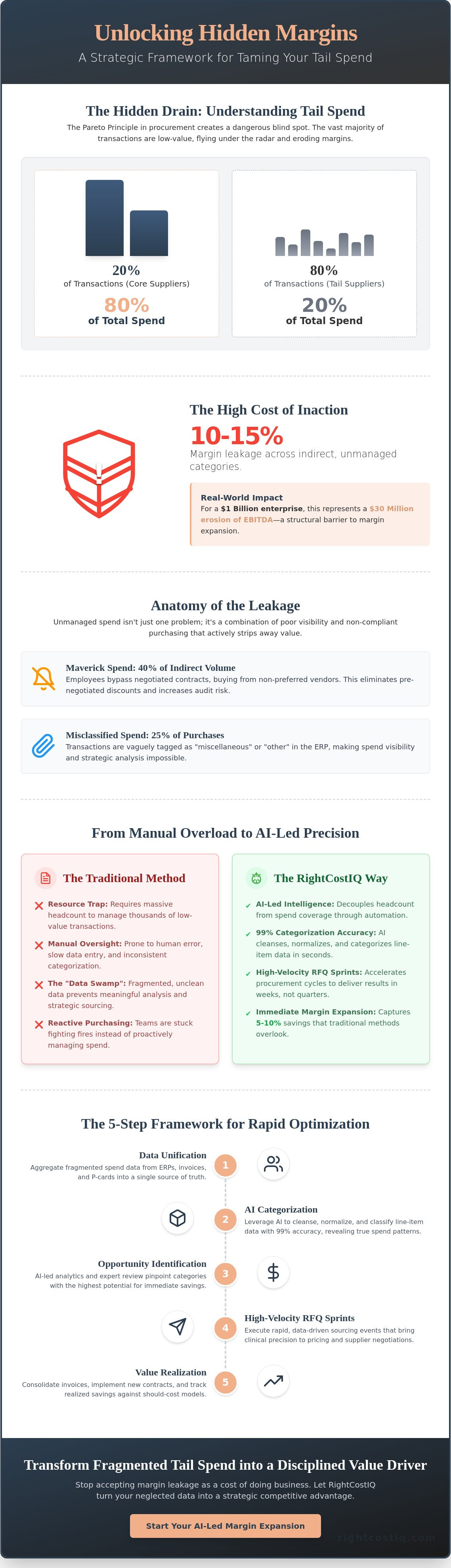
Executing the RFP Sprint: A 5-Step Framework for Rapid Optimization
Traditional procurement cycles often exceed 180 days. This sluggish timeframe renders tail spend management impossible for most enterprises. RightCostIQ replaces these stagnant processes with high-velocity RFQ Sprints. These are compressed, 14 to 21-day sourcing events designed to capture immediate margin expansion. Success requires rigorous data hygiene before launch. Clean, categorized data reduces bid variance by up to 22%. It ensures that vendors provide quotes based on accurate consumption patterns rather than inflated estimates. Strategic architects use this phase to apply should-cost modeling, establishing a baseline for what goods and services actually cost in the current market.
Step 1 & 2: Spend Mapping and Category Prioritization
Spend intelligence tools visualize the tail to identify high-frequency, low-complexity categories. Procurement teams must establish clear spend thresholds to separate automated workflows from manual intervention. For instance, transactions under $75,000 should trigger an AI-led bidding process, while larger tactical spends receive brief, expert-led oversight. Focus on MRO, IT peripherals, and facility services first. These categories typically yield 12% to 18% savings within the first 90 days. Delivering these rapid wins builds the internal credibility needed to scale optimization efforts across the entire organization. It proves that tail spend is not a cost of doing business, but a reservoir of untapped capital.
Step 3, 4 & 5: Sourcing, Negotiation, and Compliance
RFQ sprints drive price discovery through intense competitive tension. By consolidating the vendor base, enterprises increase volume-based leverage. This often leads to a 35% reduction in the total supplier count for targeted categories. The process doesn't end at the handshake. Closing the loop involves integrating new contracts directly into the corporate tech stack. This ensures 100% contract compliance. It prevents maverick spend from eroding the 15% average margin improvement these sprints generate. Continuous performance tracking, supported by commodity indexing, provides the audit trail necessary to verify that negotiated savings manifest on the P&L.
- Phase 1: Data scrubbing and taxonomy alignment (3 days).
- Phase 2: Competitive RFQ launch via automated portals (7 days).
- Phase 3: Negotiation and final vendor selection (5 days).
- Phase 4: Contract digitization and stack integration (4 days).
- Phase 5: Performance audit and margin tracking (Ongoing).
Procurement is the new value driver, and these sprints are the engine for enterprise resilience. Organizations that move from multi-month cycles to high-velocity sprints reduce their sourcing overhead by 40% while maintaining a leaner, more responsive supply chain.
RightCostIQ: The Strategic Architect for Tail Spend Margin Expansion
RightCostIQ applies clinical precision to the often-ignored 20% of unmanaged corporate expenditure. We operate as an AI-Driven Margin Expansion Firm. Our methodology transforms tail spend from a cost center into a strategic asset. We combine AI-led analytics with expert RFP management to capture value that traditional software misses. Pure automation isn't enough for complex negotiations. Our team provides professional assistance to navigate intricate contract terms and supplier dynamics. We drive margin expansion through procurement category cost benchmarking that exposes market discrepancies.
RightCostIQ integrates clean sheet cost models to validate every line item. This level of spend intelligence ensures that no dollar is left unaccounted for. We don't just provide a platform; we provide a high-level consulting partnership that aligns technical execution with financial strategy. Our Strategic Architect persona ensures that every decision is backed by data and focused on the bottom line. We prioritize results and efficiency over conversational fluff, providing a voice that's assertive and objective.
Our Methodical Approach to Spend Intelligence
We use proprietary benchmarking to identify hidden savings within your unmanaged categories. Our systems deliver vendor performance tracking that ensures 100% compliance with corporate mandates. RightCostIQ serves as a strategic mentor for procurement teams, providing the technical upskilling necessary to master modern spend intelligence through the RightCost Academy. We utilize should-cost modeling and RFQ sprints to accelerate results. This isn't just about cutting costs. It's about structural optimization and aggressive margin expansion.
Achieving Strategic Resiliency in 2026
Market volatility requires advanced price risk management tools. RightCostIQ prepares enterprise leaders for 2026 by integrating commodity indexing into every procurement lifecycle. We're the preferred partner for margin-focused leaders because we prioritize the bottom line over process for the sake of process. Procurement is the new value driver. Our tech stack bridges the gap between legacy systems and cutting-edge innovation. We utilize advanced prompt engineering to refine our AI-led insights, ensuring your tail spend strategy remains agile and resilient against inflationary pressures.
Optimize your procurement outcomes with RightCostIQ
Architecting Margin Expansion for the 2026 Fiscal Landscape
Transitioning from myth to methodology requires a clinical focus on the 20% of spend that typically accounts for 80% of supplier volume. By 2026, firms that ignore tail spend will concede an estimated 5% to 10% in potential margin expansion to more agile competitors. Success doesn't require increasing headcount. It's about deploying AI-led frameworks that execute RFP cycles with surgical precision. Recent industry benchmarks indicate that specialized category intelligence eliminates the 15% "ignorance tax" often hidden in unmanaged vendor categories.
RightCostIQ acts as the strategic architect for your procurement transformation. We provide the specialized category benchmarking and clinical execution of RFP cycles needed to convert fragmented data into bottom-line results. Procurement is the new value driver. It's time to replace guesswork with 2026-ready should-cost modeling and AI-led margin expansion frameworks. Your path to optimized efficiency starts with a commitment to data-driven rigor and technical excellence. Let's build a more resilient, profitable future for your enterprise today.
Optimize your procurement outcomes with RightCostIQ
Frequently Asked Questions
What is the 80/20 rule in tail spend management?
The 80/20 rule dictates that 80% of an enterprise's suppliers typically account for only 20% of its total spend volume. This fragmented segment is what procurement professionals define as tail spend. Managing these thousands of low-value transactions often consumes 70% of a department's administrative bandwidth. RightCostIQ identifies this imbalance as a primary target for AI-led margin expansion.
How can AI help manage fragmented tail spend?
AI-led spend intelligence platforms categorize 100% of unstructured transaction data with 95% accuracy in minutes. Manual classification processes often take months and yield 30% error rates. By using prompt engineering and machine learning, firms identify consolidation opportunities across thousands of unique SKU entries. This technological leverage converts chaotic data into actionable should-cost modeling and strategic value.
Is tail spend management worth the effort for small companies?
Tail spend management is vital for small firms because these organizations often lose 5% to 15% of their total EBITDA to unmanaged procurement. While large enterprises focus on global scale, smaller organizations require immediate cash flow. Implementing a streamlined tech stack allows a small procurement team to manage 500+ vendors effectively. It's about building a scalable foundation before organizational complexity increases.
What are the biggest risks of ignoring tail spend?
Ignoring tail spend results in an average 10% annual financial leakage due to price variances and uncontracted buying. Beyond direct costs, 60% of supply chain disruptions originate within the tail where visibility is lowest. Unmonitored suppliers often lack necessary compliance certifications. This exposes the enterprise to regulatory fines and ESG risks that professional tail spend management mitigates through clinical precision.
How do I calculate the ROI of a tail spend management program?
Calculate the ROI by dividing the sum of direct cost reductions and administrative hours saved by the total program implementation cost. A standard AI-led optimization program targets a 7:1 return on investment within the first 12 months. You must also include the cost of inaction. Industry benchmarks from 2023 place this cost at 12% of the unmanaged spend volume annually.
What is the difference between maverick spend and tail spend?
Maverick spend refers to non-compliant purchases made outside of negotiated contracts, while tail spend represents the bottom 20% of total spend volume across many low-value suppliers. Maverick buying is a behavioral issue that occurs even with strategic partners. Tail spend is a structural data challenge. Both require AI-led visibility to ensure every dollar aligns with the firm's margin expansion goals.
Can tail spend management improve supplier diversity?
Tail spend management improves supplier diversity by surfacing small, specialized vendors that often remain hidden in high-volume procurement cycles. Data from the 2023 Hackett Group report shows that top-performing procurement teams allocate 10% of their tail spend to diverse suppliers. Advanced spend intelligence tools tag these vendors automatically. This allows for strategic inclusion without compromising efficiency or cost targets.
How long does it take to see results from an RFP sprint?
A typical RFQ sprint delivers measurable results within 14 to 30 days. Traditional RFP processes often drag on for 6 months, which causes firms to lose momentum and market relevance. By utilizing AI-led templates and automated bidding, procurement teams compress the negotiation cycle by 80%. This rapid execution ensures the enterprise captures market price drops immediately rather than waiting for annual reviews.


