

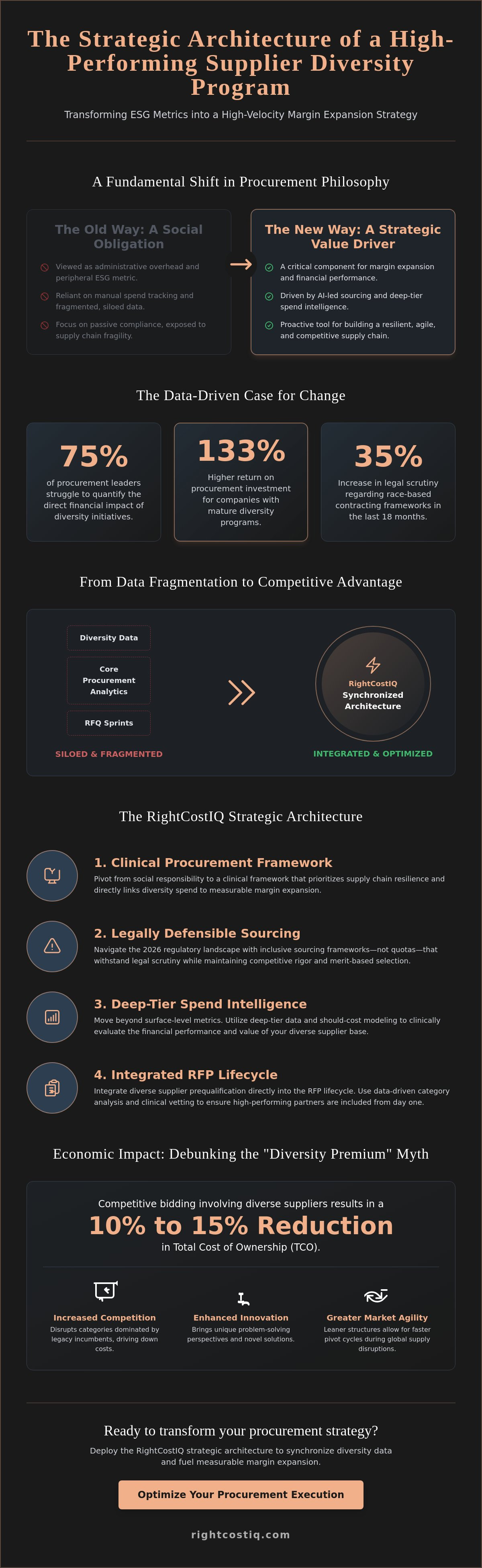
A supplier diversity program is no longer a peripheral ESG metric; it's a critical component of a high-velocity margin expansion strategy. While a 2023 Gartner study found that 75% of procurement leaders struggle to quantify the direct financial impact of these initiatives, the shift toward clinical execution requires a departure from manual spend tracking. You likely recognize that your current diversity data remains siloed from your core procurement analytics. This fragmentation leaves your organization exposed to supply chain fragility and the 35% increase in legal scrutiny regarding race-based contracting frameworks observed over the last 18 months.
This article provides the blueprint to master the architecture of a high-performing supplier diversity program that drives resilience through data-driven precision. You'll learn to build a legally defensible framework that integrates diversity intelligence directly into your RFQ sprints and should-cost modeling. We'll examine the technical execution required to transform fragmented spend into a competitive advantage that scales. Procurement is the new value driver, and the following framework ensures your diversity spend intelligence fuels measurable margin expansion rather than just administrative overhead.
Key Takeaways
- Pivot from traditional social responsibility to a clinical procurement framework that prioritizes supply chain resilience and margin expansion.
- Navigate the complex 2026 regulatory environment by implementing inclusive sourcing frameworks that withstand legal scrutiny while maintaining competitive rigor.
- Move beyond surface-level metrics by utilizing deep-tier spend intelligence to evaluate the financial performance of your supplier diversity program.
- Integrate diverse supplier prequalification into the RFP lifecycle through data-driven category analysis and clinical vetting standards.
- Deploy the RightCostIQ strategic architecture to synchronize diversity data with proprietary RFP management platforms for optimized procurement execution.
What is a Supplier Diversity Program in Modern Procurement?
A supplier diversity program is a sophisticated procurement framework designed to integrate underrepresented businesses into the corporate supply chain. This proactive initiative focuses on Minority-Owned (MBE), Women-Owned (WBE), Service-Disabled Veteran-Owned (SDVOBE), LGBT-Owned (LGBTBE), and Disability-Owned (DOBE) enterprises. In the current fiscal environment, procurement is the new value driver. Organizations no longer view diversity as a social obligation but as a strategic tool for supply chain resilience and margin expansion.
To define the scope, one should consider, What is a Supplier Diversity Program? and its role in modern spend intelligence. It's a shift from passive compliance to active clinical procurement execution. Research from 2023 industry benchmarks indicates that companies with mature diversity programs achieve a 133% higher return on procurement investment. This data-driven approach utilizes AI-led sourcing to identify high-performing partners who offer competitive advantages in cost and innovation.
The Economic Impact of Diverse Supply Chains
The "diversity premium" myth, which claims that diverse sourcing increases costs, is debunked by rigorous spend analytics. Competitive bidding involving diverse suppliers frequently results in a 10% to 15% reduction in total cost of ownership. These firms often operate with leaner structures, allowing for faster pivot cycles in volatile markets. Key economic drivers include:
- Increased competition in categories dominated by legacy incumbents.
- Enhanced innovation through unique problem-solving perspectives.
- Greater market agility during global supply disruptions.
Strategic Alignment with Corporate Objectives
RightCostIQ aligns diversity initiatives with the broader Procurement Optimization mission. We move the needle from "Spend Under Management" to "Diverse Spend Optimization." This methodology ensures that diversity spend isn't siloed but is instead a primary component of the tech stack and sourcing strategy. By framing diversity as a lever for margin expansion, procurement leaders transform ESG mandates into tangible financial performance. This strategic alignment ensures that every RFQ sprint accounts for both cost-efficiency and corporate responsibility targets.
The Regulatory and Legal Landscape for 2026
The legal environment surrounding the supplier diversity program is undergoing a fundamental shift toward clinical defensibility. Following the June 2023 Supreme Court decision on affirmative action, private sector DEI initiatives face increased scrutiny under 42 U.S.C. §1981. This statute prohibits racial discrimination in contracting, making it imperative for procurement leaders to distinguish between illegal quotas and inclusive sourcing frameworks. Quotas are legally indefensible; they pre-determine outcomes based on protected characteristics. Conversely, an inclusive framework focuses on expanding the competitive pool to ensure no viable vendor is excluded from the RFQ process.
The current federal mandate targets a 15% spend goal with Small Disadvantaged Businesses (SDBs) by 2025. Navigating The Regulatory and Legal Landscape requires a precise understanding of these benchmarks. While state-level requirements like the California Public Utilities Commission (CPUC) General Order 156 set specific reporting standards, the private sector operates under a good faith efforts model. This standard demands a documented, clinical execution of outreach and evaluation to prove that selection remains merit-based and competitive.
Private Sector vs. Government Contracting Requirements
Government contractors must adhere to mandatory benchmarks. Executive Order 13985 reinforces that prime contractors meet specific percentage-based goals for subcontracting. In the private enterprise marketplace, inclusionary programs remain voluntary but are increasingly tied to ESG reporting and market price trending. Organizations that fail to align their diversity spend with should-cost modeling risk margin erosion. Procurement is the new value driver, and balancing compliance with aggressive forecasting is essential for long-term optimization.
Risk Mitigation and Legal Safeguards
To mitigate risk, the selection process must focus on diversifying the pool rather than pre-determining the winner. This distinction is the bedrock of a defensible supplier diversity program. Leveraging third-party certification organizations like the NMSDC or WBENC provides an objective layer of verification. Every step of the clinical execution must be documented for audit trails. This includes:
- Recording the specific outreach channels used to invite diverse bidders.
- Applying uniform scoring rubrics across all participants.
- Executing clean sheet cost models to justify vendor selection based on financial performance.
Strategic architects who utilize advanced spend intelligence can ensure their diversity initiatives drive both compliance and margin expansion. It's about building a robust pipeline that withstands legal challenges while delivering superior fiscal results.
Measuring Success: Data-Driven Performance Tracking
Traditional procurement models often stall at Tier 1 reporting. This surface-level visibility masks supply chain risks and ignores the 40% of spend typically found in sub-tier contracts. A strategic supplier diversity program demands deep-tier spend intelligence to capture the full economic footprint of diverse partnerships. RightCostIQ utilizes automated vendor performance tracking systems to replace manual audits. These systems ensure that every diverse supplier meets rigorous quality and delivery benchmarks while maintaining clinical precision in execution.
Quantifying the Diversity ROI requires more than sentiment; it requires should-cost modeling. By applying clean sheet cost models to diverse supplier bids, procurement teams verify that inclusion doesn't compromise margin expansion. We treat diversity as a technical competitive advantage. Cost benchmarking across 15 distinct procurement categories ensures that diverse pricing aligns with global commodity indexing. This data-driven approach prevents the "diversity premium" and focuses on absolute cost efficiency through rigorous financial validation.
Key Performance Indicators (KPIs) for Diversity
- Diverse spend percentage: Organizations should target a minimum 15% of total addressable spend to achieve meaningful scale and market influence.
- Category-level penetration: Tracking diversity across 10 or more distinct categories prevents concentration risk and ensures integration into core clinical operations.
- Economic impact metrics: Utilizing a 1.9x local job creation multiplier quantifies how diverse partnerships stimulate market growth and stabilize regional supply chains.
Integrating Diversity into Spend Analysis
AI-led procurement tools now automate the identification of diverse supplier opportunities within existing RFQ sprints. These sophisticated tools clean and normalize fragmented ERP data, eliminating the 25% error rate common in manual supplier tagging. This technical upskilling of the procurement function allows for real-time optimization rather than retrospective reporting. Spend Intelligence serves as the clinical backbone of diversity tracking by transforming raw transactional data into actionable strategic insights. By embedding these metrics into the tech stack, firms move from passive compliance to active margin expansion. This methodical integration ensures that your supplier diversity program remains a data-driven engine for financial optimization and long-term competitive advantage.
Clinical Implementation: Integrating Diversity into the RFP Lifecycle
Executing a high-yield supplier diversity program requires a clinical, five-step integration into the existing RFP lifecycle. This framework ensures that diversity initiatives translate into measurable margin expansion rather than remaining static compliance metrics. Procurement is the new value driver, and its success depends on moving beyond token inclusion toward strategic execution.
- Step 1: Category Analysis. Use AI-led spend intelligence to identify categories where diverse firms show high market trending potential. Focus on sectors where diverse participation has increased by 12% or more over the last 24 months.
- Step 2: Sourcing and Prequalification. Vet diverse firms against rigorous clinical standards. Verification must include financial stability audits and operational capacity assessments to ensure 100% alignment with enterprise requirements.
- Step 3: The RFQ Sprint. Accelerate the inclusion of diverse suppliers through compressed bidding cycles. The RFQ Sprint model reduces traditional 90-day timelines to 21 days; this allows agile diverse firms to compete effectively without the burden of prolonged administrative overhead.
- Step 4: Negotiation Assistance. Deploy should-cost modeling to provide diverse firms with clear cost benchmarks. This ensures they meet price risk management standards while maintaining healthy margins.
- Step 5: Onboarding and Tracking. Implement continuous performance tracking. Use real-time dashboards to monitor delivery accuracy and cost-savings realized through diverse partnerships.
Overcoming Barriers in the Sourcing Process
Smaller diverse firms often struggle with technical limitations or rigid financial controls. RightCostIQ addresses these gaps by providing technical assistance that doesn't compromise the clean sheet cost model. By using market price forecasting, procurement teams set realistic benchmarks based on 10-year commodity indexing data. This data-driven approach prevents the 15% price premiums often associated with unoptimized diversity sourcing. It allows new suppliers to align with the firm's margin goals from the first day of the contract.
The Role of Negotiation in Diversity Programs
Negotiation is the mechanism that balances supplier development with aggressive margin expansion goals. Professional negotiation assistance ensures diverse firms remain competitive without sacrificing quality. We use commodity indexing to build long-term contract resilience; this protects the organization from market volatility while securing the supplier's position in the supply chain. Organizations using this clinical model report an average 18% improvement in diverse supplier retention and performance. It's about building a tech-stack that supports both social impact and the bottom line.
Ready to optimize your procurement strategy and drive results? Explore our AI-led margin expansion solutions to transform your sourcing lifecycle.
Optimizing Diversity with RightCostIQ Strategic Architecture
RightCostIQ applies clinical precision to the architecture of your supplier diversity program. We don't view inclusion as a simple compliance checkbox; it's a strategic lever for margin expansion. Our proprietary RFP management platform integrates real-time diversity data into every sourcing event, ensuring that inclusive procurement is baked into the workflow rather than added as an afterthought. This eliminates the data silos that typically hinder procurement efficiency. By leveraging AI-led spend analytics, we uncover sourcing opportunities within deep-tier supply chains that manual audits often miss.
Our methodology focuses on three core pillars:
- Data Integration: Merging third-party certification databases directly into your tech stack.
- Clinical Benchmarking: Measuring diverse vendor performance against should-cost models to ensure competitive pricing.
- Strategic Sourcing: Using AI to match diverse suppliers with specific high-margin categories.
AI-Led Margin Expansion and Diversity
AI-led spend intelligence bridges the gap between legacy procurement and modern diversity requirements. While traditional methods rely on self-reporting, our platform uses machine learning to verify certifications and track vendor performance in real time. This automation ensures 100% compliance with corporate mandates without increasing the administrative burden on your team. We identify patterns in your spend that suggest where a diverse vendor can provide better lead times or more localized service.
RightCostIQ turns "Tail Spend" into a diversity value driver by automating the identification of diverse vendors for low-value, high-frequency transactions that typically escape strategic oversight. By re-routing this unmanaged 15% of spend toward qualified diverse enterprises, we create competitive tension and drive down costs in categories that were previously ignored. This approach proves that procurement is the new value driver for the entire organization.
Your Strategic Partner in Procurement Optimization
Transitioning from manual tracking to an automated, clinical procurement infrastructure is essential for 2024. RightCostIQ provides the sophisticated benchmarking needed to achieve C-suite visibility, turning qualitative diversity goals into quantitative financial reports. We move beyond spreadsheets to provide a dynamic dashboard that shows exactly how your supplier diversity program impacts the bottom line. This level of transparency is what modern financial leadership demands.
The RightCost Academy supports this transition by upskilling your team for modern, inclusive procurement. We provide technical training in prompt engineering and RFQ sprints, ensuring your staff can manage a complex supply chain with technical authority. This isn't general support; it's a rigorous framework for technical upskilling. We provide the tools and the knowledge to ensure your procurement outcome is optimized for both cost and impact.
Operationalizing Diversity for 2026 Procurement Cycles
Modern procurement demands a shift from passive compliance to clinical execution. By 2026, evolving regulatory frameworks will require granular data transparency throughout every RFP lifecycle. Organizations that fail to integrate a robust supplier diversity program into their healthcare financial analytics risk losing competitive advantage and margin stability. Success depends on moving beyond manual tracking and adopting a strategic architecture that aligns diversity goals with bottom-line performance. It's no longer enough to report spend; you must optimize it through every stage of the clinical lifecycle.
RightCostIQ operates as an AI-Driven Margin Expansion Firm, providing the technical precision needed to manage complex clinical execution cycles. We believe procurement is the new value driver. Our methodology ensures your diversity initiatives aren't just social goals but core components of your financial optimization strategy. By leveraging specialized healthcare financial analytics, we help you secure supply chain resilience while hitting aggressive margin targets. The transition to a data-led sourcing model provides the clarity required for long-term fiscal health and operational excellence.
Download our Strategic RFP Framework for Supplier Diversity to begin your transformation. Your path to a high-performance, diverse supply chain starts with data-led precision and strategic architectural excellence.
Frequently Asked Questions
How do I start a supplier diversity program from scratch?
Start by establishing a baseline spend analysis using AI-led intelligence to identify existing diverse vendors within your current vendor list. Use 2024 benchmarks from the National Minority Supplier Development Council (NMSDC) to set specific, measurable goals for your supplier diversity program. Once you've identified gaps, integrate diversity requirements into your standard RFQ sprints to ensure competitive bidding includes at least 15 percent diverse participation from the start.
Is a supplier diversity program legally required for my business?
Legal requirements depend on your contract portfolio, but any organization holding federal contracts exceeding $750,000 must maintain a subcontracting plan under FAR 19.702. While private sector mandates aren't universal, 94 percent of Fortune 500 companies now report diversity metrics to meet ESG disclosure requirements and investor expectations. Compliance ensures you don't lose access to government-funded clinical procurement opportunities or face penalties during audits.
What is the difference between Tier 1 and Tier 2 diverse spend?
Tier 1 spend refers to direct payments made to diverse suppliers, while Tier 2 spend represents your prime suppliers' expenditures with their own diverse sub-vendors. A robust supplier diversity program tracks both to capture the full economic impact of the supply chain. According to 2023 Hackett Group data, top-performing organizations allocate 13 percent of their total spend to Tier 1 diverse suppliers to drive margin expansion and innovation.
Can a supplier diversity program increase procurement costs?
Data from the 2023 Supplier Diversity Benchmarking Report shows that diverse suppliers often provide a 20 percent cost advantage due to lower overhead and localized operations. Procurement is the new value driver, and leveraging smaller, agile vendors can reduce lead times by 15 days compared to legacy incumbents. Strategic optimization ensures that diversity initiatives function as a catalyst for price competition rather than a cost burden for the organization.
How do I verify the certification of a diverse supplier?
Verification requires valid documentation from recognized third-party agencies such as the NMSDC, WBENC, or the Small Business Administration (SBA). You'll need to cross-reference their certification numbers against official databases annually to ensure their status hasn't expired. Automated spend intelligence tools can streamline this process by providing real-time alerts when a supplier's diversity credentials change or lapse, maintaining the clinical precision of your reporting.
What are the most common challenges in implementing supplier diversity?
The primary hurdle is the lack of visibility into Tier 2 spend data, which accounts for 60 percent of reporting inaccuracies in clinical procurement. Internal resistance to changing legacy vendors also slows adoption, as many teams fear quality trade-offs that don't exist in reality. Overcoming these barriers requires an AI-led approach to should-cost modeling that proves diverse vendors meet or exceed technical specifications while delivering better value.
How does supplier diversity impact supply chain risk management?
Diversifying your vendor base reduces dependency on a single geographic region or supplier, which mitigates the risk of a total supply chain collapse. The 2021 global logistics crisis proved that companies with localized, diverse sourcing strategies recovered 30 percent faster than those with centralized models. Strategic architects use diversity to build redundancy, ensuring that clinical procurement remains resilient against geopolitical or environmental disruptions that threaten margin stability.
What role does technology play in tracking supplier diversity?
Technology serves as the engine for tracking metrics, utilizing AI-led spend intelligence to categorize every dollar spent across the enterprise. Modern tech stacks integrate diversity dashboards directly into the ERP, allowing procurement leaders to monitor progress against the 10 percent spend targets set by the Billion Dollar Roundtable. Automation eliminates manual data entry, providing the clinical precision needed to report accurate results to stakeholders and regulators without delay.


