
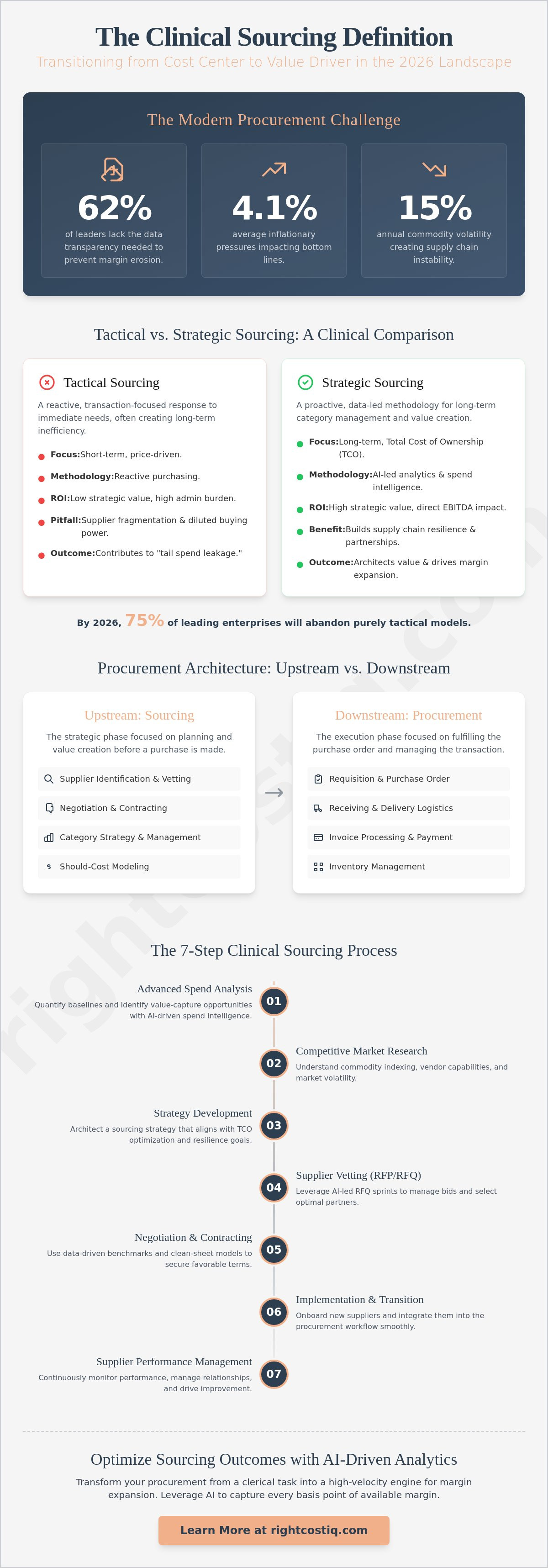
Procurement is the new value driver, yet 62% of procurement leaders in recent industry surveys struggle with the data transparency that prevents margin erosion. If you're treating supplier selection as a clerical task, you're forfeiting the most significant lever for organizational growth. A clinical sourcing definition isn't just a glossary term; it's a strategic framework designed for aggressive margin expansion and long-term supply chain resilience. You likely recognize that tactical buying is no longer sufficient to protect your bottom line against 4.1% inflationary pressures or 15% annual commodity volatility.
This article promises to provide a clinical understanding of the sourcing definition while teaching you how to convert every supplier touchpoint into a data-driven value engine. We'll examine the specific frameworks that differentiate tactical models from strategic ones, utilizing should-cost modeling and AI-led spend intelligence to ensure your organization captures every basis point of available margin.
Key Takeaways
- Master the clinical sourcing definition for the 2026 landscape, transitioning from reactive purchasing to a proactive, value-driven upstream strategy.
- Distinguish between tactical transactions and strategic category management to establish procurement as a primary driver of organizational value.
- Clarify your procurement architecture by differentiating upstream strategic vetting and contracting from downstream execution and delivery.
- Implement a rigorous 7-step clinical sourcing framework designed to quantify baselines through advanced spend analysis and competitive market research.
- Leverage AI-driven analytics and should-cost modeling to transform traditional RFP management into a high-velocity engine for margin expansion.
Defining Sourcing in a Modern Procurement Architecture
Sourcing is the clinical process of identifying, evaluating, and engaging suppliers to acquire goods or services. In a 2026 context, the sourcing definition has evolved from a tactical purchasing function into the upstream phase of procurement focused on aggressive value creation. It's no longer an administrative task; it's a strategic mandate. While the linguistic interpretation of sourcing often stops at finding a vendor, the corporate reality requires a focus on margin expansion activities. This evolution aligns with the broader Strategic Sourcing Definition, which emphasizes long-term supplier relationships and continuous improvement over transactional buying.
Procurement is the new value driver for enterprise financial health. This shift recognizes that every dollar saved in the sourcing phase contributes directly to the bottom line without the overhead associated with increasing sales volume. By applying a clinical, data-driven approach to supplier selection, organizations move beyond simple cost-cutting to architecting a resilient, high-performance supply chain. This process requires a sophisticated tech stack and a commitment to should-cost modeling to ensure all engagements are optimized for maximum ROI.
The Core Objectives of Professional Sourcing
Professional sourcing builds supply chain resilience through diversified vendor networks. This strategy mitigates the risk of the 15% average margin erosion experienced by firms during the 2022 global supply chain disruptions. Effective sourcing optimizes the total cost of ownership (TCO) rather than focusing on the initial purchase price, accounting for logistics, quality control, and holding costs. Sourcing is the intersection of market intelligence and supplier relationship management. It requires a deep understanding of commodity indexing and vendor capabilities to ensure long-term stability and competitive advantage.
Sourcing as a Financial Optimization Tool
Modern sourcing directly impacts EBITDA and corporate margin profiles by treating spend as a strategic lever. The shift from 'finding products' to 'architecting value' allows firms to use spend intelligence to uncover inefficiencies in the procurement tech stack. By utilizing AI-led RFQ sprints and clean-sheet cost models, procurement teams can benchmark their spending against 2024 market data. This high-stakes approach ensures that every contract is a tool for financial optimization. The integration of prompt engineering and advanced analytics into the sourcing workflow allows for a level of precision that traditional purchasing departments cannot match, turning procurement into a sophisticated engine for corporate growth.
Tactical vs. Strategic Sourcing: A Clinical Comparison
Distinguishing between tactical and strategic methodologies is essential for any firm targeting aggressive margin expansion. Tactical sourcing functions as a reactive, transaction-focused response to immediate supply needs. It prioritizes price and availability at the point of purchase. Conversely, a comprehensive sourcing definition in a modern context describes a proactive, data-led methodology for long-term category management. While tactical models focus on the "now," strategic frameworks focus on the "next."
The procurement industry is witnessing a rapid evolution from traditional RFQ Sprints to continuous market price trending. By 2026, 75% of leading enterprises will abandon purely tactical models in favor of AI-led strategic frameworks. This shift eliminates the inefficiencies of manual bid cycles, replacing them with real-time spend intelligence that captures value across the entire product lifecycle. This transition is supported by Sourcing Explained by IBM, which highlights how different sourcing models impact overall supply chain resilience.
Characteristics of Tactical Sourcing
Tactical sourcing is defined by its short-term focus, often sacrificing quality or partnership for immediate cost avoidance. This approach creates a high administrative burden with a low strategic ROI. Common pitfalls include:
- Supplier Fragmentation: Managing an excessive number of vendors for the same category, which dilutes purchasing power.
- Tail Spend Leakage: Unmanaged spending that typically accounts for 20% of total spend but 80% of the supplier base.
- Reactive Procurement: Purchasing initiated by urgent shortages rather than forecasted demand.
The Framework of Strategic Sourcing
Strategic sourcing operates as a "Strategic Architect" for the balance sheet. It utilizes should-cost modeling to determine the fair market value of goods before negotiations begin. This data-driven negotiation assistance ensures favorable contract terms that align with long-term corporate goals. Core pillars include:
- Supplier Relationship Management (SRM): Transitioning from adversarial bidding to collaborative partnerships that drive innovation.
- Commodity Indexing: Linking contract pricing to raw material market shifts to protect margins from volatility.
- Spend Intelligence: Using AI-led tools to identify consolidation opportunities across business units.
Modern procurement teams don't just buy; they optimize. By adopting these advanced frameworks, firms can realize a 12% to 15% reduction in total cost of ownership. To begin your transition toward high-level financial optimization, explore how to leverage AI-led procurement tools for your next category review.
Sourcing vs. Procurement: Differentiating Upstream from Downstream
Confusing sourcing with procurement often leads to 15% to 25% value leakage within the supply chain. These terms aren't interchangeable. Sourcing acts as the Strategic Architect of the organization. It's the high-level phase focused on planning, vetting, and contracting. Procurement serves as the Operational Execution engine. It's the mechanism that translates strategic intent into tangible goods and services. While sourcing builds the framework for margin expansion, procurement ensures the organization realizes those gains through daily discipline.
A precise strategic sourcing definition emphasizes the proactive identification and selection of suppliers to minimize risk. It's an analytical process that prioritizes total cost of ownership over simple price points. Procurement handles the transactional lifecycle. These two functions must integrate perfectly to maintain supply chain compliance. When the strategic architect and the operational driver aren't aligned, maverick spend can erode up to 10% of negotiated savings within the first six months of a contract.
The Upstream Lifecycle (Sourcing)
The upstream phase relies on clinical precision and data-driven market research. Category benchmarking serves as the foundation. This involves analyzing global commodity indices and should-cost modeling to understand true market value. The RFP management cycle moves rapidly from requirements gathering to vendor selection through structured RFQ sprints. During this phase, teams establish specific KPIs and performance tracking metrics. This ensures the sourcing definition isn't just a theoretical concept but a performance-based contract that protects the bottom line.
The Downstream Lifecycle (Procurement)
Downstream procurement focuses on transactional integrity and operational support. This lifecycle includes purchase order (PO) generation and three-way invoice reconciliation to prevent overpayment. It manages the day-to-day vendor relationship to ensure delivery timelines are met. The primary goal is ensuring that 100% of spend under management aligns with the pre-negotiated sourcing strategy. Effective downstream management utilizes spend intelligence to identify deviations from the contract, allowing for immediate corrective action. This operational rigor is what transforms a sourcing definition into actualized margin expansion.
The 7-Step Clinical Sourcing Process for 2026
A modernized sourcing definition requires a shift from transactional purchasing to a clinical, data-driven methodology. This 7-step framework prioritizes margin expansion through technical precision and AI-led insights. It's no longer enough to simply buy; organizations must architect their supply chains for maximum efficiency.
- Step 1: Spend Analysis and Category Identification. This phase quantifies the current baseline by aggregating 100% of historical spend data. AI-led spend intelligence platforms now categorize 98% of line-item data. This reveals fragmentation where consolidation can yield immediate 5% to 8% cost reductions.
- Step 2: Market Research and Supplier Discovery. This step identifies the competitive landscape. It uses global intelligence to find suppliers that align with specific technical requirements and ESG mandates. It's about finding the right fit for the tech stack, not just the lowest bidder.
- Step 3: RFP/RFQ Management. Precision matters here. RFQ sprints replace months of deliberation with two-week windows of high-intensity competitive bidding. This speed ensures the organization captures market-bottom pricing before commodity indexes shift.
- Step 4: Supplier Evaluation and Scoring. Stakeholders use objective data to rank performance. This eliminates bias by weighting 12 specific KPIs, including lead times, financial stability, and quality metrics.
- Step 5: Negotiation and Contracting. This step leverages cost benchmarking to secure optimal terms.
Leveraging Should-Cost Modeling in Step 5
Strategic Architects use should-cost data to provide an objective baseline for every negotiation. This model breaks down a product or service into its constituent parts, such as raw materials, labor, and overhead. It forces a shift away from price-only discussions toward transparent cost-plus models. Negotiation is not a battle of wills but a presentation of data. This methodology typically identifies 15% in hidden margins that traditional bidding misses entirely. It's the difference between guessing and knowing the true value of a contract.
Post-Sourcing: Implementation and Performance Tracking
The sourcing definition must extend beyond the signed contract to ensure long-term value. Step 6 involves implementation, where the selected vendor is onboarded into the existing tech stack. This ensures seamless data flow and procurement system alignment. Step 7 focuses on continuous monitoring. Automated vendor performance tracking is essential for maintaining margin expansion. It monitors contract KPIs in real-time, preventing the 4% annual savings erosion common in unmanaged contracts. By tracking compliance daily, firms ensure that the negotiated savings actually reach the bottom line.
Procurement is the new value driver for your organization. Optimize your margin expansion strategy with RightCostIQ.
Optimizing Sourcing Outcomes with RightCostIQ’s AI-Driven Analytics
RightCostIQ reengineers the sourcing definition to function as a high-velocity financial lever rather than a back-office administrative task. By integrating AI-driven analytics, we replace manual data entry with precise spend intelligence that identifies margin expansion opportunities in real time. Our platform transforms procurement into a clinical operation where every dollar is tracked, analyzed, and optimized. This shift allows organizations to move from reactive buying to proactive market positioning.
- Professional RFP Management: We utilize AI-led RFQ sprints to compress traditional six-month sourcing cycles into weeks, delivering a 40% reduction in administrative overhead.
- Negotiation Assistance: Data-backed should-cost modeling provides negotiators with the objective leverage needed to secure favorable terms and maximize corporate ROI.
- Risk Mitigation: Advanced market price trending and commodity indexing protect the bottom line from 2025 market volatility and supply chain shocks.
- Spend Intelligence: Automated analytics provide a clear audit trail of captured savings, positioning procurement as the new value driver within the C-suite.
Clinical precision in the supply chain builds a sustainable competitive advantage that spreadsheets cannot replicate. RightCostIQ provides the tech stack necessary to execute this vision, ensuring every sourcing decision is backed by hard data rather than intuition. It's about moving beyond simple cost-cutting to achieve holistic financial optimization.
AI-Led Margin Expansion Strategies
Automating the sourcing cycle is the primary catalyst for rapid margin expansion. By utilizing AI-driven benchmarking, firms uncover hidden savings in complex indirect spend categories that traditional audits often overlook. These tools analyze thousands of data points to identify price variances across global suppliers instantly. Learn more about our RFP management services to see how we drive 15% to 25% average cost reductions through tech-enabled negotiation and clean sheet cost models.
The Future of Sourcing: From Data to Decision
The 2026 sourcing landscape demands a transition from traditional buyer roles to that of a Strategic Architect. Predictive analytics now allow procurement professionals to forecast price fluctuations and supply chain disruptions months in advance. This foresight is critical for maintaining healthy margins in an era of rapid economic shifts. RightCostIQ empowers your team to make this transition by providing the spend intelligence required for high-stakes decision-making. Don't let your sourcing definition remain stuck in the past. Optimize your sourcing strategy with RightCostIQ today and lead your organization into a new era of financial efficiency.
Architecting Future-Proof Margin Expansion
Transitioning from tactical purchasing to a strategic sourcing definition transforms procurement into a primary value driver for the modern enterprise. By adopting the 7-step clinical sourcing process designed for 2026, organizations move beyond simple cost-cutting toward holistic margin expansion. Industry data from Gartner indicates that strategic sourcing initiatives frequently deliver a 15% reduction in total cost of ownership across complex supply chains. This shift requires moving away from reactive buying and toward proactive, data-validated decision-making.
Success in this landscape demands specialized healthcare financial analytics and expert RFP management assistance. RightCostIQ provides the AI-driven margin expansion frameworks necessary to navigate volatile commodity indexing and aggressive negotiation cycles. It's time to replace legacy spreadsheets with clinical precision and objective spend intelligence. High-level decision-makers can now leverage these tools to secure long-term competitive advantages and operational efficiency.
Scale your margins with RightCostIQ's AI-led sourcing analytics
The path to 2026 starts with a commitment to data-led optimization. Your organization's financial future depends on the strategic architecture you build today.
Frequently Asked Questions
What is the simplest definition of sourcing in business?
Sourcing is the proactive process of identifying, evaluating, and engaging suppliers to acquire goods or services. In a competitive market, a precise sourcing definition involves more than finding a vendor; it's about establishing a supply base that supports margin expansion through cost-effective resource acquisition. This strategic framework ensures that every dollar spent aligns with the long-term financial goals of the organization and its stakeholders.
How does strategic sourcing differ from traditional purchasing?
Strategic sourcing focuses on long-term value and total cost of ownership (TCO) rather than the immediate transaction price. While traditional purchasing is a reactive, administrative function, strategic sourcing is an AI-led methodology that leverages spend intelligence to optimize supplier relationships. According to a 2023 Deloitte Global Chief Procurement Officer Survey, 71 percent of high-performing procurement teams prioritize this value-driven approach over simple cost-cutting to drive sustainable growth.
What is the difference between sourcing and procurement?
Sourcing is the initial stage of the supply chain focused on supplier selection and contract negotiation, while procurement encompasses the entire end-to-end process including purchasing and payment. Think of sourcing as the strategic architect phase where you define the sourcing definition for a specific category. Procurement acts as the operational execution of those contracts to ensure business continuity and maintain the integrity of the established supply chain.
Why is sourcing important for supply chain management?
Sourcing serves as the foundation for supply chain efficiency by determining the cost structure and reliability of raw materials. Effective sourcing strategies can reduce total spend by 15 percent according to McKinsey research. By utilizing should-cost modeling during the sourcing phase, firms gain the transparency needed to manage margins and prevent supply disruptions before they impact the bottom line. It's a critical component for maintaining a competitive advantage in volatile markets.
What are the most common types of sourcing models?
Common sourcing models include single sourcing, multisourcing, and global sourcing, each serving specific risk and cost objectives. Firms often use a multisourcing model to avoid dependency on a single vendor, a strategy adopted by 80 percent of manufacturing firms since 2021 to improve resilience. Other models like nearshoring focus on reducing lead times and logistics costs by selecting suppliers in closer geographic proximity to the primary distribution points.
How do AI and technology impact the sourcing definition today?
AI transforms the sourcing definition from a manual, data-poor exercise into a high-velocity, predictive operation. Modern tech stacks enable RFQ sprints and automated commodity indexing to capture market fluctuations in real time. Gartner reports that 50 percent of procurement organizations will use AI-driven tools by 2025 to automate spend analysis and supplier performance tracking. This shift makes margin expansion a data-driven certainty rather than an aspirational goal for modern enterprises.
What is an RFP in the context of sourcing?
A Request for Proposal (RFP) is a formal document used to solicit bids from potential suppliers for specific projects or services. It allows sourcing professionals to compare complex vendor offerings based on technical capability, cost, and service levels. Utilizing structured RFP templates ensures that all bidders are evaluated against the same clinical criteria. This process is essential for maintaining objective spend intelligence and securing the most favorable terms during contract negotiations.
Can sourcing help in reducing supply chain risk?
Sourcing mitigates risk by diversifying the supplier base and vetting vendors for financial stability and compliance. A 2022 survey by the Chartered Institute of Procurement and Supply found that 65 percent of businesses increased their focus on supplier risk assessments to prevent stockouts. By implementing rigorous sourcing protocols, companies build a more resilient network that can withstand geopolitical shifts and market volatility. It's the primary defense against unforeseen supply chain interruptions.


