
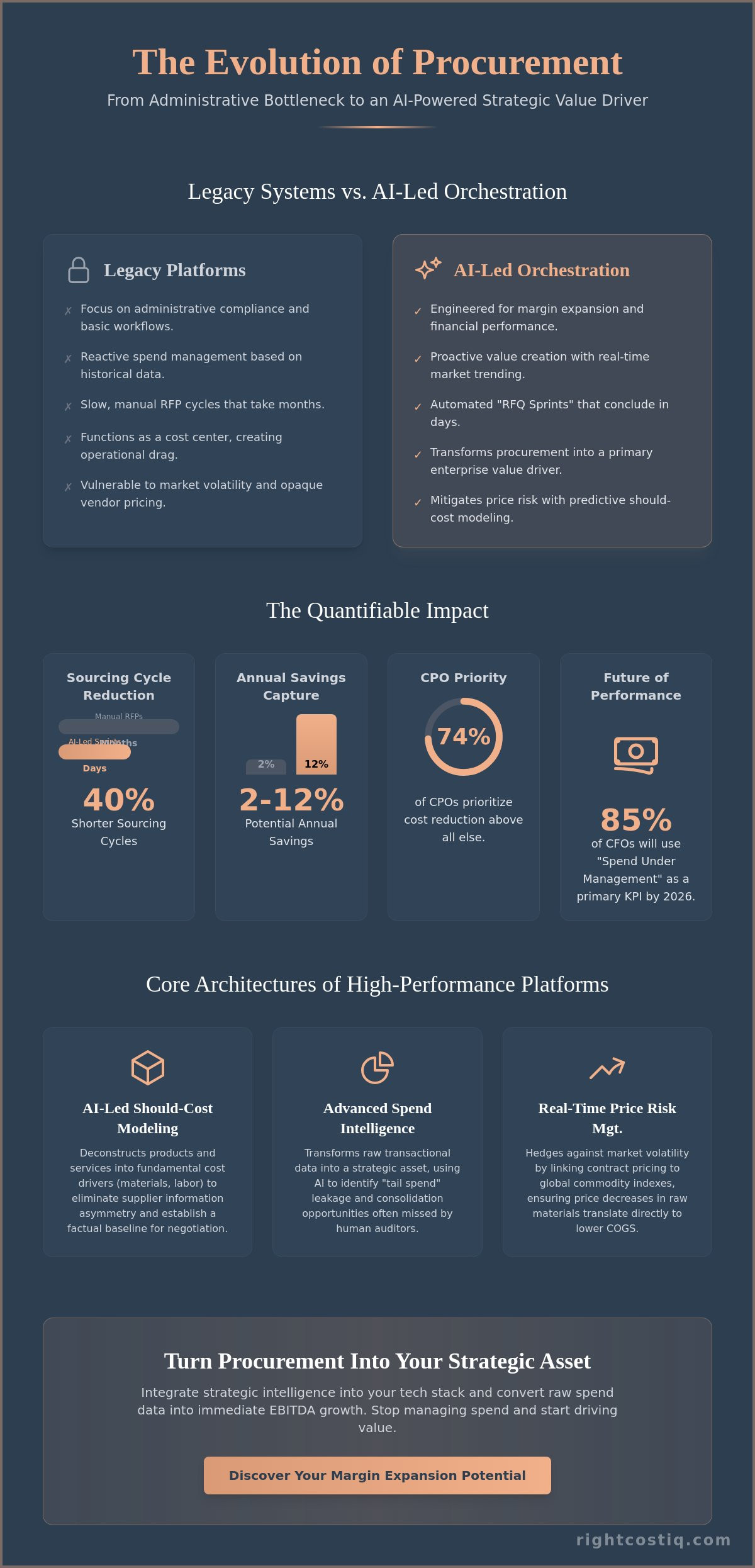
The traditional procurement platform has evolved into a legacy bottleneck that prioritizes administrative compliance over aggressive financial performance. While recent industry benchmarks indicate that 74% of Chief Procurement Officers prioritize cost reduction, most existing tech stacks fail to provide the real-time market price trending required to capture immediate bottom-line impact. You likely recognize that manual RFP cycles are too slow to keep pace with 2026's volatile commodity indexing; this delay leaves your margins vulnerable to opaque vendor pricing and missed negotiation windows. Procurement is the new value driver, but only when supported by clinical precision in cost benchmarking.
This article delivers a rigorous framework for selecting a procurement platform that transcends basic workflow automation to achieve quantifiable margin expansion and price risk mitigation. We will examine the transition from reactive spend management to proactive, AI-led should-cost modeling. You'll learn how automated RFP management and sophisticated spend intelligence tools can shorten sourcing cycles by 40% while securing a predictable competitive advantage. We conclude with a technical evaluation of the tech stack components necessary to turn procurement into a high-yield strategic asset.
Key Takeaways
- Transition from administrative e-procurement to an AI-led strategic sourcing engine engineered for measurable margin expansion.
- Identify the non-negotiable architectures and should-cost modeling modules required for a high-performance procurement platform to mitigate price risk.
- Deploy a clinical scorecard to evaluate vendor selection based on margin impact and the elimination of legacy technical debt.
- Master the "RFQ Sprint" methodology to ensure platform providers can deliver the strategic intelligence necessary for clinical execution.
- Learn to integrate strategic intelligence into your tech stack to transform procurement into a primary enterprise value driver.
Beyond Workflow: Why Procurement Platforms are the New Value Drivers
The traditional view of procurement as a back-office administrative function has reached its expiration date. In the current fiscal environment, the modern procurement platform functions as a strategic margin expansion engine. It's no longer enough to simply manage purchase orders or track delivery dates. Organizations must transition from legacy e-procurement models to AI-led strategic sourcing to maintain profitability. This shift represents a move from passive spend tracking to active capital optimization.
By 2026, "Spend Under Management" (SUM) will emerge as the critical KPI for C-suite reporting. Recent industry projections suggest that 85% of CFOs will utilize SUM as the primary metric to evaluate procurement performance. Relying on basic intake-to-pay workflows creates a clinical blind spot. These outdated systems, often categorized as standard procurement software, lack the analytical depth required to navigate complex RFP environments. Real value isn't found in the transaction; it's found in the strategic orchestration of the entire supply chain.
The Evolution of Sourcing Intelligence
Manual RFP processes are too slow for the 2026 market. Leading firms now utilize automated RFQ sprints to achieve rapid optimization. These sprints replace months of back-and-forth negotiation with data-driven cycles that conclude in days. Real-time data ingestion has rendered static vendor catalogs obsolete. By integrating live market feeds, a sophisticated procurement platform identifies category-specific savings with clinical precision. This level of detail allows for should-cost modeling that was previously impossible for human teams to execute at scale.
Procurement as a Competitive Advantage
Procurement has evolved from a cost center into a primary driver of EBITDA. When the tech stack is integrated properly, organizational agility increases by 40% based on recent operational benchmarks. This integration ensures that every dollar spent is aligned with high-level financial goals. The focus is now on margin expansion rather than simple cost avoidance. In 2026, a Value Driver is an AI-led procurement architecture that converts raw spend data into immediate EBITDA growth through autonomous negotiation and commodity indexing.
Core Architectures of High-Performance Procurement Platforms
Enterprise-grade procurement platforms function as the central nervous system for margin expansion. A high-performance procurement platform must integrate "should-cost modeling" directly into the sourcing lifecycle to establish a factual baseline for every negotiation. This clean-sheet approach eliminates supplier information asymmetry by deconstructing products and services into their fundamental cost drivers, such as raw materials, labor, and overhead. Native price risk management modules allow teams to hedge against market volatility in real-time. This shifts the procurement function from reactive purchasing to proactive value creation.
Strategic architects prioritize platforms that embed these modules natively rather than relying on third-party bolt-ons. This integration ensures that data flows seamlessly from initial spend analysis to final contract execution. Procurement is the new value driver, and the underlying architecture determines whether an organization captures 2% or 12% in annual savings.
Advanced Spend Intelligence and Benchmarking
Advanced spend intelligence transforms raw transactional data into a strategic asset. High-performance systems utilize commodity indexing to link contract pricing directly to global market trends. This technical alignment ensures that price decreases in raw materials, such as the 15% drop in specific resin indices seen in late 2023, translate immediately into lower COGS. Clinical precision in spend visibility is mandatory across all categories.
AI-led analytics identify "tail spend" leakage with surgical accuracy. While tail spend typically represents only 20% of total spend volume, it often accounts for 80% of supplier management complexity. Modern analytics engines flag non-compliant spend patterns and identify consolidation opportunities that human auditors overlook. Organizations leveraging these benchmarks often realize a 7% reduction in indirect costs within the first six months of implementation. Professional teams often partner with an AI-driven margin expansion firm to calibrate these intelligence tools for maximum competitive advantage.
RFP Management and Negotiation Orchestration
Automating the RFP lifecycle reduces administrative cycle times by 40%. This efficiency gain allows category managers to focus on strategic "RFQ sprints" rather than manual document tracking. Modern orchestration includes the deployment of prompt engineering to generate high-leverage negotiation scripts. These scripts are tailored to specific vendor archetypes and market conditions, ensuring that every interaction is data-driven and assertive.
- Automated Lifecycle Management: Standardizes the workflow from requisition to award, eliminating 15-20 hours of manual labor per RFP.
- Negotiation Scripting: Uses AI-led inputs to prepare teams for high-stakes vendor meetings with specific counter-arguments based on should-cost data.
- Performance Loops: Vendor performance tracking functions as a continuous loop, ensuring contract compliance and identifying underperformers before they impact the supply chain.
Contract compliance remains a critical failure point for many firms. High-performance platforms utilize automated alerts to flag price deviations, ensuring that the savings negotiated during the RFP phase actually reach the bottom line. It's the difference between theoretical savings and realized margin expansion.
Legacy Systems vs. AI-Led Orchestration: A Comparative Analysis
Traditional ERP procurement modules represent a heavy accumulation of technical debt. Most legacy architectures date back to the early 2000s, prioritizing static record-keeping over dynamic market responsiveness. This creates a "Clinical Execution" gap. Software alone fails because it lacks the strategic intelligence to interpret real-time commodity shifts or supplier volatility. According to the 2023 Deloitte Global Chief Procurement Officer Survey, 43% of CPOs identify technical debt as a primary barrier to digital transformation. Without AI-led orchestration, procurement teams remain reactive, trapped in administrative cycles rather than driving margin expansion.
Speed to value defines the competitive divide. Implementation cycles for legacy ERP suites frequently exceed 14 months, requiring extensive custom coding and consultant-led overhauls. Modern procurement platform solutions achieve full deployment and initial ROI within 90 days. The Strategic Architect persona doesn't want raw data; they demand actionable insights. They need tools that distill complex RFPs into clear decision matrices. AI-led systems provide this by automating the heavy lifting of data normalization, allowing leaders to focus on high-stakes negotiation strategy.
The Fallacy of 'One-Size-Fits-All' ERP Solutions
Generalist ERPs lack the granular depth required for sophisticated category management. These systems prioritize accounting logic, which often ignores the nuances of should-cost modeling or commodity indexing. A 2022 study by The Hackett Group found that organizations utilizing specialized, best-of-breed tools achieve 22% higher savings than those relying solely on ERP modules. Hidden inefficiencies in legacy workflows, such as manual bid leveling and fragmented communication, create a drag on productivity. It's time to move toward a specialized tech stack. A dedicated procurement platform integrates clean-sheet cost models directly into the sourcing event, ensuring every RFQ sprint is backed by rigorous financial benchmarks.
Quantifying the ROI of AI-Led Platforms
Direct margin expansion is the ultimate metric for AI-led orchestration. Automated sourcing engines can drive a 15% reduction in total cost of ownership (TCO) by identifying bid structures that human analysts might miss. Maverick spend, which typically accounts for 20% of indirect expenditures, is mitigated through intuitive intake validation agents. These agents act as gatekeepers, ensuring all spend aligns with pre-negotiated contracts before it occurs. This precision transforms procurement from a cost center into a value driver. Legacy data silos stagnate in isolation; AI-driven spend orchestration converts fragmented inputs into a unified engine for financial optimization.
The Strategic Evaluation Framework: Selecting for ROI and Risk
Selecting a procurement platform requires a clinical scorecard that prioritizes bottom-line results over administrative convenience. RightCostIQ utilizes a framework where every technical feature correlates directly to margin expansion. During "RFQ Sprints" with platform providers, decision-makers must demand proof of should-cost modeling capabilities and real-time commodity indexing. It's not enough to manage spend; the system must predict it. A 2023 McKinsey report indicates that companies using advanced spend intelligence see 15% higher EBITDA margins than peers.
Technical upskilling is another critical evaluation pillar. The RightCostIQ Academy ensures that the procurement team transitions from tactical buyers to strategic architects. This support component must provide specific training on prompt engineering and AI-led negotiation tactics to maximize the tech stack's utility. Evaluation should also focus on how the platform handles price volatility. Systems that integrate market trending data allow for 8% more accurate budget forecasting during inflationary cycles. Procurement is the new value driver, and the tools you select must reflect this shift.
Risk Mitigation and Compliance Standards
Resilience depends on rigorous DORA assessment and adverse media monitoring. A modern procurement platform should automate these checks to prevent supply chain disruptions. Automated audit trails and global payment compliance are non-negotiable for multi-national operations. According to a 2024 Gartner study, 70% of procurement leaders prioritize vendor performance tracking to mitigate operational risks. These digital safeguards ensure that every transaction meets strict regulatory mandates without manual intervention.
Integration and Scalability Metrics
ROI hinges on API maturity. A platform must integrate seamlessly with existing ERP and financial systems to eliminate data silos. Scalability is measured by the ability to manage diverse supplier bases across different geographic regions without performance degradation. User adoption rates remain the ultimate metric for driving value. If the interface isn't intuitive, the projected savings from AI-led optimization won't materialize. High-performing firms report 90% user adoption within the first six months of deployment.
Maximize your competitive advantage by deploying the right tech stack. Explore AI-led margin expansion strategies with RightCostIQ.
RightCostIQ: Integrating Strategic Intelligence into Your Stack
Software alone often fails to capture the 15% to 20% savings potential hidden in complex category structures. While a standard procurement platform manages the workflow, RightCostIQ injects strategic execution into the process. We operate on the conviction that procurement is the new value driver. This philosophy shifts the focus from administrative compliance to aggressive margin expansion. By combining professional negotiation assistance with platform analytics, organizations move beyond tactical purchasing. They begin to treat every RFP as a high-stakes financial instrument designed to protect the bottom line. Data without a strategy is just noise.
The transition from a cost center to a strategic asset requires more than a digital paper trail. It demands a clinical approach to spend intelligence. RightCostIQ bridges the gap between raw data and realized savings by deploying expert-led interventions where software reaches its limits. We don't just track your spend; we re-engineer it to ensure every dollar is optimized for maximum return.
The RightCostIQ Advantage: Beyond the SaaS Model
Most tools provide visibility but lack the "so what" factor necessary for financial optimization. Our AI-led analytics integrate deep category cost benchmarking and should-cost modeling to reveal what you should be paying, not just what you've paid historically. We utilize commodity indexing and price risk management to forecast market shifts 6 to 12 months in advance. This is the Strategic Architect model. We don't just provide a dashboard; we provide the technical blueprint for an average 12% cost reduction across direct and indirect spend categories. Our approach ensures your team isn't just using a procurement platform but is mastering the market variables that dictate your profitability.
Initiating Your Procurement Optimization Journey
Transformation begins with a clinical spend analysis to identify leakage points where manual processes or outdated software fail. You can engage RightCostIQ to lead high-velocity RFQ sprints or provide professional negotiation assistance for your most complex multi-year contracts. Our team aligns with your existing tech stack to ensure data flows into actionable strategy. We focus on technical upskilling and competitive advantage through our specialized Academy offerings. Your next step is to move from reactive buying to proactive margin defense. Optimize your margin expansion with RightCostIQ today and secure your position as a market leader through superior procurement intelligence.
Securing 2026 Competitive Advantage Through AI-Led Orchestration
The transition toward 2026 demands a fundamental shift from operational efficiency to aggressive margin expansion. High-performance organizations are already moving beyond basic workflow automation; they're adopting a procurement platform built on AI-led orchestration and strategic intelligence. Legacy systems often fail to deliver the granular visibility required for modern cost modeling. By prioritizing architectures that integrate proprietary category cost benchmarking, firms can secure a measurable competitive edge in volatile markets. Success requires a Strategic Evaluation Framework that prioritizes ROI over simple process speed.
RightCostIQ delivers the technical infrastructure and strategic expertise needed to transform procurement into your primary value driver. Our methodology utilizes a specialized AI-Led Margin Expansion Framework to identify hidden savings across your entire tech stack. We combine this with Expert-Led Negotiation Assistance to ensure your team captures every basis point of available margin during high-stakes RFQ cycles. It's time to replace passive spend management with active financial optimization. Don't let legacy constraints dictate your 2026 profitability outcomes.
Schedule an RFQ Sprint and Optimize Your Margins
Your path to superior financial performance starts with precise data and strategic execution.
Frequently Asked Questions
What is the difference between a procurement platform and an ERP?
An ERP manages broad back-office resources and accounting, while a specialized procurement platform focuses exclusively on strategic sourcing and spend intelligence. ERP systems often lack the granular tools required for complex RFQ sprints. A dedicated platform uses AI-led analytics to optimize supplier negotiations, whereas a 2023 Gartner report found that 65% of procurement leaders consider ERP modules insufficient for strategic cost management.
How does a procurement platform drive margin expansion?
A procurement platform drives margin expansion by identifying cost leakage and leveraging should-cost modeling to secure 10% to 15% lower contract rates. It eliminates manual data entry errors and automates the sourcing cycle, which reduces administrative overhead by 40%. This technical efficiency translates directly to the bottom line, reinforcing the philosophy that procurement is the new value driver for modern enterprises.
Can a procurement platform help manage price risk and market volatility?
Procurement platforms manage price risk through real-time commodity indexing and predictive AI-led market tracking. These systems monitor over 500 global price indices to alert procurement teams of shifts in raw material costs before they impact the supply chain. This allows firms to lock in rates before market spikes occur, protecting the organization from the 7% average annual inflation seen in industrial sectors.
What is 'should-cost modeling' and why is it essential in a platform?
Should-cost modeling is a bottom-up analysis that calculates the ideal price of a product based on raw materials, labor, and overhead. It provides a clinical "clean sheet" for use during high-stakes negotiations. Without this data, buyers overpay by an average of 18% according to industry benchmarks. Integrating these models into a platform ensures every RFQ response aligns with actual market production costs.
How long does it typically take to see ROI from a procurement platform?
Most enterprises achieve full ROI from a procurement platform within 6 to 9 months of deployment. Initial savings often materialize during the first 90 days as AI-led audits identify immediate spend anomalies and duplicate billing. By the end of the first year, companies typically realize a 5x return on their investment through sustained margin expansion and increased operational speed.
Is AI-led procurement suitable for mid-sized enterprises or only large corporations?
AI-led procurement is highly effective for mid-sized enterprises with annual spends over $50 million. These firms often don't have the massive headcounts of global corporations, making a platform a necessary force multiplier. It allows a lean team to manage complex RFPs with the precision of a much larger department. This technology levels the competitive field by providing sophisticated spend intelligence to growing firms.
How do procurement platforms handle vendor performance tracking and compliance?
Platforms automate vendor tracking by aggregating 20 or more KPIs, including delivery speed, quality scores, and contract adherence. They flag compliance deviations in real-time, which reduces contract leakage by 12% on average. This objective data ensures that renewals are based on clinical performance metrics rather than subjective relationships. It's a data-driven approach that maintains high standards across the entire supplier base.


