
More than half of a manufacturer’s total spending occurs in its supply chain on average, according to the National Institute of Standards and Technology. Procurement services for manufacturing companies help manage that spend across the purchasing lifecycle, from defining requirements and sourcing suppliers to negotiating terms and tracking performance. Procurement is more than placing orders: it connects supplier decisions with production needs, budgets, and risk.
Manufacturers need reliable inputs, transparent pricing, and supplier performance that supports production. A low quote alone does not show whether a sourcing decision will serve the business well. Quality, delivery, contract terms, and supply risk matter too.
This article explains what manufacturing procurement covers, how its core activities fit together, and what professional support can involve. It also shows how benchmarking, RFP management, negotiation, and performance tracking can improve visibility into purchasing decisions and align procurement with operational and financial priorities.
Key Takeaways
- Manufacturing procurement spans sourcing, purchasing, supplier management, risk control, and performance review, linking supply decisions to production and budgets.
- Supplier relationships are managed through clear expectations and ongoing performance tracking, not price negotiations alone.
- Defined roles, consistent processes, and accurate paperwork help connect purchasing decisions with receiving and financial operations.
- Competitive bidding and reverse auctions can support sourcing decisions, but the right approach depends on the purchase requirements and what suppliers are being evaluated on.
- Procurement savings and ROI become more visible when category costs, supplier results, and business priorities are assessed together.
What is Manufacturing Procurement?
Manufacturing procurement connects production requirements with sourcing, supplier decisions, purchasing, and performance management. According to the National Institute of Standards and Technology (NIST), more than half of a manufacturer’s total spending occurs in its supply chain on average.
Supplier Sourcing and Relationships
Supplier sourcing identifies potential sources for raw materials, components, and services, then assesses their fit against production needs. Procurement professionals can invite multiple suppliers to submit proposals, compare pricing and value, and negotiate terms such as price, quantity, delivery timelines, and payment conditions. The comparison should consider quality, reliability, and supply continuity alongside the quoted price.
Supplier relationship management continues after selection. Teams track agreed terms and supplier results, hold regular check-ins to surface issues, and discuss corrective actions when delivery or quality falls short. Assess a procurement provider by its sourcing process, negotiation support, and ability to track results against defined requirements. Procurement professionals can structure proposals, negotiate terms, and monitor supplier performance.
Procurement Risk and Compliance
Procurement risk management anticipates shortages, supply chain disruptions, and possible supplier noncompliance. Manufacturers can assess their exposure by reviewing supplier reliability, contract performance, and available alternatives for critical inputs. Developing alternative suppliers can provide options when a disruption affects an existing source. Price risk tracking also helps teams monitor changes that may affect purchasing decisions.
U.S. compliance requirements depend on the transaction and the buyer’s requirements. For federal procurement, the U.S. Government Publishing Office describes “Made in America Laws” as statutes and rules relating to procurement, including those referred to as “Buy America” or “Buy American.” Relevant requirements belong in sourcing and contract processes, not in a separate compliance step disconnected from purchasing.
Supply Chain and Vendor Management
Supply chain optimization aligns supplier capacity and performance with production requirements. Vendor management can track on-time delivery, contract compliance, cost per category, and supplier defect rates. Detailed procurement records help reveal trends, while regular supplier assessments can surface risks and improvement areas. Together, these measures make supplier discussions more specific and connect them to operational priorities.
Spare-parts and bill-of-materials management link purchasing to the components needed for production and maintenance. A bill of materials lists the inputs associated with a product, helping procurement teams identify critical items and assess where interruptions could affect output. Historical consumption data can inform inventory levels and reorder points. Teams can then coordinate supplier performance and replenishment with the production schedule.
Cost Management and Purchasing Savings
Total cost of ownership considers more than a supplier’s quoted unit price. Procurement analysis can compare category costs alongside quality, delivery performance, contract terms, and the consequences of supply disruption. For raw materials and components, teams can review market pricing, analyze category spend, and use competitive proposals to identify negotiation opportunities. The goal is to find informed savings without overlooking production requirements.
The cost of procurement services depends on the scope of work, categories involved, data requirements, and level of sourcing or negotiation support. Pricing is provided after a quote request. For manufacturers, useful analysis connects cost benchmarks with actual purchasing and supplier performance, so recommendations reflect both commercial terms and operational impact.
Procurement people, processes, and paperwork
Manufacturing procurement relies on clear ownership, a repeatable process, and records connecting purchasing decisions with production and finance. Five critical stages organize the work, from defining a need to reviewing supplier performance.
Procurement Roles and Documentation
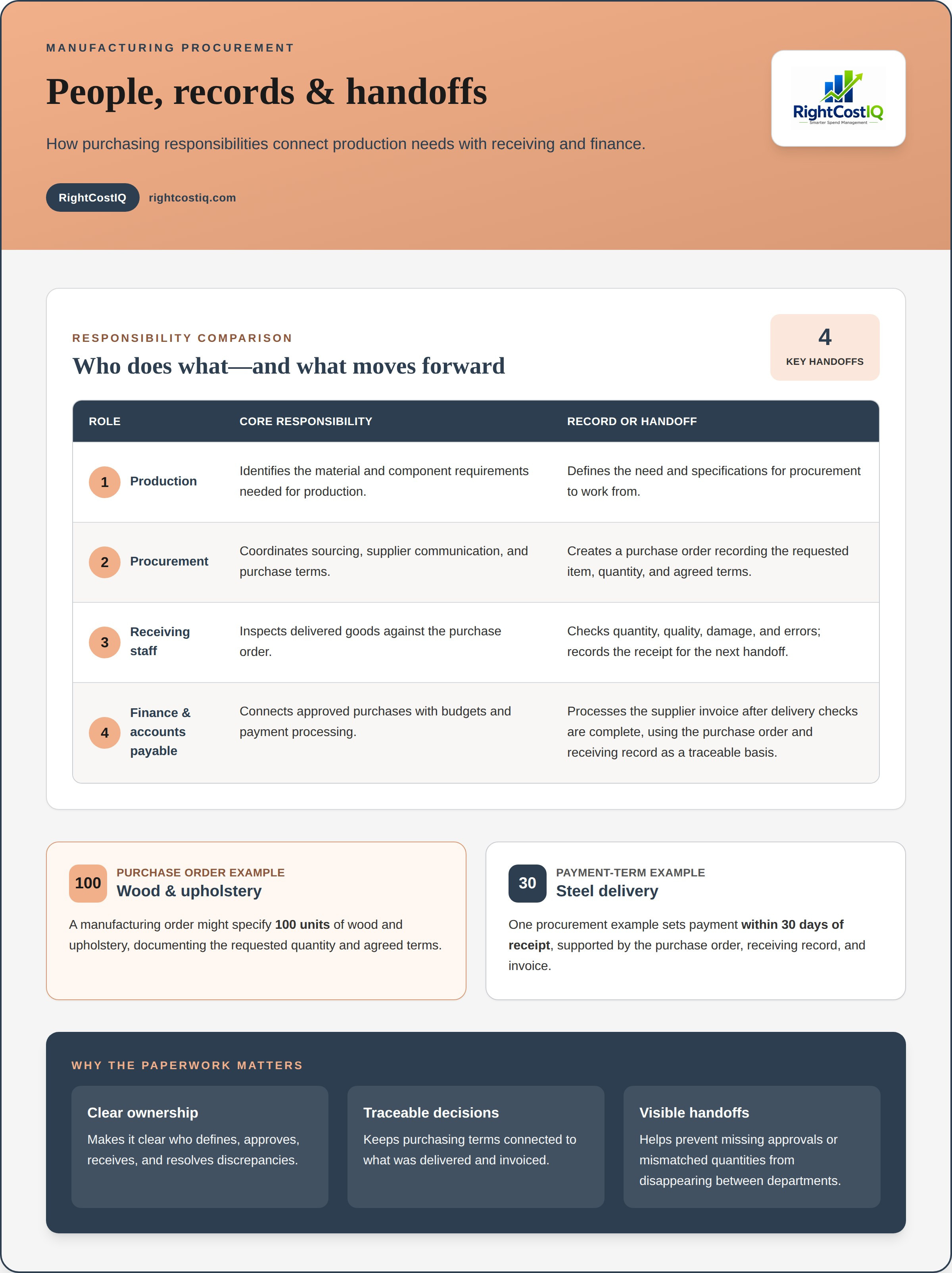
Production teams identify material and component requirements, while procurement professionals coordinate sourcing, supplier communication, and purchase terms. Finance connects approved purchases with budgets and payment processing. Clear role assignments establish who defines specifications, approves purchases, receives goods, and resolves discrepancies.
Documentation preserves each decision. A purchase order records the requested item, quantity, and agreed terms; for example, a manufacturing order might specify 100 units of wood and upholstery. After delivery, staff inspect the goods against the order for quantity, quality, damage, or errors. Accounts payable can process the supplier’s invoice after the checks are complete.
For a steel delivery, one procurement example sets payment within 30 days of receipt. The purchase order, receiving record, and invoice give finance a traceable basis for processing payment. A provider’s process should make these handoffs visible, so missing approvals or mismatched quantities don’t disappear between departments.
Manufacturing Procurement Process Steps
Procurement professionals manage the cycle by translating production requirements into documented purchases and following them through delivery and review. A practical sequence is to define the need, source and select suppliers, place the purchase, receive and inspect goods, then manage the supplier and contract. Risk reviews and performance insights inform the next purchasing decision.
Process mapping shows how a request moves between production, procurement, receiving, and accounts payable. For example, repeated manual entry of the same order details can create delays or errors. E-procurement can reduce time spent on manual processing by 40% to 60%. A global automobile company reduced manual processing time by 60% after adopting digital procurement platforms.
Optimization should target documented bottlenecks, not add software without a process objective. Procurement technology for contract management, supplier communication, and data analysis can streamline workflows and reduce human error. Procure-to-pay integration links purchasing decisions with financial operations, improving visibility and compliance. A procurement process diagnostic can help identify where workflow data points to avoidable handoffs, duplicated entries, or approval delays.
Competitive bidding and reverse auctions
Competitive bidding gives manufacturers a structured way to compare supplier proposals for a defined purchase. Procurement teams set requirements, invite supplier responses, assess offers against consistent criteria, and negotiate with preferred bidders. For example, a component request can compare price alongside specifications, delivery schedules, and service expectations.
Strong bid design starts with a clear scope. Before contacting suppliers, define the required materials, quantities, quality criteria, delivery needs, and contract terms. Give each bidder the same information and response format to make proposals easier to compare. Procurement professionals can then assess commercial terms and operational fit, rather than treating the lowest initial quote as the only deciding factor.
A reverse auction is a digital bidding process where suppliers compete by submitting lower offers during a defined event. It can suit comparable goods with clear specifications and multiple qualified sources. One global electronics manufacturer reduced total costs by 15% using a reverse e-auction to source components. That example illustrates a possible result, not a guaranteed outcome for every category.
Not every purchase suits an auction. A specialized component with detailed engineering requirements, limited supply, or close supplier collaboration may call for proposal evaluation and negotiation instead. In those cases, weigh technical fit, quality, delivery capability, and commercial terms. A competitive process should preserve supplier relationships that support ongoing production, rather than favor a short-term price reduction that undermines supply continuity.
Manufacturers comparing procurement service providers should assess how each one structures bid requirements, evaluates supplier responses, and supports negotiations. Compare approaches to category analysis, decision criteria, and post-award performance tracking. For example, a provider should be able to explain how its evaluation distinguishes a lower quote from stronger overall value, without relying on price alone.
Before a bid launches, procurement professionals can divide the requirement into comparable categories and identify qualified suppliers. During evaluation, they document exceptions, clarify assumptions, and compare total commercial terms. After selection, they record negotiated commitments and monitor supplier results. These steps create an audit trail and practical insights for future sourcing decisions.
A procurement partner’s value is clearest when its process fits the purchase. For a standardized material, competitive bids may reveal meaningful differences between offers. For a custom component, structured proposals may better expose design, quality, and delivery trade-offs. Matching the method to the category helps manufacturers make competitive decisions while keeping production needs and supplier relationships in view.
Procurement savings and ROI
Manufacturing procurement savings come from measurable changes in purchasing costs, supplier performance, and operational exposure. A useful return-on-investment review compares a defined baseline with realized results, then separates recurring savings from one-time effects. For example, a lower material price has to be considered alongside any changes to delivery terms or quality outcomes.
Start with category-level analysis. Procurement teams can compare current prices with market benchmarks, review historical purchases, and identify categories where contract terms or supplier choices deserve attention. Benchmarking industry leaders can save manufacturers 3% to 5% annually. That figure is a benchmark, not a forecast for an individual manufacturer; category mix, market conditions, and implementation affect results.
Measure cost savings against a consistent baseline. Record the original price and terms, the negotiated agreement, and actual purchase outcomes. Then track whether savings appear in invoices and whether product quality and delivery remain aligned with production needs. This helps distinguish realized value from a negotiated reduction that never affects purchasing activity.
Supplier performance adds another dimension to ROI. Teams can monitor on-time delivery, contract compliance, cost per category, and defect rates. If a supplier’s quoted price falls but defects rise, assess the combined effect on production and quality. Vendor performance tracking connects commercial decisions with operational evidence, helping procurement teams target corrective action or reconsider sourcing.
Procurement analysis can identify opportunities beyond unit-price changes. Supplier consolidation may reduce administrative work, while market price trending can inform purchasing timing and structure. Price risk management helps manufacturers monitor exposure to changing input prices. Evaluate each opportunity against supply continuity, contract commitments, and the production schedule.
Outsourcing procurement can give manufacturers focused support with category analysis, supplier negotiations, and performance tracking. It can also free internal teams to focus on production priorities while specialists organize purchasing insights. The value depends on a defined scope and useful measures, such as documented savings, supplier results, and adherence to agreed terms.
To evaluate ROI, manufacturers can connect each initiative to an owner, baseline, target, and review cadence. For example, a raw-material initiative can track negotiated terms alongside actual purchases and delivery performance. A Deloitte survey found manufacturing procurement strategies can reduce costs by at least 5% to 10% without hindering supply-chain resilience. Results depend on execution, so reporting should show both financial outcomes and operational effects.
Procurement’s role in manufacturing and business
Procurement is a strategic business function because it connects supplier decisions with production, finance, and risk. It controls an estimated 40% to 80% of company costs, so sourcing choices can affect budgets as well as factory operations. The central takeaway is clear: procurement decisions should support business performance, not operate as isolated purchase transactions.
This coordination depends on clear communication across departments. Production communicates material requirements, procurement aligns sourcing with them, and finance connects purchasing with budget controls. An ERP system can sync purchase orders with inventory and financial systems in real time, giving teams a shared view of committed purchases and stock levels. This integration helps decision-makers assess supply needs against current business plans.
Demand planning shapes inventory decisions. Manufacturers can use historical consumption data to set inventory levels and reorder points, then align them with production forecasts. For example, when planned output changes, procurement can review upcoming material demand before placing orders. This coordinates purchasing and inventory without treating a forecast as a standalone procurement task.
Contract management connects negotiated terms with daily operations. Procurement monitors contracts, tracks compliance, and renegotiates terms when business conditions or supplier performance require attention. A clear record of commitments helps teams compare actual delivery and pricing with contract expectations. It also provides a basis for escalating deviations and aligning corrective actions with production requirements.
Procurement contributes to business planning when teams connect category data with budgets and forecasts. Cost per category, supplier delivery, and contract compliance can reveal where purchasing patterns diverge from operational plans. Reviewing these measures with finance and supply chain leaders helps organizations prioritize decisions based on cost, continuity, and production demand.
Technology can strengthen this planning role when it supports a defined decision. Gartner found that AI can improve forecasting accuracy by at least 30%. Forecasting insights can inform demand planning, but teams still need to connect predictions with material requirements, supplier conditions, and inventory policies. The outcome is more coordinated planning, not technology separated from procurement judgment.
To assess procurement’s business impact, connect each sourcing decision to a production need, budget, contract commitment, and performance measure. This provides a practical basis for prioritizing improvements and tracking their operational relevance. Assess your procurement priorities against business and supply chain objectives.
RightCostIQ
RightCostIQ helps manufacturers structure sourcing decisions, analyze category costs, track supplier performance, and manage price risk. Its services support organizations seeking clearer cost benchmarks, more consistent proposal evaluation, or ongoing visibility into vendor results.
Turn to RightCostIQ when your team needs analytical support connecting procurement decisions with commercial and operational priorities. Services include RFP management and negotiation assistance, procurement category cost benchmarking and analytics, vendor performance tracking, and price risk management. These capabilities help manufacturers assess purchasing decisions and supplier outcomes using relevant data.
Contact RightCostIQ to discuss your procurement needs and priorities.
Turn procurement priorities into action
Start by choosing a focused procurement priority and linking it to a business outcome. A category with unclear cost visibility may call for deeper analysis; inconsistent supplier results may need structured performance tracking. This keeps procurement services for manufacturing companies aligned with the operational or financial decision that matters now, rather than spreading effort across disconnected initiatives.
RightCostIQ supports this work through Request For Proposal (RFP) Management and Negotiation Assistance, Procurement Category Cost Benchmarking and Analytics, and Procurement and Vendor Performance Tracking Service. These offerings help manufacturers assess sourcing decisions, understand category costs, and monitor supplier results. Choose a starting point based on the challenge and the information needed to make a clear decision.
Define the procurement issue you want to address, then start a procurement diagnostic with RightCostIQ. A focused next step can turn purchasing data into a more deliberate plan for your manufacturing operation.
Frequently Asked Questions
Why is procurement so important in business today?
Procurement affects how reliably a business meets customer demand while managing supplier commitments and spending. For a manufacturer launching a revised product, a late or unsuitable component can disrupt planned output and customer delivery. Procurement provides a structured way to align purchasing priorities with production plans, financial controls, and supply continuity. Its business value comes from connecting these decisions, rather than treating each purchase as an isolated transaction.
How Do Procurement Services Work?
Procurement services apply specialist support to a defined purchasing need or category. The work can begin with reviewing available spend and requirements, then move to supplier proposals, commercial analysis, or negotiation support. After a decision, performance information helps assess whether agreed outcomes are being achieved. For example, a manufacturer preparing a sourcing event can use external support to organize proposal evaluation while internal teams retain production and approval decisions.
What does procurement include?
Procurement includes the activities involved in preparing, authorizing, and managing business purchases. These can include defining a requirement, identifying potential suppliers, evaluating offers, agreeing commercial terms, placing orders, and managing supplier or contract performance. In manufacturing, procurement may cover raw materials, components, equipment, and business services. Activities vary by organization and purchasing need, but procurement connects the initial business requirement with the supplier relationship and resulting purchase.
What procurement services do manufacturing companies need?
Procurement services for manufacturing companies should match the organization’s current sourcing and performance challenges. A team with limited pricing visibility may benefit from category cost benchmarking and analytics. A planned supplier competition may call for RFP management and negotiation assistance. When price changes or inconsistent supplier results are concerns, price risk management or vendor performance tracking may be relevant. Align the service scope with the decision the manufacturer needs to make.
What services do manufacturing procurement firms provide?
Manufacturing procurement firms can provide sourcing-event support, category cost analysis, negotiation assistance, price risk management, and supplier performance tracking. RightCostIQ offers Request For Proposal (RFP) Management and Negotiation Assistance, Procurement Category Cost Benchmarking and Analytics, and Procurement and Vendor Performance Tracking Service. These services address different needs, from evaluating supplier proposals to understanding market pricing and monitoring vendor results. They complement, rather than replace, a manufacturer’s production and technical decisions.
How does the procurement process work for manufacturing companies?
For a production change, procurement starts by clarifying which inputs the revised design requires and when they need to be available. The team aligns sourcing decisions with the approved specification and coordinates supplier commitments with production planning. As orders progress, receiving and finance records help resolve discrepancies between what was ordered, delivered, and invoiced. After the production run, purchasing and supplier information can inform the next planning cycle.
What risks should manufacturers consider when outsourcing procurement?
Manufacturers should consider whether an outsourced team understands purchasing priorities, communicates decisions clearly, and works from accurate category and supplier information. Poorly defined responsibilities can create gaps between sourcing recommendations and internal approvals. Limited coordination may also obscure supplier issues or production requirements. Establishing decision ownership, access to relevant records, escalation paths, and performance measures helps align outsourced procurement with manufacturing operations while preserving internal oversight of critical purchasing decisions.


