
The era of procurement as a back-office support function is dead. In 2026, procurement analytics serves as the central nervous system for margin expansion, yet 62% of CPOs still struggle with fragmented data trapped in legacy ERP systems. You've likely felt the impact of sudden price volatility and the inability to benchmark complex RFPs with clinical precision. It's frustrating to enter a high-stakes negotiation when your spend data is lagging 90 days behind the actual market. Procurement is the new value driver, and the gap between leaders and laggards is defined by data integrity.
This guide provides a strategic framework to master the clinical application of spend intelligence. You'll learn to transform raw data into a high-leverage negotiation asset that protects your bottom line and drives competitive advantage. We'll examine the technical architecture required for automated vendor performance tracking, predictive market price trending, and the "should-cost" models that define the next generation of AI-led procurement. By the end of this article, you'll possess the roadmap to turn your tech stack into a relentless engine for financial optimization.
Key Takeaways
- Transition from passive historical reporting to predictive spend intelligence to secure a high-leverage position in 2026 negotiations.
- Deploy clinical procurement analytics tools like should-cost modeling and commodity indexing to dismantle opaque supplier pricing structures.
- Evaluate the strategic trade-offs between SaaS architectures and GPO models to align your tech stack with your organizational maturity.
- Master the selection criteria for analytics partners, prioritizing AI-led data cleansing and category-specific benchmarking for maximum margin expansion.
- Integrate RFQ sprints and AI-driven optimization into your procurement workflow to transform raw spend data into a clinical value driver.
Beyond Spend Analysis: The Evolution to Spend Intelligence
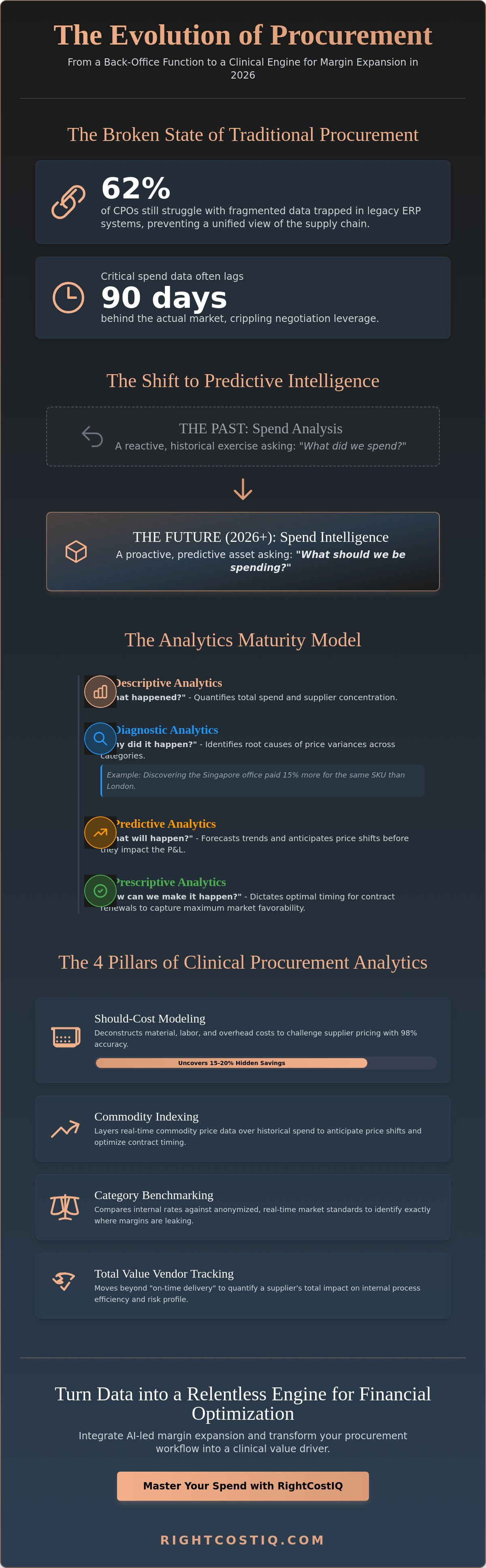
In 2026, procurement analytics isn't a reporting tool; it's a clinical synthesis of internal spend data and external market intelligence. Most firms waste 20% of their analytical bandwidth fighting "dirty data" within legacy ERP systems. This fragmentation prevents a unified view of the supply chain and creates blind spots during contract renewals. AI-led data cleansing now automates the classification process, allowing the finance team to shift from manual entry to strategic optimization. Procurement is the new value driver. It's the primary engine for margin expansion in an era where top-line growth is increasingly volatile.
Traditional Spend analysis has always been a rearview mirror exercise. It tells you what you spent last quarter, but it offers zero leverage for the next negotiation. The evolution to Spend Intelligence marks a shift toward predictive power. By layering real-time commodity indices over historical spend, organizations can anticipate price shifts before they hit the P&L. This active stance transforms procurement from a cost center into a high-leverage negotiation asset. It allows for a clinical approach to cost management that prioritizes results over conversational warmth with vendors.
The Analytics Maturity Model for Enterprise Sourcing
Progressing through the maturity model is essential for any Strategic Architect. Descriptive analytics provides the baseline, quantifying total spend and supplier concentration. Diagnostic analytics moves deeper, offering a clinical identification of price variances across regional categories. If the Singapore office paid 15% more for the same SKU than the London branch in Q3 2025, diagnostic tools highlight the root cause. Finally, predictive and prescriptive analytics leverage market signals to drive RFQ sprints. This stage doesn't just forecast trends; it dictates the optimal timing for contract renewals to capture maximum market favorability.
Quantifying Spend Under Management (SUM)
SUM serves as the primary KPI for procurement efficiency. High-performing organizations aim for a SUM ratio exceeding 85%. When SUM increases, margin expansion follows. Clinical procurement analytics architectures identify "dark spend," which is the unmanaged leakage occurring outside of negotiated contracts. By bringing this rogue spend back into the managed fold, firms typically realize a 10% to 12% reduction in category costs within the first six months of implementation. This process isn't just about cost cutting; it's about building architectural control over the entire enterprise spend to ensure every dollar is optimized for value.
The Anatomy of Clinical Procurement Analytics
Clinical procurement analytics requires a surgical deconstruction of cost drivers. It replaces the "best-and-final-offer" guessing game with a data-backed mandate for transparency. This architectural approach relies on four primary pillars: should-cost modeling, commodity indexing, category benchmarking, and total value vendor tracking. These aren't just features; they're the components of a high-leverage negotiation asset. When you deploy these tools, you move from a position of request to a position of requirement. You don't ask for a lower price; you demonstrate why the current price is mathematically unsustainable based on market fundamentals.
Effective vendor tracking must also evolve. In 2026, measuring "on-time delivery" is the bare minimum. Advanced procurement analytics frameworks now track total value contribution, quantifying a supplier's impact on your internal process efficiency and risk profile. By comparing internal rates against anonymized market standards, you identify exactly where your margins are leaking. Leveraging AI-led margin expansion strategies ensures your team isn't just reacting to the market but actively shaping it through fact-based negotiation.
Advanced Should-Cost and Clean Sheet Modeling
Should-Cost Modeling serves as a clinical tool for fact-based negotiation. It utilizes bottom-up cost engineering to challenge supplier pricing by breaking down every component of a SKU. A clean sheet model deconstructs material costs, labor hours, and overhead allocations with 98% accuracy. This level of transparency provides clinical leverage during RFP negotiations. You can pinpoint exactly where a supplier's margin is inflated. It forces vendors to justify their pricing against a "clean sheet" of objective reality, often uncovering 15% to 20% in hidden savings that traditional bidding processes miss.
Market Price Trending and Forecasting
Financial volatility is the primary enemy of margin stability. Integrating real-time market indices into your tech stack allows you to mitigate price risk before it manifests in your supply chain. Commodity indexing links your contract pricing directly to raw material fluctuations, ensuring you capture downward trends automatically. Strategic Architects use this forecasting data to time their RFQ sprints for maximum economic advantage. By identifying price troughs 60 days in advance, you can lock in favorable rates and protect your organization from sudden inflationary spikes. This proactive stance isn't just smart; it's a requirement for clinical cost management in a 2026 economy.
Evaluating Analytics Architectures: SaaS vs. Managed Services vs. GPOs
Selecting an analytics architecture is a structural decision that dictates the ceiling of your margin expansion. The SaaS model functions as a pure software play, empowering internal teams with high analytical maturity to execute procurement analytics in-house. This approach is ideal for organizations that have already invested in internal data science talent but lack the specialized tech stack to visualize spend. Conversely, the GPO model leverages collective scale, which remains effective for indirect spend categories like office supplies or MRO. However, for 2026, the most resilient organizations are moving toward hybrid approaches that combine AI-led platforms with expert-led clinical execution to handle both direct and indirect spend with equal precision.
Managed analytics services provide the professional RFP management and negotiation assistance required for high-stakes categories. While a GPO might secure a 5% discount on commodity items through volume aggregation, a managed service provider (MSP) can unlock 18% to 22% savings in complex direct spend by performing deep-dive should-cost modeling. This transition from passive participation to active clinical management is what separates a Strategic Architect from a traditional buyer. It ensures that the procurement function isn't just a cost center but a primary engine for financial optimization.
When to Choose a Managed Service Provider (MSP)
Category complexity is the primary driver for MSP adoption. In sectors like healthcare, logistics, or raw material manufacturing, the data cleansing requirements for thousands of specialized SKUs often exceed internal resource constraints. An MSP provides the benchmarking data and negotiation muscle needed for these high-stakes RFPs. Industry data from 2024 suggests that managed negotiation assistance yields a 3.4x higher ROI compared to pure software implementations when dealing with complex, non-standardized categories. This model is particularly effective when internal teams are focused on operational continuity rather than technical cost engineering.
SaaS Integration and Data Interoperability
Technical compatibility is non-negotiable for real-time spend intelligence. Modern procurement analytics tools must sit atop existing ERPs like SAP, Oracle, or NetSuite without disrupting core financial workflows. Treating analytics as a standalone layer ensures clinical precision by isolating spend data from the noise of general ledger accounting. This interoperability allows for a seamless flow of data, ensuring that your tech stack remains a responsive asset during volatile market shifts. By 2026, the ability to integrate external market indices directly into the internal ERP view will be the standard for any firm seeking to maintain a competitive advantage through data-led procurement.
The Strategic Buying Framework: How to Select an Analytics Partner
Selecting a partner for procurement analytics is a structural decision that defines your organization's negotiation ceiling. A Strategic Architect evaluates potential partners through five critical criteria: data categorization accuracy, benchmarking depth, price risk integration, negotiation support, and C-suite visibility. If a solution doesn't facilitate a direct reduction in category costs, it's a reporting cost, not a value driver. Effective price risk management and forecasting must be integrated directly into the workflow to protect margins against 2026 market fluctuations. Finally, the ability to visualize margin expansion for C-suite stakeholders transforms procurement from a back-office function into the primary engine for enterprise value. You don't need more data; you need more leverage.
Assessing Data Cleansing Capabilities
Accuracy is the clinical standard for sourcing. 99% precision in categorization is the minimum threshold for making high-stakes sourcing decisions with confidence. "Garbage in, garbage out" isn't just a cliché; it's a financial risk that leads to failed RFPs and eroded margins. When you evaluate providers, demand transparency on their AI-led categorization logic. You need to know if the system can distinguish between a direct material SKU and an indirect MRO item with zero manual intervention. Manual cleansing is too slow for 2026 market volatility. It's a relic of a legacy mindset that prioritizes activity over outcomes.
Evaluating the Negotiation Lever
Actionable intelligence must replace "pretty charts" in your tech stack. Does the provider offer Procurement Category Cost Benchmarking and Analytics that can actually be used in a live negotiation? Generic market data lacks the granularity for complex categories. Your partner should support "RFQ Sprints" by providing real-time competitive bidding environments and the should-cost models discussed in earlier sections. This level of support ensures that your procurement team enters every meeting with a data-backed mandate for optimization. To secure your competitive advantage and protect your bottom line, you must optimize your negotiation leverage through clinical precision. This approach ensures that every RFP is an opportunity for significant margin expansion rather than a simple administrative exercise.
RightCostIQ: AI-Led Margin Expansion and Strategic Optimization
RightCostIQ operates as the Strategic Architect for high-stakes procurement, transforming the traditional cost center into a relentless engine for financial optimization. In the 2026 economy, "Procurement is the new value driver," and our framework ensures every dollar spent serves as a deliberate step toward margin expansion. By deploying advanced procurement analytics, we provide the clinical precision required to dismantle supplier pricing structures and recover lost value. Our platform integrates real-time Price Risk Management and Market Price Trending, allowing decision-makers to pivot before market volatility erodes the bottom line. We don't just provide data; we provide the architectural control necessary to dominate the supply chain.
Strategic optimization requires a shift from reactive purchasing to proactive spend intelligence. Our methodology focuses on the clinical synthesis of internal data and external market signals to create a high-leverage negotiation asset. This approach ensures that your procurement function remains agile, data-backed, and focused on the bottom line. By utilizing proprietary cost engineering, RightCostIQ helps firms achieve a level of transparency that legacy ERP systems cannot match. We prioritize efficiency and results, ensuring that your organization is equipped to handle the complexities of modern enterprise finance with unwavering focus.
Clinical Execution in RFP Management
Execution at RightCostIQ moves beyond static templates to data-driven negotiation strategies that prioritize results. In a 2024 implementation for a global manufacturing client, our should-cost modeling identified a 14% discrepancy between market fundamentals and supplier quotes, leading to immediate margin recovery. Professional negotiation assistance ensures that contract compliance remains above 95%, eliminating the "handshake deals" that often lead to unmanaged spend. This clinical approach to procurement analytics forces a level of transparency that standard RFP processes simply cannot replicate, turning every negotiation into a strategic win for the P&L.
The RightCost Academy: Upskilling for Competitive Advantage
Bridging the gap between traditional buying and AI-led strategy requires a fundamental shift in human capital. The RightCost Academy serves as a sophisticated mentor for the modern procurement analyst, focusing on technical upskilling in prompt engineering and clean sheet cost modeling. We provide the technical roadmap to transition from passive data entry to strategic oversight, ensuring your team can navigate the complexities of a tech-heavy sourcing environment. To secure your position as a market leader, you must Optimize your procurement outcome with RightCostIQ. Our methodology ensures your tech stack and your talent are perfectly aligned for long-term margin expansion.
Securing Your Competitive Advantage Through Clinical Cost Architecture
The transition from passive reporting to active spend intelligence is the defining factor for enterprise resilience in 2026. By deploying advanced procurement analytics, you've moved beyond simple expense tracking to a position of clinical negotiation leverage. You now understand that should-cost modeling and commodity indexing aren't optional features; they're essential components of a high-leverage negotiation asset. This framework ensures that your procurement function remains an assertive value driver rather than a back-office cost center.
As an AI-Led Margin Expansion Firm founded by Industry Strategic Architects, RightCostIQ provides the specialized healthcare financial analytics expertise required to navigate these complex sourcing landscapes. We don't just offer software; we deliver the architectural control necessary to optimize every contract and recover lost value through fact-based precision. The roadmap to 2026 demands a shift toward results-oriented execution that prioritizes the bottom line above all else. Optimize your procurement strategy with RightCostIQ and transform your raw spend data into a relentless driver of enterprise profitability. Your organization is now positioned to lead with data and win with clinical execution.
Frequently Asked Questions
What is the primary difference between spend analysis and procurement analytics?
Spend analysis focuses on historical data to quantify past expenditures, while procurement analytics synthesizes that history with external market intelligence to drive future strategy. One tells you what happened; the other dictates what should happen next. This forward-looking approach allows for the execution of RFQ sprints based on market timing rather than administrative cycles, transforming data into a predictive asset.
How does procurement analytics contribute directly to margin expansion?
Margin expansion occurs when analytics identify the 10% to 15% price variance often found across regional categories. By deploying should-cost modeling, organizations challenge supplier margins with clinical precision. This process eliminates unmanaged "dark spend" and ensures every contract is optimized for the lowest total cost of ownership. It turns procurement into a primary engine for financial optimization and bottom-line growth.
Can procurement analytics tools integrate with my existing ERP system?
Clinical analytics tools sit as a specialized layer atop existing ERPs like SAP or Oracle to ensure data interoperability without disrupting core financial workflows. This standalone architecture prevents the "dirty data" issues common in legacy systems. It allows for real-time data flow, providing a single source of truth that reaches 99% accuracy for high-stakes sourcing decisions.
What is should-cost modeling and why is it critical for RFPs?
Should-cost modeling is a bottom-up cost engineering technique that deconstructs a product or service into its material, labor, and overhead components. It's critical for RFPs because it provides a fact-based baseline for negotiations. Instead of accepting a supplier's quote at face value, you use a clean sheet model to demonstrate what the product actually costs to manufacture, gaining significant leverage.
How often should a company conduct a spend analysis cycle?
High-performing organizations have moved from quarterly reviews to continuous, real-time spend analysis cycles. In a 2026 economy, waiting 90 days to review data means missing critical market shifts and losing your competitive advantage. Continuous monitoring allows for proactive price risk management and ensures that your managed spend ratio remains above the 85% efficiency benchmark throughout the fiscal year.
What are the risks of using inaccurate procurement data for negotiations?
Using inaccurate data leads to a 20% higher risk of failed RFP outcomes and significant margin erosion. When negotiation claims aren't backed by 99% accurate data, suppliers quickly identify the lack of clinical leverage. This "garbage in, garbage out" cycle results in sub-optimal contracts that lock in inflated pricing for multiple years, directly damaging organizational profitability.
How does market price forecasting mitigate financial volatility?
Market price forecasting uses real-time indices to anticipate commodity price shifts before they impact the P&L. By integrating these forecasts into procurement analytics, firms can trigger commodity indexing clauses in their contracts. This proactive stance allows you to capture downward price trends automatically and avoid sudden inflationary spikes in raw material costs, protecting your margins from external shocks.
Is a GPO or a specialized analytics firm better for indirect spend?
GPOs are effective for high-volume commodity items, but a specialized analytics firm is superior for complex indirect categories like logistics or professional services. Specialized firms provide the category-specific benchmarking data that generic GPOs lack. This precision often uncovers an additional 12% in savings by addressing the unique cost drivers and service level requirements of non-standardized categories.


