
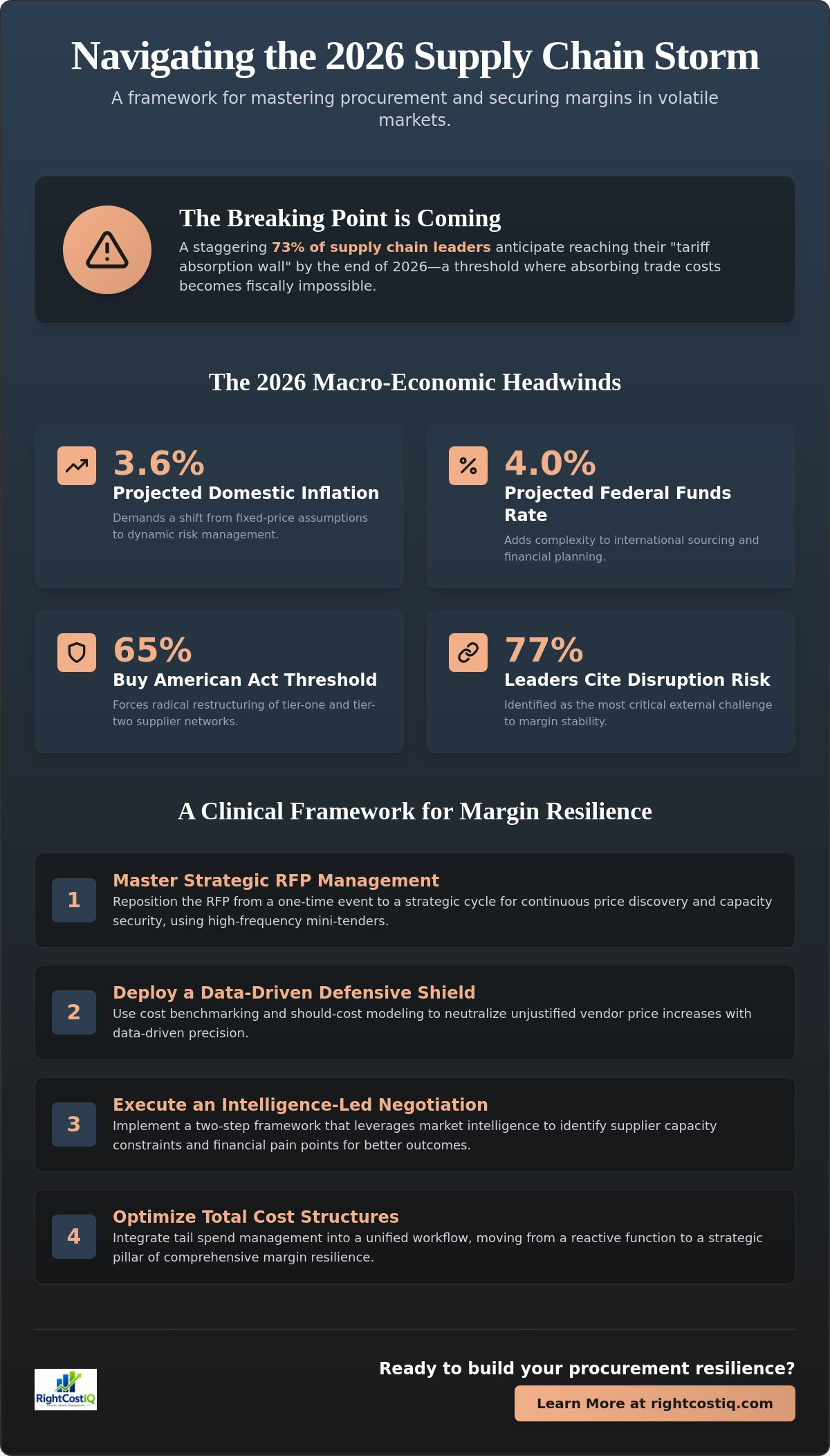
73% of supply chain leaders anticipate reaching their "tariff absorption wall" by the end of 2026, a threshold where trade cost absorption becomes impossible. This fiscal reality necessitates a transition toward sophisticated procurement strategies for volatile markets. You've likely experienced the friction of unpredictable supplier price hikes justified by opaque market conditions. It's a common pain point: inefficient RFP cycles often fail to capture competitive pricing during rapid shifts, leaving your margins exposed. Without real-time benchmarking data to challenge vendor claims, procurement remains a reactive function rather than a strategic one.
We understand that stabilizing margins in a 2026 economy requires more than just better negotiation; it requires a clinical framework for procurement resilience. This article details how to master the strategic execution of RFP management and market intelligence to secure predictable cost structures despite market swings. You'll learn to apply clinical precision to vendor negotiations and implement a scalable framework for price risk management. We will examine the specific analytics and performance tracking services that enable your team to maintain operational efficiency amidst a projected 3.6% inflation rate and fluctuating interest targets.
Key Takeaways
- Identify the specific 2026 macroeconomic triggers and geopolitical shifts that necessitate a transition from reactive purchasing to clinical risk management.
- Master procurement strategies for volatile markets by repositioning the RFP as a strategic cycle for continuous price discovery and capacity security.
- Deploy cost benchmarking and should-cost modeling as a defensive shield to neutralize unjustified vendor price increases with data-driven precision.
- Execute a two-step negotiation framework that leverages market intelligence to identify supplier capacity constraints and financial pain points.
- Optimize total cost structures by integrating tail spend management into a unified workflow for comprehensive margin resilience.
The 2026 Volatility Landscape: Defining Modern Supply Chain Risk
Supply chain volatility is the frequency and magnitude of changes in demand and pricing within a global ecosystem. In 2026, this isn't a temporary state; it's a structural reality. Procurement leaders face a convergence of high Federal Funds Rates, projected to reach 4.0% by year-end, and a domestic inflation rate of 3.6%. These metrics demand a shift in procurement processes from fixed-price assumptions to dynamic risk management. Reactive firefighting fails because it ignores the data-driven foresight required to protect margins. Clinical procurement optimization replaces panic with precision. Developing resilient procurement strategies for volatile markets requires a departure from legacy sourcing models that prioritize short-term savings over long-term stability.
Macro-Economic Drivers of Procurement Instability
Global trade policy shifts are the primary architects of category cost escalation. The Buy American Act domestic content threshold now stands at 65%, forcing a radical restructuring of tier-one and tier-two supplier networks. When 73% of supply chain leaders anticipate hitting a "tariff absorption wall" by the end of 2026, the economic necessity of real-time market intelligence becomes absolute. Currency fluctuations add another layer of complexity. With the ECB projecting 3.0% inflation and the Fed maintaining a hawkish stance, international sourcing requires a sophisticated understanding of interest rate parity. Labor market volatility further compromises vendor performance. Unpredictable wage growth and talent shortages directly impact delivery timelines, making vendor performance tracking a critical survival metric for the modern CPO.
The Failure of Legacy Sourcing Models
The traditional just-in-time inventory model has proven inadequate in an era where U.S. business logistics costs have reached $2.58 trillion. Modern resilience requires a "just-in-case" procurement strategy that prioritizes capacity security over lean inventory. Static vendor contracts are a liability in a dynamic price environment. Contracts that lack flexible indexing or frequent should-cost modeling adjustments leave organizations vulnerable to sudden supplier price hikes. 77% of procurement leaders now identify supply-disruption risk as their most critical external challenge. Supply chain volatility represents the variance in external market forces that directly erodes margin stability if left unmitigated by clinical data frameworks. Using procurement strategies for volatile markets allows firms to transition from defensive postures to offensive market positioning.
Clinical RFP Management as a Volatility Buffer
Modern procurement strategies for volatile markets prioritize the RFP not as a document, but as a strategic cycle for price discovery and market calibration. While competitors often suggest stockpiling inventory to survive market swings, clinical procurement relies on the precision of the bid process to lock in supplier capacity during windows of lower volatility. This proactive approach prevents the "tariff absorption wall" by ensuring that cost structures are vetted before market shifts occur. Utilizing automated RFP management significantly reduces cycle times. This speed allows procurement teams to respond to 2026's rapid inflationary cycles with surgical accuracy. Precision frameworks in drafting requirements are essential; they specify exactly how risk is shared between the buyer and the vendor, removing the ambiguity that suppliers often exploit during periods of instability.
Architecting the High-Frequency RFP
The traditional annual bid is obsolete in a global economy defined by 3.6% inflation and fluctuating interest targets. High-frequency procurement involves category-specific mini-tenders that allow for rapid recalibration. These structured bids must be designed to capture variable pricing components and link them to specific market indices. This ensures that vendor price hikes are justified by verified data rather than opportunistic claims. Rigorous vendor performance tracking during the bid phase further ensures that only the most resilient partners enter the supply chain. By executing these high-frequency cycles, teams can implement procurement strategies for volatile markets that prioritize agility over rigid, multi-year commitments.
Leveraging Sourcing for Strategic Resilience
Strategic resilience is built through the integration of category management into every stage of the RFP lifecycle. This holistic view identifies risks that legacy models overlook, particularly within unmanaged expenditure. Addressing tail spend management reveals hidden volatility risks where small, unvetted transactions can aggregate into significant margin erosion. Precision in RFP drafting directly correlates to margin stability by establishing immutable cost baselines that vendors cannot circumvent during market fluctuations. Organizations looking to stabilize their sourcing operations can deploy a structured RFP framework to gain immediate visibility into vendor pricing behaviors. This methodical approach ensures that every dollar spent is accounted for and every vendor claim is verified against objective market data.
Cost Benchmarking and Market Price Trending: The Defensive Shield
Clinical procurement demands an objective baseline that supersedes supplier narratives. Should-cost modeling provides this anchor. It's the primary mechanism for transitioning from anecdotal evidence to data-driven cost transparency for the C-suite. Without this baseline, procurement teams remain defenseless against unjustified price hikes that erode bottom-line growth. Integrating should-cost modeling into procurement strategies for volatile markets ensures every price adjustment is rooted in constituent economic reality rather than supplier opportunism. This transparency allows the CPO to present cost avoidance as a measurable financial metric, elevating the procurement function from a cost center to a strategic driver of enterprise stability.
Implementing Should-Cost Analytics
Effective cost management requires a granular breakdown of vendor pricing into raw material, labor, and overhead components. Using should-cost tools allows procurement professionals to challenge blanket price increases with surgical precision. When a vendor cites "market conditions" for a 10% hike, benchmarking internal spend against industry-standard cost indices provides the validation needed to counter the claim. This clinical approach identifies exactly when a supplier is overcharging relative to actual market shifts. It's about verifying the delta between a vendor's quote and the true market cost basis. By utilizing category benchmarking, organizations can identify outliers in their supplier base and renegotiate terms that align with competitive market standards, effectively neutralizing the "tariff absorption wall" mentioned previously.
Forecasting as a Risk Mitigation Tool
Market price trending acts as a predictive engine for forecasting future cost basis and risk. By developing models that predict 6-12 month cost trajectories, organizations can shift from reactive purchasing to strategic positioning. Identifying leading indicators of volatility within specific categories, such as specialized labor shortages or energy price fluctuations, enables teams to hedge against upcoming spikes. For instance, tracking metrics similar to the General Services Administration (GSA) Transactional Data Reporting (TDR) can provide a broader view of market pricing behaviors. Real-time analytics don't just solve immediate problems; they enhance enterprise value by creating a predictable cost environment. This level of foresight is a hallmark of advanced procurement strategies for volatile markets, ensuring the organization remains resilient even as global economic conditions fluctuate and regulatory overhauls continue.
Negotiation Strategies for Volatile 2026 Markets
Negotiation in a 2026 economy defined by 3.6% inflation and 4.0% interest rates isn't a battle of wills; it's a battle of data. Effective procurement strategies for volatile markets require a five-step tactical roadmap to ensure margin preservation. Step one establishes a data-driven baseline using cost benchmarking and analytics to neutralize supplier narratives. Step two involves identifying vendor pain points and capacity constraints through market intelligence. In step three, procurement leaders utilize market forecasting as a lever for volume commitments and price locks. Step four focuses on architecting flexible contracts with index-based price adjustment clauses. Finally, step five employs a negotiation coach to refine tactical execution and ensure alignment with high-level financial growth metrics.
The Shift from Adversarial to Strategic Negotiation
Strategic negotiation prioritizes long-term resilience over short-term unit price reductions. Building collaboration buffers with key suppliers ensures your organization receives priority during the 77% of supply-disruption events identified by industry leaders. Negotiating for transparency allows procurement teams to see the underlying cost drivers, making it easier to verify when price increases are truly market-justified. Vendor performance tracking acts as a critical lever during contract renewals. By presenting objective data on delivery timelines and quality metrics, you shift the power dynamic in your favor. This clinical approach transforms the supplier relationship into a sophisticated partnership focused on mutual operational efficiency.
Managing Price Risk in Contractual Agreements
Contractual architecture must evolve to handle the rapid shifts of the 2026 global economy. Structuring caps and collars within agreements limits your exposure to extreme market swings while providing vendors with a safety net. This equitable distribution of risk prevents supplier default during periods of hyper-volatility. Dual-sourcing remains a foundational tactic; having a secondary vendor strengthens your negotiation position and provides a necessary contingency. The primary goal of negotiation in a volatile market is the institutionalization of margin protection through the surgical distribution of external price risk. To evaluate your current negotiation readiness and identify hidden cost drivers, access our procurement diagnostic tool today. Implementing these procurement strategies for volatile markets ensures your organization remains solvent and competitive despite ongoing geopolitical and economic disruption.
The RightCostIQ Framework for Margin Resilience
Achieving structural stability in a 2026 global economy requires the integration of RFP management, cost benchmarking, and strategic negotiation into a single clinical workflow. Legacy processes relying on manual spreadsheets are insufficient for managing the projected 3.6% domestic inflation rate and complex trade policy shifts. The RightCostIQ framework replaces fragmented tactics with an integrated procurement infrastructure designed for high-stakes decision-making. By consolidating market intelligence and performance tracking, the platform enables procurement teams to function as strategic architects rather than administrative cost centers. A critical component of this optimization involves tail spend management, which addresses the unmanaged expenditure where volatility risks often aggregate. This comprehensive approach ensures that procurement strategies for volatile markets are not just theoretical concepts but operational realities that protect financial growth.
Quantifying the ROI of Procurement Optimization
Measuring the effectiveness of these frameworks requires a rigorous focus on spend under management as a primary KPI. Clinical execution allows organizations to move beyond simple unit-price reductions toward sophisticated cost avoidance and realized savings tracking. In an environment where 73% of supply chain leaders expect to hit a tariff absorption wall by the end of 2026, the ability to document these metrics is essential for enterprise valuation. Effective price risk management functions as a defensive shield that preserves capital during market swings. By institutionalizing these analytics, CPOs can demonstrate a direct correlation between procurement precision and bottom-line efficiency. This data-driven transparency provides the C-suite with the confidence to navigate inflationary cycles without compromising operational scale.
Next Steps: Securing Your Supply Chain
Transitioning to a resilient model begins with a comprehensive volatility audit of your current procurement categories. This audit identifies specific areas where legacy sourcing models leave the organization exposed to unpredictable supplier price hikes. Implementing the RightCostIQ framework provides immediate cost transparency and establishes the baseline required for clinical negotiation. To begin your transition toward data-driven sourcing, visit the RightCostIQ diagnostic page to initiate your optimization cycle. Adopting advanced procurement strategies for volatile markets is the only viable path to maintaining a competitive advantage in a high-interest, high-inflation landscape. Secure your margins today by replacing reactive firefighting with the clinical precision of a strategic architect.
Secure Your Margins Through Clinical Precision
Transitioning from reactive purchasing to a strategic architect persona is no longer optional. The 2026 economic landscape requires a relentless focus on data-driven benchmarking and high-frequency RFP cycles to maintain structural stability. By institutionalizing should-cost modeling and index-based contracts, your team can successfully navigate the tariff absorption wall and protect bottom-line growth. Effective procurement strategies for volatile markets transform external risks into manageable variables, ensuring that supplier price hikes are met with verified data rather than concession.
It's time to replace legacy spreadsheets with an integrated infrastructure that prioritizes margin resilience. Optimize your procurement outcomes with RightCostIQ's clinical RFP management and negotiation assistance. Our framework leverages data-driven cost benchmarking and analytics, alongside real-time market price trending and forecasting. With expert-led negotiation assistance for complex RFPs, your organization can achieve predictable cost structures despite global economic swings. You have the tools to convert market volatility into a distinct competitive advantage.
Frequently Asked Questions
How does supply chain volatility impact procurement costs in 2026?
Supply chain volatility drives procurement costs higher by compressing margins through unpredictable supplier price hikes. In 2026, firms face a domestic inflation forecast of 3.6% and a logistics cost burden reaching $2.58 trillion. These forces create a "tariff absorption wall" for 73% of supply chain leaders who can no longer absorb trade costs. Clinical cost management requires moving beyond fixed-price assumptions to protect financial growth metrics during these rapid inflationary cycles.
What is the difference between reactive and proactive volatility management?
Reactive management relies on firefighting sudden disruptions, whereas proactive management utilizes clinical data frameworks to anticipate shifts. Proactive strategies employ high-frequency RFP cycles and real-time benchmarking to secure capacity during windows of low volatility. This expert-led approach prioritizes operational efficiency and margin resilience over desperate, late-stage sourcing. It's the difference between enduring a disaster and managing a variable through strategic architecting and data-driven foresight.
How can RFP management help mitigate supply chain risks?
RFP management mitigates risk by transforming the bidding process into a continuous cycle of price discovery. Automated systems reduce cycle times, enabling procurement teams to respond to 2026's digital disruptions with surgical speed. By drafting precise requirements, organizations can clearly define risk-sharing parameters with vendors. This ensures that capacity is locked in at competitive rates before market swings occur, providing a necessary defensive buffer for the enterprise.
Why is should-cost modeling essential for vendor negotiations?
Should-cost modeling provides the objective baseline required to challenge opportunistic vendor price increases. By breaking down costs into raw materials, labor, and overhead, procurement teams can verify if a specific hike is actually market-justified. This clinical transparency replaces anecdotal evidence with data-driven facts. It's an essential defensive shield that ensures every negotiation is rooted in constituent economic reality rather than unverified supplier narratives.
What role does market price trending play in procurement strategy?
Market price trending functions as a predictive engine for forecasting future cost basis and enterprise risk. It identifies leading indicators of volatility within specific categories, such as labor market shifts or currency fluctuations. By predicting 6-12 month cost trajectories, procurement leaders can shift toward long-term strategic positioning. This foresight allows for the proactive implementation of procurement strategies for volatile markets, securing favorable terms before leading indicators trigger widespread price spikes.
How can businesses manage price risk without excessive stockpiling?
Businesses manage price risk by institutionalizing index-based adjustment clauses and price caps within contractual agreements. This approach utilizes clinical precision in contract architecture rather than the capital-intensive stockpiling of physical inventory. Dual-sourcing and volume commitments based on forecasted trending also strengthen the organization's position. It focuses on the surgical distribution of external price risk, ensuring margin stability without the burden of excessive logistics or storage costs.
What are the most effective negotiation tactics for volatile markets?
The most effective tactics involve establishing data-driven baselines and identifying vendor pain points through market intelligence. Negotiators should leverage performance tracking and category benchmarking to shift the power dynamic in their favor. Using a negotiation coach helps refine tactical execution for complex RFPs. This methodical approach prioritizes transparency and strategic collaboration, ensuring the organization remains resilient even as global trade policies and regulatory thresholds continue to evolve.


