
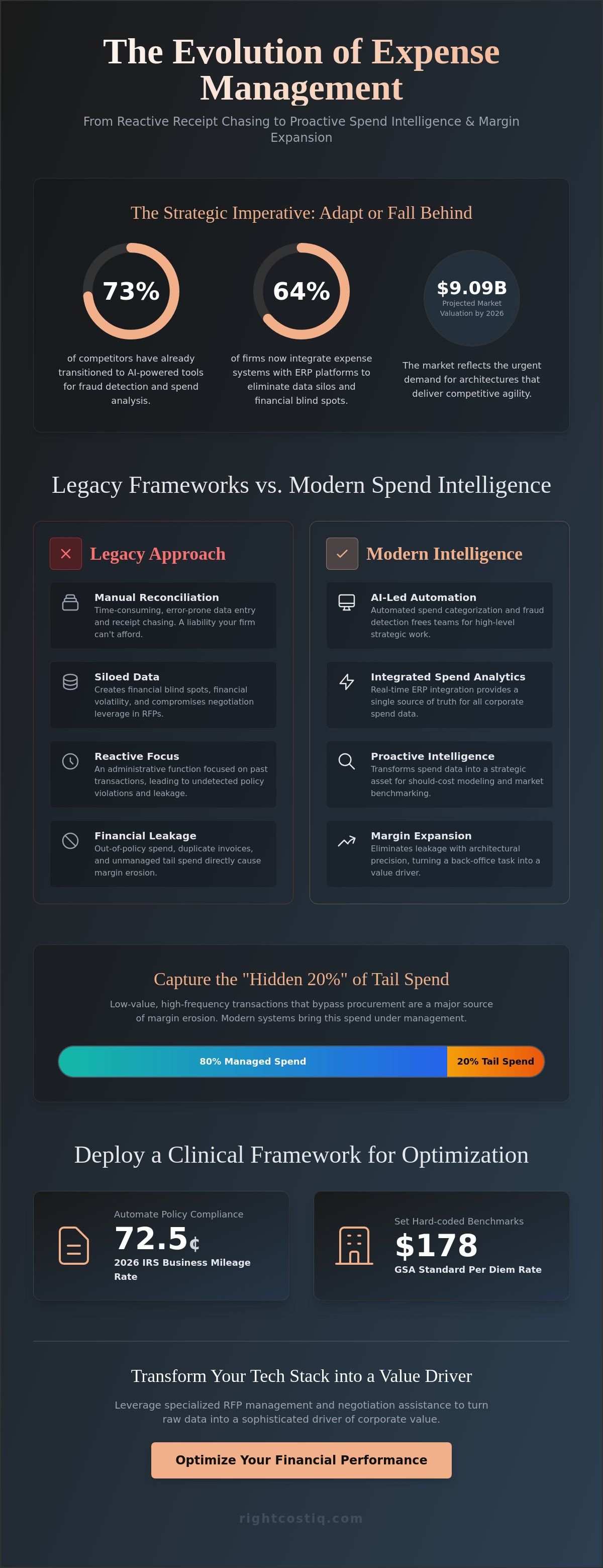
If you still view expense management as a clerical exercise in receipt tracking, you're missing the most potent lever for margin expansion in 2026. While 73% of your competitors have already transitioned to AI-powered tools for fraud detection, most firms remain trapped in a cycle of manual reconciliation and siloed data. You've likely felt the frustration of overpaying due to a lack of market price benchmarking; it's a systemic failure that turns back-office tasks into a significant financial leak.
This article provides a clinical comparison of legacy frameworks versus modern spend intelligence. You'll learn how to automate policy compliance using the 2026 IRS business mileage rate of 72.5 cents and the GSA standard per diem of $178 as hard-coded benchmarks. We'll outline the blueprint for integrating your expense data directly into a broader procurement strategy. By the end of this guide, you'll have the technical roadmap to transform your tech stack into a value driver that delivers absolute spend visibility and eliminates leakage with architectural precision.
Key Takeaways
- Evolve from reactive receipt chasing to proactive spend intelligence to unlock immediate margin expansion.
- Identify the strategic boundary between employee-led costs and procurement categories to capture the "Hidden 20%" of tail spend.
- Replace manual expense management cycles with AI-led architectures that provide real-time policy enforcement and integrated spend analytics.
- Deploy a clinical framework using commodity indexing and market price trending to ensure your policies align with actual market realities.
- Leverage specialized RFP management and negotiation assistance to transform raw data into a sophisticated driver of corporate value.
The Strategic Evolution of Expense Management in 2026
In the current fiscal year, sophisticated organizations have redefined expense management as a clinical process for identifying, authorizing, and auditing corporate spend. It's no longer a passive administrative function. It's a high-stakes strategic lever. This expense management overview highlights how the industry has pivoted from reactive receipt chasing toward proactive spend intelligence. Procurement is the new value driver, and firms that fail to treat their spend data as a strategic asset face immediate margin erosion. The high cost of visibility gaps is staggering; siloed data creates financial volatility that prevents leaders from making data-driven decisions during critical RFQ sprints.
The global market for these financial tools reflects this urgency, with an estimated valuation between $4.89 billion and $9.09 billion in 2026. Companies are no longer content with "good enough" accounting. They're demanding architectures that integrate directly into their ERP platforms. This shift ensures that every transaction is categorized and audited in real time, transforming a historically slow back-office task into a source of competitive agility.
From Clerical Tracking to Spend Intelligence
Manual data entry is a liability that your firm can't afford. As of April 2026, 73% of companies have implemented AI-powered tools for tracking and fraud detection. These AI-led systems move beyond simple OCR. They provide automated spend categorization that aligns with complex commodity indexing. This transition toward real-time financial transparency allows for immediate policy adjustments. When you move away from manual reconciliation, you free your financial team to focus on should-cost modeling and high-level strategy. Clinical precision in data capture is the only way to maintain a competitive cost structure in an increasingly automated landscape.
The Economic Impact of Inefficient Expense Visibility
Inefficiency creates leakage that directly impacts your bottom line. Out-of-policy spend and duplicate invoicing often go unnoticed in legacy systems, but these errors compound over time. Around 64% of companies now integrate their expense management systems with ERP platforms to eliminate these blind spots. Without this integration, your negotiation leverage in RFP cycles is severely compromised because you lack a comprehensive view of your tail spend. You can't negotiate what you can't see. Spend intelligence is the synthesis of raw data and market benchmarking. By utilizing market price trending and commodity indexing, a Strategic Architect can transform raw expense data into a powerful tool for margin expansion and long-term financial stability.
Expense Management vs. Procurement: Defining the Strategic Boundary
The distinction between employee-led expense management and strategic procurement is the line where clerical tracking ends and margin expansion begins. Most organizations erroneously treat these as separate silos. One is viewed as a reimbursement hurdle; the other is a contract negotiation function. However, the Strategic Architect recognizes that every dollar exiting the firm, regardless of its origin, must be subjected to clinical scrutiny. Employee-led spending often bypasses the rigorous "should-cost" modeling applied to major contracts, yet it forms the foundational data layer required to optimize your entire financial tech stack.
Procurement is the new value driver because it bridges the gap between individual transactions and enterprise-wide savings. When you integrate expense data with your procurement strategy, you eliminate the visibility gaps that lead to overpayment. This integration allows for a more sophisticated approach to vendor management, ensuring that even small, fragmented purchases align with the broader corporate objective of margin optimization.
Categorizing Spend: OpEx, CapEx, and Tail Spend
Effective spend intelligence requires a granular understanding of how funds are allocated across Operational Expenditure (OpEx) and Capital Expenditure (CapEx). While CapEx involves high-stakes, long-term investments, OpEx is where the "Hidden 20%" of Tail Spend typically resides. This unmanaged spend consists of low-value, high-frequency transactions that don't fall under traditional procurement contracts. Without a clinical framework, these small expenses aggregate into significant margin erosion. To capture this lost value, firms must move tail spend into managed categories by applying AI-led categorization and automated policy enforcement. This transition ensures that every transaction, no matter how minor, contributes to the bottom line.
For specialized categories such as SaaS, where unused subscriptions often lead to invisible leakage, you can visit LicenseIQ to discover and recover wasted spend on Microsoft 365 licenses through AI-native intelligence.
Spend Under Management (SUM) as a Key Performance Metric
Spend Under Management (SUM) is the primary metric for C-suite reporting because it correlates directly with corporate profitability. A higher SUM percentage indicates that a larger portion of company spend is being actively monitored, negotiated, and optimized. In 2026, top-performing firms aim for a SUM exceeding 85% by incorporating expense management data into their core procurement platforms. This visibility allows you to track vendor performance with clinical precision and identify duplicate invoicing before it impacts your cash flow. If your current architecture fails to provide this level of transparency, you may need to optimize your procurement tech stack to regain control over your financial cycles.
By treating expense data as a precursor to should-cost modeling, you gain the leverage needed for more effective RFQ sprints. This data-driven approach ensures that your negotiation strategy is based on actual market price benchmarking rather than historical estimates, securing your position as an industry leader in financial efficiency.
Comparison: Traditional Reporting vs. AI-Led Margin Expansion Platforms
Traditional reporting frameworks prioritize the speed of execution over the quality of the data captured. While many 2026 platforms boast about rapid reimbursement, a Strategic Architect understands that speed without benchmarking is just efficient overpayment. Modern expense management must evolve from a system of record into a system of intelligence. This requires moving beyond simple approval workflows that rely on human intervention and toward predictive guardrails that leverage real-time market price trending. If your platform only tells you what you spent yesterday, it isn't providing intelligence. It's providing history. True optimization requires forecasting tools that evaluate current spend against future commodity indexing to protect your margins before they're compromised.
Manual Reconciliation vs. Real-Time Policy Enforcement
Retrospective auditing is a structural failure. Catching an out-of-policy transaction three weeks after the spend has occurred is too late to preserve margin. By April 2026, 73% of organizations have deployed AI-led tools to automate fraud detection and policy enforcement. These systems act as immediate spend guardrails. They prevent non-compliant transactions before they hit the ledger. This proactive stance doesn't just eliminate leakage; it significantly reduces the cycle time for RFQ sprints. When your data is clean at the point of entry, your procurement team doesn't waste time on manual reconciliation during high-stakes negotiation cycles. Clinical precision at the point of purchase is the only way to ensure 100% policy compliance without increasing administrative headcount.
Siloed Data vs. Integrated Spend Intelligence
Standalone tools create data islands that blind your procurement strategy. When your expense management data is siloed from your broader ERP and vendor performance metrics, you lose the ability to perform accurate should-cost modeling. Approximately 64% of forward-thinking firms now integrate their spend platforms with their primary tech stack to create a single source of truth. This integration allows for advanced benchmarking against industry cost standards, such as the 2026 GSA standard lodging rate of $110 per night or the 72.5 cents per mile business rate. A unified architecture reveals whether you're overpaying for tail spend categories compared to market averages. It transforms fragmented receipts into a cohesive dataset that informs every RFx sprint and vendor negotiation. This clinical visibility ensures that procurement remains your primary value driver, turning every line item into a strategic asset rather than a clerical burden.
Implementing a Clinical Framework for Expense Optimization
Executing a clinical framework for expense management requires an architectural blueprint that transcends basic software installation. Organizations must move beyond static budgetary limits to category-specific, data-driven policies that reflect the volatile realities of 2026 supply chains. This shift involves utilizing clean sheet cost models to validate every expense category against theoretical minimums. Precision is mandatory. By establishing automated vendor compliance and performance tracking architectures, you ensure that every dollar spent aligns with your broader margin expansion goals. This methodical approach transforms raw data into a strategic asset, allowing for the identification of should-cost variances in real time.
This clinical precision should also extend to tax optimization and corporate finance. For organizations investing heavily in innovation, Recoup Capital provides the consultancy needed to maximize R&D tax credit claims, ensuring that research spend is leveraged for maximum financial return and margin expansion.
Developing Sophisticated Expense Policies
Sophisticated policies eliminate the ambiguity of "max spend" limits. Instead, they utilize category-specific guardrails that adjust based on market realities. For instance, your travel policy should reflect the GSA standard lodging rate of $110 per night and the meals and incidental expenses rate of $68 per day for FY 2026. Applying the IRS business mileage rate of 72.5 cents per mile ensures your reimbursement cycles are compliant and data-driven. This granularity prevents the margin erosion typically found in "one size fits all" policies. You must also ensure these guardrails align with broader supply chain compliance requirements to maintain a unified financial posture across all OpEx categories. If your current policy framework lacks this level of technical detail, it's time to optimize your expense management strategy with a clinical architecture.
Leveraging Market Price Trending for Better Outcomes
Market price trending provides the foresight necessary to anticipate price volatility before it impacts your bottom line. By integrating forecasting models into your tech stack, you can identify service-based expense categories where costs are likely to escalate. This data serves as a powerful negotiation lever during RFQ sprints, allowing you to secure favorable terms based on commodity indexing rather than historical averages. Commodity indexing protects margins during inflationary periods. This integration ensures that your procurement team is not just reacting to price changes but is actively positioning the firm for long-term financial stability. Utilizing these AI-led insights allows for the dynamic adjustment of service caps, ensuring that your organization remains agile in a fast-paced economic environment. Procurement is the new value driver, and leveraging these sophisticated models is the only way to achieve clinical precision in spend visibility.
Optimizing Financial Performance with RightCostIQ
RightCostIQ serves as the Strategic Architect for organizations demanding clinical precision in their financial operations. We move beyond the administrative limitations of legacy expense management by treating every transaction as a primary data point for margin expansion. Our platform doesn't just record spend; it audits it against the 2026 GSA standard per diem of $178 and the 72.5 cents per mile business rate to ensure absolute policy compliance. By integrating real-time analytics with professional negotiation assistance, we transform fragmented financial cycles into a unified value driver. This methodical approach ensures that your tech stack functions as a proactive guardrail rather than a retrospective ledger.
AI-Led Procurement and Margin Expansion
RightCostIQ differentiates itself from generic software providers by focusing on the synthesis of AI-led analytics and expert execution. Our should-cost modeling identifies variances between actual spend and market benchmarks, providing the leverage necessary for successful RFQ sprints. This methodology ensures that enterprise procurement outcomes are driven by clinical data rather than historical inertia. We provide clean sheet cost models that strip away vendor margins to reveal the true cost of services. This level of execution allows our partners to achieve significant margin expansion in tail spend categories, often identifying savings that generic platforms overlook. Procurement is the new value driver, and our architecture ensures your firm captures every available dollar through relentless optimization.
RightCostIQ Academy: Upskilling for Competitive Advantage
Technical upskilling is the prerequisite for financial leadership in the era of AI-driven finance. The RightCostIQ Academy prepares your team to execute sophisticated cost models and manage complex commodity indexing with precision. We transition your staff from administrative roles to strategic roles, focusing on prompt engineering and spend intelligence. This investment in human capital ensures that your expense management tech stack is utilized to its full potential. Our curriculum focuses on the pragmatic realities of negotiation and market price trending, providing a competitive advantage that software alone cannot replicate. It's time to move past clerical tracking and embrace a clinical framework for financial optimization. You can optimize your procurement architecture with RightCostIQ today to secure your firm's fiscal future.
Architecting a High-Performance Financial Future
Transitioning from clerical tracking to clinical spend intelligence is no longer optional for firms targeting sustainable margin expansion. By 2026, leading organizations will have replaced reactive expense management with AI-led architectures that provide real-time policy enforcement and market price trending. Integrating should-cost modeling and commodity indexing transforms fragmented data into a powerful negotiation lever. This strategic shift eliminates visibility gaps that lead to financial volatility and missed savings opportunities.
RightCostIQ provides the specialized tools and expertise required to execute this transition with precision. Our AI-Led Procurement solutions are engineered for complex cost structures, utilizing a proprietary RFQ Sprint methodology to deliver rapid optimization. We combine deep expertise in forecasting with professional negotiation assistance to ensure every transaction contributes to your bottom line. It's time to reclaim your margins and lead your industry with data-driven confidence.
Optimize your enterprise margin expansion with RightCostIQ's strategic procurement frameworks.
Frequently Asked Questions
What is the primary difference between expense management and spend management?
Expense management focuses on employee-initiated transactions like travel and office supplies, while spend management encompasses the entire organizational procurement lifecycle. Spend intelligence acts as the analytical layer across both to drive margin expansion. This holistic view ensures that OpEx and CapEx categories are optimized through a single, clinical framework that treats every dollar as a strategic asset.
How does AI-led procurement improve expense policy compliance?
AI-led procurement implements real-time guardrails that prevent non-compliant transactions before they occur. With 73% of organizations deploying these tools by April 2026, manual reconciliation is becoming obsolete. These systems automatically audit receipts against benchmarks like the 2026 IRS 72.5 cents mileage rate; this eliminates leakage and ensures 100% policy adherence without increasing administrative headcount.
What is Spend Under Management (SUM) and why does it matter for CFOs?
Spend Under Management represents the percentage of total corporate spend that is actively monitored and negotiated by the procurement team. For CFOs, increasing SUM toward the 85% benchmark is a primary driver of corporate profitability. High SUM visibility allows for more accurate should-cost modeling and protects the firm from the financial volatility caused by unmanaged tail spend.
Can expense management software help with RFP management and vendor negotiations?
Yes, modern expense management data provides the granular visibility required for effective RFP management and vendor negotiations. This data allows for the creation of clean sheet cost models that reveal actual vendor margins. By utilizing this intelligence during RFQ sprints, organizations negotiate from a position of data-driven authority rather than relying on historical estimates.
How do market price trending and forecasting models impact expense control?
Market price trending and forecasting models transform static budgets into dynamic spend guardrails. Instead of relying on fixed annual limits, these models adjust based on commodity indexing and inflation data. This proactive approach ensures that travel and service caps reflect actual market realities, such as the FY 2026 GSA $110 lodging rate, preventing margin erosion during volatile economic cycles.
What are the common challenges when integrating expense analytics into an existing ERP?
The primary challenge is overcoming siloed data structures that prevent a unified view of company spend. Approximately 64% of firms integrate their systems with ERP platforms to solve this, yet many struggle with the "Hidden 20%" of fragmented tail spend. Successful integration requires a clinical architecture that categorizes raw data into actionable intelligence for the procurement team.
How does RightCostIQ assist in identifying savings within tail spend categories?
RightCostIQ utilizes proprietary RFQ Sprints and AI-driven categorization to illuminate savings within fragmented tail spend categories. Our architecture identifies should-cost variances that generic software misses. By applying clinical execution to these low-value, high-frequency transactions, we capture the margin expansion opportunities hidden within your existing expense management data and transform them into bottom-line results.
Why is 'clean sheet cost modeling' essential for modern expense management?
Clean sheet cost modeling is essential because it establishes the theoretical minimum cost for a product or service. This methodology strips away vendor overhead and profit margins to define what a category "should cost" in reality. Modern finance teams use this clinical benchmark to validate expense categories and ensure that negotiation outcomes align with enterprise-wide optimization goals.


