
Most procurement teams are negotiating in the dark because they mistake a supplier's quote for market reality. You likely recognize the friction caused by opaque pricing structures and the difficulty of justifying aggressive savings targets to a results-oriented C-suite. With procurement workloads projected to increase by 8.0% in 2026 while budgets contract, the need for data-driven precision is urgent. Creating a should-cost model for procurement is the only way to bridge this visibility gap and reclaim strategic control over your category spend.
By mastering the architectural process of building precision should-cost models, you can eliminate pricing opacity and secure maximum negotiation leverage. This clinical framework shifts the power dynamic from the supplier to the procurer through absolute transparency. We'll examine the essential components of technical cost decomposition, the integration of real-time market intelligence, and the methodology for transforming fragmented data into a defensible negotiation weapon. This approach ensures your team operates with the analytical authority required to drive measurable financial growth and operational efficiency in an increasingly volatile global market.
Key Takeaways
- Transition from reactive price-based sourcing to a strategic bottom-up architecture that exposes hidden supplier margins and structural inefficiencies.
- Master the 5-step technical framework for creating a should-cost model for procurement to establish a defensible, data-backed baseline for every major spend category.
- Deconstruct the value chain by analyzing regional labor variances and raw material price trending to effectively counteract pricing opacity.
- Empower negotiation teams with precise target prices and tactical frameworks to neutralize supplier objections regarding proprietary cost structures.
- Integrate automated category cost benchmarking to validate model assumptions and ensure a measurable, repeatable reduction in total category spend.
The Strategic Architecture of Should-Cost Modeling in 2026
Procurement success in the current economic climate is no longer defined by simple bid comparisons. Creating a should-cost model for procurement represents a fundamental shift from reactive price-based negotiation to clinical cost transparency. Unlike traditional methods that rely on historical pricing or supplier quotes, should-cost modeling utilizes a bottom-up analysis of material, labor, overhead, and margin components. This methodology provides a comprehensive cost estimation overview that exposes the structural reality of a supplier's pricing, stripping away the opacity that often hides inefficient processes or excessive markups.
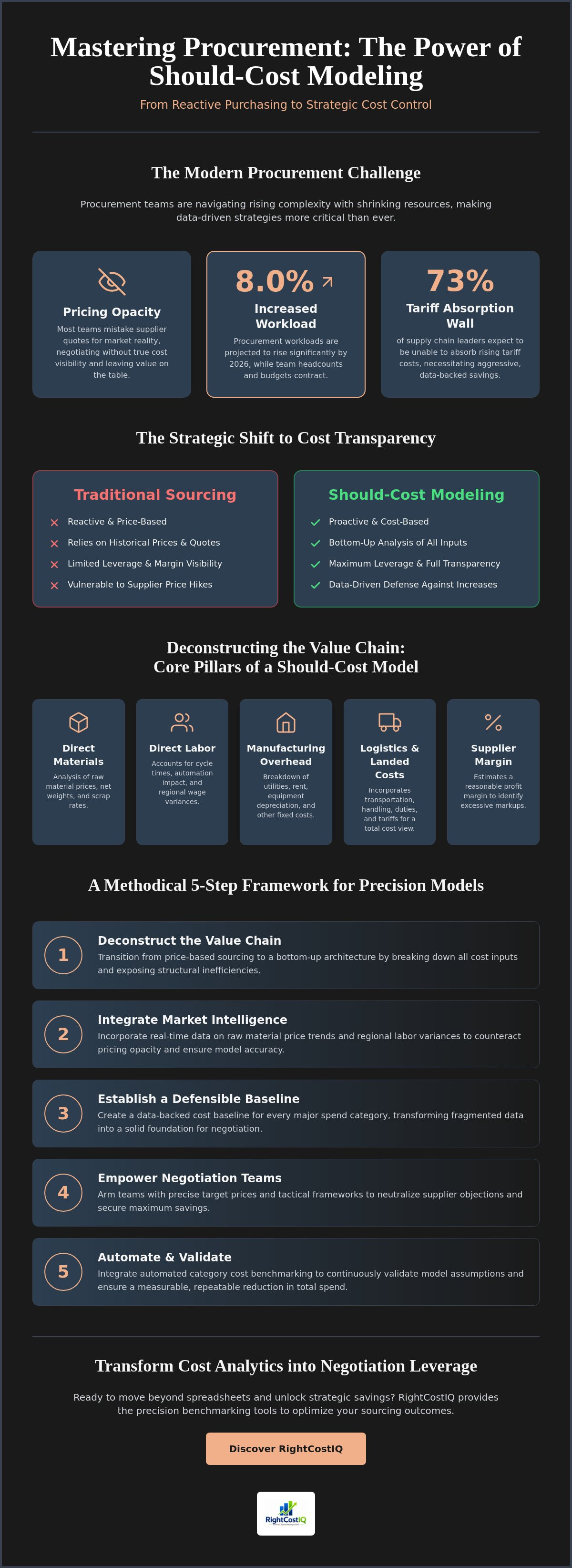
The economic imperative for this level of granularity is absolute. Research indicates that 73% of supply chain leaders expect to reach their tariff absorption wall by the end of 2026, meaning organizations can't afford to absorb rising costs without a data-driven defense. A precision should-cost model acts as the primary driver for identifying category savings, allowing teams to challenge price increases with empirical data rather than anecdotal evidence. It's a strategic architecture designed for a world where top-tier CPO teams allocate 24% of their budgets to technology to bridge the widening productivity gap caused by shrinking headcounts and expanding workloads.
Beyond the Spreadsheet: The Strategic Imperative
Should-cost models function as a clinical diagnostic tool for margin leakage. They transform procurement from a reactive purchasing function into a proactive cost-management engine. By understanding the granular cost drivers of a category, teams can predict how market shifts will impact future pricing. This foresight is critical for supply chain resilience. It allows firms to identify which suppliers are truly efficient and which are simply passing through their own operational waste. This level of insight is essential when creating a should-cost model for procurement that actually delivers measurable results.
Financial Growth Metrics and Operational Efficiency
Accuracy in cost modeling correlates directly to EBITDA improvements. When procurement justifies savings targets with data-backed leverage, the C-suite gains confidence in the department's ability to drive bottom-line growth. Modern cost intelligence also reduces RFP cycle times by establishing clear target price ranges before the first bid is even received. This efficiency is vital as procurement workloads increase by 8.0% while staffing levels decline by 0.9%. The "Strategic Architect" persona emerges here, moving beyond transactional duties to become a high-level consultant focused on technical upskilling and competitive advantage. Through this clinical framework, procurement functions as a primary driver for financial growth.
Deconstructing the Value Chain: Core Components of a Should-Cost Framework
Precision in creating a should-cost model for procurement requires a clinical decomposition of the supplier's financial ecosystem. A robust model doesn't guess at prices; it reconstructs them using five primary cost pillars. Direct material costs form the foundation, necessitating an analysis of net weights, scrap rates, and volatile raw material price trending. Direct labor requirements follow, where analysts must account for cycle times, regional wage variances, and the increasing impact of automation on total output. This level of rigor mirrors established government procurement should-cost concepts, which prioritize efficiency and economic transparency over simple market averages.
Direct vs. Indirect Cost Drivers
Distinguishing between variable costs that scale with volume and fixed overhead structures is essential for model accuracy. Clinical precision is required when estimating energy consumption in heavy manufacturing, as utility volatility can swing margins by double digits. By integrating Market Price Trending into direct material forecasting, procurement architects can predict cost shifts before they manifest in supplier quotes. This proactive stance transforms the model from a static document into a dynamic strategic asset. If you're ready to modernize your approach, you can evaluate your current category transparency with a specialized audit.
The Supplier Margin Paradox
Identifying "fair profit" benchmarks is the final step in neutralizing pricing opacity. Suppliers often mask excessive profit within SG&A (Selling, General, and Administrative) expenses or inflated overhead allocations. Red flags include overhead structures that scale linearly with volume or administrative costs that exceed industry norms. Utilizing Procurement Category Cost Benchmarking allows teams to validate component estimates against verified market data. This data-backed leverage is the primary driver for reclaiming strategic control during high-stakes negotiations, ensuring that profit remains reasonable and defensible rather than exploitative.
A Methodical 5-Step Process for Creating a Precision Should-Cost Model
Execution of a high-leverage sourcing strategy requires a repeatable, clinical logic. Creating a should-cost model for procurement is not a one-time calculation; it's a dynamic architectural process. Precision execution demands that teams move beyond surface-level quotes to deconstruct the actual value of a category. This 5-step framework provides the technical roadmap for building a defensible cost baseline that suppliers cannot ignore.
- Step 1: Define Scope and Granularity. Identify the specific category or SKU. Determine the level of detail required based on the total spend and strategic importance of the item.
- Step 2: Collect Multi-Source Data. Gather primary data from internal RFP cycles and secondary market intelligence. This is where should-cost modeling gains its authority, utilizing external benchmarks to challenge internal assumptions.
- Step 3: Build Bottom-Up Architecture. Assemble the cost pillars identified in the value chain analysis. Assign specific values to materials, labor, and overhead based on industry-standard benchmarks.
- Step 4: Validate and Calibrate. Compare the model output against historical spend patterns and current market price trends. Identify any significant variances that require manual adjustment.
- Step 5: Perform Sensitivity Analysis. Stress-test the model against external shocks. Creating a should-cost model for procurement is only effective if it accounts for the volatility inherent in global supply chains.
Data Sourcing and Integrity
Data integrity is the foundation of a defensible model. Extracting granular cost drivers from RFP Management cycles allows teams to see exactly how different suppliers allocate their overhead. Analysts must normalize this data across disparate quotes to ensure a true comparison. Clinical execution requires utilizing third-party sources for global labor rates and material indices to validate supplier claims. This rigorous normalization prevents "garbage-in, garbage-out" scenarios that undermine negotiation credibility.
Sensitivity Analysis and Scenario Planning
Static models fail in volatile markets. Procurement architects must model the impact of 5%, 10%, and 20% fluctuations in raw material pricing to understand margin risk. Currency exchange rate shifts also drastically affect total landed costs for global sourcing. Integrating Price Risk Management into the final output ensures the model remains relevant as market conditions evolve. This proactive scenario planning transforms the should-cost model from a historical report into a predictive tool for long-term category management and financial growth.
Transforming Cost Analytics into Negotiation Leverage
Data is a secondary asset until it is applied tactically at the negotiation table. Creating a should-cost model for procurement provides the empirical foundation required to define a precise "Target Price" and a defensible "Walk-Away Price." Instead of engaging in arbitrary haggling, teams enter the room knowing the exact threshold where a supplier’s margin transitions from fair to exploitative. This level of clinical transparency effectively neutralizes the most common supplier defense: the claim that their cost structure is proprietary. When you present a model built on verified material indices and regional labor benchmarks, the burden of proof shifts back to the vendor to justify any variance from the data.
This shift in the power dynamic forces a transition toward an "Open-Book" negotiation environment. Discussions evolve from simple price reductions to a collaborative analysis of structural value drivers. By focusing on the granular components of the quote, procurement architects identify where a supplier’s internal inefficiencies are driving up the final bid. This data-driven leverage serves as the primary engine for margin expansion during high-stakes sourcing events, ensuring that every dollar spent is tied to a verifiable cost component.
The Negotiation Coach Framework
Strategic success depends on the ability to challenge supplier overhead claims with declarative, data-backed statements. Rather than requesting a generic discount, use the should-cost model to propose specific "Cost-Plus" or "Index-Based" contract structures. These frameworks protect both parties from the market volatility expected through 2026, tying price adjustments to objective market shifts rather than supplier whim. This methodology ensures that your contracts remain competitive over their entire lifecycle. For complex categories requiring specialized expertise, utilizing professional Negotiation Assistance can bridge the gap between technical analysis and successful deal closure.
Identifying and Eliminating Non-Value-Added Costs
The should-cost model functions as a diagnostic tool to target specific inefficiencies in a supplier's manufacturing or service delivery process. You aren't just negotiating for a lower margin; you are negotiating for a more efficient value chain. If the model reveals that a supplier’s energy consumption or scrap rate is 15% higher than industry benchmarks, that inefficiency becomes a focal point for process improvement. Quantifying these improvements provides the measurable ROI necessary for C-suite buy-in. It transforms procurement from a cost center into a strategic partner capable of delivering direct EBITDA impact. To see how your current strategies measure up against these precision standards, access our category transparency diagnostic today.
Optimizing Sourcing Outcomes with RightCostIQ’s Precision Benchmarking
Scaling the clinical framework of cost decomposition requires a move away from manual, error-prone calculations toward a centralized intelligence platform. RightCostIQ provides the technological infrastructure to integrate automated cost benchmarking directly into your existing procurement infrastructure. This integration transforms the labor-intensive task of creating a should-cost model for procurement into a streamlined, high-speed strategic function. By utilizing proprietary data sets to validate should-cost assumptions instantly, teams eliminate the research lag that typically compromises high-stakes negotiation timelines. This speed is essential as procurement workloads are projected to increase by 8.0% through 2026, demanding higher productivity from leaner departments.
Data-driven target pricing ensures that the RFP process is no longer a fishing exercise but a targeted strike. Procurement architects use these models to pre-filter supplier bids, identifying which vendors align with structural cost realities before formal discussions begin. This precision leads to sustainable margin expansion by establishing a baseline for clinical vendor performance tracking. When price adjustments are tied to objective market price trending rather than supplier claims, the organization secures long-term financial growth and protects its EBITDA from the "tariff absorption wall" facing 73% of supply chain leaders by the end of 2026.
The RightCostIQ Advantage: Clinical Precision
RightCostIQ automates the most labor-intensive phases of value chain deconstruction. The platform creates a synergy between market price trending and real-time cost analytics, allowing for a seamless transition from static spreadsheets to a strategic cost intelligence platform. This automation is the primary driver for efficiency, enabling the process of creating a should-cost model for procurement to occur at scale across hundreds of SKUs simultaneously. It replaces anecdotal supplier feedback with a clinical, data-backed reality, ensuring that every sourcing decision is grounded in technical cost decomposition and market-verified benchmarks.
Next Steps for Strategic Procurement Leaders
Transitioning to a data-first procurement culture requires immediate, methodical action. Leaders should begin by auditing current category strategies to identify areas of pricing opacity and significant margin leakage. Implementing a pilot should-cost program for high-impact spend categories allows the team to demonstrate measurable ROI to the C-suite quickly. To maximize the impact of these analytical insights, consult with a Negotiation Coach to refine your team's data-driven approach. This technical upskilling ensures that your staff can confidently challenge proprietary supplier cost structures and secure the maximum leverage required for operational efficiency and competitive advantage.
Reclaiming Strategic Authority in Category Sourcing
Success in 2026 demands a transition from reactive purchasing to clinical cost architecture. By deconstructing the value chain and applying a methodical 5-step process, teams move beyond the opacity of supplier quotes to a defensible market reality. Creating a should-cost model for procurement is no longer an optional analytical exercise; it's the primary driver for margin expansion and long-term supply chain resilience. This framework ensures that your negotiation leverage is grounded in empirical data rather than anecdotal market sentiment.
To institutionalize these gains, procurement leaders must integrate advanced technology into their traditional business functions. RightCostIQ provides the specialized tools necessary to bridge the productivity gap and deliver measurable category savings. Leverage our clinical RFP management frameworks and proprietary cost benchmarking analytics to validate your sourcing assumptions instantly. You can also refine your data-driven approach by utilizing our expert-led negotiation coach services. Optimize your procurement outcomes with RightCostIQ’s precision should-cost modeling and negotiation assistance. Reclaiming control over your category spend starts with absolute transparency.
Frequently Asked Questions
What is the primary difference between a should-cost model and a quote analysis?
Quote analysis is a reactive process that compares different supplier bids against one another to find the most competitive offer. Creating a should-cost model for procurement is a proactive, bottom-up reconstruction of what a product or service actually costs to produce. While quote analysis tells you what the market is asking, should-cost modeling tells you what the market reality is by deconstructing material, labor, and overhead components.
How accurate does a should-cost model need to be to be effective in negotiations?
Clinical precision within a 5% to 10% variance is typically sufficient to secure maximum negotiation leverage. You don't need accounting-level perfection to challenge a supplier's pricing opacity. As long as your model is built on defensible regional benchmarks and verified material indices, it shifts the burden of proof to the supplier to justify any significant deviations from your data-backed baseline.
Can should-cost modeling be applied to service-based procurement categories?
Yes, service categories are modeled by deconstructing direct labor hours, regional wage variances, and administrative overhead structures. Creating a should-cost model for procurement in services allows you to move the discussion from a flat hourly rate to a clinical analysis of utilization and efficiency. This approach identifies margin padding in "general and administrative" allocations that often hide significant non-value-added costs.
What data sources are most reliable for building an international should-cost model?
Reliable international modeling requires a combination of global material indices, such as the London Metal Exchange (LME), and regional labor data from the International Labour Organization (ILO). You should also integrate local utility rates and logistics benchmarks to account for total landed costs. These third-party sources provide the empirical foundation necessary to neutralize supplier claims about proprietary or localized cost structures.
How often should a should-cost model be updated to remain relevant?
Models should be updated quarterly or immediately following significant market volatility in raw material prices or currency exchange rates. Static models lose their strategic utility in the face of shifting global trade policies and labor regulations. Maintaining a rhythmic update cycle ensures your negotiation team always operates with current intelligence, protecting your EBITDA from unexpected supply chain shocks.
Is should-cost modeling effective for low-spend "tail spend" categories?
Full bottom-up modeling is rarely cost-effective for tail spend due to the high resource requirements of data collection and validation. Strategic architects focus these clinical diagnostic tools on high-spend, high-impact categories where margin expansion delivers a measurable ROI. For low-spend items, utilize automated benchmarking tools rather than a granular 5-step modeling process to maintain operational efficiency.
How do I handle a supplier who refuses to share their cost breakdown?
When a supplier claims their cost structure is proprietary, use your should-cost model to present your own data-backed estimate of their costs. This reversal forces the supplier to either accept your target price or provide specific evidence to refute your model. By presenting a clinical decomposition of their value chain, you eliminate their ability to hide behind opaque pricing structures.
What software is best for creating and managing should-cost models at scale?
Specialized procurement intelligence platforms are superior to manual spreadsheets for managing complex cost architectures at scale. RightCostIQ integrates automated cost benchmarking and market price trending to validate your assumptions instantly. This technology allows procurement teams to maintain clinical precision across hundreds of categories, transforming raw data into actionable negotiation leverage without the labor-intensive research lag.


