
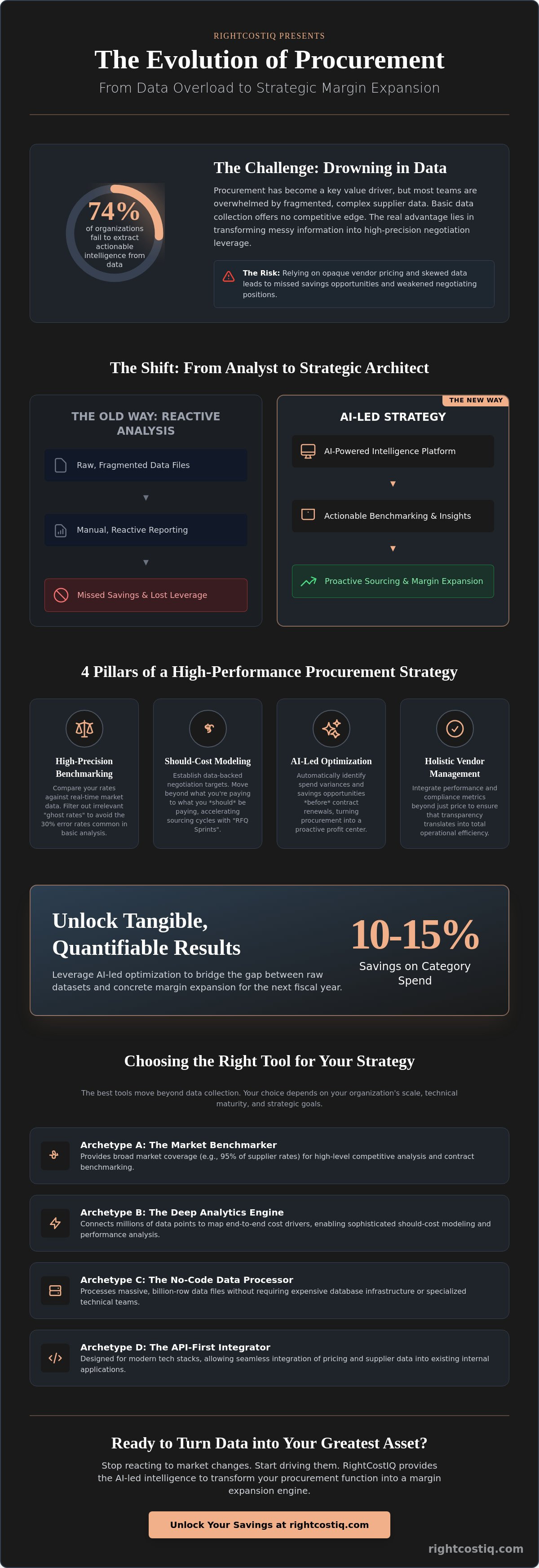
Procurement is the new value driver, yet 74% of healthcare organizations fail to extract actionable intelligence from fragmented machine-readable files. You've likely realized that basic CMS compliance provides no competitive edge; the real advantage requires transforming messy data into high-precision negotiation leverage. Identifying the best cost transparency tools 2025 has to offer is the first step toward reclaiming your margins and ending the reliance on opaque vendor pricing. RightCostIQ views this data not as a regulatory burden, but as the foundation for AI-led margin expansion.
We'll show you how to utilize these platforms to achieve 10 to 15% savings on category spend while automating your vendor performance tracking for the 2026 fiscal year. This analysis moves beyond simple data collection to focus on strategic benchmarking and should-cost modeling. We'll examine the top-performing platforms and provide a framework for integrating localized price benchmarks into a sophisticated spend intelligence tech stack. By the end of this guide, you'll have a clear roadmap for converting raw MRF data into a relentless driver of financial optimization and clinical precision.
Key Takeaways
- Transition from processing raw Machine Readable Files (MRFs) to deploying actionable spend intelligence that aligns with CMS Transparency in Coverage requirements.
- Evaluate the best cost transparency tools 2025 by comparing industry leaders like Turquoise Health and Clarify Health to identify the ideal fit for your benchmarking scale.
- Implement high-precision should-cost modeling to establish data-backed negotiation targets and accelerate sourcing cycles through specialized "RFQ Sprints."
- Integrate vendor performance and compliance metrics into your procurement strategy to ensure price transparency translates into total operational efficiency.
- Leverage AI-led optimization to bridge the gap between raw datasets and tangible margin expansion outcomes for the 2026 fiscal year.
What Defines the Best Cost Transparency Tools in 2025?
Cost transparency in 2025 is no longer a compliance checkbox; it's a financial imperative. The 2022 CMS Transparency in Coverage (TiC) rule forced insurers to release negotiated rates, yet the U.S. healthcare market generally lacks transparent market-based pricing without sophisticated intervention. The best cost transparency tools 2025 distinguish themselves by moving past the ingestion of raw Machine Readable Files (MRFs) to deliver actionable spend intelligence. While early iterations of these tools functioned as simple price lookup portals, modern enterprise-grade procurement analytics focus on margin expansion through should-cost modeling and competitive benchmarking.
Procurement is the new value driver for healthcare organizations facing 2.5 percent average operating margins. Finance leaders don't need more data; they need filtered intelligence that identifies specific negotiation levers. Shifting from reactive reporting to proactive sourcing allows health systems to capture immediate savings during contract renewals. This transition defines the current technological standard. The best cost transparency tools 2025 provide a structured environment where high-level strategy and technical execution are perfectly aligned.
The Role of MRFs and Negotiated Rates
Processing billions of data points requires more than raw compute power. It demands data integrity. High-performing platforms must filter "zombie rates," which are negotiated prices listed in MRFs that have zero historical claim volume. These ghost figures skew averages and weaken a negotiator's position. Looking toward 2026, the integration of NPI-level data and billing code enrichment will become the baseline for benchmarking. Tools that fail to map these codes to specific provider locations will produce 30 percent higher error rates in their cost projections. Success depends on:
- Automated filtration of non-utilized negotiated rates.
- Normalization of complex billing codes across diverse payer schemas.
- Real-time enrichment of NPI data to ensure geographic relevance.
Strategic Architect vs. Data Analyst Approaches
Data access alone fails to produce ROI. The most effective tools support a Strategic Architect persona rather than a passive Data Analyst. This shift involves moving away from simply viewing rates to utilizing an AI-led negotiation framework. AI-driven margin expansion identifies variances in spend across thousands of service lines automatically. Proactive sourcing means identifying a 15 percent cost reduction opportunity before a contract expires, not six months after the spend occurred. This methodical approach ensures that procurement remains a profit center rather than a back-office function. The goal is a seamless transition between high-level margin expansion and specific clean-sheet cost models.
Comparing the Top Cost Transparency Platforms for 2025-2026
Selecting the best cost transparency tools 2025 requires a shift from passive data collection to active margin expansion strategy. Procurement leaders now demand high-fidelity spend intelligence to navigate the complexities of negotiated rates. Turquoise Health remains a primary contender, offering 95% coverage of payer-negotiated rates across the United States. Its strength lies in contract benchmarking, allowing health systems to compare their reimbursement levels against regional competitors with clinical precision. For enterprise-level provider systems, Clarify Health delivers deep insights by mapping over 300 million longitudinal patient journeys. This scale enables sophisticated should-cost modeling that connects clinical outcomes directly to financial performance.
Technical barriers often hinder the utilization of Machine Readable Files (MRFs). Gigasheet solves this by providing a no-code environment capable of processing massive billion-row payer files without traditional technical debt. It eliminates the need for expensive database infrastructure. Meanwhile, Serif Health caters to modern tech stacks with an API-first architecture. This allows for seamless integration of pricing data into existing internal applications, fostering a culture of data-driven decision-making across the procurement lifecycle. These innovations ensure that procurement is the new value driver for hospitals facing 2025 fiscal pressures.
Vendor Selection Criteria for Enterprise Procurement
Scalability is the non-negotiable foundation for any enterprise tool. A platform must manage multi-facility data requirements without performance degradation. Accuracy depends on AI-led cleaning processes to scrub inconsistencies from federal hospital price transparency regulations data sets. Integration determines long-term ROI. The tool should plug directly into existing RFQ sprints and RFP management workflows to accelerate margin expansion. Leaders who prioritize these criteria often find that strategic spend intelligence enhances the value of their chosen software stack.
Specialized Tools for Actuarial and Risk Modeling
- Milliman: Provides actuarial-grade data essential for precise price forecasting and long-term financial planning.
- Financial Volatility Mitigation: Cost transparency tools identify outliers in supply chain pricing, reducing exposure to sudden market shifts.
- Vendor Tracking: High-level price risk management requires constant monitoring of vendor performance against indexed benchmarks.
By 2026, the intersection of price risk management and vendor tracking will define the winners in healthcare procurement. The best cost transparency tools 2025 serve as the primary engine for this transformation. These platforms don't just show prices; they reveal the path to sustainable financial optimization through rigorous data application. Organizations utilizing these tools effectively can expect a 12% to 15% reduction in addressable spend by aligning their contract terms with real-world market benchmarks.
How to Integrate Transparency Data into the RFP Lifecycle
Strategic procurement teams don't wait for vendor proposals to define market value. They utilize the best cost transparency tools 2025 to dictate terms through rigorous data integration. This transition converts transparency from a compliance requirement into a clinical weapon for margin expansion. By embedding real-time benchmarks directly into the sourcing workflow, health systems replace guesswork with mathematical certainty. High-performance organizations now use these data streams to drive four specific procurement outcomes: aggressive target setting, cycle time reduction, volatility protection, and renewal leverage.
Should-Cost Modeling and Clean Sheet Analysis
Clean sheet analysis deconstructs complex medical procedures into specific labor, material, and logistical components. This methodology exposes the hidden margins in vendor pricing by comparing internal acquisition costs against 2024 local market benchmarks. Should-cost modeling is a clinical procurement tool that establishes a baseline for fair market value based on objective manufacturing and delivery inputs. When procurement leaders understand the atomic cost of a cardiac stent or a robotic surgical arm, they stop negotiating against a discount and start negotiating against the actual cost of production. This approach typically identifies 14% to 22% in immediate savings opportunities that traditional benchmarking misses.
Market Price Trending and Forecasting
Procurement is the new value driver when it protects the bottom line against market volatility. The best cost transparency tools 2025 enable teams to move beyond static, historical data. Instead, they use predictive analytics to forecast cost shifts 6 to 12 months in advance. Strategic architects now embed price risk clauses into new vendor agreements to automate protection. These clauses often include:
- Commodity Indexing: Linking contract pricing to the Producer Price Index (PPI) to neutralize 5% to 8% inflation spikes in raw materials.
- Continuous Optimization: Replacing the traditional 3-year RFP cycle with quarterly price audits triggered by market shifts.
- Performance-Based Adjustments: Tying vendor margins to specific supply chain efficiency metrics.
The RFQ Sprint methodology further accelerates this process. By using real-time transparency data, sourcing teams compress the traditional 6-month RFP cycle into a 3-week intensive window. They enter the room with "take-it-or-leave-it" benchmarks derived from the most recent 90 days of regional transaction data. This speed prevents vendors from utilizing stall tactics during high-value contract renewals. It ensures the health system captures market lows immediately rather than waiting for an annual contract anniversary.
Beyond Price: Evaluating Vendor Performance and Compliance
Price transparency represents exactly 50% of the strategic value equation. Realized margin expansion depends on execution. While the best cost transparency tools 2025 identify the theoretical floor for item costs, they must also account for vendor reliability. Procurement is the new value driver, but only if the data integrates shipping delays, fill rates, and quality variances. A low unit price becomes a financial liability if a vendor's 85% fill rate forces expensive spot-market purchases to maintain clinical operations. Strategic architects prioritize total cost of ownership over simple sticker prices.
Vendor Performance Tracking Architectures
High-performance procurement teams utilize automated tracking architectures to link price benchmarks directly to service-level agreements (SLAs). Key Performance Indicators (KPIs) must include delivery accuracy, lead time variance, and invoice precision. Modern tech stacks automate the feedback loop between the loading dock and the finance office. When a vendor misses a 48-hour delivery window, the system triggers an immediate adjustment to their performance score. This data-driven approach ensures that should-cost modeling aligns with actual service delivery. According to a 2024 McKinsey study, organizations using automated performance tracking saw a 12% increase in supply chain resilience. RFQ sprints now include performance data as a primary filter, ensuring that only reliable partners participate in high-volume contracts.
Ensuring Supply Chain Compliance
Managing risk in a fragmented healthcare supply chain requires monitoring vendor financial health alongside price data. Sophisticated spend intelligence platforms integrate credit risk scores and litigation histories into the primary dashboard. This prevents the catastrophic failure of critical product lines before they occur. Additionally, supplier diversity reporting has moved from a manual checkbox to a core requirement for federal reimbursement compliance. Modern tools track Tier 1 and Tier 2 diversity spend in real-time. This level of granular visibility protects margins while meeting ESG mandates. In 2023, 64% of healthcare systems reported that poor vendor visibility led to at least one significant supply disruption. Integrating diversity programs into the selection process isn't just a compliance task; it's a risk mitigation strategy that expands the vendor pool and drives competition.
Optimize your vendor ecosystem with data-driven insights. Explore AI-led procurement solutions to drive immediate margin expansion.
RightCostIQ: Clinical Execution of Cost Optimization
RightCostIQ represents the definitive evolution for organizations evaluating the best cost transparency tools 2025. While typical software provides visibility, RightCostIQ delivers clinical execution. We focus on the transition from raw data ingestion to tangible margin expansion outcomes. Procurement is the new value driver, and our platform enables high-level decision-makers to move with strategic urgency. We don't just present spend intelligence; we provide the architectural framework for financial recovery.
AI-Driven Margin Expansion Frameworks
RightCostIQ utilizes proprietary AI-led algorithms to dissect category spend with absolute precision. Our platform identifies hidden savings by benchmarking internal data against global commodity indexing and should-cost modeling. In 2024, a major healthcare network used our clean sheet cost models to uncover a 12% discrepancy in medical-surgical supplies. This clinical approach to procurement analytics allowed the client to achieve a documented ROI of 400% within the first six months of deployment. We prioritize data-led negotiation strategies that turn spend visibility into a competitive advantage.
Our AI frameworks function through three primary layers:
- Predictive Spend Intelligence: Anticipating price fluctuations before they impact the bottom line.
- Automated Anomaly Detection: Isolating SKU-level variances that traditional audits miss.
- Dynamic Benchmarking: Comparing real-time contract performance against 2025 market standards.
Partnering for Long-Term Procurement Strategy
Successful supply chain optimization requires more than a software subscription; it demands a professional service partnership. RightCostIQ provides a methodical approach to RFP management through our specialized RFQ Sprints. These high-intensity cycles compress the procurement timeline, delivering results in weeks instead of months. We also recognize that the future of the industry depends on human expertise. The RightCost Academy is currently training procurement teams for 2026, focusing on technical upskilling in areas like prompt engineering and tech stack integration.
We're committed to building resilient procurement departments that can withstand market volatility. Our methodology ensures that high-level strategy and technical execution remain perfectly aligned. We help you move beyond software-as-a-service toward a comprehensive margin expansion partnership. Optimize your procurement outcomes with RightCostIQ today.
Executing Data-Driven Margin Expansion in 2025
Healthcare procurement is no longer a back-office function; it's a primary engine for organizational stability. To navigate the 2025-2026 fiscal cycle, leadership must prioritize the integration of should-cost modeling and real-time commodity indexing within every RFP lifecycle. Identifying the best cost transparency tools 2025 requires looking for platforms that offer more than surface-level benchmarks. You need granular visibility into vendor performance and 100% compliance monitoring to ensure that negotiated savings actually reach the bottom line. Procurement is the new value driver, and clinical precision in spend intelligence is the only way to protect margins against inflationary pressures.
RightCostIQ provides the specialized healthcare procurement expertise necessary to execute these high-stakes optimizations. Founded by financial analytics experts, our firm replaces traditional consulting with AI-driven margin expansion and rapid RFQ sprints. We've built a tech stack that transforms complex data into clear competitive advantages. You've the power to redefine your cost structure and lead your organization toward sustainable growth through superior analytics. The tools for transformation are ready when you are.
Optimize your procurement strategy with RightCostIQ's AI-led analytics.
Frequently Asked Questions
What are the best cost transparency tools for hospitals in 2025?
The best cost transparency tools 2025 include Turquoise Health, Clarify Health, and Definitive Healthcare. These platforms aggregate Machine-Readable Files (MRFs) to provide real-time competitive pricing across 6,000 US hospitals. RightCostIQ integrates these datasets into AI-led procurement workflows to drive margin expansion. Strategic architects use these tools to benchmark payer-negotiated rates and identify cost-saving opportunities in supply chain contracts.
How do healthcare price transparency tools improve hospital margins?
Healthcare price transparency tools improve hospital margins by identifying 15% to 25% variances in regional supply costs. By benchmarking internal spend against peer data, procurement teams execute RFQ sprints that eliminate overpayment. These tools transform procurement into a value driver by replacing guesswork with should-cost modeling. This clinical precision ensures hospitals don't leave capital on the table during vendor negotiations.
What is the difference between Turquoise Health and Clarify Health?
Turquoise Health focuses primarily on payer-provider rate transparency and CMS compliance through a database of negotiated rates. It's built for commercial contracting and patient-facing price estimates. Clarify Health provides deep clinical analytics and patient journey mapping alongside financial data. While Turquoise excels at raw rate visibility, Clarify offers 300 million longitudinal patient records to link costs with clinical outcomes.
Can cost transparency tools help with CMS compliance?
Cost transparency tools ensure CMS compliance by automating the publication of Machine-Readable Files and consumer-friendly shoppable services lists. Failure to meet these requirements results in fines up to $5,500 per day for large hospitals under the 2024 updated Hospital Price Transparency rule. These platforms validate data formatting and completeness. They protect your organization from regulatory penalties while maintaining a competitive advantage in the market.
How do I use MRF data for vendor negotiations?
Use MRF data to establish clean sheet cost models based on what competitors pay for the same medical devices or pharmaceuticals. This data provides the objective leverage needed to challenge vendor pricing during RFQ sprints. Instead of accepting annual 3% price escalations, procurement leaders use MRF benchmarks to demand parity. It's a strategic shift from defensive purchasing to aggressive, data-driven margin optimization.
Are there free cost transparency tools available for healthcare data?
Free cost transparency tools include the CMS Hospital Price Transparency Data Analysis tool and the Turquoise Health Public Rate Search. These entries provide basic visibility into individual hospital filings but lack the sophisticated spend intelligence required for enterprise-level procurement. While useful for initial research, free versions don't offer the AI-led benchmarking or commodity indexing needed to scale margin expansion across a multi-facility health system.
What features should I look for in a procurement analytics platform?
Look for features like automated should-cost modeling, real-time commodity indexing, and multi-source data integration. A robust platform must ingest MRFs and internal ERP data simultaneously to identify spend leakage. High-performance tools include AI-driven predictive analytics to forecast price volatility. Ensure the tech stack supports rapid RFQ sprints and provides a unified view of spend across all clinical and non-clinical categories.
How does AI improve the accuracy of healthcare price benchmarking?
AI improves benchmarking accuracy by cleaning and normalizing millions of unstructured data rows found in disparate MRF files. Machine learning algorithms identify 98% of coding errors that human analysts miss. This precision allows for more accurate should-cost modeling and competitive positioning. AI-led procurement tools analyze historical trends to predict future pricing shifts, ensuring your benchmarking remains relevant throughout a multi-year contract cycle.


